Gove r nanc e in Highe r E duc ation: Ne w Boar d Me mbe r T - - PowerPoint PPT Presentation

gove r nanc e in highe r e duc ation ne w boar d me mbe r
SMART_READER_LITE
LIVE PREVIEW

Gove r nanc e in Highe r E duc ation: Ne w Boar d Me mbe r T - - PowerPoint PPT Presentation

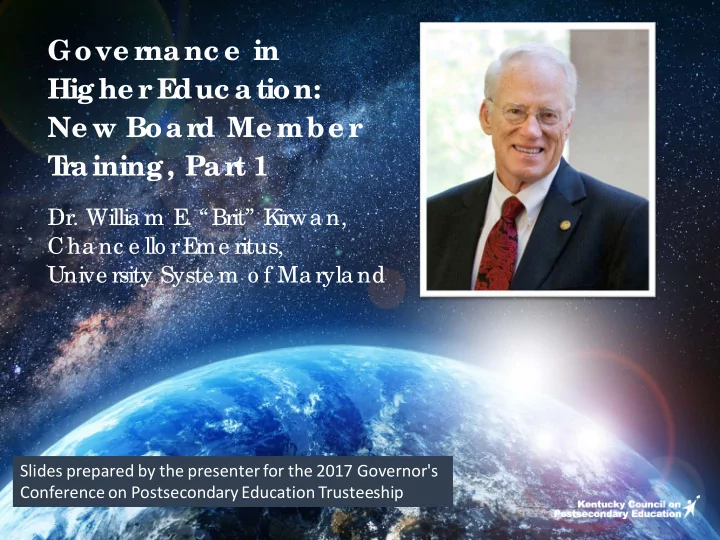
Gove r nanc e in Highe r E duc ation: Ne w Boar d Me mbe r T r aining, Par t 1 Dr. Willia m E . Brit Kirwa n, Cha nc e llo r E me ritus, Unive rsity Syste m o f Ma ryla nd Slides prepared by the presenter for the 2017


slide-1
SLIDE 1

Gove r nanc e in Highe r E duc ation: Ne w Boar d Me mbe r T r aining, Par t 1

  • Dr. Willia m E

. “Brit” Kirwa n, Cha nc e llo r E me ritus, Unive rsity Syste m o f Ma ryla nd

Slides prepared by the presenter for the 2017 Governor's Conference on Postsecondary Education Trusteeship

slide-2
SLIDE 2

Consequential Boards and 21st Century Governance

Prepared for the Conference on Postsecondary Education Trusteeship

Brit Kirwan AGB Senior Consultant September 11, 2017

slide-3
SLIDE 3

3

THE PRESIDENT AND THE INSTITUTION ARE ONLY AS GOOD AS THE BOARD

slide-4
SLIDE 4

4

Challenging Times for Higher Ed

At risk are…

  • Accessibility, affordability, and degree

attainment

  • Institutional fiscal sustainability
  • Educational quality
  • Economic development and social equity
  • Service to communities
  • Knowledge creation
slide-5
SLIDE 5

5

Realities to Recognize

  • New student populations
  • New educational delivery methods
  • Basic changes in financing
  • Rising expectations from the public
  • Changing mission
  • Greater accountability
slide-6
SLIDE 6

6

Kentucky Postsecondary Trusteeship

Eight Characteristics of Highly Performing Boards

slide-7
SLIDE 7

7

High Performing Boards

  • 1. Understand the difference between governance and

management

  • Set - and ensure presidents faithfully implement -

institutional policies

  • Thoroughly review and approve institutional mission,

major goals and plans; and hold president accountable for progress toward their achievement

  • Raise issues of interest; get responses through the

president

  • Recognize that the president is both CEO and the

board’s chief administrative officer

slide-8
SLIDE 8

8

High Performing Boards

  • 2. Boards focus on long-term fiscal stability and

academic quality

  • Constantly monitor and prepare for changing

fiscal circumstances

  • Ensure meaningful degrees at affordable costs
  • Periodically review existing degree programs for

quality and relevance to institutional mission

  • Ensure development of new programs to meet

workforce needs

slide-9
SLIDE 9

9

High Performing Boards

  • 3. Improve governance through:
  • Adhering to established processes
  • Attention to board/president relationship
  • Requires direct and constructive dialogue
  • Annual and systematic performance review
  • Commitment to shared governance
  • 4. Improve capacity and functionality through:
  • Attention to qualifications and recruitment of members
  • Orientation and continuing education
  • Committee composition
slide-10
SLIDE 10

10

High Performing Boards

  • 5. Make meetings meaningful
  • Ensure time spent on items reflects their importance
  • Develop consent agendas for routine matters
  • Use performance dashboards to expedite

transparency and accountability

  • Encourage full and inclusive discussion
  • Promote spirited inquiry and respect constructive

dissent

  • Include forums on emerging issues
slide-11
SLIDE 11

11

High Performing Boards

  • 6. Add value to the institution by gaining and ensuring

public trust and by adherence to fiduciary responsibilities

  • Advocates for the value of the institution and

its mission

  • Highly creditable source of institution integrity

(MORE ON FIDUCIARY DUTIES IN A MOMENT)

slide-12
SLIDE 12

12

High Performing Boards

  • 7. Set goals annually aimed at improving performance

and impact

  • Monitor progress
  • Celebrate successes

8. Conduct periodic evaluations of performance

slide-13
SLIDE 13

13

Boards at Their Best

  • Maintain fidelity to institutions’ missions
  • Focus on the main things vs “majoring in minors”
  • Think independently; govern collectively
  • Accept joint ownership of problems and decisions
  • Operate transparently and champion accountability
  • Model behaviors and values trustees want

institution to emulate

slide-14
SLIDE 14

14

Boards at Their Best

continued…

  • Are a source of strategic and comparative advantage
  • Prepare diligently and participate collegially
  • Abstain from individual initiatives and directives
  • Pose the right questions; don’t impose the wrong

solutions

slide-15
SLIDE 15

15

Boards at Their Best

Think and work in 3 modes:

  • 1. Oversight
  • 2. Foresight
  • 3. Insight
slide-16
SLIDE 16

16

Three Modes

Oversight – Set and refine missions – Generate and allocate resources – Ensure integrity and compliance – Monitor performance Foresight – Insist on and review SWOT analyses – Probe and approve plans and strategies –Ensure resource allocations are aligned with priorities

slide-17
SLIDE 17

17

Three Modes

Insight

  • Raise problems and issues
  • Identify opportunities
  • Ensure different perspectives are heard

Richard Chait, Harvard University

slide-18
SLIDE 18

18

Boards as Fiduciaries

slide-19
SLIDE 19

19

Who is a Fiduciary?

A person who holds a legal and ethical

  • bligation of trust in overseeing the assets
  • f another person or entity.
slide-20
SLIDE 20

20

Trustees as Fiduciaries

The Assets

  • The college governed, including its mission and

identity, physical property, human resources, educational product, endowment, and reputation. For Whom

  • The institution, its students and their families

(current and future), faculty, donors, alumni.

  • The state and country and citizens
slide-21
SLIDE 21

21

Three Fiduciary Duties

  • 1. Duty of Care
  • 2. Duty of Loyalty
  • 3. Duty of Obedience
slide-22
SLIDE 22

22

Fiduciary Duties

Duty of Care

  • Act in good faith and in the best interests of the institution
  • Act with the degree of diligence and skill ordinarily prudent

persons would exercise in like positions Obligations

  • Ensuring institution’s short and long-term fiscal well-being
  • Protecting its academic reputation
  • Faithfully attending board meetings and making informed

decisions

  • Holding in strict confidence all personnel and other

sensitive matters brought before the board

slide-23
SLIDE 23

23

Fiduciary Duties

Duty of Loyalty

  • Always act in what is deemed to be the best interest of

the institution

  • Never act out of personal interests
  • Avoid undo external external influence on board actions

Obligations

  • Establishing and periodically reviewing policies on conflict
  • f interest
  • Establishing processes for recusal when board members

have conflicts of interest

slide-24
SLIDE 24

24

Fiduciary Duties

Duty of Obedience

  • Ensure the institution acts consistently with its mission
  • Ensure the institution acts in accordance

with federal and state laws and board policies Obligations

  • Conduct periodic review of institutional mission and

make adjustments to it when necessary

  • Create and maintain policies and practices that ensure
  • ngoing compliance with federal, state and county laws

and reporting requirements

slide-25
SLIDE 25

25

THE PRESIDENT AND THE INSTITUTION ARE ONLY AS GOOD AS THE BOARD

slide-26
SLIDE 26

26

Additional questions?

Thank You

  • Dr. William “Brit” Kirwan

bkirwan@usmd.edu