Google example query: heat in query doesnt match with thermodynamics - - PowerPoint PPT Presentation

google example query
SMART_READER_LITE
LIVE PREVIEW

Google example query: heat in query doesnt match with thermodynamics - - PowerPoint PPT Presentation

Overview Introduction to Information Retrieval Recap http://informationretrieval.org 1 IIR 9: Relevance Feedback & Query Expansion Relevance feedback: Basics 2 Hinrich Sch utze Relevance feedback: Details 3 Institute for Natural


slide-1
SLIDE 1

Introduction to Information Retrieval

http://informationretrieval.org IIR 9: Relevance Feedback & Query Expansion

Hinrich Sch¨ utze

Institute for Natural Language Processing, Universit¨ at Stuttgart

2008.06.03

1 / 57

Overview

1

Recap

2

Relevance feedback: Basics

3

Relevance feedback: Details

4

Global query expansion

2 / 57

Plan for this lecture

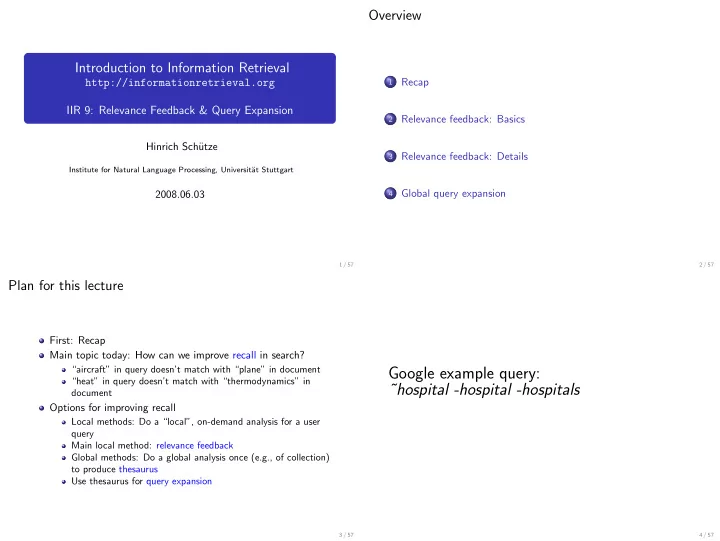
First: Recap Main topic today: How can we improve recall in search? “aircraft” in query doesn’t match with “plane” in document “heat” in query doesn’t match with “thermodynamics” in document Options for improving recall Local methods: Do a “local”, on-demand analysis for a user query Main local method: relevance feedback Global methods: Do a global analysis once (e.g., of collection) to produce thesaurus Use thesaurus for query expansion

3 / 57

Google example query: ˜hospital -hospital -hospitals

4 / 57
slide-2
SLIDE 2

Overview

1

Recap

2

Relevance feedback: Basics

3

Relevance feedback: Details

4

Global query expansion

5 / 57

Outline

1

Recap

2

Relevance feedback: Basics

3

Relevance feedback: Details

4

Global query expansion

6 / 57

Relevance

We will evaluate the quality of an information retrieval system and, in particular, its ranking algorithm with respect to relevance. A document is relevant if it gives the user the information she was looking for. To evaluate relevance, we need an evaluation benchmark with three elements: A benchmark document collection A benchmark suite of queries An assessment of the relevance of each query-document pair

7 / 57

Relevance: query vs. information need

The notion of “relevance to the query” is very problematic. Information need i: You are looking for information on whether drinking red wine is more effective at reducing your risk of heart attacks than white wine. Query q: wine and red and white and heart and attack Consider document d′: He then launched into the heart of his speech and attacked the wine industry lobby for downplaying the role of red and white wine in drunk driving. d′ is relevant to the query q, but d′ is not relevant to the information need i. User happiness/satisfaction (i.e., how well our ranking algorithm works) can only be measured by relevance to information needs, not by relevance to queries.

8 / 57
slide-3
SLIDE 3

Precision and recall

Precision (P) is the fraction of retrieved documents that are relevant Precision = #(relevant items retrieved) #(retrieved items) = P(relevant|retrieved) Recall (R) is the fraction of relevant documents that are retrieved Recall = #(relevant items retrieved) #(relevant items) = P(retrieved|relevant)

9 / 57

A combined measure: F

F allows us to trade off precision against recall. Balanced F: F1 = 2PR P + R This is a kind of soft minimum of precision and recall.

10 / 57

Averaged 11-point precision/recall graph

0.2 0.4 0.6 0.8 1 0.2 0.4 0.6 0.8 1 Recall Precision

This curve is typical of performance levels for the TREC benchmark. 70% chance of getting the first document right (roughly) When we want to look at at least 50% of all relevant documents, then for each relevant document we find, we will have to look at about two nonrelevant documents. That’s not very good. High-recall retrieval is an unsolved problem.

11 / 57

Outline

1

Recap

2

Relevance feedback: Basics

3

Relevance feedback: Details

4

Global query expansion

12 / 57
slide-4
SLIDE 4

Relevance feedback: Basic idea

User issues a (short, simple) query Search engine returns set of docs User marks some docs as relevant, some as nonrelevant Search engine computes a new representation of information need – better than initial query Search engine runs new query and returns new results New results have (hopefully) better recall. We can iterate this. We will use the term ad hoc retrieval to refer to regular retrieval without relevance feedback. We will now look at three different examples of relevance feedback that highlight different aspects of the process.

13 / 57

Relevance Feedback: Example

14 / 57

Results for initial query

15 / 57

User feedback: Select what is relevant

16 / 57
slide-5
SLIDE 5

Results after relevance feedback

17 / 57

Ad hoc retrieval for query “canine” (1)

source: Fernando D´ ıaz

18 / 57

Ad hoc retrieval for query “canine” (2)

source: Fernando D´ ıaz

19 / 57

User feedback: Select what is relevant

source: Fernando D´ ıaz

20 / 57
slide-6
SLIDE 6

Results after relevance feedback

source: Fernando D´ ıaz

21 / 57

Results for initial query

Initial query: New space satellite applications Results for initial query:
  • 1. 0.539, 08/13/91, NASA Hasn’t Scrapped Imaging Spectrom-
eter
  • 2. 0.533, 07/09/91, NASA Scratches Environment Gear From
Satellite Plan
  • 3. 0.528, 04/04/90, Science Panel Backs NASA Satellite Plan,
But Urges Launches of Smaller Probes
  • 4. 0.526, 09/09/91, A NASA Satellite Project Accomplishes In-
credible Feat: Staying Within Budget
  • 5. 0.525, 07/24/90, Scientist Who Exposed Global Warming Pro-
poses Satellites for Climate Research
  • 6. 0.524, 08/22/90, Report Provides Support for the Critics Of
Using Big Satellites to Study Climate
  • 7. 0.516, 04/13/87, Arianespace Receives Satellite Launch Pact
From Telesat Canada
  • 8. 0.509, 12/02/87, Telecommunications Tale of Two Companies
User then marks relevant documents with “+”. 22 / 57

Expanded query after relevance feedback

2.074 new 15.106 space 30.816 satellite 5.660 application 5.991 nasa 5.196 eos 4.196 launch 3.972 aster 3.516 instrument 3.446 arianespace 3.004 bundespost 2.806 ss 2.790 rocket 2.053 scientist 2.003 broadcast 1.172 earth 0.836

  • il

0.646 measure

23 / 57

Results for expanded query

*

  • 1. 0.513, 07/09/91, NASA Scratches Environment Gear From

Satellite Plan *

  • 2. 0.500, 08/13/91, NASA Hasn’t Scrapped Imaging Spectrom-

eter

  • 3. 0.493, 08/07/89, When the Pentagon Launches a Secret Satel-

lite, Space Sleuths Do Some Spy Work of Their Own 4. 0.493, 07/31/89, NASA Uses ‘Warm’ Superconductors For Fast Circuit *

  • 5. 0.492, 12/02/87, Telecommunications Tale of Two Companies
  • 6. 0.491, 07/09/91, Soviets May Adapt Parts of SS-20 Missile

For Commercial Use 7. 0.490, 07/12/88, Gaping Gap: Pentagon Lags in Race To Match the Soviets In Rocket Launchers

  • 8. 0.490, 06/14/90, Rescue of Satellite By Space Agency To Cost

$90 Million

24 / 57
slide-7
SLIDE 7

Outline

1

Recap

2

Relevance feedback: Basics

3

Relevance feedback: Details

4

Global query expansion

25 / 57

Key concept for relevance feedback: Centroid

The centroid is the center of mass of a set of points. Recall that we represent documents as points in a high-dimensional space. Thus: we can compute centroids of documents. Definition:

  • µ(D) =

1 |D|

  • d∈D
  • v(d)

where D is a set of documents and v(d) = d is the vector we use to represent the document d.

26 / 57

Centroid: Examples

x x x x ⋄ ⋄ ⋄ ⋄ ⋄ ⋄

27 / 57

Rocchio algorithm

The Rocchio algorithm implements relevance feedback in the vector space model. Rocchio chooses the query qopt that maximizes

  • qopt = arg max
  • q

[sim( q, Dr) − sim( q, Dnr)] Closely related to maximum separation between relevant and nonrelevant docs This optimal query vector is:

  • qopt =

1 |Dr|

  • dj∈Dr
  • dj + [ 1

|Dr|

  • dj∈Dr
  • dj −

1 |Dnr|

  • dj∈Dnr
  • dj]

Dr: set of relevant docs; Dnr: set of nonrelevant docs

28 / 57
slide-8
SLIDE 8

Rocchio algorithm

The optimal query vector is:

  • qopt =

1 |Dr|

  • dj∈Dr
  • dj + [ 1

|Dr|

  • dj∈Dr
  • dj −

1 |Dnr|

  • dj∈Dnr
  • dj]

q-opt = centroid-rel - (centroid-rel - centroid-nonrel) We move the centroid of the relevant documents by the difference between the two centroids. We had to assume | µr| = | µnr| = 1 for this derivation.

29 / 57

Rocchio illustrated

x x x x x x

  • µR
  • µNR
  • µR −

µNR

  • qopt

circles: relevant documents, Xs: nonrelevant documents µR: centroid

  • f

relevant documents

  • µR

does not separate rele- vant/nonrelevant. µNR: centroid of nonrelevant documents µR −

  • µNR: difference vector Add difference vector to

µR . . . . . . to get

  • qopt

qopt separates relevant/nonrelevant perfectly.

30 / 57

Rocchio 1971 algorithm (SMART)

Used in practice:

  • qm = α

q0 + β 1 |Dr|

  • dj∈Dr
  • dj − γ

1 |Dnr|

  • dj∈Dnr
  • dj

qm: modified query vector; q0: original query vector; Dr and Dnr: sets of known relevant and nonrelevant documents respectively; α, β, and γ: weights attached to each term New query moves towards relevant documents and away from nonrelevant documents. Tradeoff α vs. β/γ: If we have a lot of judged documents, we want a higher β/γ. Set negative term weights to 0. “Negative weight” for a term doesn’t make sense in the vector space model.

31 / 57

Rocchio relevance feedback illustrated

Questions?

32 / 57
slide-9
SLIDE 9

Positive vs. negative relevance feedback

Positive feedback is more valuable than negative feedback. Why? For example, set β = 0.75, γ = 0.25 to give higher weight to positive feedback. Many systems only allow positive feedback.

33 / 57

Aside: 2D/3D graphs can be misleading

dtrue dprojected x1 x2 x3 x4 x5 x′

1

x′

2

x′

3

x′

4

x′

5

x′

1

x′

2

x′

3

x′

4

x′

5

Left: A projection of the 2D semicircle to 1D. For the points x1, x2, x3, x4, x5 at x coordinates −0.9, −0.2, 0, 0.2, 0.9 the distance |x2x3| ≈ 0.201 only differs by 0.5% from |x′

2x′ 3| = 0.2; but

|x1x3|/|x′

1x′ 3| = dtrue/dprojected ≈ 1.06/0.9 ≈ 1.18 is an example of

a large distortion (18%) when projecting a large area. Right: The corresponding projection of the 3D hemisphere to 2D.

34 / 57

Relevance feedback: Assumptions

When can relevance feedback enhance recall? Assumption A1: The user knows the terms in the collection well enough for an initial query. Assumption A2: Relevant documents contain similar terms (so I can “hop” from one relevant document to a different one when giving relevance feedback).

35 / 57

Violation of A1

Violation of assumption A1: The user knows the terms in the collection well enough for an initial query. Mismatch of searcher’s vocabulary and collection vocabulary Example: cosmonaut / astronaut

36 / 57
slide-10
SLIDE 10

Violation of A2

Violation of A2: Relevant documents are not similar. Example query: contradictory government policies Why is relevance feedback unlikely to increase recall substantially for this query? Several unrelated “prototypes” Subsidies for tobacco farmers vs. anti-smoking campaigns Aid for developing countries vs. high tariffs on imports from developing countries Relevance feedback on tobacco docs will not help with finding docs on developing countries.

37 / 57

Relevance feedback: Evaluation

Pick one of the evaluation measures from last lecture, e.g., precision in top 10: P@10 Compute P@10 for original query q0 Compute P@10 for modified relevance feedback query q1 In most cases: q1 is spectacularly better than q0! Is this a fair evaluation?

38 / 57

Relevance feedback: Evaluation

Fair evaluation must be on “residual” collection: docs not yet judged by user. Studies have shown that relevance feedback is successful when evaluated this way. Empirically, one round of relevance feedback is often very

  • useful. Two rounds are marginally useful.
39 / 57

Evaluation: Caveat

True evaluation of usefulness must compare to other methods taking the same amount of time. Alternative to relevance feedback: User revises and resubmits query. Users may prefer revision/resubmission to having to judge relevance of documents. There is no clear evidence that relevance feedback is the “best use” of the user’s time.

40 / 57
slide-11
SLIDE 11

Do search engines use relevance feedback?

41 / 57

“similar pages” at Google

42 / 57

Relevance feedback: Problems

Relevance feedback is expensive. Relevance feedback creates long modified queries. Long queries are expensive to process. Users are reluctant to provide explicit feedback. It’s often hard to understand why a particular document was retrieved after applying relevance feedback. Excite had full relevance feedback at one point, but abandoned it later.

43 / 57

Other use of relevance feedback

Maintaining a standing query Example: “multicore computer chips” I want to receive each morning a list of news articles published in the previous 24 hours on “multicore computer chips”. Relevance feedback can be used to refine this standing query

  • ver time.

Many spam filters offer a similar functionality. For standing queries, relevance feedback is more practical than in web search. We’ll revisit this issue in IIR 13.

44 / 57
slide-12
SLIDE 12

Pseudo-relevance feedback

Pseudo-relevance feedback automates the “manual” part of true relevance feedback. Pseudo-relevance algorithm: Retrieve a ranked list of hits for the user’s query Assume that the top k documents are relevant. Do relevance feedback (e.g., Rocchio) Works very well on average But can go horribly wrong for some queries. Several iterations can cause query drift. Why?

45 / 57

Pseudo-relevance feedback at TREC4

Cornell SMART system Results show number of relevant documents out of top 100 for 50 queries (so total number of documents is 5000): method number of relevant documents lnc.ltc 3210 lnc.ltc-PsRF 3634 Lnu.ltu 3709 Lnu.ltu-PsRF 4350 Results contrast two length normalization schemes (L vs. l) and pseudo-relevance feedback (PsRF). The pseudo-relevance feedback method used added only 20 terms to the query. (Rocchio will add many more.) This demonstrates that pseudo-relevance feedback is effective on average.

46 / 57

Outline

1

Recap

2

Relevance feedback: Basics

3

Relevance feedback: Details

4

Global query expansion

47 / 57

Global query expansion

Query expansion is another method for increasing recall. We use “global query expansion” to refer to “global methods for query reformulation”. In global query expansion, the query is modified based on some global resource, i.e. a resource that is not query-dependent. Main information we use: (near-)synonymy A publication or database that collects (near-)synonyms is called a thesaurus. We will look at two types of thesauri: manually created and automatically created.

48 / 57
slide-13
SLIDE 13

“Global” query expansion: Example

49 / 57

Types of user feedback

User gives feedback on documents. More common in relevance feedback User gives feedback on words or phrases. More common in query expansion Relevance feedback can also be thought of as a type of query expansion. We add terms to the query. The terms added in relevance feedback are based on “local” information in the result list. The terms added in query expansion are often based on “global” information that is not query-specific.

50 / 57

Types of query expansion

Manual thesaurus (maintained by editors, e.g., PubMed) Automatically derived thesaurus (e.g., based on co-occurrence statistics) Query-equivalence based on query log mining (common on the web as in the “palm” example)

51 / 57

Thesaurus-based query expansion

For each term t in the query, expand the query with words the thesaurus lists as semantically related with t. Example from earlier: hospital → medical Generally increases recall May significantly decrease precision, particularly with ambiguous terms interest rate → interest rate fascinate evaluate Widely used in specialized search engines for science and engineering It’s very expensive to create a manual thesaurus and to maintain it over time. A manual thesaurus is roughly equivalent to annotation with a controlled vocabulary.

52 / 57
slide-14
SLIDE 14

Example for manual thesaurus: PubMed

53 / 57

Automatic thesaurus generation

Attempt to generate a thesaurus automatically by analyzing the distribution of words in documents Fundamental notion: similarity between two words Definition 1: Two words are similar if they co-occur with similar words. Definition 2: Two words are similar if they occur in a given grammatical relation with the same words. You can harvest, peel, eat, prepare, etc. apples and pears, so apples and pears must be similar. Co-occurrence is more robust, grammatical relations are more accurate.

54 / 57

Co-occurence-based thesaurus: Examples

Word Nearest neighbors absolutely absurd, whatsoever, totally, exactly, nothing bottomed dip, copper, drops, topped, slide, trimmed captivating shimmer, stunningly, superbly, plucky, witty doghouse dog, porch, crawling, beside, downstairs makeup repellent, lotion, glossy, sunscreen, skin, gel mediating reconciliation, negotiate, case, conciliation keeping hoping, bring, wiping, could, some, would lithographs drawings, Picasso, Dali, sculptures, Gauguin pathogens toxins, bacteria, organisms, bacterial, parasite senses grasp, psyche, truly, clumsy, naive, innate

55 / 57

Summary

Relevance feedback and query expansion increase recall. In many cases, precision is decreased, often significantly. Log-based query modification (which is more complex than simple query expansion) is more common on the web than relevance feedback.

56 / 57
slide-15
SLIDE 15

Resources

Chapter 9 of IIR Resources at http://ifnlp.org/ir Salton and Buckley 1990 (original relevance feedback paper) Spink, Jansen, Ozmultu 2000: Relevance feedback at Excite Sch¨ utze 1998: Automatic word sense discrimination (describes a simple method for automatic thesuarus generation)

57 / 57