Good Times Bad Times: the welfare myth of them and us Polly Toynbee - - PowerPoint PPT Presentation

good times bad times the welfare myth of them and us
SMART_READER_LITE
LIVE PREVIEW

Good Times Bad Times: the welfare myth of them and us Polly Toynbee - - PowerPoint PPT Presentation

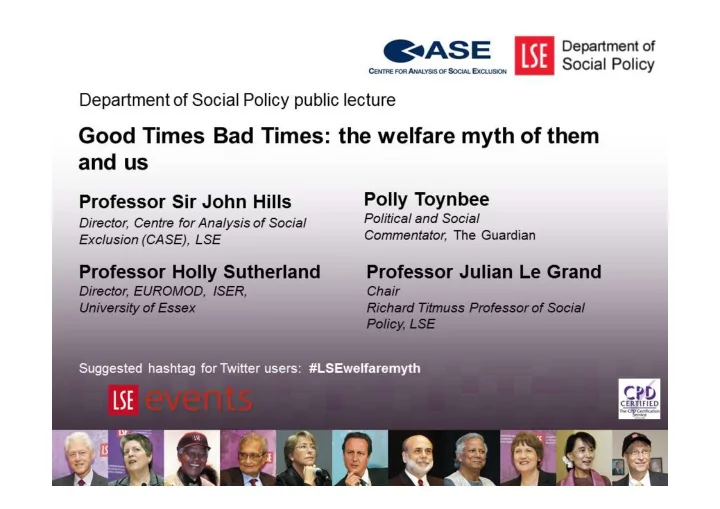
Department of Social Policy public lecture Good Times Bad Times: the welfare myth of them and us Polly Toynbee Professor Sir John Hills Political and Social Director, Centre for Analysis of Social Commentator, The Guardian Exclusion (CASE),


slide-1
SLIDE 1

Good Times Bad Times: the welfare myth of them and us

Suggested hashtag for Twitter users: #LSEwelfaremyth

Department of Social Policy public lecture

Professor Sir John Hills

Director, Centre for Analysis of Social Exclusion (CASE), LSE

Professor Julian Le Grand

Chair Richard Titmuss Professor of Social Policy, LSE

Polly Toynbee

Political and Social Commentator, The Guardian

Professor Holly Sutherland

Director, EUROMOD, ISER, University of Essex

slide-2
SLIDE 2

Good Times Bad Times: The welfare myth of them and us

John Hills London School of Economics 12 November 2014

slide-3
SLIDE 3

Spongers: May 1989

slide-4
SLIDE 4

Where are they now? 25 years on The Osbornes

Henrietta (1957) Stephen (1955) Charlotte (1980) Henry (1981) Clare (1983) Edward (2013) Lucy (2008)

The Ackroyds

Jim (1968) Tracy (1963) Wayne (1982) Ryan (2006) Paul (1991) Denise (1986) Gary (1985) Michelle (1982) Chloe (2002) George (2013)

slide-5
SLIDE 5

Two nations? Them and us

‘Two groups need to be satisfied with our welfare system. Those who need it – who are old, who are vulnerable, who are disabled, or have lost their job and who we as a compassionate society want to support. And there’s a second

  • group. The people who pay for this system: who go out to

work, who pay their taxes and expect it to be fair on them too. (George Osborne, Chancellor of the Exchequer, June 2013; emphasis added)

  • ‘Strivers’ vs ‘shirkers’
  • ‘Three generations who have never worked’ vs ‘hard working

families’

  • ‘Curtains drawn in mid morning’ vs ‘alarm clock Britain’
slide-6
SLIDE 6

Henry, Michelle and the State, 2010

Michelle Ackroyd

£5,940 after NICs £2,845 Child Tax Credit £1,060 Child Benefit £3,810 Working Tax Credit £1,720 Housing Benefit £612 Net Council Tax £14,740 £3,000 Indirect Taxes £10,300 Schools, NHS, housing NET £16,100 from the state this year

Henry & Clare Osborne

£53,300 (after pension contributions) £12,900 (income tax and NICs) £545 Child Tax Credit £1,060 Child Benefit £1,988 Council Tax £40,000 £6,900 indirect taxes £4,000 NHS NET £16,200 to the state this year

slide-7
SLIDE 7

Receipts from the welfare state and taxes by income group (£, 2010-11)

Source: Office for National Statistics (2013)

slide-8
SLIDE 8

The long view: The original lifetime sums (adjusted to 2010 earnings terms)

Stephen & Henrietta Osborne

£50,000 cash benefits £152,000 pensions £153,000 NHS £153,000 education £509,000 total from the welfare state £140,000 tax relief on mortgage £104,000 other £896,000 taxes Net loss £140,000 LIFETIME EARNINGS £2.7 million

Jim & Tracy Ackroyd

£215,000 cash benefits £102,000 pensions £134,000 NHS £85,000 education £535,000 total from the welfare state £6,000 other £334,000 taxes Net gain £200,000 LIFETIME EARNINGS £1 million

slide-9
SLIDE 9

Lifecycle average receipts and taxes, 2005-06 (£/year, not equivalised)

Source: Office for National Statistics from Redistribution of Income series. Taxes are direct and indirect allocated to households.

slide-10
SLIDE 10

Market and disposable incomes, 2005-06 (£/year)

Source: Office for National Statistics from Redistribution of Income series (original income estimated using average equivalisation factors by age for disposable income).

slide-11
SLIDE 11

But other parts of life-cycle redistribution are in retreat

Protected: Schools Cuts:

  • Child Benefit
  • Allowances for

staying at school

  • Youth provision

Cuts:

  • Local Authority

care for elderly

  • Age allowance

in income tax

  • Higher pension

age (but longevity) Cuts:

  • Working age benefits

(CPI/ limits on totals/ 3 years of real cuts)

  • Disability benefits
  • Housing Benefit
  • Council Tax Benefit
  • Tax credits
  • Student loan

repayments Protected:

  • NHS
  • State pensions

(better for some)

  • Winter fuel etc.

Protected: Higher tax allowances

slide-12
SLIDE 12

Life is complicated for some…

Charlotte Osborne April to July £1,815 Gary and Denise Ackroyd April £1,150 £1,890

October to March

£918 May £719 August £1,360 September

slide-13
SLIDE 13

Tracking incomes over the year: Highly erratic cases (four week periods)

500 1000 1500 2000 2500 3000 1 2 3 4 5 6 7 8 9 10 11 12 13

£/four weeks

Period

H1 H2 H3 H4

slide-14
SLIDE 14

Durations on Jobseekers’ Allowance, starting in 2007, 2009, 2011

Source: Data supplied by Department for Work and Pensions.

slide-15
SLIDE 15

Ups and downs in the 2000s: Positions in the income distribution (percentiles)

10 20 30 40 50 60 70 80 90 100 2001 2002 2003 2004 2005 2006 2007 2008 2009 2010

Stephen and Henrietta Stephen’s heart attacks

slide-16
SLIDE 16

Ups and downs in the 2000s: Positions in the income distribution (percentiles)

10 20 30 40 50 60 70 80 90 100 2001 2002 2003 2004 2005 2006 2007 2008 2009 2010

Jim and Tracy Stephen and Henrietta Michelle moves

  • ut again

Jim loses job Empty nest Stephen’s heart attacks

slide-17
SLIDE 17

Tangled spaghetti

Source: Jenkins (2011), figure 7.2, based on BHPS

slide-18
SLIDE 18

Child poverty lengths over nine years

Source: Jenkins (2011), figure 8.4, based on BHPS

slide-19
SLIDE 19

Accumulate, accumulate….

The Osbornes

£700,000 financial assets £700,000 house £700,000 pension rights £2,100,000

The Ackroyds

Assets: personal possessions, furniture, car £6,000 in a building society account £16,000

slide-20
SLIDE 20

Total household wealth by age, 2008-10 (£)

Source: Office for National Statistics analysis of Wealth and Assets Survey, wave 2 (revised). Includes pension rights.

  • 200,000

400,000 600,000 800,000 1,000,000 1,200,000 1,400,000 16-24 25-34 35-44 45-54 55-64 65-74 75-84 85+ Age of household head P90 P70 Median P30 P10

slide-21
SLIDE 21

The next generation: George Ackroyd and Edward Osborne

Private /state school 64% of private A level students go to prestigious universities 24% of state school A level students go to prestigious universities 11 83% of students not on Free School Meals (FSM) achieve level 4 11 66% of students on FSM achieve level 4

Edward Osborne George Ackroyd

Age Development and skills Age Development and skills 5 60% up a scale of development 5 33% of the way up a scale of development 16 62% of way up the GCSE national range 16 33% of way up the GCSE national range 19 58% achieve A Level qualifications who have not been on FSM 19 34% achieve A level qualifications who have had FSM HE 55% of least deprived fifth go

  • n to Higher Education

HE 18% of the most deprived fifth go on to higher education

slide-22
SLIDE 22

The Great Gatsby Curve

Source: Corak (2013), Journal of Economic Perspectives, figure 1.

slide-23
SLIDE 23

Winners and losers from austerity, May 2010 to 2014-15 (vs. CPI indexation)

Stephen Osborne

£96,840 annual earnings

Gain Loss £29 total NICs £926 total income tax NET £59,241 after PC/TAX

Henrietta Osborne

£8,608 annual earnings

Gain Loss £113 total NICs £547 total income tax

Stephen and Henrietta Osborne

£297 Council Tax £698 VAT TOTAL LOSS £638 (=£12.20 per week)

Loss of disposable income per year

0.7%

Michelle Ackroyd

£123 weekly earnings

Gain

Loss

£2.28 Child Benefit £2.04 Child Tax Credit Working Tax Credit £6.61 Housing Benefit £0.94 Net Council Tax £5.09 VAT at 17.5% £1.42 TOTAL LOSS £14.27

Loss of income after housing costs

6%

slide-24
SLIDE 24

IFS analysis of effects of tax and benefit reforms since January 2010 (% change)

Source: Joyce (2014), post-Budget analysis (compared to price- linked base).

slide-25
SLIDE 25

Where your money goes: Treasury view

Source: HMRC

slide-26
SLIDE 26

Where your money goes: Another view 1

slide-27
SLIDE 27

Where your money goes: Another view 2

slide-28
SLIDE 28

Where your money goes: Another view 3

slide-29
SLIDE 29

The myths and the consequences

  • The median belief is that 40 per cent of the social security

and tax credit budget goes on benefits for unemployed

  • people. It is actually 4 per cent. And cash transfers are

less than half of all welfare state spending

  • All ‘welfare’ payments to those of working age are less

than £1 in £12.50 of what we spend on the welfare state

  • And the average belief is that 27% of total benefits are

claimed fraudulently. That would be £58 billion.

  • This is 50 times DWP’s estimates from random probes
  • In effect, people think that fraud of unemployment benefits

is at least tenth of all social security spending, when it is really one thousandth Such myths have consequences….

slide-30
SLIDE 30

Good Times Bad Times: The welfare myth of them and us

John Hills London School of Economics 12 November 2014

slide-31
SLIDE 31

Good Times Bad Times: the welfare myth of them and us

Suggested hashtag for Twitter users: #LSEwelfaremyth

Department of Social Policy public lecture

Professor Sir John Hills

Director, Centre for Analysis of Social Exclusion (CASE), LSE

Professor Julian Le Grand

Chair Richard Titmuss Professor of Social Policy, LSE

Polly Toynbee

Political and Social Commentator, The Guardian

Professor Holly Sutherland

Director, EUROMOD, ISER, University of Essex