Gold Exploration & Resource Expansion Finland & Australia - - PowerPoint PPT Presentation

gold exploration resource expansion finland australia
SMART_READER_LITE
LIVE PREVIEW

Gold Exploration & Resource Expansion Finland & Australia - - PowerPoint PPT Presentation

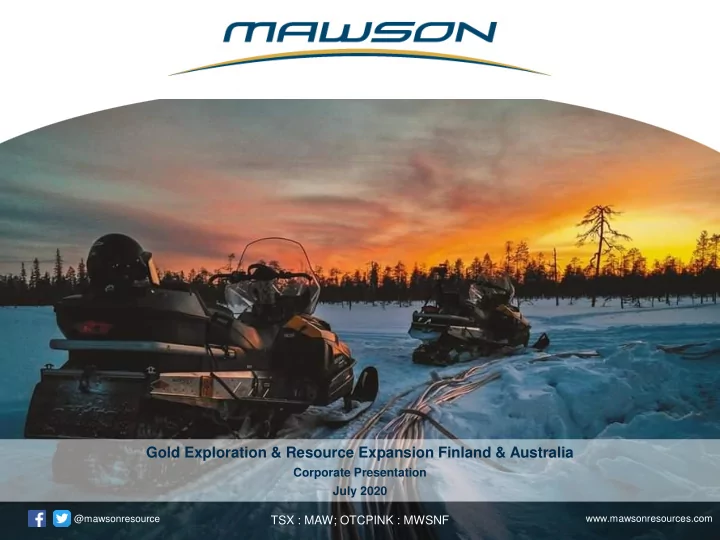
Gold Exploration & Resource Expansion Finland & Australia Corporate Presentation July 2020 @mawsonresource TSX : MAW; OTCPINK : MWSNF www.mawsonresources.com Disclaimer Accuracy of Information: Readers are directed to the public


slide-1
SLIDE 1

TSX : MAW; OTCPINK : MWSNF

www.mawsonresources.com @mawsonresource

Gold Exploration & Resource Expansion Finland & Australia

Corporate Presentation July 2020
slide-2
SLIDE 2

Accuracy of Information: Readers are directed to the public disclosure of Mawson Resources Limited (“Mawson”) available under Mawson’s profile on the System for Electronic Document Analysis and Retrieval (“SEDAR”) at www.sedar.com. Information contained in this presentation was believed to be accurate at the time it was posted, but may be superseded by more recent public disclosure of Mawson. Mawson makes no representations or warranties as to the accuracy, reliability, completeness or timeliness of the information in this presentation. Forward-Looking Information: Some of the statements contained in this presentation may be forward-looking statements or forward-looking information within the meaning of applicable securities laws (collectively, "forward-looking statements"). All statements herein, other than statements of historical fact, are forward-looking statements. Although Mawson believes that such statements are reasonable, it can give no assurance that such expectations will prove to be correct. Forward-looking statements are typically identified by words such as: believe, expect, anticipate, intend, estimate, postulate, and similar expressions, or are those, which, by their nature, refer to future events. Mawson cautions investors that any forward-looking statements are not guarantees of future results or performance, and that actual results may differ materially from those in forward-looking statements as a result of various factors, including, but not limited to, capital and other costs varying significantly from estimates, changes in world metal markets, changes in equity markets, planned drill programs and results varying from expectations, delays in obtaining results, equipment failure, unexpected geological conditions, local community relations, dealings with non-governmental organizations, delays in operations due to permit grants, environmental and safety risks, and other risks and uncertainties disclosed under the heading "Risk Factors" in Mawson's most recent Annual Information Form filed on www.sedar.com. Any forward-looking statement speaks only as of the date on which it is made and, except as may be required by applicable securities laws, Mawson does not assume the obligation to revise or update forward-looking statements or information that may be contained in this presentation or to revise them to reflect the occurrence of future unanticipated events. NI 43-101 Technical Report: On December 19, 2018, Mawson filed an independent National Instrument 43-101 Technical Report (the “NI 43-101 Technical Report”) on the Mineral Resource Estimate for the Raja and Palokas Prospects, at the 100% owned Rajapalot Project in Finland, (the “NI 43-101 Technical Report”), in support of the Company’s news release dated December 17,

  • 2018. The NI 43-101 Technical Report was authorized by Mr. Rod Webster of AMC Consultants Pty Ltd (“AMC”) of Melbourne,

Australia, and Dr. Kurt Simon Forrester of Arn Perspective of Surrey, England. Each of Mr. Webster and Dr. Forrester are independent “qualified persons” as defined by National Instrument 43-101. The NI 43-101 Technical Report may be found on the Company’s website at www.mawsonresources.com or under the Company’s profile on SEDAR at www.sedar.com. Qualified Person: The qualified person for Mawson’s projects, Nick Cook, President for Mawson, and a Fellow of the Australasian Institute of Mining and Metallurgy, has reviewed and verified the contents of this presentation.

2

Disclaimer

June 2020

slide-3
SLIDE 3

3

FINLAND:

14km drill program in Finland delivering data for an updated resource estimate in Q3 2020;

Substantial exploration target area to test and extend known resources areas

Effective Drill Targeting: Based on discovery success from earlier this year, drilling will be directed by geologic controls of high-grade gold zones and fixed loop electromagnetic (“EM”) conductors, with further targeting refined by down hole EM (“DHEM”);

Building ounces: to date 70-90,000 oz AuEq per 100 metre of mineralization drilled within each of 3 mineralized bodies

Drill hits in 2020 include: 7.2 metres @ 21.7 g/t gold (including 2 metres @ 52.7 g/t gold) and 19.5 metres @ 7.1 g/t gold, 1,006 ppm cobalt including 7.0 metres @ 17.0 g/t gold, 2,168 ppm cobalt

Fully permitted for summer and winter drilling for next 2 years, strong local support, cobalt a strategic resource AUSTRALIA

Outright purchase and joint venture of three high-grade, Fosterville-style (shallow-orogenic) exploration projects with numerous historic mines that lack drill testing.

Right of first refusal on largest contiguous land package in the State of Victoria with 3,600sq km of high priority exploration ground.

Geophysics July 2020, Drilling late August 2020

Gold in Two safe, Tier 1 Jurisdictions

slide-4
SLIDE 4

4

Capitalization Summary Major Shareholder Summary

Share Price (July 07, 2020) C$0.37 Basic Shares Outstanding 250.9M Fully Diluted 316.3M Basic Market Capitalization C$93.8M Cash C$18.0M TOTAL ENTERPRISE VALUE C$75.8M % Institutions (+11) 60.9 Corporates (Newmont, Orano (Areva)) 10.0 Insiders 3.0 TOTAL 73.9

Warrants and Options Share Price Performance – 1 Year

Ownership & Capital Structure

Exchanges: TSX : MAW; OTCPINK : MWSNF; Frankfurt : MXR

slide-5
SLIDE 5

Discovery is About Leadership

5

Michael Hudson Chairman & CEO

29 yrs Geology, Capital Markets

  • Dr. Nick Cook

President

25 yrs Geology

Noora Ahola Environmental Director

12 yrs Finnish Env. Admin.

Mariana Bermudez

Corporate Secretary

Tapani Hyysalo

Manager Operations Finland

Nick Demare

CFO

Noora Ahola Environmental Nick DeMare CPA David Henstridge Geologist Michael Hudson Geologist Colin Maclean Geologist / Finance Philip Williams Corporate Finance

Directors Management Advisers

Georgina Carnegie Ex: World Bank, OECD

  • Dr. Erkki Vanhanen

Finnish Gold Exploration

slide-6
SLIDE 6

6

The World´s Highly Prospective Mineral Regions

Map by Risto Pietilä

Finland is the new “Klondike”, new discoveries, shallow cover, entry of significant players

Nordics: Rocks & Opportunity

Metal basket of Europe

+500 year history, many Tier 1 projects

Reformation since early 1990’s. Clear guidelines

Geologically analogous to Tanami (Aus), West Africa, Homestake (US)

slide-7
SLIDE 7

7

7.4Moz Au Kittilä mine

Building Ounces: Runway

100 km ▪

Dec 2018: Maiden Inferred Resource (contained 15 km of drilling

424kOz AuEq Constrained, 4.3Mt @ 3.1 AuEq, 2.3g/t Au, 430ppm Co

Concluding: Nov. 19 - May 20: 14km drill program

+1.3 - 1.5 million ounces exploration target between 3-5 g/t AuEq*

Q3 2020 Resource Upgrade (45 km drilling)

2020++: Further 60km drilling investment

2.5-3.0 million ounces exploration target between 3-5 g/t AuEq*

*The basis for the exploration target is by extending resource areas that have been drilled in shallower and up- plunge positions. Extending these volumes below resources areas is considered reasonable, given the continuity of the linear high-grade gold mineralization within electromagnetic (“EM”) conductors, that coincide with and extend below known mineralization to significant depths. 3-5g/t AuEQ exploration target grade range is from 2.3g/t Au and 400ppm Co to 4.4g/t Au and 500ppm Co. The gold equivalent ("AuEq") value was calculated using the following formula: AuEq g/t = Au g/t + (Co ppm/608) with assumed prices of Co $30/lb; and Au $1,250/oz. AuEq varies with Au and Co prices. The potential quantity and grade of the exploration target is conceptual in nature, there has been insufficient exploration to increase the mineral resource and it is uncertain if further exploration will result in the exploration target being delineated as a mineral resource.

slide-8
SLIDE 8

8

Safe

Cheap Grid Power

Water

Roads

“The second top jurisdiction in the world for investment based on the Investment Attractiveness Index.”

Benefits for Developers Investment Attractiveness Index - Global

Skilled workforce

Airport

No FIFO

20% tax

7.4Moz Au Kittilä mine

Finland is a Mining Country

100 km

Finland hosts the largest primary gold producer in Europe

Kittilä Snapshot 2018 Production 188,979 ounces Production cost $831/oz gold Total cash costs $853/oz gold Proven and Probable Grade 4.5g/t Au

slide-9
SLIDE 9

9

Top 10% of all TSX/TSX-V, European-based companies gold-containing drill hits ranked by

  • AuEq. x metres

Opaxe took all relevant reports, and further filtered them so that each unique project was only stated once (with the top intercept reported for that project). 31 unique projects were identified along with the top intercept reported for that unique project and this list is provided in the 'Drill hits - top per project' sheet. The top Mawson Resources report from the Rompas-Rajapalot project is provided in red for easy identification. The above graph shows the top intercept for each project ranked by AuEq. x meters for each of the 31 unique projects in the opaxe database. Mawson Resources had the highest AuEq. x meters intercept with a 6m @ 616.7g/t Au intercept from 2012 (giving a AuEq. x m result of 3700.2)

TSX/TSX-V European Gold Projects

slide-10
SLIDE 10

10

Opaxe took all relevant reports, and further filtered them so that each unique project was only stated once (with the top intercept reported for that project). 31 unique projects were identified along with the top intercept reported for that unique project and this list is provided in the 'Drill hits - top per project' sheet. The top Mawson Resources report from the Rompas-Rajapalot project is provided in red for easy identification. The above graph shows the top intercept for each project ranked by AuEq. x meters for each of the 31 unique projects in the opaxe database. Mawson Resources had the highest AuEq. x meters intercept with a 6m @ 616.7g/t Au intercept from 2012 (giving a AuEq. x m result of 3700.2)

Finnish Gold Projects – Grade and Width

Interval Width (m) Interval Width (m) AuEq g/t AuEq g/t

Mawson leading in grade and width

Finland Projects: Drill hole intersections - grade versus width

slide-11
SLIDE 11

11 2018: 33.6 metres @ 8.0 g/t gold, 823 ppm cobalt

Rompas-Rajapalot: A Big New Camp

2011: 6 metres @ 617 g/t gold including 1 metre @ 3,540 g/t gold

Rajapalot average hole depth 136 metres (65.5km) 85% DDH in last 3 seasons

2019: 19.7 metres @ 7.4 g/t gold, 908 ppm cobalt 2020: 7.2 metres @ 21.7 g/t gold

slide-12
SLIDE 12

12

Rajapalot Plan - Upside

Raja Existing Resource Dec 2018 Resource Expansion Areas

(1,500m of trend to 800m depth, building 70-90,000oz Au per 100 linear m)

? Pre-resource drilling areas Modelled EM Plates

Oblique section view

Assay Key: Interval (m) / Au (g/t) / Co (ppm)

> 7.5 g/t Au 5.0—7.5 g/t Au 4.0—5.0 g/t Au 3.0—4.0 g/t Au 2.0—3.0 g/t Au < 2.0 g/t Au Drill intersection spheres sized by AuEq grade times width and coloured by Au grade

slide-13
SLIDE 13

Rajapalot – Oblique section view

Palokas South Palokas Rumajärvi Raja A A B

Plan view

250 m

?

340° 160°

North

> 10 g/t AuEQ 2 -10 g/t AuEQ 0.5 - 2 g/t AuEQ

?

2.5 km

?

The Hut

13

North South B

slide-14
SLIDE 14

Kittilä Mine

14

Source: s21.q4cdn.com/374334112/files/doc_downloads/GeologyMaps/June2019/Kittila-Mine-Composite-Longitudinal-Section.png

……..Versus Rajapalot Composite Long Section

slide-15
SLIDE 15

15

Palokas to South Palokas Oblique Sec.

View 60 degrees towards 120 degrees

slide-16
SLIDE 16

16

Raja Prospect: Long Section

16

PAL0075 2m @ 4.6 g/t Au, 851 ppm Co from 65m 2m @ 6.0 g/t Au, 573 ppm Co, from 70m 8.8m @ 7.5 g/t Au, 1229 ppm Co from 82.2m PAL0189 2.2m @ 6.3 g/t Au, 12 ppm Co from 182.9m 2m @ 6.4 g/t Au, 549 ppm Co from 203m 1.1m @ 7.3 g/t Au, 1003 ppm Co from 213.2m PAL0062 3m @ 6.0 g/t Au, 323 ppm from 181.9m 6m @ 5.3 g/t Au, 369 ppm Co from 186.5m PAL0188 8.0m @ 5.9 g/t Au, 1840 ppm Co from 307.7m 7.0m @ 11.9 g/t Au, 1641 ppm Co from 321.6m PAL0093 1m @ 5.3 g/t Au, 894 ppm Co from 247m 9.7m @ 23.1 g/t Au, 1080 ppm Co from 252.m 1.9m @ 9.5 g/t Au, 731 ppm Co from 265.9m 2m @ 5.1 g/t Au, 1786 ppm Co from 273.7m 1m @ 6.8 g/t Au, 206 ppm Co from 280.4m PAL0190 4m @ 11.2 g/t Au, 1758 ppm Co from 374m 6m @ 11.8 g/t Au, 949 ppm Co from 381.8m PAL0230 1m @ 6.9 g/t Au, 204 ppm Co from 553m PAL0159 1m @ 5.4 g/t Au, 1416 ppm Co from 435m 1m @ 3.9 g/t Au, 1208 ppm Co from 452m

>7.5 g/t Au 5.0—7.5 g/t Au 4.0—5.0 g/t Au 3.0—4.0 g/t Au 2.0—3.0 g/t Au < 2.0 g/t Au

Drill intersection spheres sized by AuEq grade times width and coloured by Au grade

PAL0191 1m @ 23.1 g/t Au, 717 ppm Co from 424m 1m @ 7.7 g/t Au, 425 ppm Co from 429m 1m @ 8.7 g/t Au, 539 ppm Co from 436m 0.7m @ 6.5 g/t Au, 1013 ppm Co from 449m

Resource Expansion Areas

(1,500m of trend to 800m depth, building 70-90,000oz Au per 100 linear m)

Modelled EM Plates

slide-17
SLIDE 17

17

Opportunity for further discovery is high

High grade gold found within a 100 sq. km area

Current resource area discoveries made from outcrop, while 99% cover exists over project

BOT percentiles Au-Bi-Te Base of till drilling percentile anomaly map 1,700 holes completed at 150m grid and 25m infill

Exploration Methodologies

In subcrop:

Base of till drilling boulder/outcrop anomalies

At shallow depths:

Near surface induced polarisation anomalies

At depth >40 metres:

Electromagnetics 2 km

Current Rajapalot drill area

slide-18
SLIDE 18

18

Social License: Ylitornio and Rovaniemi

Data from Leena Suopajärvi, Lapland University May 19, 2020. Number surveyed approx. 300.

slide-19
SLIDE 19

19

Finland’s Strategic Cobalt

Finland refines half the world’s cobalt outside of China. The world’s largest cobalt refinery is located 400 kilometres to the south of Rajapalot

CRU estimates refining of 22,734 tonnes of cobalt in Finland (2017) (or 18.4% of world refined cobalt production of ~123,000 tonnes), with 90% of Finnish refined cobalt sourced from several Chinese-owned mines in the DRC

Meanwhile, Finland mines just 650 tonnes or 0.5% of the world's cobalt

Finland and Sweden are on the hunt for an ethical sources with a traceable ledger for cobalt, considered crucial for achieving climate goals.

New Exploration Technologies

slide-20
SLIDE 20

20

Optimized gravity: >90% liberation of gold and cobalt in the two heaviest gravity fractions with 50 micron grinding;

Native gold (>95% as single grains) and cobaltite dominant

Metallurgical studies continue

Mineral Processing - Conventional

Gold: 95% - 99% (average 97%) recovery obtained by a combination of gravity (26-48%) and conventional cyanidation*

*SGS Cornwall

Cobalt: Mineralogical work shows cobalt hosted in cobaltite (85% mass) and linneate (15% mass) in certain areas and cobalt pentlandite only in other areas

slide-21
SLIDE 21

TSX : MAW; OTCPINK : MWSNF

www.mawsonresources.com @mawsonresource

The Victorian Goldfields

May 2020

https://www.heathcote.org.au/about-heathcote

slide-22
SLIDE 22

22

Australia Transaction

Entry into the Tier 1 goldfields of central Victoria, Australia, via a multifaceted agreement with major landholder Nagambie Resources Limited (NAG:ASX)

Acquisition of three Fosterville-style high-grade gold assets in Victoria, Australia, with substantial historic mines that have not been tested to depth:

Sunday Creek (100%) A$500,000 cash and 1.0 million Mawson Shares.

Redcastle and Doctor’s Gully Option and JVs

Earn up to 70% joint venture interest in both by incurring A$1,000,000 in expenditures over 5 yrs

Strategic 10% equity investment into Nagambie Resources Ltd:

For 8.5 million shares of Mawson (4.2% of Mawson)

Secures a right of first refusal over a well located 3,600 square kilometre tenement package

slide-23
SLIDE 23

23

Giant Orogenic Gold Deposits

Schematic world map showing interpreted age of basement rocks and distribution of giant orogenic gold, Carlin- type, IRGD (intrusive related gold deposits) and IOCG (iron oxide copper gold)

Modified from: https://reader.elsevier.com/reader/sd/pii/S1674987115000808?token=927DCC2EAF8EB5A3F63D462B4E0E0F4BA65EAA7FB4732F8C11B716D72D7CB58A20E359D983EBBEBFA29E4BA6BD2ECC51

Victoria

slide-24
SLIDE 24

24

A New Search Space

There are two distinct sub-types of orogenic gold mineralization in the Victoria, formed during different metallogenic events at approximately 445 Ma and 370-380 Ma that

  • ccur in distinct regional domains;

Fosterville has rewritten the Victorian geological opportunity for epizonal gold deposits. We now understand that epizonal systems can develop extremely high-grade, free gold deposits.

This has provided insight into a never-explored search space for high grades at depth below historic mines and oxide epizonal gold targets (just like Fosterville) that only exist in the Melbourne and eastern Bendigo Zones

slide-25
SLIDE 25

25

Victoria: Old is New Again

Boom 1 Goldrush

  • Nuggety, or
  • Refractory 5g/t Au UG
  • Poor jurisdiction

Boom 3 Fosterville!! Boom 2 Pre-WW1

UG again but deeper search space, very high grade Underground, high grade, 200ft limit in most part Open pit oxide, low grade Mesozonal – nuggety, alluvials, easy met Epizonal

slide-26
SLIDE 26

26

The Melbourne Zone Opportunity

Regional geology and orogenic gold deposits

  • f Victoria or Western Lachlan Orogen (WLO).

Interpreted composite seismic cross section of Victoria

Stawell Bendigo Melbourne Epizonal gold window

Image modified from www.mandalayresources.com/wp-content/uploads/2019/12/2019-12-01-MND-IR-PPT_final-1.pdf and https://api.research-repository.uwa.edu.au/portalfiles/portal/5263287/Lysytsyn_Volodymyr_2015.pdf

slide-27
SLIDE 27

27

The Melbourne Zone Opportunity

Source: http://earthresources.efirst.com.au/product.asp?pID=971&cID=42

Victoria government Gold Undercover Report 17, February 2010 (written long before Fosterville cam on the global map):

The geologically permissive area where undiscovered epizonal orogenic gold deposits may occur under cover is 4,000km2

The northern part of the Melbourne Zone was estimated to host 8 significant epizonal

  • rogenic gold and gold-antimony ore fields

with a likely interval from 3 to 20 ore fields

One undiscovered ore field may contain more than 1Moz of gold

Therefore, the Melbourne Zone was estimated to host 8Moz of epizonal orogenic gold and gold-antimony ore fields with a likely interval from 3Moz to 20Moz

Mawson holds a ROFR over 3,600km2 of the Melbourne zone

slide-28
SLIDE 28

28

The Giant Reawakens

Shallow orogenic (“epizonal”) (Fosterville-style)

Gold Mineralization

Other gold mineralization Mainly “mesozonal”

Two distinct sub-types of orogenic gold mineralization in the Victoria, formed during different metallogenic events and

  • ccurring in distinct regional domains

Costerfield Mine 1.82Mt @ 8.2g/t Au and 2.8% Sb Fosterville Mine 6 Moz Au 23.8Mt @ 7.9g/t Au Shallow orogenic (“epizonal”) gold deposits exist east of Fosterville, as they overlie the Selwyn Block

slide-29
SLIDE 29

29

Tenure: Main Players and ROFR

Fosterville 6 Moz Au 23.8Mt @ 7.9g/t Au Fosterville South Costerfield 1.82Mt @ 8.2g/t Au and 2.8% Sb North Central Victorian Goldfields Ground Release Tender Area of Right of First Refusal

Shallow orogenic (Fosterville-style) Gold Mineralization Other gold mineralization Tenement Holders

➢ Right of first refusal on a commanding 3,600 sq. km land position in Victoria

Doctor’s Gully Sunday Creek Redcastle

slide-30
SLIDE 30

30

Redcastle - JV

Fosterville 6.5 Moz Au Costerfield 1.2Moz AuEq North Central Victorian Goldfields Ground Release Tender

Epizonal (Fosterville-style) Gold Mineralization Mesozonal gold Tenement Holders

➢Redcastle is one of the most significant historic epizonal high-grade goldfields in Victoria ➢A high-grade epizonal gold system with visible gold in quartz (+/- stibnite)

Redcastle

Key Structures

slide-31
SLIDE 31

31

An Example: Redcastle (Mawson JV)

Image modified from https://www.mandalayresources.com/wp-content/uploads/2019/12/2019-12-01-MND-IR-PPT_final-1.pdf

Redcastle/Costerfield

10 km

Plan Cross Section

Redcastle (Mawson JV) and Costerfield (Mandalay) are located along a parallel structure to Fosterville (Kirkland Lake Gold). Similar source rocks, transport (structure) and trap;

Two mines and Redcastle (Mawson JV) has not been explored below 50 metres depth!

slide-32
SLIDE 32

32

Redcastle - JV

➢ First discovered in 1859, an extremely high-grade epizonal gold system with visible gold in quartz (+/- stibnite) association; ➢ Extremely high gold grades were mined over a 4.5 x 7 square kilometre area containing over 24 historic mining areas including:

  • The Welcome Group of mines were exploited over 2 kilometres strike length from

1859–1865, down to a maximum depth of 125 metres and extracted 20,583 oz @ 254.6 g/t gold. Forbes and Murray (1895) describe the mineralized zone as 1.2 metres wide with individual laminated veins from 5-7cm wide to 35cm wide. Forbes (1898) described the reef as 53 metres long and 0.2 - 0.4 metres wide at 187 g/t to 622 g/t gold. ➢ Redcastle has never been drill tested beneath any of the historic high-grade mining areas:

  • 17 kilometres of combined high-grade vein strike remains completely untested

below the water table (50 metres average depth) (Figure 2);

  • Modern drilling from Redcastle focussed on shallow, previously mined surface

workings, and the average drill hole depth is 38 metres;

  • Thin alluvial cover exists over approximately 50% of Redcastle, obscuring much
  • f the area from historic prospecting and mining attempts;
slide-33
SLIDE 33

33

Sunday Creek – 100% Mawson

slide-34
SLIDE 34

34

Sunday Creek High Grade Drill Ready

A shallow orogenic (or epizonal) Fosterville-style deposit – veined, brecciated and disseminated gold

100% Mawson

Mined 1870s-1920 to an av. depth 40 metres: 20K oz gold @ 17g/t gold.

Stibnite (antimony sulphide) and hosted in sediments and proximately associated with diorite dykes.

Extensive low-grade oxide gold in trenching 166 metres at 0.9 g/t gold

High grade drilling over 800m to 50-80m depth, historic trend continues for 11 kilometres and remains undrilled:

CRC013: 21 metres @ 4.8 g/t gold from 9 metres including 2 metres @ 28.8 g/t gold from 15 metres

VCRC022: 8 metres @ 11.3 g/t gold from 66 metres including 2 metres @ 40.3 g/t gold from 70 metres

VCRC011: 18 metres @ 4.5 g/t gold from 37 metres including 10 metres @ 7.1 g/t gold from 42 metres

VCRC007: 15 metres @ 4.5 g/t gold from 62 metres including 5 metres @ 11.2 g/t gold from 67 metres

CRC020: 15 metres @ 4.1 g/t gold from 25 metres including 3 metres @ 15.4 g/t gold from 32 metres

slide-35
SLIDE 35

35

Sunday Creek: Apollo Cross Section A-A’

slide-36
SLIDE 36

36

Sunday Creek: Rising Sun Cross Section B-B’

slide-37
SLIDE 37

37

Redcastle and Doctor’s Gully JVs

Redcastle and Doctor’s Gully are shallow orogenic (or epizonal) Fosterville-style historic high- grade orefields

Previous explorers have focussed exclusively on heap leachable near-surface gold and the projects remain untested to depth.

Redcastle

One of three historic main workings in the “Fosterville Triangle”

Discovered in 1859 and underground mined until 1902. High grades of gold and associated stibnite were recorded from nearly all mines, which were only worked to an average of 55 metres depth within a 5 kilometre by 4 kilometres area. The Redcastle Gold Mining Company is reported to have produced 35,000 ounces of gold from Clarke’s Reef alone at a grade of 33 g/t gold.

Better intersections 10 metres at 2.5g/t gold from 22 metres (RRC26), 2 metres at 10.7 g/t gold from 39 metres (RRC41) and 2 metres at 6.3 g/t gold from 26 metres (PR16).

Doctor’s Gully

21 historic gold showings and mines. Modern mining has focused on extracting oxide gold.

RC drilling in 1988, which has never been followed- up, intersected 7 metres @ 4.1 g/t gold from 40 metres (WHP7), 8 metres @ 3.2 g/t gold from 40 metres (WHP26) and 1 metre @ 14.6 g/t gold from 62 metres (WHP26).

slide-38
SLIDE 38

Next 12 Month Technical Program

38

Dec Oct Sept Aug Jul Jun Apr Mar Feb Jan May Nov

FIN Winter Work FIN Summer Work

2020

FIN Environmental Permitting FIN ResourceUpgrade Resource Expansion Drilling 14km total FIN EM plus gravity AUS Drilling/Geophysics and FIN Summer Field Work FIN EM Geophysics FIN 20km DDH

slide-39
SLIDE 39

39

A high-quality gold exploration portfolio in two safe, Tier 1 mining friendly jurisdictions (Finland and Australia);

Finland: Significant and strategic regional-scale gold-cobalt discovery in Northern Finland:

Updated Resource Q3 2020 : The current and ongoing 15km drill program (Nov ’19 - April ‘20) aims to infill and extend the Palokas, South Palokas and Raja resource areas delivering the data for an updated resource estimate;

Building ounces: to date 70-90,000 oz AuEq per 100 metre of mineralization drilled within each of 3 mineralized bodies

Fully permitted for summer and winter drilling for next 2 years in Finland, north and southern hemisphere drill seasons;

Victoria: Fosterville has rewritten the geological opportunity for epizonal gold deposits. We now understand that epizonal systems can develop extremely high-grade, free gold deposits.

This has provided insight into a never-explored search space for high grades at depth below historic mines and oxide epizonal gold targets

Three Fosterville-style high-grade gold assets with substantial historic mines that have not been tested to depth, ROFR on 3,600 sq km.

Geophysical surveys (microgravity, detailed ground magnetics and induced polarization) and alteration studies, followed by 5,000 metres of diamond drilling during Q3 and Q4 2020.

Building Value By Drilling and Discovery

slide-40
SLIDE 40

40

MAWSON RESOURCES LTD INVESTOR RELATIONS (CANADA) MAWSON OY SUOMI (FINLAND)

Mariana Bermudez

  • Corporate Secretary

Tel: +1 (604) 685 9316 Fax: +1 (604) 683 1585 info@mawsonresources.com Noora Ahola Environmental Director Ahjotie 7, 96320 Rovaniemi, Finland nahola@mawson.fi

Contact Us

slide-41
SLIDE 41

41

1.78Ga – Late and Straight (a model)

slide-42
SLIDE 42

42

Raja – Block Diagram and Cross Section

slide-43
SLIDE 43

Kittilä (Agnico) Finland Timeline

1986

Discovery GTK

Visible Gold SSW Suurikuusikko 1986 01

77 drill holes

Two campaigns 9319m 1987-1997 02 1996

0.285 Moz

1.5Mt @ 5.9 g/t Au (285K Oz Au) 1997 03

Agnico

Acquisition 2005 US$150 million 05

Riddarhyttan

Public tender April 1998 04 2016 07

Mine

Decision 2006

468 drill holes

143km 1998-2005 06

2.6 Moz

16Mt @ 5.1g/t Au 2007 08

7.4 Moz

26.9Mt @ 4.7g/t Au 2017 10 2006 09

575 drill holes

140 km 2006-2008

PIVOT

5.7 Moz Au 2008 ML 2003

First Resource Published

43

slide-44
SLIDE 44

44

Two Different Gold Styles

New Old The different geological styles have driven both success and failure during the epochs

Epizonal Gold Mesozonal Gold

Fosterville, Costerfield, Nagambie, Redcastle, Sunday Creek, Doctor’s Gully, Baileston Bendigo, Stawell, Walhalla, Woods Point Microscopic gold, at times missed by old timers, +/-refractory, minimal alluvial. Swan zone at Fosterville free gold and extremely high-grade Historical primary gold production, nuggety, main source of alluvial

  • gold. Unsuited to modern day resource calculations. Major failures in

the modern day. Structurally controlled and localised as gently plunging elongate shoots in dilational zones developed where reverse faulting passes from concordant to being discordant to bedding, Usually as a result

  • f the presence of parasitic folding.

Dilational zones in faults and at fold axes - saddle reefs and trough reefs. Emplacement 2 – 6 km, temps 170°C - 300°C Emplacement 6 - 12 km, temps 300°C - 475°C Timing 380Ma. Post-dated the main phase of the Tabberabberan Orogeny. Bendigo and Stawell 440 Ma, Melbourne Zone 380 Ma. Coincided with the late stages of the Benambran Orogeny Broadly synchronous with the emplacement of post-tectonic granites and dykes. Not accompanied or closely followed by any documented magmatism. Characterised by the prevalence of refractory, or ultra-fine (usually <10 µm), gold in sulphide grains (arsenopyrite and pyrite in thin veins and stockworks and disseminated in host turbidites), or by free gold in stibnite–quartz veins. Deposits of this sub-type typically contain stibnite, either as a minor component in quartz–pyrite– arsenopyrite refractory gold deposits or as a major to dominant mineral in stibnite–quartz veins. These deposits, jointly referred to as gold-antimony-arsenic (Ramsay et al., 1998), or epizonal orogenic Ferromagnesian carbonates, few % pyrite and (in some cases pyrrhotite and arsenopyrite), with smaller amounts of chalcopyrite, sphalerite and galena. Native gold is found as both free grains and sub microscopic inclusions in sulphides.

slide-45
SLIDE 45

45

Fosterville: A brief history

1884-1903: Fosterville discovered and near surface oxide mined. Produced 28K ounces

  • f gold;

1973 to 1983 the field was looked at by Lone Star Exploration NL, Noranda Australia Ltd, Pennzoil of Australia Ltd, Newmont Pty Ltd, and Apollo International Minerals NL. They all thought it was too small!

1930’s and 1988-1989: Minor tailings retreatment;

1991-2001 oxide mining from (Perseverance), 21 shallow pits were developed to depths of 35m to 60m over a strike length of 10km. Produced 239K ounces of gold;

2004 mining commenced into sulphide zones – underground 5g/t Au BIOX refractory;

2008-2016 Canadian Corporate Transactions (not Australian!)

In 2008 Perseverance acquired by Northgate Minerals. In 2011, Northgate merged with AuRico Gold. In March 2012 Crocodile Gold acquired the mine from AuRico. In 2015, Newmarket Gold merged with Crocodile Gold. In November 2016, Kirkland Lake Gold Inc. of Canada merged with Newmarket to form Kirkland Lake Gold Ltd.

2017-2018 Eureka!

Image sourced from https://www.klgold.com/our-business/australia/fosterville-mine/default.aspx

slide-46
SLIDE 46

46

Gold

Kirkland Lake’s Fosterville has placed the district back on the global map thanks to bonanza gold grades and ultra-low production costs

Mawson has three high grade gold epizonal projects in the Fosterville area including with hundreds of historic mines and high-grade drilled near surface mineralization Kirkland Lake (ASX:KLA, NYSE/TSX:KL)

A Global High Grade Gold Address

slide-47
SLIDE 47

Key Recent Intersections in Victoria

47

* 32m @ 5.9% copper, 1.0g/t gold and 58g/t silver

*

slide-48
SLIDE 48

TSX : MAW; OTCPINK : MWSNF

www.mawsonresources.com @mawsonresource

Two distinct sub-types of orogenic gold mineralization in the Victoria, formed during different metallogenic events and occurring in distinct regional domains

slide-49
SLIDE 49

49

A Brief Tectonic History of Victoria

Summarized from https://api.research-repository.uwa.edu.au/portalfiles/portal/5263287/Lysytsyn_Volodymyr_2015.pdf

Victoria (and the Western Lachlan Fold belt) have experienced three major regional deformational events (orogenies):

Delamerian (520 to 490 Ma) - documented along the western margin of the Stawell Zone but may have affected the entire Stawell Zone.

Benambran (455 to 440 Ma) - the main deformational event in the Bendigo Zone which also affected the Stawell Zone.

Tabberabberan (~390) - the main deformational event in the Melbourne Zone which also affected the eastern Bendigo Zone (ie Fosterville) and reactivated some pre-existing structures further west.

The bulk of the exposed volcano-sedimentary rocks in Victoria are characterised by regional metamorphism

  • f the greenschist facies, with the amphibolite facies present along the western margin of the Stawell Zone

and the subgreenschist facies prevalent in the eastern Bendigo and Melbourne zones

The geodynamic history of Victoria:

Origin as an oceanic basin in a forearc setting in the Cambrian, evolving into a sediment-filled back- arc basin, inverted and cratonised by the Benambran Orogeny.

Convergence between the Cambrian Delamerian Orogen in the west and the Selwyn Block in the east in a back-arc setting in the Ordovician, culminating in their collision and deformation of the Stawell and Bendigo zones during the Benambran Orogeny.

A major feature of this collisional event was that the Cambrian oceanic crust of the Bendigo Zone was not consumed by subduction but tectonically thickened by shallow thrusting.

The Melbourne Zone, deposited on top of the micro-continental Selwyn Block, was not deformed during the Benambran Orogeny, protected by the underlying rigid crustal block. It was inverted and tectonically thickened by the Tabberrabberan Orogeny.

slide-50
SLIDE 50

50

Deep Crustal Architecture Controls Gold

Understanding of the overall crustal architecture and geodynamic evolution of Victoria has greatly improved over the last decade, particularly following the interpretation of a series of deep crustal seismic surveys transecting the Western Lachlan orogen

The scale and broad regional distribution of gold endowment in Victoria is largely controlled by the volume of originally hydrous crustal source rocks – limited by crustal architecture, which was in turn has been defined by the tectonic evolution.

The most critical structural mineral system controls are related to crustal block boundaries in the middle to lower crust, this being the western margin of the Selwyn Block in Victoria.

Spatial data analysis of gold deposit patterns reveals important properties of the spatial distribution of

  • rogenic gold mineralization. These can be explained by the deep crustal architecture of Victoria.

Seismic data indicate that both the Stawell and Bendigo zones are composed of Cambrian oceanic and arc-related metavolcanics and interbedded metasedimentary rocks, overlain by thick Cambrian to Ordovician metaturbidites.

The structurally thickened older Cambrian metavolcanics and associated metasedimentary rocks form a contiguous lower crustal region below a depth of approximately 6 km in the Stawell Zone and approximately 15 km in the Bendigo Zone.

The Melbourne Zone has a completely different composition of the middle and lower crust.

It is entirely underlain by older Proterozoic to Cambrian continental crust of the Selwyn Block which also underlies the eastern Bendigo Zone (ie Fosterville).

The Selwyn Block is overlain by up to 15 km of tectonically thickened Palaeozoic turbidites in the Melbourne Zone, thinning out under the eastern Bendigo Zone where its outer margin underlies 35 km of Cambrian and Ordovician volcanic and sedimentary rocks.

Summarized from https://api.research-repository.uwa.edu.au/portalfiles/portal/5263287/Lysytsyn_Volodymyr_2015.pdf

slide-51
SLIDE 51

51

Two Distinct Sub-types of Orogenic Gold

There are two distinct sub-types of orogenic gold mineralization in the Victoria, mostly formed during different metallogenic events at approximately 445 Ma and 370-380 Ma and occurring in distinct regional domains;

Both styles commonly occur in clusters, sometimes >10 km along the dominant structural trend, spatially grouped and described as gold ore fields.

The 445 Ma event was the main phase of gold mineralization in the region, forming almost all significant gold deposits in the Bendigo and Stawell zones (mesozonal gold). It coincided with the late stages of the Benambran Orogeny which was not accompanied or closely followed by any documented magmatism.

The 375 Ma event formed all the epizonal gold deposits in the Melbourne Zone and the eastern Bendigo Zone, including Fosterville. This gold event post-dated the main phase of the Tabberabberan Orogeny and was broadly synchronous with the emplacement of post-tectonic granites and dykes.

At a regional scale, both between and within individual structural zones, the spatial distribution of ore fields is strongly heterogeneous.

The Bendigo Zone is by far the most richly endowed region, with >70 Moz of total gold production (60% of which from alluvial deposits),

Compared to 7 Moz produced from the Stawell Zone and

>4 Moz from the Melbourne Zone - considered to be underexplored, not targeted by the old- timers and the new search space

Summarized from https://api.research-repository.uwa.edu.au/portalfiles/portal/5263287/Lysytsyn_Volodymyr_2015.pdf

slide-52
SLIDE 52

52

A New Search Space

There are two distinct sub-types of orogenic gold mineralization in the Victoria, mostly formed during different metallogenic events at approximately 445 Ma and 370-380 Ma and occurring in distinct regional domains;

Spatial data analysis of gold deposit patterns reveals important properties of the spatial distribution of

  • rogenic gold mineralization. These can be explained by the deep crustal architecture of Victoria;

A majority of gold in Victoria has been produced from mesozonal gold systems, targeted by the old- timers in the Bendigo and Stawell zones;

The Melbourne and Eastern Bendigo Zones host epizonal gold deposits because they are entirely underlain by older Proterozoic to Cambrian continental crust of the Selwyn Block, which has been the fluid source for these deposits;

Fosterville has rewritten the Victorian geological opportunity for epizonal gold deposits. We now understand that epizonal systems can develop extremely high-grade, free gold deposits.

This has provided insight into a never-explored search space for high grades at depth below historic mines and oxide epizonal gold targets (just like Fosterville) that only exist in the Melbourne and eastern Bendigo Zones

slide-53
SLIDE 53

53

Add a New Paradigm in Understanding

1866 2020

http://www.australiaminerals.gov.au/__data/assets/pdf_file/0010/47674/Presentation-New-Developments-in-Victorian-Geology-and-Mineral-Prospectivity-GSV.pdf

Emerging geological concepts are changing Victorian gold and base metals prospectivity

slide-54
SLIDE 54

54

Comparables Finland

Mawson Resources Ltd (TSX:MAW) C$93.8M

www.mawsonresources.com

Aurion Resources Ltd (TSXV:AU) C$117.7M

www.aurionresources.com

Rupert Resources Ltd (TSXV:RUP) C$559.7M

www.rupertresources.com

Firefox Gold Corp. (TSXV:FFOX) C$9.6M

www.firefoxgold.com

* Updated as of July 08, 2020

slide-55
SLIDE 55

55

Comparables Victoria

Fosterville Sth Exploration Ltd (TSXV:FSX) C$245.0M

www.fostervillesouth.com

Catalyst Metals Ltd (ASX:CYL) A$223.3M

www.catalystmetals.com.au

Stavely Minerals Ltd (ASX:SVY) A$133.6M

www.stavely.com.au

Chalice Gold Mines Ltd (ASX:CHN) A$285.0M

www.chalicegold.com

Kalamazoo Resources Ltd (ASX:KZR) A$79.0M

www.kzr.com.au

Navarre Minerals Ltd (ASX:NML) A$69.35M

www.navarre.com.au

* Updated as of July 08, 2020