Goals Writing Talks & Using Beamer What are we trying to do? - - PowerPoint PPT Presentation

goals writing talks using beamer
SMART_READER_LITE
LIVE PREVIEW

Goals Writing Talks & Using Beamer What are we trying to do? - - PowerPoint PPT Presentation

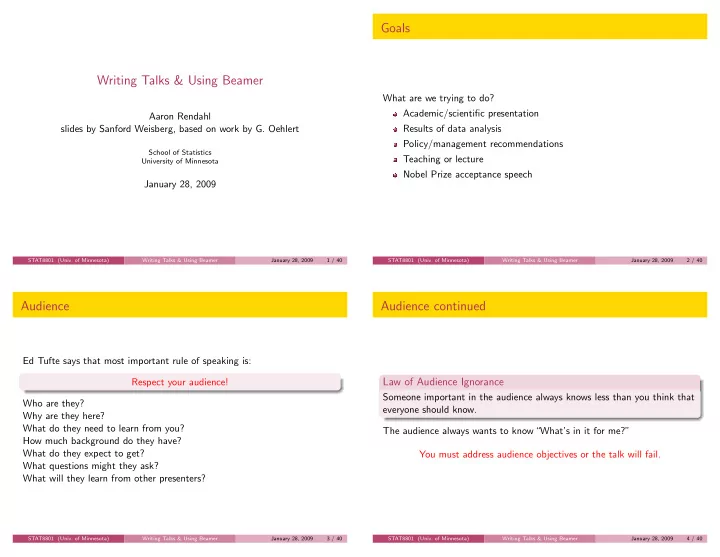
Goals Writing Talks & Using Beamer What are we trying to do? Academic/scientific presentation Aaron Rendahl slides by Sanford Weisberg, based on work by G. Oehlert Results of data analysis Policy/management recommendations School of


slide-1
SLIDE 1

Writing Talks & Using Beamer

Aaron Rendahl slides by Sanford Weisberg, based on work by G. Oehlert

School of Statistics University of Minnesota

January 28, 2009

STAT8801 (Univ. of Minnesota) Writing Talks & Using Beamer January 28, 2009 1 / 40

Goals

What are we trying to do? Academic/scientific presentation Results of data analysis Policy/management recommendations Teaching or lecture Nobel Prize acceptance speech

STAT8801 (Univ. of Minnesota) Writing Talks & Using Beamer January 28, 2009 2 / 40

Audience

Ed Tufte says that most important rule of speaking is: Respect your audience! Who are they? Why are they here? What do they need to learn from you? How much background do they have? What do they expect to get? What questions might they ask? What will they learn from other presenters?

STAT8801 (Univ. of Minnesota) Writing Talks & Using Beamer January 28, 2009 3 / 40

Audience continued

Law of Audience Ignorance

Someone important in the audience always knows less than you think that everyone should know. The audience always wants to know“What’s in it for me?” You must address audience objectives or the talk will fail.

STAT8801 (Univ. of Minnesota) Writing Talks & Using Beamer January 28, 2009 4 / 40

slide-2
SLIDE 2

How much time do you have?

Assume everyone is busy No need to tell everything you know About one slide/overhead per minute

STAT8801 (Univ. of Minnesota) Writing Talks & Using Beamer January 28, 2009 5 / 40

Things to know

You must:

Never speed up!

You must:

Know your subject matter!

You must:

Know your limitations!

You must:

Never blame the audience!

STAT8801 (Univ. of Minnesota) Writing Talks & Using Beamer January 28, 2009 6 / 40

Organize

Approach the talk logically:

1 Determine the objective/goal of talk 2 Analyze the audience; you say different things to scientists, juries or

bus drivers.

3 Identify takeaway message; build presentation around it 4 Organize your information; match content and structure to audience

and objective

5 Choose a look for presentation STAT8801 (Univ. of Minnesota) Writing Talks & Using Beamer January 28, 2009 7 / 40

Structure of a basic talk

This works most of the time

Tell them what you are going to say, then say it, then tell them what you said.

Or ...

Get their attention, let them have it, then drive it home.

1 Set up (opening) 2 Say it (body) 3 Repeat and conclude (summary)

Repetition not a vice.

STAT8801 (Univ. of Minnesota) Writing Talks & Using Beamer January 28, 2009 8 / 40

slide-3
SLIDE 3

Set up

Announce your topic clearly and state objective Using an outline of the talk is often recommended, but I don’t do it. Outline should be understandable by itself Don’t need abstract Let audience know importance and why they should care

STAT8801 (Univ. of Minnesota) Writing Talks & Using Beamer January 28, 2009 9 / 40

At the start: The Introduction

The most memorable parts are beginning and end; make them work for you. Introductions can benefit from: Personal anecdotes Visual imagery Quotes Facts Questions Challenge

STAT8801 (Univ. of Minnesota) Writing Talks & Using Beamer January 28, 2009 10 / 40

At the end: The summary

Summarize and refer back to opener Link with key points/ideas Be ready for questions

STAT8801 (Univ. of Minnesota) Writing Talks & Using Beamer January 28, 2009 11 / 40

Structure of Case Study talks

You may decide to vary the order of some of these elements in any talk, and you don’t need all of them for every talk.

1 Introduce the problem. For the class, this should be short because

everyone has seen the case study. Generally, it needs to engage the audience.

2 Key takeaway message 3 Objectives 4 What you did: Models and Methodology (brief!) 5 Findings and implications 6 Recommendations STAT8801 (Univ. of Minnesota) Writing Talks & Using Beamer January 28, 2009 12 / 40

slide-4
SLIDE 4

Technical talk

Five things listener wants to know

1 What is problem and why is it a problem 2 What has been done about it before 3 What is presenter doing about it 4 What is added value of presenter’s approach 5 Where do we go from here 6 . . . bibliographies, extra material for use with questions can be helpful STAT8801 (Univ. of Minnesota) Writing Talks & Using Beamer January 28, 2009 13 / 40

Back to School

Grammar Spelling Emphasis Repetition Examples Practice! Practice! Practice! (and get feedback)

STAT8801 (Univ. of Minnesota) Writing Talks & Using Beamer January 28, 2009 14 / 40

Stage Presence

You should be

1 Positive, confident, enthusiastic 2 Facing the audience; make eye contact 3 Speak slowly 4 Using a microphone is not a sign of personal weakness! 5 Be careful with laser pointers, hold them steady 6 Use humor wisely 7 Try to involve the audience 8 Use short simple phrases with no filler words like“Note that”or“It is

  • bvious that”

STAT8801 (Univ. of Minnesota) Writing Talks & Using Beamer January 28, 2009 15 / 40

Meetings

Check location of room. Arrive early Meet session chair Stay whole session Understand equipment: computers, projectors, microphones

STAT8801 (Univ. of Minnesota) Writing Talks & Using Beamer January 28, 2009 16 / 40

slide-5
SLIDE 5

Preparing your talk

Apart from classroom teaching, using computer presentations is almost universal. PowerPoint and pdf-using-L

A

T EX: Can look quite good Can use hi-res graphics, animations, etc. Often easy to make handouts But Still not universal High failure rate Preparation time Tendency for medium to be message

STAT8801 (Univ. of Minnesota) Writing Talks & Using Beamer January 28, 2009 17 / 40

Tufte’s dissent

PowerPoint is a competent slide manager and projector. But rather than supplementing a presentation, it has become a substitute for it. The presentation needs Content Simple, logical structure Appropriate detail Appropriate emphasis Does not need fancy animations, transitions, etc.

STAT8801 (Univ. of Minnesota) Writing Talks & Using Beamer January 28, 2009 18 / 40

PowerPoint

Ubiquitous Large user base Stinks at mathematics, but. . . Extremely easy to use if no mathematics PowerPoint cost money, but free versions exist Bill Gates is the antiChrist and MicroSoft is the spawn of Satan. G.W. Oehlert and others Check http://www.norvig.com/Gettysburg/

STAT8801 (Univ. of Minnesota) Writing Talks & Using Beamer January 28, 2009 19 / 40

L

AT

EX

Available on most platforms Great at math Great flexibility Mostly academic user base Harder to use beyond basics than PowerPoint beamer, and other, packages designed to create talks Great flexibility (also bad) Multimedia much harder

STAT8801 (Univ. of Minnesota) Writing Talks & Using Beamer January 28, 2009 20 / 40

slide-6
SLIDE 6

Beamer

These slides were prepared with the Beamer package in L

A

T EX.

1 L

A

T EXfile mystuff.tex on class webpage

2 Fill mystuff.tex with Beamer commands 3 pdflatex mystuff.tex on Linux produces mystuff.pdf 4 Use Adobe Reader or other pdf viewer

Links to user manual and other useful documents are on the class web page, including advice for Windows.

STAT8801 (Univ. of Minnesota) Writing Talks & Using Beamer January 28, 2009 21 / 40

Beamer, top information

\documentclass{beamer} \usepackage{wasysym,graphicx,pgfpages} \usetheme{Boadilla} \title{Oral Presentation} \author{Ima G. Student} \date{January 22, 2008} % (see man colors on Linux for list of colors) \definecolor{maroon}{rgb}{.6902,.1882,.3765} \definecolor{sienna}{rgb}{.53,.31,.16} \definecolor{gold}{rgb}{1,.84314,.0000} \setbeamercolor{frametitle}{fg=maroon,bg=gold} \usecolortheme[named=maroon]{structure}

STAT8801 (Univ. of Minnesota) Writing Talks & Using Beamer January 28, 2009 22 / 40

Beamer title and table of contents

\begin{document} \frame{\titlepage} %create titlepage \frame{\tableofcontents} %create table of contents page \section{Name of first section in table of contents} Entries in the table of contents are generated by \section{} commands

STAT8801 (Univ. of Minnesota) Writing Talks & Using Beamer January 28, 2009 23 / 40

Beamer example, continued

\begin{frame} \frametitle{This is the frame title} \begin{block}{This is a block title} This is the block content. \end{block} \pause This appears after the pause: \[ E(y|x) = \beta_0 + \beta_1x \] \alert{This is an alert in the alert color.} %\end{frame}

STAT8801 (Univ. of Minnesota) Writing Talks & Using Beamer January 28, 2009 24 / 40

slide-7
SLIDE 7

This is the frame title

This is a block title

This is the block content This appears after the pause: E(y|x) = β0 + β1x This is an alert in the alert color.

STAT8801 (Univ. of Minnesota) Writing Talks & Using Beamer January 28, 2009 25 / 40

Frames with computer output:

Use verbatim for computer output. This requires making the frame containsverbatim. \begin{frame}[containsverbatim] \frametitle{Some computer output} This has computer output: % begin{verbatim} Coefficients: Estimate Std. Error t value Pr(>|t|) (Intercept) 90.9609 37.3532 2.435 0.0289 * Pressure 0.7650 0.6608 1.158 0.2664 Lpres 0.6649 0.3859 1.723 0.1069 % end{verbatim} % end{frame}

STAT8801 (Univ. of Minnesota) Writing Talks & Using Beamer January 28, 2009 26 / 40

Some computer output

This has computer output: Coefficients: Estimate Std. Error t value Pr(>|t|) (Intercept) 90.9609 37.3532 2.435 0.0289 * Pressure 0.7650 0.6608 1.158 0.2664 Lpres 0.6649 0.3859 1.723 0.1069

STAT8801 (Univ. of Minnesota) Writing Talks & Using Beamer January 28, 2009 27 / 40

More beamer

Use itemize, description, and enumerate environments. To include graphics, save as pdf or png (or others), and use, for example \includegraphics[width=.8\textwidth]{mypic.pdf} You can create pdf graphics in R using the pdf() device: > pdf("mypic.pdf") > plot(Y~X,dataframe) > dev.off()

STAT8801 (Univ. of Minnesota) Writing Talks & Using Beamer January 28, 2009 28 / 40

slide-8
SLIDE 8

Beamer and Sweave

You can use Beamer and Sweave at the same time to use R output in your presentation.

1 Name your main file myfile.Rnw rather than myfile.tex 2 Add the line

\usepackage{Sweave} to the preamble. (May not be needed.)

3 Create .tex file with R CMD Sweave myfile.Rnw 4 Create .pdf file with pdflatex myfile.tex 5 View the resulting .pdf file with konquerer or Acrobat reader. 6 Links to Sweave documentation on class website STAT8801 (Univ. of Minnesota) Writing Talks & Using Beamer January 28, 2009 29 / 40

Sweave, text only, set containsverbatim option

\<<echo=TRUE>>= library(alr3) data(forbes) m1 <- lm(Lpres~Temp,forbes) summary(m1)$coef \@ Produces this: > library(alr3) > data(forbes) > m1 <- lm(Lpres ~ Temp, forbes) > summary(m1)$coef Estimate Std. Error t value Pr(>|t|) (Intercept) -42.1377793 3.34019890 -12.61535 2.175977e-09 Temp 0.8954937 0.01645176 54.43147 1.186078e-18

STAT8801 (Univ. of Minnesota) Writing Talks & Using Beamer January 28, 2009 30 / 40

Using xtable

The xtable package outputs data in L

AT

EX format: \<<echo=FALSE,results=tex>>= library(xtable) xtable(summary(m1)$coef) \@ Produces: Estimate

  • Std. Error

t value Pr(>|t|) (Intercept)

  • 42.14

3.34

  • 12.62

0.00 Temp 0.90 0.02 54.43 0.00

STAT8801 (Univ. of Minnesota) Writing Talks & Using Beamer January 28, 2009 31 / 40

Draw graphics

Name the section of output, for example: \<<one,echo=TRUE,fig=TRUE,include=TRUE>>= plot(Lpres~Temp,forbes) abline(m1) \@ creates a file called mystuff1-one.pdf because fig=TRUE, and then automatically prints it in the presentation because include=TRUE. alertHint: When using lattice graphics, you must use a command like print(xyplot(Lpres~Temp,data=forbes))

STAT8801 (Univ. of Minnesota) Writing Talks & Using Beamer January 28, 2009 32 / 40

slide-9
SLIDE 9

Draw a graph automatically

> plot(Lpres ~ Temp, forbes) > abline(m1)

  • 195

200 205 210 135 140 145 Temp Lpres

This graph is automatically sized to be 80% of the width of the page.

STAT8801 (Univ. of Minnesota) Writing Talks & Using Beamer January 28, 2009 33 / 40

Draw a graph but you size it

\<<two,echo=FALSE,height=4,width=5,fig=TRUE,include=FALSE>>= plot(Lpres~Temp,forbes) abline(m1) \@ \vspace{-.5in} \includegraphics[width=0.5\textwidth]{beamer-two.pdf} Can also use nogin option to documentclass so that size is equal to actual size, not 80% of width.

STAT8801 (Univ. of Minnesota) Writing Talks & Using Beamer January 28, 2009 34 / 40

Create a graph, but you size it

  • 195

200 205 210 135 140 145 Temp Lpres STAT8801 (Univ. of Minnesota) Writing Talks & Using Beamer January 28, 2009 35 / 40

Advice

Imitate other Beamer files when making first presentation. Many pictures, short phrases Simple styles/options are generally better Be consistent (don’t keep changing) Beware of gratuitous use of color; some people can’t see colors

STAT8801 (Univ. of Minnesota) Writing Talks & Using Beamer January 28, 2009 36 / 40

slide-10
SLIDE 10

More advice

Have full references available. Your name, the date, and contact info should be included Graphs need axis labels and need to be discussed Keep math to a minimum Tabled data should be relevant and properly laid out The beginning of the beamer manual is a good reference for structuring your beamer document.

STAT8801 (Univ. of Minnesota) Writing Talks & Using Beamer January 28, 2009 37 / 40

Evaluation should always be constructive

” Begin your criticism with a compliment. Remember this fellow has a lot of time invested in this enterprise, and if your are going to get him to change what he is doing, you need to convince him that you are on his side.” —Mosteller, Tukey and Cochran, Statistical Problems of the Kinsey Report

STAT8801 (Univ. of Minnesota) Writing Talks & Using Beamer January 28, 2009 38 / 40

Be careful with words:

Not so good. . .

Your talk was total rubbish.

  • Better. . .

I got lost as soon as you started the technical discussion. I couldn’t follow what you were doing.

Even better. . .

When you set up your model, I could not follow the notation that was

  • used. It would have helped me if you. . .

STAT8801 (Univ. of Minnesota) Writing Talks & Using Beamer January 28, 2009 39 / 40

Big Picture and Details

The Big Picture matters!

1 Were important elements of the talk missing? 2 Could you summarize what you were told in the talk? 3 Was it interesting?

Details matter!

1 Couldn’t hear? 2 Bad notation? 3 Poor English? 4 And so on. STAT8801 (Univ. of Minnesota) Writing Talks & Using Beamer January 28, 2009 40 / 40