Goals Today IT420: Database Management Reminder IT/CS Dinner Meal - - PDF document
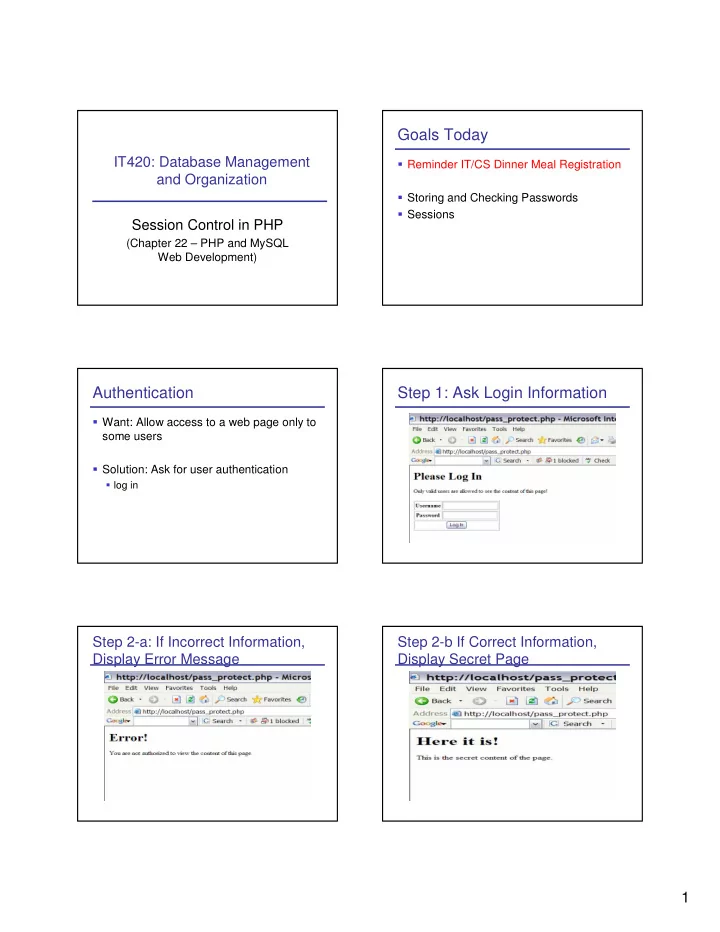
Goals Today IT420: Database Management Reminder IT/CS Dinner Meal Registration and Organization Storing and Checking Passwords Sessions Session Control in PHP (Chapter 22 PHP and MySQL Web Development) Authentication Step 1:
2
Class Exercise
Write a PHP script:
If no login info given, ask for login information If username = ‘user’ and password = ‘pass’,
display protected content
Else, display error message
pass_protect.php Problems with the code
One user-name and password hard-coded Password stored as plain text Protection for only one page Password transmitted as plain text
Storing Users and Passwords
In a file on the server In a database
Users(Username, Password) How do we test that user information matches the information in the database?
Encrypting Passwords
DO NOT store passwords as plain text! Use one-way hash functions
string sha1(string str)
Example: sha1(‘pass’) == ‘9d4e1e23bd5b727046a9e3b4b7db57bd8d6ee684 ’
Deterministic output!
Given same string, sha1 returns the same result every time
Example Using Encrypted Password
Instead of
if ($name == ‘user’ && $pass == ‘password’){ //OK, passwords match }
Use
if ($name == ‘user’ && sha1($pass) == ‘9d4e1e23bd5b727046a9e3b4b7db57bd8d6ee684’ ){ //OK, passwords match }
3
Problems with the code
One user-name and password hard-coded Password stored as plain text Protection for only one page Password transmitted as plain text
Learned So Far…
Ask login information Encrypt passwords
sha1()
Store/get login information
File Database
Session Control
HTTP – no built-in way to maintain state between two transactions Want: Track a user during a single session
- n a website – remember state
Show content personalized to user Implement shopping carts
PHP Session Control
Session ID – cryptographically random number
Generated for each session Stored on client site
Cookie URL
Session variables
Created by PHP script Stored on the server site If session id visible (cookie or URL), session variables can be accessed by all scripts
Implementing Sessions in PHP
Start a session – session_start() Register session variables
$_SESSION[‘myvar’] = ‘some value’
Use session variables
session_start() if ( isset($_SESSION[‘myvar’] ) ) { //OK code}
Deregister variables
unset($_SESSION[‘myvar’])
Destroy session
session_destroy()
Session Demo
4
sesstart.php
<?php session_start(); //Create session //Create session variable - Save user name $_SESSION['login'] = $_POST[‘login’]; //Display session variable include(‘header.inc.php’); echo ‘<p>Content of $_SESSION[\'login\'] is '. $_SESSION['login']."</p>"; echo '<p><a href="ss1.php">page 1</a></p>'; include(‘footer.inc.php’); ?>
ss1.php
<?php session_start(); // Use session variable include(‘header.inc.php’); echo ‘<p>Content of $_SESSION[\'login\'] is '. $_SESSION['login']." </p>"; echo '<p><a href="ss2.php">page 2</a></p>'; include(‘footer.inc.php’); ?>
ss2.php – Use, Unset
<?php session_start(); include(‘header.inc.php’); // Use session variable echo ‘<p>Content of $_SESSION[\'login\'] is '. $_SESSION['login']." </p>"; // Unset session variable- should not be visible anymore unset($_SESSION['login']); echo ‘<p>We unset the session varible</p>'; echo '<p><a href="ss3.php">page 3</a></p>'; include(‘footer.inc.php’); ?>
ss3.php – Cannot Use Session Var
<?php session_start(); include(‘header.inc.php’); //Try use session variable if (empty($_SESSION['login'])) echo ‘<p>$_SESSION[\'login\'] is Empty </p>'; else echo ‘<p>$_SESSION[\'login\'] is Not Empty </p>'; echo ‘<p>Content of $_SESSION[\'login\'] is '. $_SESSION['login']." </p>"; include(‘footer.inc.php’); //Destroy session $_SESSION = array(); session_destroy(); ?>
Class Exercise
Given: Login page to get user info (HTML)
action = “login.php” method = “post” input fields names: user and pwd
Write PHP to implement db authentication
First page: check user against the information in the database – host cs-mysqlsrvr.cs.usna.edu, database IT420, table Users, Next pages: display only if user logged in Logout page
(extra space)