
SLIDE 1
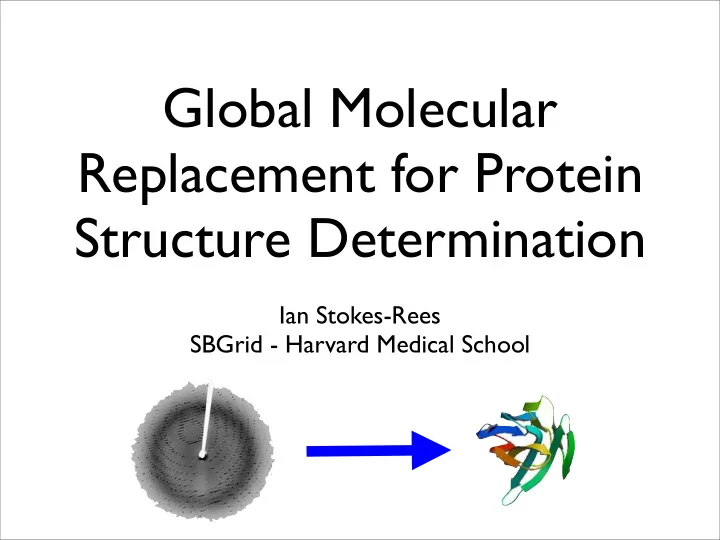
Global Molecular Replacement for Protein Structure Determination
Ian Stokes-Rees SBGrid - Harvard Medical School
Global Molecular Replacement for Protein Structure Determination - - PowerPoint PPT Presentation
Global Molecular Replacement for Protein Structure Determination Ian Stokes-Rees SBGrid - Harvard Medical School SBGrid and NEBioGrid Cornell U. Washington U. School of Med. R. Cerione NE-CAT T. Ellenberger B. Crane R. Oswald D. Fremont
Ian Stokes-Rees SBGrid - Harvard Medical School
Rice University
Y.J. Tao
CalTech
Stanford
UCSF
JJ Miranda
UC Davis
UCSD
WesternU
Washington U. School of Med.
Vanderbilt
Center for Structural Biology
Rosalind Franklin
S.Walker T.Walz
S.C. Harrison
Harvard and Affiliates
NE-CAT
Cornell U. Brandeis U.
Tufts U.
UMass Medical
NIH
Yale U.
Columbia U.
Rockefeller U.
Thomas Jefferson
Not Pictured: University of Toronto: L. Howell, E. Pai, F. Sicheri; NHRI (Taiwan): G. Liou; Trinity College, Dublin: Amir Khan
Primary thesis: Molecular replacement, used to solve over 60% of known structures, can benefit from novel computationally intensive techniques to identify search models, including those with low sequence identity or a lack of previous association with the unknown structure. Expected benefits: identify search models which would otherwise be missed; faster bootstrapping of MR search model selection; broaden range of structures amenable to MR, avoiding more costly phasing techniques; allow greater parameter tuning of MR stage; Transferable infrastructure: framework developed to support 20,000 CPU-hour computation with 10 GB of data,100,000 invocations of a scientific application, and the consequent results filtering, aggregation, and analysis can be re-used for other applications.
carefully selected search model
0.1 CPUh
10-20 Solutions
Internal Validation
+ Refinement Validation
0.2 0.4 0.6 0.8 1 2 3 4 5 0.225 0.450 0.675 0.900 1 2 3 4 5
95,000 carefully edited search models
~50K Solutions
External Validation
+ Refinement Validation
9500 CPUh
Score Individual Models
differences in loops, and shifts of the secondary structure elements degrade results
α12 β2m α3 Vα Vβ
influenza-virus matrix peptide
presentation of the peptide by the major Histocompatibility Complex (MHC) molecule
(2 Immunoglobulin Domains + peptide binding domain)
T cell receptor
(4 Immunoglobulin Domains)
α12 β2m α3 Vα Vβ
SCOP d.19.1.1 - MHC antigen recognition domain, 568 domains SCOP b.1.1.1 - antibody variable domain-like, 2001 domains SCOP b.1.1.2 - antibody constant domain-like, 2535 domains
Molecular Weight of the complex: 94.495 kDa
~22% by MW
~12.5% by MW
5 min timeout 2000 CPU cores on OSG 24h
Bjorkman et al. Structure of the human class I histocompatibility antigen, HLA-
Garboczi et al. Structure of the complex between human T
peptide and HLA-A2. Nature (1996) vol. 384 (6605) pp. 134-41
2vlj
1im3a2
100%, 181aa
(TFZ=13,LLG=92)
R factor (weak predictor): TFZ (good predictor) LLG (strongest predictor)
α12 domains SCOP class: d.19.1.1
5 min timeout 2000 CPU cores on OSG 24h 13% 14% 31% 18% 22%
1ogad1
(7.9,43)
1ogae1
(6.8/37)
HSLUV PROTEASE-CHAPERONE COMPLEX
R factor above 55
1g3iv_
(5.4,46)
false positive
Quick Refinement:
A B E D
1kgce2
(19.2,220)
99.2%, 129 aa
1ogad1
100%, 115aa
1ogae1
100%, 114aa
rigid
three domains added 42.26/43.74 40.78/42.75
b.1.1.2 b.1.1.1
#1: 1agdb - 100% B2M, 99aa #2: 2bnra1 - 100% A3, 95aa #3: 1kgcd2 - 100% D2, 89aa
D2 A3 B2M
#1 #2 #3
Top 280 solutions with B2M SCOP domains Highest Scoring TCR D2 ranks as #345
rigid
three domains added 42.26/43.74 40.78/42.75 32.23/34.95
Least Squares: commonly used for molecular replacement model quality measure select model with minimum error between observed amplitudes |FO| and calculated amplitudes |FC| Problem: Implicitly biased towards model to select h (structure parameters) based on model phasing
difference between scalar amplitudes magnitude of vector difference
parametric model to fit to observations
Iterative Convergence: Rotate search model (3D RF) then translate (3D TF) to find best (lowest) least squares fit
real-space equivalent
Solution Quality: Typically measured by heuristic score, or residual factor (measure of agreement between solution and experimental observations)
(maximum likelihood)
positive negative
Clear separation between two populations!
(Crowther rotation + FFT in reciprocal space)
TFZ LLG
Phaser performs better (although more CPU demanding)
Fast and slow searches return comparable results
extended: TZF> 4 traditional TFZ region extended TFZ/LLG Region traditional: TZF > 7
2ak4f2 80% 2mhac2 72% 1mhca2 60%, B=24 2nx5q2 60%, B=44
LLG heat
MHC
Ig Ig
MHC
With small fraction of target (~22%) sequence identity > 60% (rmsd < 1.5) required For Ig domains (~12%) even 100% is barely sufficient
Seq ID heat
2vlj
1mhca2
(6,49)
d2fsea2
(3.1/14)
1zagb2
(4.8,31)
1im3a2
(13,92)
SCOP ID (TFZ/LLG)
100% 64%, C
2nx5q2
(3.6,51) 84.8%
37.1%, W 14.7%
differences in loops, and shifts of the secondary structure elements degrade results
Ig Domains variable and constant
LLG Seq ID LLG RMSD
Sequence Identity < 20% 3 cycles of refinement in Phenix shift secondary structure elements and lower Rfac to 43%
Interactive dynamic web portal for workflow definition, submission, monitoring, and access control
GridSite based web portal for file-system level access (raw job output), meta-data tagging, X.509 access control/sharing, CGI
Python wrappers around CCP4 structural biology applications
Python wrappers around common Condor operations enhanced Condor log analysis
Python wrappers around common OSG
Python representation of GACL model and API to work with GACL files
Swiss army knife OSG wrapper script to handle file staging, parameter sweep, DAG, results aggregation, monitoring
data analysis and graphing tools for structural biology data sets
tools to enhance monitoring of job set and remote OSG site status
Write bash scripts in Python: replicate commands, syntax, behavior
Universal configuration
1077 662 1173 840 47 76 5292 17 52 349 1409 1159 421 237 4 12 628 190 720 407 1657
UNL FNAL MIT HMS Caltech UCR
20 60
Purdue
20
Buffalo
3
Cornell
3 6 24
ND
316 1216 248
SPRACE
120
UWisc
47 79 39
RENCI
10k grid jobs approx 30k CPU hours 99.7% success rate 24 wall clock hours
held - orange evicted - red completed - green running remote queue local queue 10,000 jobs 24 hours
Python API Fortran bin Multi-exec wrapper Result aggregator Grid management Web interface
Map- Reduce
Piotr Sliz PI and SBGrid team leader Peter Doherty Grid Administrator Ian Levesque Systems Architect Ben Eisenbraun Software Curator Steve Jahl System Administrator http://abitibi.sbgrid.org http://www.nebiogrid.org
low-scoring hit for domain 1 high-scoring hit for domain 1 low-scoring hit for domain .. low-scoring hit for domain n high-scoring hit for domain .. high-scoring hit for domain n
2vlj
color all Ig domains
R factor (bad predictor): TFZ (good predictor) LLG (good predictor)
α12 domains SCOP: d.19.1.1
with missed searches LLG score does not overlap with failed searches
2nx5q2
(3.6,51) 80.7%
1qsee1
(19.8,209)
1vgkb1
(16.40,193)
1e4xl1
(9.0,147)
Rfac=49.94
4lvea
(4.2,146)
Rfac=49.09 Rfac=50.82
*Refined Rfac, Phenix
A B E D
77% 100% 19% 27%
*Pairwise Identity, Geneious 4.8.0
Rfac=50.66
Translation Function Z Score A B C D