- Given a Polynomial of Degree Bound 8
Given a Polynomial of Degree Bound 8 Find 8 Distinct Points to - - PowerPoint PPT Presentation
Given a Polynomial of Degree Bound 8 Find 8 Distinct Points to Efficiently Evaluate it at
- Given a Polynomial of Degree Bound 8
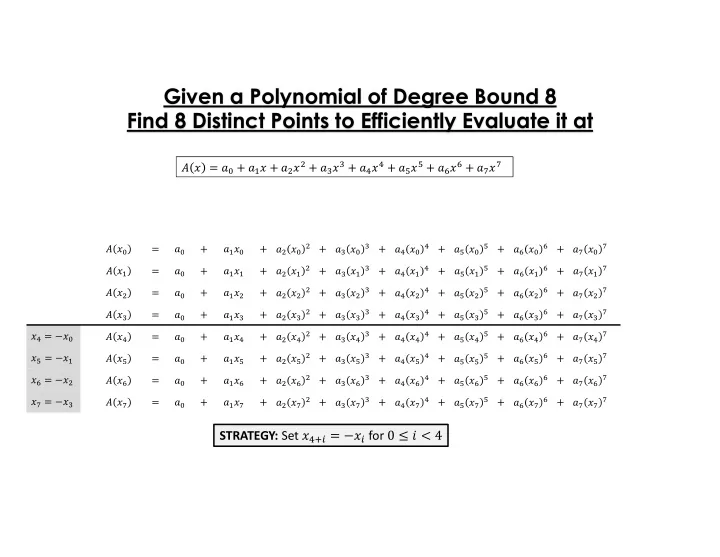
Find 8 Distinct Points to Efficiently Evaluate it at
STRATEGY: Set for 0 4
- Given a Polynomial of Degree Bound 8
Find 8 Distinct Points to Efficiently Evaluate it at
STRATEGY: Set for 0 4
- Given a Polynomial of Degree Bound 8
Find 8 Distinct Points to Efficiently Evaluate it at
STRATEGY: Set for 0 4
- Given a Polynomial of Degree Bound 8
Find 8 Distinct Points to Efficiently Evaluate it at
STRATEGY: Set for 0 4
- Given a Polynomial of Degree Bound 8
Find 8 Distinct Points to Efficiently Evaluate it at
STRATEGY: Set for 0 4
- Given a Polynomial of Degree Bound 8
Find 8 Distinct Points to Efficiently Evaluate it at
We save roughly half the work. STRATEGY: Set for 0 4
- Given a Polynomial of Degree Bound 2
Find 2 Distinct Points to Efficiently Evaluate it at
STRATEGY: Set for 0 1
- Given a Polynomial of Degree Bound 2
Find 2 Distinct Points to Efficiently Evaluate it at
STRATEGY: Set for 0 1
- Given a Polynomial of Degree Bound 2
Find 2 Distinct Points to Efficiently Evaluate it at
1 1
STRATEGY: We will evaluate any polynomial of degree bound 2 at 1 1
- Given a Polynomial of Degree Bound 4
Find 4 Distinct Points to Efficiently Evaluate it at
STRATEGY: Set for 0 2
- Given a Polynomial of Degree Bound 4
Find 4 Distinct Points to Efficiently Evaluate it at
STRATEGY: Set for 0 2
- Given a Polynomial of Degree Bound 4
Find 4 Distinct Points to Efficiently Evaluate it at
STRATEGY: Set for 0 2
- Given a Polynomial of Degree Bound 4
Find 4 Distinct Points to Efficiently Evaluate it at
STRATEGY: Set for 0 2
- Given a Polynomial of Degree Bound 4
Find 4 Distinct Points to Efficiently Evaluate it at
STRATEGY: Set for 0 2
Given a Polynomial of Degree Bound 4 Find 4 Distinct Points to Efficiently Evaluate it at
- STRATEGY: Set for 0 2
Given a Polynomial of Degree Bound 4 Find 4 Distinct Points to Efficiently Evaluate it at
- STRATEGY: Set for 0 2
Given a Polynomial of Degree Bound 4 Find 4 Distinct Points to Efficiently Evaluate it at
- Observe that we evaluate both and at
and .
But we decided to always evaluate polynomials of degree bound 2 at 1 and 1. So,
1 ⇒ 1 and 1 ⇒
1 .
Given a Polynomial of Degree Bound 4 Find 4 Distinct Points to Efficiently Evaluate it at
- So, we evaluate any polynomial of degree bound 4 at
1, and 1,
- Given a Polynomial of Degree Bound 8
Find 8 Distinct Points to Efficiently Evaluate it at
Observe that we evaluate both and at
, , and .
But we decided to always evaluate polynomials of degree bound 4 at 1, , 1 and . So,
1 ⇒ 1, ⇒
- ,
1 ⇒ , and ⇒ ! .
- Given a Polynomial of Degree Bound 8
Find 8 Distinct Points to Efficiently Evaluate it at
So, we evaluate any polynomial of degree bound 8 at 1,
- , ,
!
- and
1,
- , ,
!
Given a Polynomial of Degree Bound " #$ Find " #$ Distinct Points to Efficiently Evaluate it at
degree bound how did we find the points to evaluate the polynomial at? the points point property 2 ⋯ ⋯ ⋯
1, 1
all 2nd roots of unity 2 take positive and negative square roots of points used for degree bound 2 which are already the 2nd roots of unity
1, , 1,
- all 4th roots of unity
2 take positive and negative square roots of points used for degree bound 2 which are already the 4th roots of unity
1, 1 2 , 1, 1 2 , , 1 2 , , 1 2
all 8th roots of unity 2 take positive and negative square roots of points used for degree bound 2 which are already the 8th roots of unity
1, 2 2 2 2 2 2 , 1,
- 2
2 2 2 2 2 , ⋯ , ⋯ , ⋯ , ⋯
all 16th roots of unity ⋯ ⋯ ⋯ ⋯ ⋯ ⋯
⋯ ⋯ ⋯
⋯ ⋯ ⋯ 2'! take positive and negative square roots of points used for degree bound 2(! which are already the 2(!th roots of unity
⋯ ⋯ ⋯
all 2'!th roots of unity ) 2' take positive and negative square roots of points used for degree bound 2(! which are already the 2(!th roots of unity
⋯ ⋯ ⋯
all 2'th roots of unity (i.e., )th roots of unity)
How to Find all "th Roots of Unity
Euler’s Formula: For any real number *, cos * sin * 01 The )th roots of unity are: 1, 2, 2 , 2 , … … … , 2 !, where 2 cos
4 sin 4
567 8 is known as the primitive )th roots of unity.
The result above can be derived using Euler’s Formula. Euler’s formula follows very easily from the following three power series each of which holds for ∞ * ∞: cos * 1
15 ! 1; ! 1< ! 1= >! ⋯
sin * *
1? ! 1@ ! 1A ! 1B C! ⋯
01 1 *
15 ! 1? ! 1; ! 1@ ! 1< ! 1A ! 1= >! ⋯
How to Find all "th Roots of Unity
Observe that for (any) real numbers * and D, cos * sin * E 01 E 0 E1 cos D* sin D* Also observe that for any integer F, cos F G 2Π sin F G 2Π 1 G 0 1 Then the )th root of 1 (unity) is 1
I 8 cos F G 2Π sin F G 2Π I 8 cos F G
4 J
sin F G
4
- Observe that cos F G
4 J
sin F G
4
- takes ) distinct values for 0 F ), and then simply repeats
those values for F 0 and F K ). When F 1, we have cos F G
4 J
sin F G
4
- cos
4 J
sin
4
- 2 primitive )th root of 1.
Clearly, for any F, cos F G
4 J
sin F G
4
- cos
4 J
sin
4
- '
2 ' Hence, 1
I 8 cos F G
4 J
sin F G
4
- 2 ', for F 0, 1, 2, … , ) 1.