
SLIDE 1
Gilman Drive
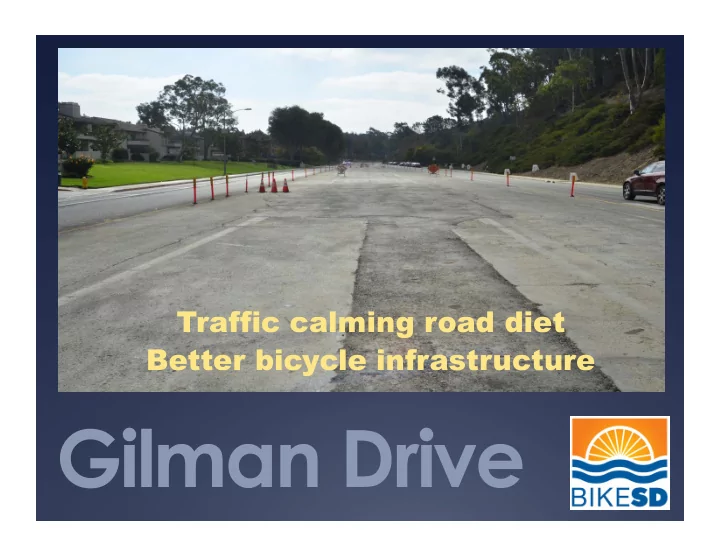
Traffic calming road diet Better bicycle infrastructure
Gilman Drive Gilman Drive: important to San Diegos bike network - - PowerPoint PPT Presentation
Traffic calming road diet Better bicycle infrastructure Gilman Drive Gilman Drive: important to San Diegos bike network & UCSD students, faculty, and staff Vital link between UCSD area and Mission Bay area. Highly utilized by both
Traffic calming road diet Better bicycle infrastructure
Gilman Drive: important to San Diego’s bike network & UCSD students, faculty, and staff
Vital link between UCSD area and Mission Bay area.
Highly utilized by both commuters and recreation cyclists
Faculty, staff, and students travel by bicycle, scooter, and walk on Gilman Drive
Connection to future SANDAG Rose Canyon Bike Path links to Gilman Drive (currently under construction)
UNFUNDED Segment of Coastal Rail Trail.
In preliminary design phase
Construction costs estimated at $20 million UNFUNDED
Gilman Drive: Entrance to a globally renowned university
UCSD encourages safe cycling and is working to create a
more bike-friendly campus for students, faculty, and staff.
UCSD partnered with Spin, one of North America’s
leading dockless bikeshare companies, to launch a new campus bikeshare program. Approximately 300 Spin bikes are available in key campus locations.
UCSD strives to practice and promote the principle of
sustainability.
Gilman Drive Current Bicycle Infrastructure
High motor vehicle speeds and lack of buffers
Narrow Class
ll bike lanes
Door zone
hazards
50 mph
posted speed limit
High motor
vehicle speeds
Large speed
differential
Traffic calming reduces speed
What is a Road Diet?
A typical Road Diet converts
an existing four-lane road to three-lanes with two through lanes and a center, two-way left-turn lane.
Benefits of a Road Diet Low cost lane restriping Enhanced safety and
access for all road users
Supports a variety of
transportation modes
Traffic calming, noise
reduction
Road Diets can significantly
improve 911 response times by allowing emergency vehicles to bypass traffic by using the center two-way left-turn lane.
U.S. Department of Transportation safety.fhwa.dot.gov/road_diets
What is a Road Diet?
NACTO Transportation Research Board U.S. Department of Transportation
A two-way left-turn lane
reduces head-on and rear-end crashes by providing left-turning vehicles their own lane.
A reduction in the number
traffic, reduce weaving, reduce speeds, and reduce the number of lanes pedestrians have to cross.
Traffic volume on Gilman
Drive (ADT 17,800) is appropriate for a Road Diet
Gilman Drive 2018 Construction
Via Alicante to La Jolla Village Dr
Test Road Diet
One vehicle lane removed
in each direction
Remaining vehicle lane
narrowed
Speed limit reduced to
35mph
No delay to vehicles Free flowingly traffic
remain
Traffic slowing remains
at the entrance to I-5
Wide bicycle lanes with
buffers
Door zone hazards
removed
Future of Gilman Drive
UCSD/City of San Diego current plan is to reinstate the
previous striping
Narrow Bike lanes with door zone hazards High vehicle speeds
Bike San Diego & San Diego County Bicycle Coalition are
asking for UCPG support for a enhanced bicycle lanes
Wide buffered bicycle lanes Narrower traffic lanes to calm speeds Road diet
Future of Gilman Drive
Our streets should be
safe,
no matter where we go or how we get there. Let’s shift the focus away from the dominating car, and back down to a more human level.