Ghost Free, Singularity Free Theory of Gravity and observational - - PowerPoint PPT Presentation

ghost free singularity free theory of gravity and
SMART_READER_LITE
LIVE PREVIEW

Ghost Free, Singularity Free Theory of Gravity and observational - - PowerPoint PPT Presentation

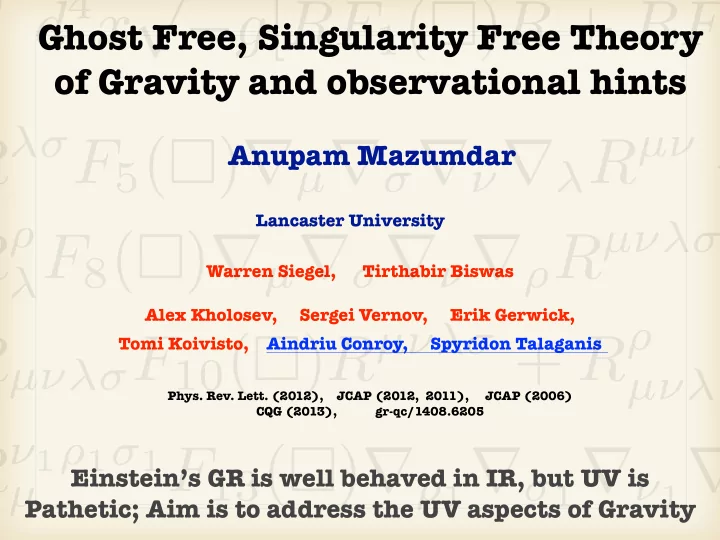
d 4 x g [ RF 1 ( ) R + RF 2 Ghost Free, Singularity Free Theory of Gravity and observational hints R F 5 ( ) R + Anupam Mazumdar Lancaster University R F 8 ( )


slide-1
SLIDE 1

Anupam Mazumdar

Lancaster University

Ghost Free, Singularity Free Theory

  • f Gravity and observational hints

Warren Siegel, Tirthabir Biswas

  • Alex Kholosev, Sergei Vernov, Erik Gerwick,

Tomi Koivisto, Aindriu Conroy, Spyridon Talaganis

⇤ d4x⇥g[RF1(⇤)R + RF2 RλσF5(⇤)⇤µ⇤σ⇤ν⇤λRµν + Rρ

λF8(⇤)⇤µ⇤σ⇤ν⇤ρRµνλσ

RµνλσF10(⇤)Rµνλσ + Rρ

µνλF

Rν1ρ1σ1

µ

F13(⇤)⇤ρ1⇤σ1⇤ν1⇤

  • Phys. Rev. Lett. (2012), JCAP (2012, 2011), JCAP (2006)

CQG (2013), gr-qc/1408.6205

Einstein’s GR is well behaved in IR, but UV is Pathetic; Aim is to address the UV aspects of Gravity

slide-2
SLIDE 2

Tests of 1/r gravity:

V = −Gm1m2 r ⇣ 1 + αe−r/λ⌘

There is NO departure from inverse square law gravity

10−4 cm − 1026 cm

hep-ph/0611184 1109.6571

slide-3
SLIDE 3

UV is Pathological, IR Part is Safe

Classical Singularities

⇤ d4x⇥g[RF1(⇤)R + RF2 RλσF5(⇤)⇤µ⇤σ⇤ν⇤λRµν + Rρ

λF8(⇤)⇤µ⇤σ⇤ν⇤ρRµνλσ

RµνλσF10(⇤)Rµνλσ + Rρ

µνλF

Rν1ρ1σ1

µ

F13(⇤)⇤ρ1⇤σ1⇤ν1⇤

S = Z √−gd4x ✓ R 16πG + · · · ◆

S = Z √−gd4x ✓ R 16πG ◆

What terms shall we add such that gravity behaves better at small distances and at early times ?

  • While keeping the General Covariance
slide-4
SLIDE 4

Motivations

Resolution to Blackhole Singularity

  • Resolution for Quantum Mechanics &

Gravity Blackhole Information Loss Paradox

  • Resolution to Cosmological Big Bang

Singularity Geodesically complete Inflationary Trajectory

While Keeping IR Property of GR Intact

⇤ d4x⇥g[RF1(⇤)R + RF RλσF5(⇤)⇤µ⇤σ⇤ν⇤λRµν Rρ

λF8(⇤)⇤µ⇤σ⇤ν⇤ρRµνλ

RµνλσF10(⇤)Rµνλσ + Rρ

µνλ

Rν1ρ1σ1

µ

F13(⇤)⇤ρ1⇤σ1⇤ν1

slide-5
SLIDE 5

Bottom-up approach

Higher derivative gravity & ghosts Covariant extension of higher derivative ghost-free gravity Singularity free theory of gravity Background independent action of UV gravity

⇤ d4x⇥g[RF1(⇤)R + RF RλσF5(⇤)⇤µ⇤σ⇤ν⇤λRµν Rρ

λF8(⇤)⇤µ⇤σ⇤ν⇤ρRµνλ

RµνλσF10(⇤)Rµνλσ + Rρ

µνλ

Rν1ρ1σ1

µ

F13(⇤)⇤ρ1⇤σ1⇤ν1

4d picture of Gravity

Mp M

EFT is a good approximation in IR Corrections in UV becomes important

slide-6
SLIDE 6

As a smoking gun example…

String Theory Introduces 2 Parameters

  • Fundamental Strings are Non-Local

DBI action ameliorates the Point like Singularity of Coulomb Solution

  • DBI Action Provides a Description of Open

Strings to All Orders in at One-Loop

+ + +

κ2 ≈ g2

s(α)12

S = −Tp Z dp+1ζ p −det(γab + 2πα0Fab)

α0

Challenge for String Theorists: To Construct a similar Action for Closed Strings with All Orders in α0

slide-7
SLIDE 7

4th Derivative Gravity & Power Counting renormalizability

I =

  • d4x √g
  • λ0 + k R + a RµνRµν − 1

3 (b + a)R2

Utiyama, De Witt (1961), Stelle (1977)

Massive Spin-0 & Massive Spin-2 ( Ghost ) Stelle (1977)

D ∝ 1 k4 + Ak2 = 1 A ✓ 1 k2 − 1 k2 + A ◆

Modification of Einstein’s GR

Modification

  • f Graviton

Propagator

Extra propagating degree of freedom

Challenge: to get rid of the extra dof

slide-8
SLIDE 8

Higher Order Derivative Theory Generically Carry Ghosts ( -ve Risidue ) with real “m”( No- Tachyon)

Propagator with first

  • rder poles

Ghosts

Ghosts cannot be cured order by order, finite terms in perturbative expansion will always lead to Ghosts !!

slide-9
SLIDE 9

Higher Derivative Action around Minkowski

S = SE + Sq

Sq =

  • d4x√−gRµ1ν1λ1σ1Oµ1ν1λ1σ1

µ2ν2λ2σ2Rµ2ν2λ2σ2

Covariant derivatives

Unknown Infinite Functions of Derivatives

gµν = ηµν + hµν

R ∼ O(h)

Sq = Z d4x√−g [R....O....

....R.... + R....O.... ....R....O.... ....R.... + R....O.... ....R....O.... ....R....O.... ....R.... + · · · ]
slide-10
SLIDE 10

RF2()∇µ∇νRµν + RµνF3( + RF6()∇µ∇ν∇λ∇σRµνλ + Rµ1ν1F9()∇µ1∇ν1∇µ F11()∇ρ∇σRµνλσ + Rµρ ∇ν∇ρ∇σRµνλσ + Rµ1ν1ρ1σ1

∞ − → ∞

What Have We Gained ?

Fundamental Theory Must have Finite Parameters

Sq =

  • d4x√−g[RF1()R + RF2()∇µ∇νRµν + RµνF3()Rµν + Rν
µF4()∇ν∇λRµλ

+ RλσF5()∇µ∇σ∇ν∇λRµν + RF6()∇µ∇ν∇λ∇σRµνλσ + RµλF7()∇ν∇σRµνλσ + Rρ

λF8()∇µ∇σ∇ν∇ρRµνλσ + Rµ1ν1F9()∇µ1∇ν1∇µ∇ν∇λ∇σRµνλσ

+ RµνλσF10()Rµνλσ + Rρ

µνλF11()∇ρ∇σRµνλσ + Rµρ1νσ1F12()∇ρ1∇σ1∇ρ∇σRµρνσ

+ Rν1ρ1σ1

µ

F13()∇ρ1∇σ1∇ν1∇ν∇ρ∇σRµνλσ + Rµ1ν1ρ1σ1F14()∇ρ1∇σ1∇ν1∇µ1∇µ∇ν∇ρ∇σRµνλσ

⇧ Fi(⇤) = ⇤

n≥0

fi,n⇤n. d the most general no

slide-11
SLIDE 11

Redundancies

∆L = √−g (αR2 + βR2

µν + γR2 αβµν)

d4x√−g(R2 − 4R2

µν + R2 µναβ) ,

Gauss-Bonet Gravity

= Z d4x√−g ⇥ R + RF1(⇤)R + RµνF2(⇤)Rµν + RµναβF3(⇤)Rµναβ⇤

Sq =

  • d4x√−g[RF1()R + RF2()∇µ∇νRµν + RµνF3()Rµν + Rν
µF4()∇ν∇λRµλ

+ RλσF5()∇µ∇σ∇ν∇λRµν + RF6()∇µ∇ν∇λ∇σRµνλσ + RµλF7()∇ν∇σRµνλσ + Rρ

λF8()∇µ∇σ∇ν∇ρRµνλσ + Rµ1ν1F9()∇µ1∇ν1∇µ∇ν∇λ∇σRµνλσ

+ RµνλσF10()Rµνλσ + Rρ

µνλF11()∇ρ∇σRµνλσ + Rµρ1νσ1F12()∇ρ1∇σ1∇ρ∇σRµρνσ

+ Rν1ρ1σ1

µ

F13()∇ρ1∇σ1∇ν1∇ν∇ρ∇σRµνλσ + Rµ1ν1ρ1σ1F14()∇ρ1∇σ1∇ν1∇µ1∇µ∇ν∇ρ∇σRµνλσ

slide-12
SLIDE 12

Rµνλσ = 1 2(∂[λ∂νhµσ] − ∂[λ∂µhνσ]) Rµν = 1 2(∂σ∂(νhσ

µ) − ∂ν∂µh − ⇤hµν)

R = ∂ν∂µhµν − ⇤h

Sq = − ⇤ d4x ⌅1 2hµνa(⇤)⇤hµν + hσ

µb(⇤)∂σ∂νhµν

(3) + hc(⇤)∂µ∂νhµν + 1 2hd(⇤)⇤h + hλσ f(⇤) ⇤ ∂σ∂λ∂µ∂νhµν⇧ .

a + b = 0 c + d = 0 b + c + f = 0

a() = 1 − 1 2F2() − 2F3() b() = −1 + 1 2F2() + 2F3() c() = 1 + 2F1() + 1 2F2() d() = −1 − 2F1() − 1 2F2() f() = −2F1() − F2() − 2F3().

F3(⇤) is redundant

= Z d4x√−g ⇥ R + RF1(⇤)R + RµνF2(⇤)Rµν + RµναβF3(⇤)Rµναβ⇤

gµν = ηµν + hµν

around Minkowski

slide-13
SLIDE 13

Graviton Propagator

Π−1

µν λσhλσ = ⇤⇧µν

a(⇤)⇤hµν + b(⇤)∂σ∂(νhσ

µ) + c(⇤)(ηµν∂ρ∂σhρσ + ∂µ∂νh)

+ηµνd(⇤)⇤h + 1 4f(⇤)⇤−1∂σ∂λ∂µ∂νhλσ = κτµν

κτ⇧µτ µ

ν = 0 = (c + d)⇤∂νh + (a + b)⇤hµ ν,µ + (b + c + f)hαβ ,αβν

= 0 = 0 = 0

Π = P 2 ak2 + P 0

s

(a − 3c)k2 + P 0

w

(c − a + f)k2

a + b = 0 c + d = 0 b + c + f = 0

Bianchi Identity

h = hT T + hL + hT

slide-14
SLIDE 14

Covariant Modification of a Graviton Propagator : Only 1 Entire Function

Π = P 2 ak2 + P 0

s

(a 3c)k2

lim

k2→0 Πµν λσ = (P 2/k2) (P 0 s /2k2)

a(0) = c(0) = b(0) = d(0) = 1

ONLY 1 Non-Singular, Analytic functions at k=0, is required to Ameliorate the UV property of GR

  • ‘a’ should be an Entire Function & cannot contain

non-local operators, such as a(⇤) ∼ 1/⇤ Recovers GR UV IR

= 1 a P 2 k2 − P 0

s

2k2

  • Demand:

a(k2) = c(k2)

slide-15
SLIDE 15

a() = c() ⇒ 2F1() + F2() + 2F3() = 0

a() = e−

M2 and F3 = 0 ⇒ F1() = e− M2 − 1

  • = −F2()

2

Ghost Free Gravity

Entire Function

a(⇤) = c(⇤) = e−⇤/M2

= 1 a P 2 k2 − P 0

s

2k2

  • Π = P 2

ak2 + P 0

s

(a 3c)k2

Some function of k which falls faster than1/k2

slide-16
SLIDE 16

UV Gravity Simplified

S =

  • d4x √−g
  • R

2 + R

  • e
− M2 − 1
  • R − 2Rµν
  • e−
M2 − 1
  • Rµν
  • above action contains only the graviton as physical degrees of freedom as

= Z d4x√−g ⇥ R + RF1(⇤)R + RµνF2(⇤)Rµν + RµναβF3(⇤)Rµναβ⇤

Applications

Black Hole Singularity, i.e. Schwarzschild Type

  • Cosmological Singularity, i.e. Big Bang Type

Biswas, Gerwick, Koivisto, AM, PRL (2012) (gr-qc/1110.5249) Biswas, AM, Siegel, JCAP (hep-th/0508194), Brandenberger, Biswas, AM, Siegel, JCAP ( hep-th/0610274) Biswas, AM, Koivisto, JCAP (1005.0590)

slide-17
SLIDE 17

Newtonian Potential

4a(2)2Φ = 4a(2)2Ψ = ⌅⌥ = ⌅m⇥3( r).

a(⇤) = e−⇤/M2

mM ⌧ M 2

p =

) m ⌧ Mp

Biswas, Gerwick, Koivisto, AM, PRL, (gr-qc/1110.5249)

Linearized Solution

(a() − 3c())h + (4c() − 2a() + f())∂µ∂νhµν = κρ a()h00 + c()h − c()∂µ∂νhµν = −κρ

For f = 0 and a() = c(),

Φ(r) ∼ κm dp p e−p2/M 2 sin (p r) = κ mπ 4π2 rerf rM 2

  • = Gm

r erf rM 2

  • =

m 4πM 2

prerf

rM 2

  • ds2 = −(1 − 2Φ)dt2 + (1 + 2Ψ)dr2

Varying slowly with time

⇤ ! r2

slide-18
SLIDE 18

Non Singular Solution

Out[37]= 2 4 6 8 10 0.2 0.4 0.6 0.8 1.0 1.2 Out[38]= 20000 40000 60000 80000 100000 0.00002 0.00004 0.00006 0.00008 0.00010 0.00012

UV limit:

r → 0, erf(r) → r

Φ(r) → const.

IR limit:

Φ(r) → 1 r

r → ∞, erf(r) → 1

ds2 = (1 − 2Gm r erf (rM/2))dt2 − dr2 (1 − 2Gm

r

erf (rM/2))

No Singularity No Horizon

mM ⌧ M 2

p =

) m ⌧ Mp

No Information Loss Paradox

slide-19
SLIDE 19

Rotational Motion of

Where would you expect the modifications?

Singularity is capped at the scale of non-locality M ≤ Mp

slide-20
SLIDE 20

Gravitational Waves

r = ⇒ 0, No Singularity ¯ hjk ≈ Gω2(ML2) r ¯ hjk ≈ Gω2(ML2) r erf ✓rMP 2 ◆

Large r limit

Biswas, Gerwick, Koivisto, AM,

  • Phys. Rev. Lett. (gr-qc/1110.5249)
slide-21
SLIDE 21

Non-Singular Bouncing Solution

h ⇤ diag(0, A sin ⇧t, A sin ⇧t, A sin ⇧t) with A ⌅ 1

Non- Singular Bouncing, Homogeneous & Isotropic Universe

Such a solution is not possible in GR

Biswas, Gerwick, Koivisto, AM,

  • Phys. Rev. Lett. (gr-qc/1110.5249)

S =

  • d4x √−g
  • R

2 + R

  • e
− M2 − 1
  • R − 2Rµν
  • e−
M2 − 1
  • Rµν
  • above action contains only the graviton as physical degrees of freedom as
slide-22
SLIDE 22

RabN aN b = 8πTabN aN b ≥ 0

General Relativity Non-local extension of GR

ρ + p ≥ 0

RabN aN b 6= 8πTabN aN b

RabN aN b ≤ 0, dθ dτ + 1 2θ2 ≥ 0

Conroy, Koshlev, AM, (gr-qc/1408.6205)

Revisiting Hawking-Penrose Singularity Theorems

slide-23
SLIDE 23

Revisiting Singularity Theorems

Rµνkµkν ≤ 0, Tµνkµkν ≥ 0 → (ρ + p ≥ 0)

Conroy, Koshlev, AM, (gr-qc/1408.6205)

dθ dτ + 1 2θ2 ≥ 0

slide-24
SLIDE 24

Non-locality & Quantum Gravity

Gravity is a Gauge Theory : Free kinetic action is tangled with

interactions

Vertices have the same exponential enhancement as the suppression in the propagator : One has to do the calculation ... Effective description : Arising from the integrations of quantum

fluctuations of some unknown degrees of freedom -- the question of quantisation has no meaning, and one has to use the classical solutions as master fields (collective variables) for the quantum dynamics of the unknown degrees of freedom. S =

  • d4x
  • φe
− M2 φ − φ6

M 2

6
  • 1

M 2

6

 

  • d4pe
−p2 M2

p2   ∼ M 2 M 2

6

S = Z d4x√−g R 2 + α0(R, Rµν) + α1(R, Rµν)RF1(⇤)R +α2(R, Rµν)RµνF2(⇤)Rµν + α3(R, Rµν)CµνλσF3Cµνλσ⇤

slide-25
SLIDE 25

Summary

S =

  • d4x √−g
  • R

2 + R

  • e
− M2 − 1
  • R − 2Rµν
  • e−
M2 − 1
  • Rµν
  • above action contains only the graviton as physical degrees of freedom as

Absence of Cosmological and Blackhole Singularities

S = Z d4x√−g R 2 + α0(R, Rµν) + α1(R, Rµν)RF1(⇤)R +α2(R, Rµν)RµνF2(⇤)Rµν + α3(R, Rµν)CµνλσF3Cµνλσ⇤

Conjecture : The Form of Most General Action

slide-26
SLIDE 26

Conclusions

  • We have constructed a Ghost Free & Singularity Free

Theory of Gravity

  • If we can show higher loops are finite then it is a great

news -- this is what we are working now

  • But, studying singularity theorems, positive energy

theorems, Hawking radiation, Non-Singular Bouncing Cosmology , ....., many interesting problems can be studied in this framework

  • Holography is no longer a property of UV, becomes part
  • f an IR effect. The area law of gravitational entropy will

no longer hold true in UV.

slide-27
SLIDE 27

Extra Slides

slide-28
SLIDE 28

Full Non-Singular Solution

¨ a > 0 = ⇒ Λ > 0

Does Not Contribute to Dynamics But to Perturbations

Biswas, AM, Siegel, JCAP (hep-th/0508194) Biswas, Koivisto, AM, JCAP ( hep-th/1005.0590 )

S =

  • d4x √−g
  • R

2 + R

  • e
− M2 − 1
  • R − 2Rµν
  • e−
M2 − 1
  • Rµν
  • ve action contains only the graviton as physical degrees of freedom as

R = r1R + r2

Λ = − r2M 2

P

4r1

a(t) = cosh r1 2 t

slide-29
SLIDE 29

Remarks on f(R) Gravity & 4th Order Gravity

f(R) type model can be made Ghost Free but they do not improve UV behaviour

Π ∼ −1/2k2(k2 − m2) + . . . . T usual, the wrong sign of the res

: Π ∼ P2/k2(k2 − m2) + . . . . T

L ≈ R + c1R2 + c2R3 + c2R4 + c3R5 + c6R6 + · · ·

4th Order Gravity can Improve UV behaviour but has a Ghost

I =

  • d4x √g
  • λ0 + k R + a RµνRµν − 1
3 (b + a)R2

Scalar Ghost ( Massive Spin 0 ) Massive Spin-2 Ghost

= Z d4x√−g ⇥ R + RF1(⇤)R + RµνF2(⇤)Rµν + RµναβF3(⇤)Rµναβ⇤

slide-30
SLIDE 30

Non-Singular Bouncing Solution

h ⇤ diag(0, A sin ⇧t, A sin ⇧t, A sin ⇧t) with A ⌅ 1

⌥ c(⇤) ⇥ a(⇤) 3 ⇤ 1 + 2

  • 1 ⇤

m2 ⇥ ˜ c(⇤) ⌅

a(⇤)[⇤hµ⇤

  • ⇧ (⇤h⇧

µ)] + c(⇤)[⇥µ⇤ ⌅ ⇧h⌅⇧ + µ ⇤h ⇥µ⇤⇤h]

+ [a(⇤) c(⇤)] ⇤1 ⇧ µ ⇤h⇧ = ⇤⇧µ⇤

Non- Singular Bouncing, Homogeneous & Isotropic Universe

Such a solution is not possible in GR

= Z d4x√−g ⇥ R + RF1(⇤)R + RµνF2(⇤)Rµν + RµναβF3(⇤)Rµναβ⇤

Biswas, Gerwick, Koivisto, AM, PRL (2012) (gr-qc/1110.5249)

slide-31
SLIDE 31

Pure Gravity requires 1 new counter term @ 2 Loops !

Perturbative Quantum Gravity

S =

L(x) d4x ; L(x) = √−g

  • R

16πG + Lmatter

xµ → xµ + εηµ(x)

= √ 16⌥G ,

∆L = √−g (αR2 + βR2

µν + γR2 αβµν)

d4x√−g(R2 − 4R2

µν + R2 µναβ) ,

Pure Gravity is 1-Loop Renormalizable !

Loops diagrams :

Superficial degree of divergence of a Feynman diagram

D = L d + 2V − 2I, L : number of loops, V : number of vertices, I : number of internal lines in the graph. Topological relation between V, I and L, L = 1 + I − V,

D = 2 + (d − 2)L. For d = 4 → D = 2 + 2L .

slide-32
SLIDE 32

Graviton Propagator in G-R

∂σhµν ∂σhµν , ∂νhµν ∂σhµσ ∂νhµν ∂µh σ

σ

, ∂µh ν

ν ∂µh σ σ

Lsym = − 1

4 ∂σhµν ∂σhµν + 1 2 ∂νhµν ∂σhµσ

− 1

2 ∂νhµν ∂µh σ σ + 1 4 ∂µh ν ν ∂µh σ σ

2 hµν − 2 ∂ν ∂σ ¯ hµσ = −κ ¯ Tµν

¯ hµν = hµν − 1

2 ηµν h σ σ

¯ hµν = hµν − 1

2 ηµν h σ σ

= 0 hµν = κ 1 k2 ( Tµν − 1

2 ηµνT σ σ

) (

L = − 1

4 ∂µhαβ ∂µhαβ + 1 8 (∂µhα α)2 + 1 2 C2 µ + 1 2 κ hµν T µν + Lgf + . . .

Harmonic Gauge

Dµναβ(k) = ηµαηνβ + ηµβηνα −

2 d−2ηµν ηαβ

k2

De Donder Gauge P Van Nieuwenhuizen (1973)

slide-33
SLIDE 33

Superficial Degree of Divergence: GR vs BGKM Gravity

E = nh − Ih nh = # of graviton vertices Ih = # of internal graviton propagator Using Topological Identity : E = 1 − L For L ≥ 2 ⇒ E < 0

Loops diagrams :

Superficial degree of divergence of a Feynman diagram

D = L d + 2V − 2I, L : number of loops, V : number of vertices, I : number of internal lines in the graph. Topological relation between V, I and L, L = 1 + I − V,

D = 2 + (d − 2)L. For d = 4 → D = 2 + 2L .

Higher Loops are well behaved

slide-34
SLIDE 34

Background Independent Action : de & Anti-de Sitter

S =

  • d4x √−g
  • R

2 + α1(R)R

  • e−
M2 − 1

/M 2

  • R − 2α2(R)Rµν
  • e−
M2 − 1

/M 2

  • Rµν − Λ
  • Generic Form of Action

S = Z d4x√−g R 2 + α0(R, Rµν) + α1(R, Rµν)RF1(⇤)R +α2(R, Rµν)RµνF2(⇤)Rµν + α3(R, Rµν)CµνλσF3Cµνλσ⇤

Biswas, AM, 2012 ( Unpublished )

α1(0) = α2(0) = 1

gµν = ¯ gµν + hµν , ¯ Rµν = λ¯ gµν ; ¯ R = 4λ and ¯ ∇µ¯ gνρ = 0

λ

  • 1 − 32λ2α
1(λ)

M 2

p

− 16λ2α

2(λ)

M 2

p
  • =

Λ M 2

p
slide-35
SLIDE 35

Looking for Ghosts

F(R) = R +

  • n=0

cnRnR

S =

  • d4x√−g
  • ΦR + ψ

  • 1

ciiψ − {ψ(Φ − 1) − c0ψ2}

  • δS

δΦ = 0 ⇒ ψ = R .

ψ = 3φ , φ = 2 ∞

  • 1

ciiψ + c0ψ

  • 1 − 6
  • cii+1
  • φ ≡ Γ()φ = 0 .

O S ≈

  • d4x
  • −g
  • R + 3

2φφ + ψ

  • 1

ci

iψ − {ψφ − c0ψ2}
slide-36
SLIDE 36

Newtonian Potential

ds2 = −(1 − 2Φ)dt2 + (1 + 2Ψ)dr2

Out[37]= 2 4 6 8 10 0.2 0.4 0.6 0.8 1.0 1.2

r → 0, erf(r) → r

Φ(r) → const.

UV limit:

r → ∞, erf(r) → 1

Φ(r) → 1 r

IR limit:

ds2 = (1 − 2Gm r erf (rM/2))dt2 − dr2 (1 − 2Gm

r

erf (rM/2))

Φ(r) = Ψ(r) = m1m2 4πM 2

prerf

✓rM 2 ◆ ⌧ 1

No Singularity, No Horizon, No Information Loss for Mini-Bhs

mM ⌧ M 2

p =

) m ⌧ Mp

slide-37
SLIDE 37

Local Non-Local

+ + +

S = 1 2κ2

  • d26X

√ −G R

κ2 ≈ g2

s(α)12

= l2

s

T = 1 2⇥

Sstring = SPoly + λχ

χ = 2 2h = 2(1 g) (

gs = eλ

String Theory Inevitably Introduces 2 Parameters !

@ the lowest order Mostly we Deal with Free Strings

String Interactions (summing over Topologies)

slide-38
SLIDE 38

Perturbative Quantum Gravity

Pure Gravity is 1-Loop Renormalizable ! Pure Gravity requires 1 new counter term @ 2 Loops !

Loops diagrams :

Superficial degree of divergence of a Feynman diagram

D = L d + 2V − 2I, L : number of loops, V : number of vertices, I : number of internal lines in the graph. Topological relation between V, I and L, L = 1 + I − V,

D = 2 + (d − 2)L. For d = 4 → D = 2 + 2L .

Π = P 2 k2 − P 0

s

2k2

GR Propagator in 4 Dimensions: