
SLIDE 1
1 http://www.cs.wisc.edu/condor
Getting popular
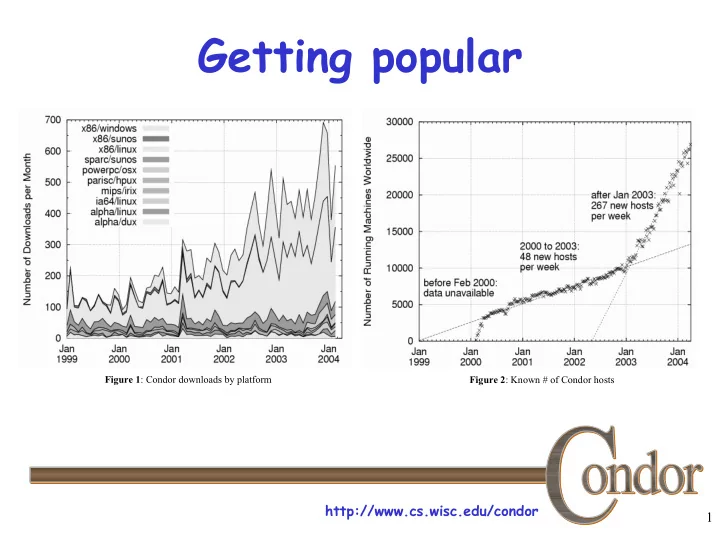
Figure 1: Condor downloads by platform Figure 2: Known # of Condor hosts
Getting popular Figure 1 : Condor downloads by platform Figure 2 : - - PowerPoint PPT Presentation
Getting popular Figure 1 : Condor downloads by platform Figure 2 : Known # of Condor hosts http://www.cs.wisc.edu/condor 1 http://www.cs.wisc.edu/condor 2 Interfacing Applications w/ Condor Suppose you have an application which needs a
1 http://www.cs.wisc.edu/condor
Getting popular
Figure 1: Condor downloads by platform Figure 2: Known # of Condor hosts
2 http://www.cs.wisc.edu/condor
3 http://www.cs.wisc.edu/condor
Interfacing Applications w/ Condor
› Suppose you have an application which
needs a lot of compute cycles
› You want this application to utilize a
pool of machines
› How can this be done?
4 http://www.cs.wisc.edu/condor
Some Condor APIs
› Command Line tools
condor_submit, condor_q, etc
› SOAP › DRMAA › Condor GAHP › MW › Condor Perl Module › Ckpt API
5 http://www.cs.wisc.edu/condor
Command Line Tools
› Don’t underestimate them › Your program can create a submit file
condor_submit:
system(“echo universe=VANILLA > /tmp/condor.sub”); system(“echo executable=myprog >> /tmp/condor.sub”); . . . system(“echo queue >> /tmp/condor.sub”); system(“condor_submit /tmp/condor.sub”);
6 http://www.cs.wisc.edu/condor
Command Line Tools
› Your program can create a submit file
and give it to condor_submit through stdin:
PERL: fopen(SUBMIT, “|condor_submit”); print SUBMIT “universe=VANILLA\n”; . . . C/C++: int s = popen(“condor_submit”, “r+”); write(s, “universe=VANILLA\n”, 17/*len*/); . . .
7 http://www.cs.wisc.edu/condor
Command Line Tools
› Using the +Attribute with
condor_submit:
universe = VANILLA executable = /bin/hostname
log = job.log +webuser = “zmiller” queue
8 http://www.cs.wisc.edu/condor
Command Line Tools
› Use -constraint and –format with
condor_q:
% condor_q -constraint ‘webuser==“zmiller”’
ID OWNER SUBMITTED RUN_TIME ST PRI SIZE CMD 213503.0 zmiller 10/11 06:00 0+00:00:00 I 0 0.0 hostname
% condor_q -constraint 'webuser=="zmiller"' -format "%i\t" ClusterId -format "%s\n" Cmd 213503 /bin/hostname
9 http://www.cs.wisc.edu/condor
Command Line Tools
› condor_wait will watch a job log file
and wait for a certain (or all) jobs to complete: system(“condor_wait job.log”);
10 http://www.cs.wisc.edu/condor
Command Line Tools
› condor_q and condor_status –xml
› So it is relatively simple to build on
top of Condor’s command line tools alone, and can be accessed from many different languages (C, PERL, python, PHP, etc).
› However…
11 http://www.cs.wisc.edu/condor
DRMAA
› DRMAA is a GGF standardized job-
submission API
› Has C (and now Java) bindings › Is not Condor-specific -- your app could
submit to any job scheduler with minimal changes (probably just linking in a different library)
12 http://www.cs.wisc.edu/condor
DRMAA
› Unfortunately, the DRMAA API does
not support some very important features, such as:
Two-phase commit Fault tolerance Transactions
13 http://www.cs.wisc.edu/condor
Condor GAHP
› The Condor GAHP is a relatively low-level protocol
based on simple ASCII messages through stdin and stdout
› Supports a rich feature set including two-phase
commits, transactions, and optional asynchronous notification of events
› Is available in Condor 6.7.X
14 http://www.cs.wisc.edu/condor
GAHP, cont
Example: R: $GahpVersion: 1.0.0 Nov 26 2001 NCSA\ CoG\ Gahpd $ S: GRAM_PING 100 vulture.cs.wisc.edu/fork R: E S: RESULTS R: E S: COMMANDS R: S COMMANDS GRAM_JOB_CANCEL GRAM_JOB_REQUEST GRAM_JOB_SIGNAL GRAM_JOB_STATUS GRAM_PING INITIALIZE_FROM_FILE QUIT RESULTS VERSION S: VERSION R: S $GahpVersion: 1.0.0 Nov 26 2001 NCSA\ CoG\ Gahpd $ S: INITIALIZE_FROM_FILE /tmp/grid_proxy_554523.txt R: S S: GRAM_PING 100 vulture.cs.wisc.edu/fork R: S S: RESULTS R: S 0 S: RESULTS R: S 1 R: 100 0 S: QUIT R: S
15 http://www.cs.wisc.edu/condor
SOAP
› Simple Object Access Protocol › Mechanism for doing RPC using XML
typically over HTTP
› A World Wide Web Consortium
(W3C) standard
16 http://www.cs.wisc.edu/condor
Benefits of a Condor SOAP API
› Condor becomes a service
Can be accessed with standard web service tools
› Condor accessible from platforms where its
command-line tools are not supported
› Talk to Condor with your favorite language and
SOAP toolkit
17 http://www.cs.wisc.edu/condor
Condor SOAP API functionality
› Submit jobs › Retrieve job output › Remove/hold/release jobs › Query machine status › Query job status
18 http://www.cs.wisc.edu/condor
Getting machine status via SOAP
Your program SOAP library
queryStartdAds()
condor_collector Machine List
SOAP
19 http://www.cs.wisc.edu/condor
Getting machine status via SOAP (in Java with Axis)
locator = new CondorCollectorLocator(); collector = locator.getcondorCollector(new URL(“http://machine:port”)); ads = collector.queryStartdAds(“Memory>512“); Because we give you WSDL information you don’t have to write any of these functions.
20 http://www.cs.wisc.edu/condor
Submitting jobs
1.
Begin transaction
21 http://www.cs.wisc.edu/condor
MW
›
MW is a tool for making a master-worker style application that works in the distributed, opportunistic environment of Condor.
›
Use either Condor-PVM or MW-File a file-based, remote I/O scheme for message passing.
›
Motivation: Writing a parallel application for use in the Condor system can be a lot of work.
Workers are not dedicated machines, they can leave the computation at any time. Machines can arrive at any time, too, and they can be suspended and resume computation. Machines can also be of varying architechtures and speeds.
›
MW will handle all this variation and uncertainly in the
22 http://www.cs.wisc.edu/condor
23 http://www.cs.wisc.edu/condor
MW and NUG30
quadratic assignment problem 30 facilities, 30 locations
between them
posed in 1968 as challenge, long unsolved but with a good pruning algorithm & high- throughput computing...
24 http://www.cs.wisc.edu/condor
NUG30 Solved on the Grid with Condor + Globus
Resource simultaneously utilized:
›
the Origin 2000 (through LSF ) at NCSA.
›
the Chiba City Linux cluster at Argonne
›
the SGI Origin 2000 at Argonne.
›
the main Condor pool at Wisconsin (600 processors)
›
the Condor pool at Georgia Tech (190 Linux boxes)
›
the Condor pool at UNM (40 processors)
›
the Condor pool at Columbia (16 processors)
›
the Condor pool at Northwestern (12 processors)
›
the Condor pool at NCSA (65 processors)
›
the Condor pool at INFN (200 processors)
25 http://www.cs.wisc.edu/condor
NUG30 - Solved!!!
Sender: goux@dantec.ece.nwu.edu Subject: Re: Let the festivities begin. Hi dear Condor Team, you all have been amazing. NUG30 required 10.9 years of Condor Time. In just seven days ! More stats tomorrow !!! We are off celebrating ! condor rules ! cheers, JP.
26 http://www.cs.wisc.edu/condor
Condor Perl Module
› Perl module to parse the “job log file” › Recommended instead of polling w/
condor_q
› Call-back event model › (Note: job log can be written in XML)
27 http://www.cs.wisc.edu/condor
“Standalone” Checkpointing
› Can use Condor Project’s checkpoint
technology outside of Condor…
SIGTSTP = checkpoint and exit SIGUSR2 = periodic checkpoint condor_compile cc myapp.c –o myapp myapp -_condor_ckpt foo-image.ckpt … myapp -_condor_restart foo-image.ckpt
28 http://www.cs.wisc.edu/condor
Checkpoint Library Interface
› void init image with file name( char *ckpt file name ) › void init image with file descriptor( int fd ) › void ckpt() › void ckpt and exit() › void restart() › void condor ckpt disable() › void condor ckpt enable() › int condor warning config( const char *kind,const char
*mode)
› extern int condor compress ckpt