Video is Popular in Korea The Rise of Shared Online Video, the Fall - - PDF document

video is popular in korea
SMART_READER_LITE
LIVE PREVIEW

Video is Popular in Korea The Rise of Shared Online Video, the Fall - - PDF document

Video is Popular in Korea The Rise of Shared Online Video, the Fall of Traditional Learning Dr. Curtis J. Bonk, cjbonk@indiana.edu Professor, I ndiana University February 21, 2012 February 24, 2012 Video is Popular around the World Video is


slide-1
SLIDE 1

1

The Rise of Shared Online Video, the Fall of Traditional Learning

  • Dr. Curtis J. Bonk, cjbonk@indiana.edu

Professor, I ndiana University

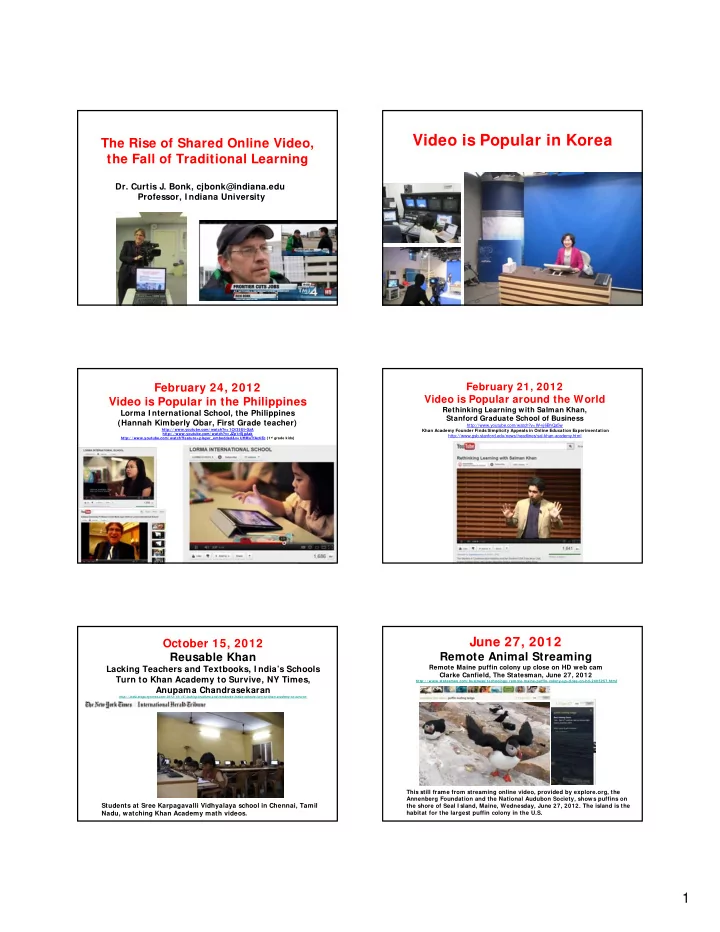
Video is Popular in Korea

February 24, 2012 Video is Popular in the Philippines

Lorma I nternational School, the Philippines (Hannah Kimberly Obar, First Grade teacher)

http:/ / www.youtube.com/ watch?v= 1C435Ut-GzA http:/ / www.youtube.com/ watch?v= JZp1rEjgAak http:/ / www.youtube.com/ watch?feature= player_embedded&v= UHMuTfAc6Ec (1st grade kids)

February 21, 2012 Video is Popular around the World

Rethinking Learning with Salman Khan, Stanford Graduate School of Business

http://www.youtube.com/watch?v= W-vj6BhQa5w Khan Academy Founder Finds Simplicity Appeals in Online Education Experimentation http://www.gsb.stanford.edu/news/headlines/sal-khan-academy.html

October 15, 2012 Reusable Khan

Lacking Teachers and Textbooks, I ndia’s Schools Turn to Khan Academy to Survive, NY Times, Anupama Chandrasekaran

http:/ / india.blogs.nytimes.com/ 2012/ 10/ 15/ lacking-teachers-and-textbooks-indias-schools-turn-to-khan-academy-to-survive/

Students at Sree Karpagavalli Vidhyalaya school in Chennai, Tamil Nadu, watching Khan Academy math videos.

June 27, 2012

Remote Animal Streaming

Remote Maine puffin colony up close on HD web cam Clarke Canfield, The Statesman, June 27, 2012

http:/ / www.statesman.com/ business/ technology/ remote-maine-puffin-colony-up-close-on-hd-2405257.html

This still frame from streaming online video, provided by explore.org, the Annenberg Foundation and the National Audubon Society, shows puffins on the shore of Seal I sland, Maine, Wednesday, June 27, 2012. The island is the habitat for the largest puffin colony in the U.S.

slide-2
SLIDE 2

2

June 27, 2012 Google Glass

ABC News, Google I / O Conference: Project Glass Prototype For Sale

http:/ / abcnews.go.com/ Technology/ google-project-glass-prototypes-offered-google-io-confernce/ story?id= 16663176

March 9, 2012

Online Learning Polyglots

http://www.nytimes.com/2012/03/11/nyregion/a-teenage-master-of-languages-finds-online-fellowship.html?_r=1&pagewanted=all

Timothy posts videos of himself speaking several languages on YouTube.

October 27, 2012

Chuck Severance (U Michigan/ Coursera) in Barcelona

http:/ / www.youtube.com/ watch?v= JzNHvmSv8TI

January 30 and 31, 2013

Global voices in education technology: Daphne Koller, Coursera BETT 2013 Keynote Talk (posted March 14, 2013)

http:/ / www.youtube.com/ watch?v= BMiI 6RdlNQs&WT.tsrc= Email&WT.mc_id= NWS14

March 17, 2013 Globalizing MOOCs (George Siemens)

Chris Olds, I nside Higher Ed

http:/ / www.insidehighered.com/ blogs/ globalhighered/ globalizing-moocs

March 2013

Eric Whitacre: Virtual Choir Live

http:/ / www.ted.com/ talks/ eric_whitacre_virtual_choir_live.html

http:/ / www.youtube.com/ watch?v= 6WhWDCw3Mng

slide-3
SLIDE 3

3

April 18, 2013

Quincy Jones goes high-tech for the lowdown on music, Marco della Cava, USA TODAY, Playground Sessions

http:/ / www.playgroundsessions.com/ about.html

Celebrity I nstructors in YouTube

April 2008 ~ 2 million views October 2008 7.5 million views

April 18, 2013

15.8+ million views

Randy Pausch’s last lecture

http:/ / www.youtube.com/ watch?v= ji5_MqicxSo

Segment Video Anchors

(e.g., TubeChop of V-PORTAL: Video Primers in an Online Repository of e-Teaching and Learning; “Wikibooks Hooray for Us”)

http:/ / www.tubechop.com/ watch/ 378752

April 2011

Teaching, Learning, and Sharing: How Today’s Higher Education Faculty Use Social Media

July 26, 2011

71 Percent Report Using Video Sharing Sites, Pew I nternet and American Life Report. Kathleen Moore

http:/ / technolog.msnbc.msn.com/ _news/ 2011/ 07/ 26/ 7171105-71-percent-using-video-sharing-sites-pew-report

How long is an ideal YouTube video? (Lin, Bonk, et al., 2010)

0.00% 10.00% 20.00% 30.00% 40.00% 50.00% 60.00% 70.00%

1‐4 minutes 4‐7 minutes 7‐10 minutes Less than a minute Over 10 minutes 64.05% 24.53% 4.57% 4.57% 2.28%

slide-4
SLIDE 4

4

Why Use Video?

  • 1. David Ausubel (1978) argued that knowledge

was hierarchically organized.

  • 2. New learning concepts and ideas to be

subsumed under or anchored within prior learning experiences (i.e., meaningful info must be related to what already know).

  • 3. Advance Organizers: Per Ausubel, we must

provide a context, richer, deeper learning.

Why Use Video?

  • 4. Dual coding theory (learning

information verbally and visually is more richly stored): Alan Paivio.

  • 5. Anchored instruction and

macrocontexts: John Bransford and colleagues.

  • 6. Multimedia theory: Richard Mayer.

Which of these video sharing sites do you use?

1. BBC News Video and Audio 2. CNN.com Video 3. MSNBC.com 4. Google Video, Yahoo Video 5. Current TV 6. Fora TV 7. MI T World 8. YouTube, YouTube Edu 9. TeacherTube

  • 10. Link TV, Explore, Global Pulse, Latin Pulse
  • 11. Howcast, Big Think, WonderHowTo, Explo.TV, NASA TV,

ClipChef, TV Lesson, BookTV, Edutopia videos, MonkeySee, doFlick, the Research Channel, iVideosong

TED Talks

(Build a School in the Cloud; Self-Organized Learning Environments (SOLEs), February 2013, TED Talk from Sugata Mitra

http:/ / www.ted.com/ talks/ sugata_mitra_build_a_school_in_the_cloud.html

Educational Video Anchors TED-Ed: http:/ / education.ted.com/

Academic Earth

slide-5
SLIDE 5

5

BookTV on C-Span2

(author interviews)

Fora TV (i.e., “the Conference Channel”

  • r “YouTube for Thinkers;” videos on business,

technology, science, politics, and culture)

Big Think

(short topical video interviews and blogs posts from famous people)

TV Lesson

(expert videos)

History for Music Lovers

The French Revolution ("Bad Romance" by Lady Gaga) Trojan War (“Tainted Love” by Soft Cell) Charlemagne (“Call Me” by Blondie) The Vikings ("Personal Jesus" by Depeche Mode) The Crusades ("Eyes Without a Face" by Billy I dol) Constantine ("Come On, Eileen" by Dexy's Midnight Runners)

http://www.youtube.com/user/historyteachers

Ten Anchors and Enders: I nstructor Centered

slide-6
SLIDE 6

6

Video Course I ntros

(examples from Northern Virginia Community College)

Yun Yun Chow, Open U Malaysia, Making Art Lessons Come Alive with Web 2.0

http:/ / www.youtube.com/ watch?v= BO9rqJD1GXo

  • 1. Online Video Anchoring

Online videos are used as an anchor or advance organizer of a class lecture.

Learning and Memory Videos

  • 2. Online Video Ender

Online videos are used after discussion and activities as a class “ender” or capstone event.

  • 4. Online Class Previews

and Discussions

The instructor(s) finds videos and then posts them to the course management system for students to watch prior to or after class. I f students participate in an online discussion based on such videos, the instructor should be clear about the length of post (e.g., two paragraphs) and how many comments of peers to respond to.

Flipping the Class

Collaboration and Discussion in Google Hangouts, Jan. 28 and Feb 7, 2013

(Carrie Gong from Beijing Normal University)

slide-7
SLIDE 7

7

April 15, 2013 Guest Speakers

Sara de Freitas and Jim Hensman, U of Coventry, UK

(https:/ / connect.iu.edu/ p2ie1yx6z6x/ )

Jay Cross, Berkeley (https:/ / connect.iu.edu/ p4bytsoronh/ )

  • 5. Anchor with Discussion

The instructor(s) finds videos and shows them in class and students discuss them in small groups with certain assigned tasks. Discuss Videos

(e.g., Grockit Answers and Vialogues;

https:/ / vialogues.com/ )

Collaborative Video Annotations and Discussions (Craig Howard, I U)

http:/ / scholarworks.iu.edu/ journals/ index.php/ ijdl/ article/ view/ 853/ 912

  • 6. Pause and Reflect

The instructor(s) plays a portion

  • f a YouTube video and pauses

for reflections and then continues playing the video which is followed by still more class reflection.

  • 7. Key Concept Reflections

I nstructor shows the YouTube video and asks students to reflect on concepts embedded in it. He may replay the video 1-2 more times while prompting the class for certain key

  • concepts. He might ask students to say

“pause” when they see a concept from a particular chapter or unit displayed.

slide-8
SLIDE 8

8

Ten Anchors and Enders: Student Centered

  • 1. Course Resource

Provider Handouts

Students find videos and show them in class and discussion unfolds. Students assigned as the cool resource providers for the week are asked to create a handout for the videos and other course resources selected.

I nteractive Multimedia Glossaries Umida Khikmatillaeva, Dec. 2011, P540 http:/ / learningplanet.shutterfly.com/

  • 4. Student Anchor

Demonstrations

Each student brings a video to class and presents and explains how each one is related to course

  • concepts. A coinciding handout
  • f videos and concepts is

recommended.

April 25, 2012

MI T+ K-12 Making Video to Make a Difference http:/ / k12videos.mit.edu/

WonderHowTo and Howcast

slide-9
SLIDE 9

9

  • 5. Anchor Creators

Students create their own YouTube videos to illustrate course concepts. Student Films and Documentaries

http:/ / www.youtube.com/ watch?v= I QZHvuZ3rbw&feature= youtu.be (Yue) Miguel Lara, R685 (Web 2.0 FREEDOM): http:/ / www.youtube.com/ watch?v= 8cmCFWi9lW8 Shuya Xu &Yue Ma (Blog my online lrng): http:/ / www.youtube.com/ watch?v= im7GQM9fzhc

  • 7. Video Anchor

Competitions

Students find relevant videos and send the list to the instructor(s) for viewing and

  • selecting. The students whose

videos are selected might receive special class recognition or bonus points.

  • 9. Video Anchor Debates

Students are asked to find YouTube

  • r other online video content on the

pro and con sides of a key class issue and then use them in face-to-face or

  • nline discussions and debates.
  • 10. Anchor Creator

I nterviews

Students find YouTube videos relevant to course concepts and email interview the creator about the purpose and potential uses of the video or perhaps request that the creator join the class in a synchronous chat.

Karl Fisch, Did You Know? Shift Happens—Globalization, I nformation Age

slide-10
SLIDE 10

10

But who can use shared

  • nline video?

Advice and Guidelines

  • 1. When using shared online videos,

consider the learning theory or approach makes them more powerful than other media.

  • 2. Assign students to reflect on why or

how you used them.

Advice and Guidelines

  • 3. Length of video for activities should

be less than 10 minutes and preferably under 4 minutes.

  • 4. Watch and approve all videos

before selecting. And test for link rot.

Advice and Guidelines

  • 5. Have back-up videos in case do not

work or are taken down.

  • 6. Considering offering online video

creation as an option—can foster student creativity.

Final Thoughts

I t is important for instructors to begin to reflect on the power of such online video technology, to experiment on their use, and to share their results. Slides at: TrainingShare.com Papers: PublicationShare.com Book: http:/ / worldisopen.com/ Questions, Comments, Share I deas

(Will Work, might work, won’t work)