GETTING BEYOND OSHA PANELISTS The Ripple Effects That OSHAs New - - PowerPoint PPT Presentation

getting beyond osha
SMART_READER_LITE
LIVE PREVIEW

GETTING BEYOND OSHA PANELISTS The Ripple Effects That OSHAs New - - PowerPoint PPT Presentation

GETTING BEYOND OSHA PANELISTS The Ripple Effects That OSHAs New Silica Standard is likely to have on the legal environment, and in turn, the Insurance and Construction Industries. Phil Beck Smith Currie & Hancock Kevin Barry XL


slide-1
SLIDE 1

GETTING BEYOND OSHA

The Ripple Effects That OSHA’s New Silica Standard is likely to have on the legal environment, and in turn, the Insurance and Construction Industries.
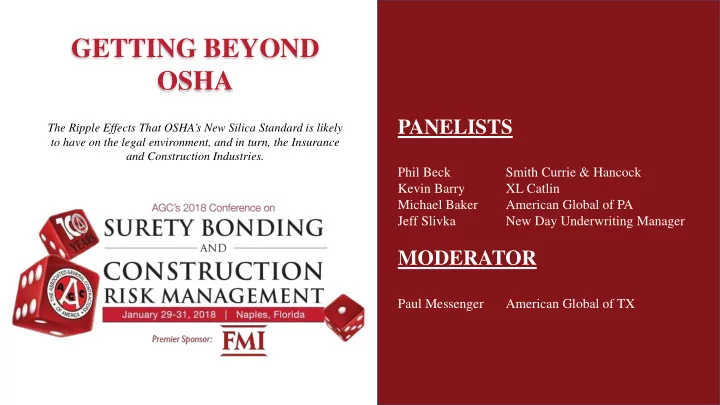
Phil Beck Smith Currie & Hancock Kevin Barry XL Catlin Michael Baker American Global of PA Jeff Slivka New Day Underwriting Manager

MODERATOR

Paul Messenger American Global of TX

PANELISTS

slide-2
SLIDE 2

OSHA Silica Standard: What’s in the Rule???

KEY POINTS FROM THE NEW SLICIA DUST STANDARD I. The new standard requires a more stringent “permissible exposure limit” II. OSHA offers (3) methods an employer can choose to demonstrate compliance and assess employee exposure

  • III. Employers are required to have a written exposure control plan
  • IV. Medical surveillance (exams) must be offered for employees required by the standard to wear a

respirator for 30 or more days per year V. Train workers on the effect of Silica exposure, workplace tasks that can expose them to Silica and ways to limit exposure

slide-3
SLIDE 3

Legal Ramifications

I. Legal requirements imposed on the contractors (typically subcontractors) who generate respirable crystalline silica. II. Legal requirements imposed on general contractors (who do not directly create the risk).

  • III. The importance of recordkeeping.
  • IV. U.S. Court of Appeals for the D.C. Circuit’s 12/22/17 Decision in North America’s Building

Trades unions v. OSHA V. Potential Liability a) OSHA Fines b) Personal injury litigation: “Silica Solicitors”

slide-4
SLIDE 4

Loss Control

I. Exposure Potentials a) CM/GC vs Subs b) Multi Employer Worksite II. Best Practices a) Policy b) Field Controls

  • III. OSHA Enforcement
  • IV. Resources Available

a) Broker/Carrier b) AGC and other Trade Organizations c) Vendors

slide-5
SLIDE 5

Insurance & Risk Management

I. Risk Management Considerations a) Contractual Risk Transfer  Broad Indemnification Language  Requiring Contractors Pollution Liability Insurance of Subcontractors? b) Verification of Insurance from Subcontractors c) Adherence to Safety Manuals & Risk Management Guidelines II. Insurance Implications a) Commercial General Liability b) Workers Compensation & Employers Liability c) Prevalence of Silica and Dust Exclusions d) Non-standard Policy Language e) Contractors Pollution Liability Insurance (CPL)

slide-6
SLIDE 6

Insurance & Risk Management

  • III. Contractors Pollution Liability Insurance (CPL) Coverage Considerations

a) 3rd Party Liability - BI/PD/Clean up/Defense for contracting activities performed by or on behalf

  • f the insured

b) Definition of “pollutant” or “pollution conditions/events” c) Medical monitoring of a pollution condition d) Civil penalties e) Third party action-over f) Emergency Response Cost coverage