Germination Index as a tool to assess phytotoxicity of olive mill - - PowerPoint PPT Presentation

germination index as a tool to assess phytotoxicity of
SMART_READER_LITE
LIVE PREVIEW

Germination Index as a tool to assess phytotoxicity of olive mill - - PowerPoint PPT Presentation

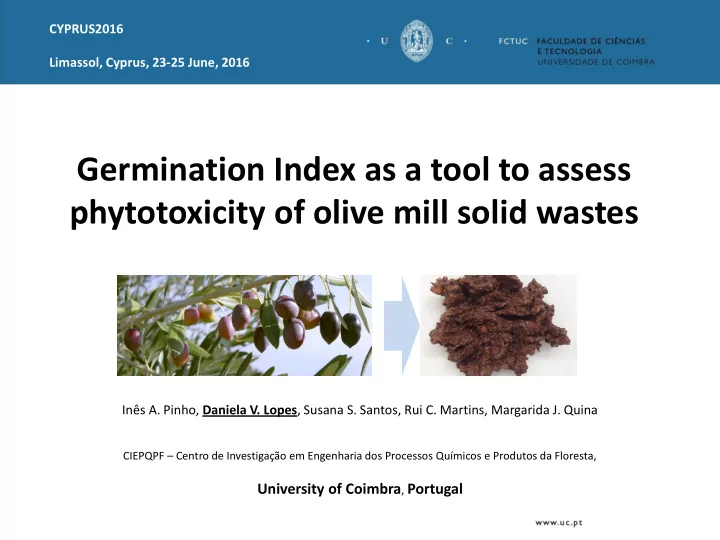
CYPRUS2016 Limassol, Cyprus, 23-25 June, 2016 Germination Index as a tool to assess phytotoxicity of olive mill solid wastes Ins A. Pinho, Daniela V. Lopes , Susana S. Santos, Rui C. Martins, Margarida J. Quina CIEPQPF Centro de


slide-1
SLIDE 1

CYPRUS2016 Limassol, Cyprus, 23-25 June, 2016

Germination Index as a tool to assess phytotoxicity of olive mill solid wastes

Inês A. Pinho, Daniela V. Lopes, Susana S. Santos, Rui C. Martins, Margarida J. Quina

CIEPQPF – Centro de Investigação em Engenharia dos Processos Químicos e Produtos da Floresta,

University of Coimbra, Portugal

slide-2
SLIDE 2
  • 1. Introduction

(Azbar et al., 2004)

3P-OMSW Olive mill solid wastes : 2P-OMSW Olive oil production processes:

  • Traditional press
  • 3-phase centrifugation
  • 2-phase centrifugation
slide-3
SLIDE 3
  • 1. Introduction
  • Water-solid mixture/ alperujo/ wet olive husk …

3-phase olive oil production 2-phase olive oil production OMSW constitute an important environmental concern High energy and water demands High wastewater production

  • Olive husk/ olive pomace
  • Wastewater

Process called “ecological”: Less wastewater with lower pollutant load BUT Water-solid waste has high moisture and organic load

  • Water-solid mixture
slide-4
SLIDE 4
  • 1. Introduction

Olive mill liquid and solid wastes as economic resources

Soil conditioner Biomass fuel Compost Irrigation water

slide-5
SLIDE 5
  • 1. Introduction

Soil applications of olive mill wastes

Advantages Disadvantages High nutrients concentration (K, P) High mineral salt content High antimicrobial capacity Low pH High C/N ratio Polyphenols

slide-6
SLIDE 6
  • 1. Introduction

Main objective of the study:

Investigate the main compounds responsible for phytotoxicity of OMSW

Specific objectives:

1. Characterization of two olive mill solid wastes (OMSW):

– 2P-OMSW – 3P-OMSW

2. Assess phytotoxicity of both wastes: germination assays with Lepidium Sativum (garden cress):

– Rate of seed germination – Root length – Germination Index Influence of :

  • L/S ratio
  • Phenolic compounds concentration
slide-7
SLIDE 7
  • 2. Experimental methodology

1) Sampling of both wastes

Collected from a 2-phase olive mill in the Spanish region of Estremadura. Wet appearance (H ≈70%) Collected from a 3-phase olive mill in the center of Portugal. Dry appearance (H ≈20%) 2P-OMSW 3P-OMSW

slide-8
SLIDE 8
  • 2. Experimental methodology

2) Characterization of 2P-OMSW and 3P-OMSW

 Moisture (H) and Total Solids (TS)  Volatile Solids (VS) and Total Organic Carbon (TOC)  Water Holding Capacity (WHC)  pH  Electrical Condutivity (EC)  Chemical Oxygen Demand (COD)  Total Phenolic Content (TPH)  Total Kjeldahl Nitrogen (TKN)  Total Nitrogen (TN)  Phosphorous Concentration (P)

Gallic acid

slide-9
SLIDE 9
  • 2. Experimental methodology

3) Germination Index assays

Germination assays were performed using the method discribed by Trautmann and Krasny (1977) Petri dishes with 9 cm diameter 10 seeds of Lepidum Sativum 5 mL of waste extract/ phenolic solution

  • Number of germinated seeds (NSG)
  • Root length (LR)

48 h 25 C darkness Determination of:

  • Relative Seed Germination (RSG)
  • Relative Root Growth (RRG)

(by comparison with the blank) 𝑯𝑱 % = 𝑺𝑻𝑯 × 𝑺𝑺𝑯 × 𝟐𝟏𝟏

GI (%) > 100 The material maximizes plants germination and root growth 80 – 100 No phytotoxic 60 – 80 Moderately phytotoxic 60 – 40 Phytotoxic < 40 Highly phytotoxic

slide-10
SLIDE 10
  • 2. Experimental methodology

3) Germination Index assays

i. L/S ratio assays: 10, 50, 100, 250 and 500 L/kg ii. Phenolic compounds assays: concentration range 5–500 ppm

  • iii. Synthetic effluent assay: mixture of six phenolic acids tested at 100, 50 and 25 ppm

(Martins, Rossi, & Quinta-ferreira, 2010)

 3,4,5-Trimethoxybenzoic acid  4-Hydroxybenzoic acid  Caffeic acid  Cinnamic acid  Gallic acid  p-Coumaric acid  Phenol  Protocatechuic acid  Syring acid  Vanillic acid  3,4,5-Trimethoxybenzoic acid  4-Hydroxybenzoic acid  Protocatechuic acid  Syringic acid  Vanillic acid  Veratric acid

slide-11
SLIDE 11
  • 3. Results and discussion

3.1 – Characterization of 2P and 3P-OMSW

2P-OMSW 3P-OMSW H (%) 67,1  0,5 17,6  0,6 TS (%) 32,9  0,5 82,4  0,56 VS (%) 95,2  0,2 94,2  1,8 TOC (%) 52,9  0,1 54,4  1,0 WHC (%) 97,8  6,9 91,4  16,8 pH 4,82  0,00 4,96  0,02 EC (mS/cm) 2,77  0,03 0,92  0,05 COD (g O2/ g dm) 2,40  0,19 2,48  0,05 TPH (mg GAE/ g dm) 0,99  0,03 0,93  0,03 TKN (mg/ g dm) 10,5  4,7 11,1  1,8 TN (mg/ g dm) 11,7  0,05 14,0  0,9

mean  std dm – dry matter GAE – gallic acid equivalentes

slide-12
SLIDE 12
  • 3. Results and discussion

3.2 Germination assays with olive mill wastes extracts

L/S ratio

10 100 1000

GI (%)

20 40 60 80 100 120 140 2P-OMSW 3P-OMSW

L/S ratio

10 100 1000

Relative seed germination (%)

20 40 60 80 100 120 2P-OMSW 3P-OMSW

Highly phytotoxic (GI<40%) Phytotoxic (40<GI<60%)

L/S ratio

10 100 1000

Relative root growth (%)

20 40 60 80 100 120 140 2P-OMSW 3P-OMSW

50

slide-13
SLIDE 13
  • 3. Results and discussion

Concentration (ppm)

10 100 1000

Relative seed germination (%)

20 40 60 80 100 120 Cinnamic acid p-Coumaric acid Caffeic acid

Concentration (ppm)

10 100 1000

GI (%)

20 40 60 80 100 120 140 Cinnamic acid p-Coumaric acid Caffeic acid

Concentration (ppm)

10 100 1000

Relative root growth (%)

20 40 60 80 100 120 140 Cinnamic acid p-Coumaric acid Caffeic acid

3.3 Germination assays with phenolic compounds (Cinnamic Acids)

Caffeic p-Coumaric Cinnamic

47 167

Less –OH groups  Higher phytotoxicity  Less root growth  Less germinated seeds

slide-14
SLIDE 14
  • 3. Results and discussion

Concentration (ppm)

10 100 1000

Relative seed germination (%)

60 70 80 90 100 110 120 3,4,5-Trimethoxybenzoic acid Syringic acid Vanillic acid

Concentration (ppm)

10 100 1000

GI (%)

20 40 60 80 100 120 140 3,4,5-Trimethoxybenzoic acid Syringic acid Vanillic acid

Concentration (ppm)

10 100 1000

Relative root growth (%)

20 40 60 80 100 120 140 3,4,5-Trimethoxybenzoic acid Syringic acid Vanillic acid

Vanillic Syringic 3,4,5-Trimethoxybenzoic

93

Less –OCH3 groups  Higher phytotoxicity  Less root growth

3.3 Germination assays with phenolic compounds (– OCH3 –OH acids)

slide-15
SLIDE 15
  • 3. Results and discussion

Concentration (ppm)

10 100 1000

GI (%)

20 40 60 80 100 120 140 Gallic acid 4-Hydroxybenzoic acid Protocatehuic acid Phenol

Concentration (ppm)

10 100 1000

Relative seed germination (%)

60 70 80 90 100 110 120 Gallic acid 4-Hydroxybenzoic acid Protocatechuic acid

Phenol Concentration (ppm)

10 100 1000

Relative root growth (%)

20 40 60 80 100 120 140 Gallic acid 4-Hydroxybenzoic acid Protocatechuic acid Phenol

3.3 Germination assays with phenolic compounds (benzoic acids and phenol)

Less –OH groups  Higher phytotoxicity  Less root growth

Phenol 4-Hydroxybenzoic Protocatechuic Gallic

57 326

slide-16
SLIDE 16
  • 3. Results and discussion

3.4 Germination assays with a synthetic effluent

Concentration of each phenolic acid (ppm)

20 40 60 80 100 120

Relative seed germination (%)

60 70 80 90 100 110 120

Concentration of each phenolic acid (ppm)

20 40 60 80 100 120

Relative root growth (%)

20 40 60 80 100 120 140

4-Hydroxybenzoic 3,4,5-Trimethoxybenzoic Protocatechuic Syringic Vanillic Veratric

Concentration of each phenolic acid (ppm)

20 40 60 80 100 120

GI (%)

20 40 60 80 100 120 140

Phytotoxic (40<GI<60%)

slide-17
SLIDE 17
  • 4. Conclusions

 2P-OMSW is more phytotoxic than 3P-OMSW for Lepidium Sativum;  For cinnamic acids, molecules with less –OH groups seem to have higher phytotoxicity, less root growth and less germinated seeds;  For –OCH3 acids, less –OCH3 groups reveal higher phytotoxicity and less root growth;  For benzoic acids, less –OH groups also causes higher phytotoxicity and less root growth.

slide-18
SLIDE 18

Universidade de Coimbra - Portugal

Daniela Lopes dvlopes@eq.uc.pt

Acknowledgements: PD/BD/114106/2015 IF/00215/2014