SLIDE 5 2" " "
Find a common driver:
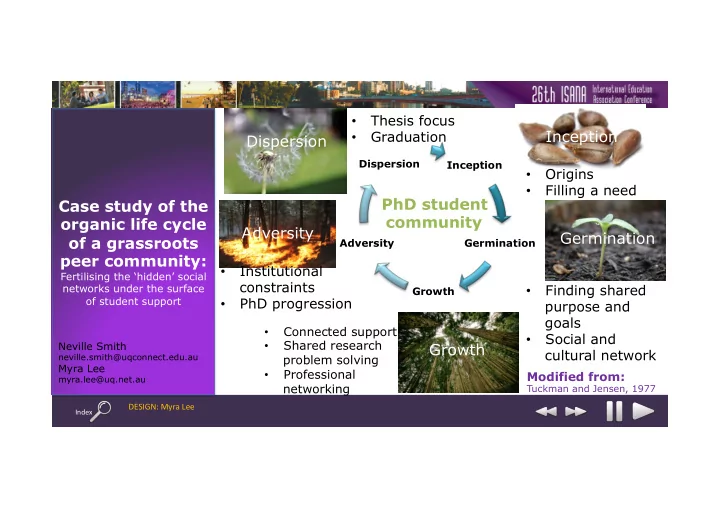
Start with the commitment to give purpose to forming a community of practice. Our common purpose was to form a group to practice reading and writing formal academic English. For example, a writing group for journal articles and sharing research methodologies.
"
Cross-cultural importance:""
Forming a group of international and domestic students provides international students with the chance to mingle with the host culture as opposed to naturally congregating only in international student communities.
"
All work and no play""
For a community of practice to function successfully, the ‘fun’ factor is an important
- component. We created pleasant experience through organised social activities. For example,
we celebrated cultural diversity, such as sharing food from different cultures, and accommodating families during our gatherings. This brought the group together more tightly.
"
Assign roles:""
Although our group was organic, assigning roles were important for two reasons: structure and momentum. Designating roles facilitates a distributed responsibility amongst group members and ensures accountability for the participation of members. We set out a meeting agenda for individual presentations of members’ research work experiences; for instance, data collection and analysis, and research approach.
"""""""""""""""""""""""""""""""""""""""""""""
Assigned roles also assist the functioning of group processes. When the facilitation of the group was left to one or two members, the group’s momentum stalled. Delegating responsibilities to other members would enable the momentum to continue. This addresses the transient nature of the PhD cohort and may potentially stave off the inevitable demise of the group.
" " " " Further"reading"
Cotterall, S. (2011). Identity and learner autonomy in doctoral study: International students' experiences in an Australian
- university. In B. Morrison (Ed.), Independent language learning: Building on experience, seeking new perspectives (pp. 57-
72). Hong Kong: Hong Kong University Press. Hingst, Raymond D. (2006). Tuckman’s theory of group development in a call centre context: does it still work? In 5th Global Conference on Business & Economics - Proceedings, Global Conference on Business & Economics. ( 5th Global Conference on Business & Economics, 6-8 July 2006, Cambridge, UK.)