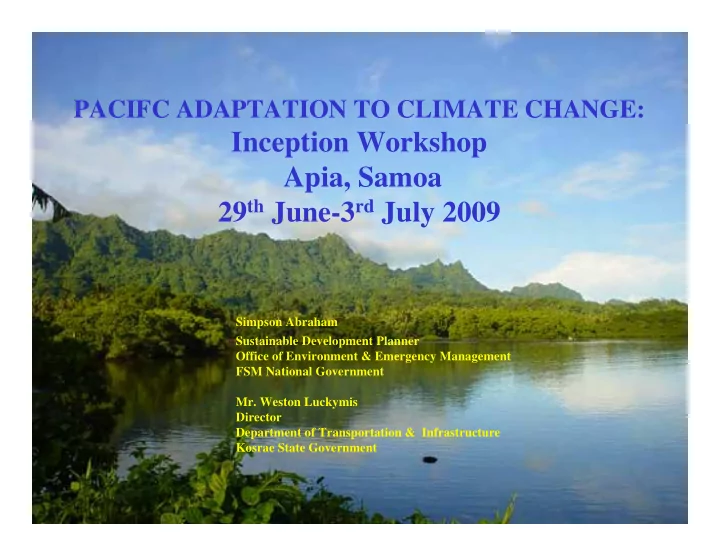
Inception Workshop Apia, Samoa 29 th June-3 rd July 2009 Simpson - - PowerPoint PPT Presentation

inception workshop apia samoa 29 th june 3 rd july 2009
SMART_READER_LITE
LIVE PREVIEW

Inception Workshop Apia, Samoa 29 th June-3 rd July 2009 Simpson - - PowerPoint PPT Presentation

PACIFC ADAPTATION TO CLIMATE CHANGE: Inception Workshop Apia, Samoa 29 th June-3 rd July 2009 Simpson Abraham Sustainable Development Planner Office of Environment & Emergency Management FSM National Government Mr. Weston Luckymis


slide-1
SLIDE 1

PACIFC ADAPTATION TO CLIMATE CHANGE:

Inception Workshop Apia, Samoa 29th June-3rd July 2009

Simpson Abraham Sustainable Development Planner Office of Environment & Emergency Management FSM National Government

  • Mr. Weston Luckymis

Director Department of Transportation & Infrastructure Kosrae State Government

slide-2
SLIDE 2
  • General Information of Kosrae State, FSM
  • Geographical Conditions:
  • Kosrae is roughly triangular in shape with a land area of 42

square miles.

  • High, steep, rugged mountains covered with dense tropical

vegetation characterize the island’s interior. Several mountain peaks rise to 2,000 feet above sea level. Much

  • f the shoreline is fringed with beautiful, dense mangrove

forests.

  • Climatic Conditions:
  • The climate is characterized by high humidity and

temperatures that average 80 degrees Fahrenheit year

  • round. Annual rainfall averages over 200 inches per year

near the coast and up to 240 inches per year in the upland.

Country Information Country Information

607 high islands and atolls (65 inhabited) Politically divided into four states Total land area is 271 sq. miles 1,149,500 sq. miles of EEZ Population is approx. 107,000 (2000) Federated States of Micronesia Federated States of Micronesia

slide-3
SLIDE 3
  • General Information of Kosrae State, FSM
  • Geographical Conditions:
  • Kosrae is roughly triangular in shape with a land area of 42

square miles.

  • High, steep, rugged mountains covered with dense tropical

vegetation characterize the island’s interior. Several mountain peaks rise to 2,000 feet above sea level. Much

  • f the shoreline is fringed with beautiful, dense mangrove

forests.

  • Climatic Conditions:
  • The climate is characterized by high humidity and

temperatures that average 80 degrees Fahrenheit year

  • round. Annual rainfall averages over 200 inches per year

near the coast and up to 240 inches per year in the upland.

slide-4
SLIDE 4

Kosrae State, PACC FSM Pilot Site

75% of Kosrae is experiencing coastal erosion. As virtually most of the infrastructures, commercial enterprises & residential properties are located within the coastal zone.

slide-5
SLIDE 5

Linking PACC to National Sustainable Development Strategies:

FSM has already mainstreamed climate change into its policies and strategic plan. e.g. FSM (SDP) Strategic Development Plan includes the IDP already climate proofed

Other Soft adaptation efforts

Micronesian Challenge, Protect Area Network 2nd National Communication, UNFCCC elaborate V&A component SLM/NAP, UNCCD – V&A Component Recent Study UH, USFS- Climate Change in FSM- Food and Water Security, Climate Risk Management, Adaptation Strategy

US Forest Service Projects (Mangrove rehabilitations projects) Integrated Water Resource Management (IWRM) assisted by SOPAC Pohnpei & Chuuk pilot sites

slide-6
SLIDE 6

Cont..

  • Integrated Water Resource Management (IWRM) assisted by SOPAC

Pohnpei & Chuuk pilot sites Venezuela grants for SLM related projects Turkey grants for MC activities Japanese Cool Earth Partnership assistance & PALM 5 Meeting in Japan last month Renewable Energy projects (EU, Japan, US, others)

slide-7
SLIDE 7

INSTITUTIONAL ARRANGEMENTS

All climate change programmes, projects and activities are coordinated by the National Office of Emergency Environment & Emergency Management (OEEM). The OEEM will also provides oversight and guidance on the implementation of activities relating to climate change. Under the PACC-FSM project, the OEEM will continue to coordinate climate change activities relating to PACC. However, given that PACC is focused on implementation

  • f adaptation activities in the State of Kosrae, the implementing agency for PACC

FSM will be Kosrae Island Resource Management Authority (KIRMA). KIRMA will also serve as secretariat to report to National FSM SD Council & OEEM on issues relating to the implementation of PACC-FSM. KIRMA will host the staff(s) that will provide the day-to-day operation of the PACC. These staffs will be part of the PACC Project Management Unit (PMU) who will be directly responsible to the Executive Director of KIRMA. At the national level, PACC-FSM will be implemented by various stakeholders within their respective mandates while scientific, technical and policy oversight will be provided by the OEEM and FSM Climate Change Country Team.

slide-8
SLIDE 8

SOME COMMITEMENTS TO BE USED AS PARALLEL C0-FIINANCING

  • US COMPACT FUNDS
  • JAPAN OVERSEAS DEVELOPMENT GRANT(ODA)
  • KOSRAE STATE GOVT. (OFFICE SPACE)
  • OTHER MULTILATERAL ASSISTANCE
slide-9
SLIDE 9

C e m e n t a t

Adaptation project for salt water, FSM outer islands

Cement taro beds are a successful adaptation to salinization. Soil (right) within the beds is built by composting methods on a regular schedule twice per week. Rainwater alone provides sufficient

  • moisture. Residents report that building these beds in soil pits

prevents overheating of plants near the cement walls.

slide-10
SLIDE 10

Houk Island, Chuuk; pop.500 Wells previously used for drinking water have turned brackish (left) and are now only used for washing. A formerly fresh water lake has turned brackish (middle). The brackish water has spread into adjoining soil and wetlands damaging and destroying food crops including taro, banana, breadfruit, and others. Breadfruit trees (right), decades old and hundreds of feet high, are losing their leaves. Salt in the soil does not wash

  • ut in the rains because it absorbs rainwater, which then evaporates, leaving

the salt.

slide-11
SLIDE 11

Challenges linked to Climate Change:

Our homes and families Our communities Our livelihoods and lifestyles (Diseases) Our economy Our welfare and well-being Altered currents/storm patterns etc….

slide-12
SLIDE 12

Other domestic activities contributing to all these problems

slide-13
SLIDE 13

Land Based Activities

  • Upland clearing
  • E

arth moving/ upland dredging

  • Road Development
slide-14
SLIDE 14

4 Meter Spatial Resolution

Mangrove filling Fire woods Sand mining (shoreline) Inland mining Infrastructure Airport on the reef flat

slide-15
SLIDE 15

CHALLENGES CHALLENGES

  • Scattered islands

Scattered islands

  • Four highly autonomous states

Four highly autonomous states

  • Coordination

Coordination

  • Technical expertise

Technical expertise

  • Information access/availability

Information access/availability

THANK YOU…