Geometry to Contemporary Architecture Helmut Pottmann Vienna - - PowerPoint PPT Presentation

geometry to contemporary architecture
SMART_READER_LITE
LIVE PREVIEW

Geometry to Contemporary Architecture Helmut Pottmann Vienna - - PowerPoint PPT Presentation

GEOMETRIE The Contribution of Discrete Differential Geometry to Contemporary Architecture Helmut Pottmann Vienna University of Technology, Austria 1 Project in Seoul, Hadid Architects GEOMETRIE 2 Lilium Tower Warsaw, Hadid Architects


slide-1
SLIDE 1

1

GEOMETRIE

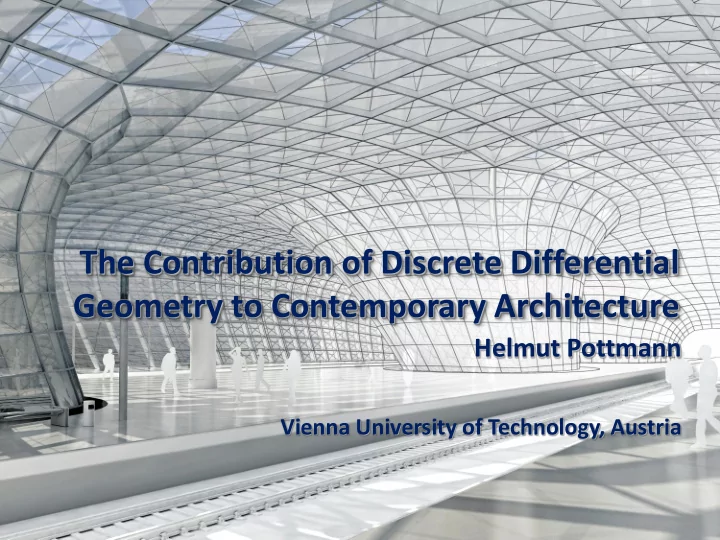
The Contribution of Discrete Differential Geometry to Contemporary Architecture

Helmut Pottmann

Vienna University of Technology, Austria

slide-2
SLIDE 2

2

GEOMETRIE

Project in Seoul, Hadid Architects

slide-3
SLIDE 3

3

GEOMETRIE

Lilium Tower Warsaw, Hadid Architects

slide-4
SLIDE 4

4

GEOMETRIE

Project in Baku, Hadid Architects

slide-5
SLIDE 5

5

GEOMETRIE

Discrete Surfaces in Architecture

triangle meshes

slide-6
SLIDE 6

6

GEOMETRIE

Chapter 19 - Discrete Freeform Structures 6

Zlote Tarasy, Warsaw

Waagner-Biro Stahlbau AG

slide-7
SLIDE 7

7

GEOMETRIE

Visible mesh quality

slide-8
SLIDE 8

8

GEOMETRIE

Geometry in architecture

 The underlying geometry representation

may greatly contribute to the aesthetics and has to meet manufacturing constraints

 Different from typical graphics applications

slide-9
SLIDE 9

9

GEOMETRIE

slide-10
SLIDE 10

10

GEOMETRIE

nodes in the support structure

 triangle mesh: generically

nodes of valence 6; `torsion´: central planes of beams not co-axial torsion-free node

slide-11
SLIDE 11

11

GEOMETRIE

quad meshes in architecture

Schlaich Bergermann

hippo house, Berlin Zoo

 quad meshes with planar faces (PQ meshes) are

preferable over triangle meshes (cost, weight, node complexity,…)

slide-12
SLIDE 12

12

GEOMETRIE

Discrete Surfaces in Architecture

Helmut Pottmann1, Johannes Wallner2, Alexander Bobenko3 Yang Liu4, Wenping Wang4

1 TU Wien 2 TU Graz 3 TU Berlin 4 University of Hong Kong

slide-13
SLIDE 13

13

Previous work

slide-14
SLIDE 14

14

GEOMETRIE

Previous work

 Difference geometry (Sauer, 1970)  Quad meshes with planar faces (PQ meshes)

discretize conjugate curve networks.

Example 1: translational net Example 2: principal curvature lines

slide-15
SLIDE 15

15

GEOMETRIE

PQ meshes

 A PQ strip in a PQ mesh is a discrete model of a

tangent developable surface.

 Differential geometry tells us: PQ meshes are

discrete versions of conjugate curve networks

slide-16
SLIDE 16

16

GEOMETRIE

Previous work

 Discrete Differential Geometry:

 Bobenko & Suris, 2005: integrable systems  circular meshes: discretization of the network of

principal curvature lines (R. Martin et al. 1986)

slide-17
SLIDE 17

17

Computing PQ meshes

slide-18
SLIDE 18

18

GEOMETRIE

Computational Approach

 Computation of a PQ mesh is based on

a nonlinear optimization algorithm:

 Optimization criteria

 planarity of faces  aesthetics (fairness of mesh polygons)  proximity to a given reference surface

 Requires initial mesh: ideal if taken

from a conjugate curve network.

slide-19
SLIDE 19

19

GEOMETRIE

subdivision & optimization

 Refine a coarse PQ mesh by repeated

application of subdivision and PQ optimization

PQ meshes via Catmull-Clark subdivision and PQ optimization

slide-20
SLIDE 20

20

GEOMETRIE

Opus (Hadid Architects)

slide-21
SLIDE 21

21

GEOMETRIE

Opus (Hadid Architects)

slide-22
SLIDE 22

22

GEOMETRIE

OPUS (Hadid Architects)

slide-23
SLIDE 23

23

Conical Meshes

slide-24
SLIDE 24

24

GEOMETRIE

Conical meshes

 Liu et al. 06  Another discrete

counterpart of network of principal curvature lines

 PQ mesh is conical if all

vertices of valence 4 are conical: incident oriented face planes are tangent to a right circular cone

slide-25
SLIDE 25

25

GEOMETRIE

Conical meshes

 Cone axis: discrete

surface normal

 Offsetting all face planes

by constant distance yields conical mesh with the same set of discrete normals

slide-26
SLIDE 26

26

GEOMETRIE

Offset meshes

slide-27
SLIDE 27

27

GEOMETRIE

Offset meshes

slide-28
SLIDE 28

28

GEOMETRIE

Offset meshes

slide-29
SLIDE 29

29

GEOMETRIE

Offset meshes

slide-30
SLIDE 30

30

GEOMETRIE

normals of a conical mesh

 neighboring discrete

normals are coplanar

 conical mesh has a

discretely orthogonal support structure

slide-31
SLIDE 31

31

GEOMETRIE

Multilayer constructions

slide-32
SLIDE 32

32

GEOMETRIE

Computing conical meshes

 angle criterion  add angle criterion to PQ

  • ptimization

 alternation with

subdivision as design tool

slide-33
SLIDE 33

33

GEOMETRIE

subdivision-based design

combination of Catmull-Clark subdivision and conical optimization; design: Benjamin Schneider

slide-34
SLIDE 34

34

GEOMETRIE

design by Benjamin Schneider

slide-35
SLIDE 35

35

Mesh Parallelism and Nodes

slide-36
SLIDE 36

36

GEOMETRIE

supporting beam layout

 beams: prismatic,

symmetric with respect to a plane

 optimal node (i.e.

without torsion): central planes of beams pass through node axis

 Existence of a parallel

mesh whose vertices lie on the node axes

geometric support structure

slide-37
SLIDE 37

37

GEOMETRIE

Parallel meshes

 meshes M, M* with planar faces are parallel if

they are combinatorially equivalent and corresponding edges are parallel M M*

slide-38
SLIDE 38

38

GEOMETRIE

Geometric support structure

 Connects two parallel meshes M, M*

slide-39
SLIDE 39

39

GEOMETRIE

Computing a supporting beam layout

 given M,

construct a beam layout

 find parallel

mesh S which approximates a sphere

 solution of a

linear system

 initialization

not required

slide-40
SLIDE 40

40

GEOMETRIE

Triangle meshes

 Parallel triangle

meshes are scaled versions of each

  • ther

 Triangle meshes

possess a support structure with torsion free nodes only if they represent a nearly spherical shape

slide-41
SLIDE 41

Triangle Meshes – beam layout with optimized nodes

  • We can minimize torsion in the supporting beam layout for

triangle meshes

41

slide-42
SLIDE 42

Mesh optimization

  • Project YAS island (Asymptote, Gehry Technologies, Schlaich

Bergermann, Waagner Biro, …)

42

slide-43
SLIDE 43

Mesh smoothing

  • Project YAS island (quad mesh with nonplanar faces)

43

slide-44
SLIDE 44

Mesh smoothing

  • Project YAS island (quad mesh with nonplanar faces)

44

slide-45
SLIDE 45

Optimized nodes

  • Torsion minimization also works for quadrilateral meshes

with nonplanar faces

45

slide-46
SLIDE 46

Optimized nodes

  • Torsion minimization also works for quadrilateral meshes

with nonplanar faces

46

slide-47
SLIDE 47

YAS project, mockup

47

slide-48
SLIDE 48

48

Offset meshes

slide-49
SLIDE 49

49

GEOMETRIE

node geometry

Employing beams

  • f constant height:

misalignment on

  • ne side
slide-50
SLIDE 50

50

GEOMETRIE

Cleanest nodes

 Perfect alignment on both sides if a mesh with

edge offsets is used

slide-51
SLIDE 51

51

GEOMETRIE

Cleanest nodes

slide-52
SLIDE 52

52

GEOMETRIE

Offset meshes

at constant distance d from M is called an offset of M.

 different types, depending on the definition of

 vertex offsets:  edge offsets: distance of corresponding (parallel)

edges is constant =d

 face offsets: distance of corresponding faces (parallel

planes) is constant =d

slide-53
SLIDE 53

53

GEOMETRIE

Exact offsets

 For offset pair define

Gauss image

 Then:

 vertex offsets

vertices of S lie in S2 (if M quad mesh, then circular mesh)

 edge offsets

edges of S are tangent to S2

 face offsets

face planes of S are tangent to S2 (M is a conical mesh)

slide-54
SLIDE 54

54

Meshes with edge offsets

slide-55
SLIDE 55

55

GEOMETRIE

Edge offset meshes

 M has edge offsets iff it is parallel to a

mesh S whose edges are tangent to S2

slide-56
SLIDE 56

56

GEOMETRIE

Koebe polyhedra

 Meshes with planar faces and

edges tangent to S2 have a beautiful geometry; known as Koebe polyhedra. Closed Koebe polyhedra defined by their combinatorics up to a Möbius transform

 computable as minimum of a

convex function (Bobenko and Springborn)

slide-57
SLIDE 57

57

GEOMETRIE

vertex cones

 Edges emanating from a vertex in an EO

mesh are contained in a cone of revolution whose axis serves as node axis.

 Simplifies the construction of the support

structure

slide-58
SLIDE 58

58

GEOMETRIE

Laguerre geometry

 Laguerre geometry is the geometry of oriented

planes and oriented spheres in Euclidean 3- space.

 L-trafo preserves or. planes, or. spheres and

contact; simple example: offsetting operation

 or. cones of revolution are objects of Laguerre

geometry (envelope of planes tangent to two spheres)

 If we view an EO mesh as collection of vertex

cones, an L-trafo maps an EO mesh M to an EO mesh .

slide-59
SLIDE 59

59

GEOMETRIE

Example: discrete CMC surface M (hexagonal EO mesh) and Laguerre transform M´

slide-60
SLIDE 60

60

GEOMETRIE

Hexagonal EO mesh

slide-61
SLIDE 61

61

GEOMETRIE

Planar hexagonal panels Planar hexagons

 non-convex in

negatively curved areas

 Phex mesh layout

largely unsolved

 initial results by

  • Y. Liu and W. Wang
slide-62
SLIDE 62

62

Single curved panels, ruled panels and semi-discrete representations

slide-63
SLIDE 63

63

GEOMETRIE

developable surfaces in architecture

 (nearly) developable surfaces

  • F. Gehry, Guggenheim Museum, Bilbao
slide-64
SLIDE 64

64

GEOMETRIE

surfaces in architecture

single curved panels

slide-65
SLIDE 65

65

GEOMETRIE

D-strip models

developable strip model (D-strip model) semi-discrete surface representation One-directional limit of a PQ mesh:

slide-66
SLIDE 66

66

GEOMETRIE

Principal strip models I

Circular strip model as limit of a circular mesh

slide-67
SLIDE 67

67

GEOMETRIE

Principal strip models II

Conical strip model as limit of a conical mesh

slide-68
SLIDE 68

68

GEOMETRIE

Principal strip models III

Conversion: conical model to circular model

slide-69
SLIDE 69

69

GEOMETRIE

Conical strip model

slide-70
SLIDE 70

70

GEOMETRIE

Conical strip model

slide-71
SLIDE 71

71

GEOMETRIE

Multi-layer structure

D-strip model on top of a PQ mesh

slide-72
SLIDE 72

Project in Cagliari, Hadid Architects

slide-73
SLIDE 73

Approximation by ruled surface strips

73

slide-74
SLIDE 74

Semi-discrete model: smooth union of ruled strips

74

slide-75
SLIDE 75

75

Circle packings on surfaces

  • M. Höbinger
slide-76
SLIDE 76

76

GEOMETRIE

Project in Budapest, Hadid Architects

slide-77
SLIDE 77

77

GEOMETRIE

Selfridges, Birmingham

Architects: Future Systems

slide-78
SLIDE 78

78

GEOMETRIE

Optimization based on triangulation

slide-79
SLIDE 79

79

GEOMETRIE

Circle packings on surfaces

slide-80
SLIDE 80

80

GEOMETRIE

slide-81
SLIDE 81

81

GEOMETRIE

slide-82
SLIDE 82

82

GEOMETRIE

slide-83
SLIDE 83

83

GEOMETRIE

slide-84
SLIDE 84

84

GEOMETRIE

Conclusion

 architecture poses new challenges to geometric

design and computing: paneling, supporting beam layout, offsets, …

 Main problem: rationalization of freeform shapes,

i.e., the segmentation into panels which can be manufactured at reasonable cost; depends on material and manufacturing technology

 many relations to discrete differential geometry  semi-discrete representations interesting as well  architectural geometry: a new research direction

in geometric computing

slide-85
SLIDE 85

85

GEOMETRIE

Acknowledgements

 S. Brell-Cokcan, S. Flöry, Y. Liu,

  • A. Schiftner, H. Schmiedhofer,
  • B. Schneider, J. Wallner, W. Wang

 Funding Agencies: FWF, FFG  Waagner Biro Stahlbau AG, Vienna  Evolute GmbH, Vienna  RFR, Paris  Zaha Hadid Architects, London

slide-86
SLIDE 86

86

GEOMETRIE

Literature

Architectural Geometry

  • H. Pottmann, A. Asperl,
  • M. Hofer, A. Kilian

Publisher: BI Press, 2007 ISBN: 978-1-934493-04-5 725 pages, 800 color figures

www.architecturalgeometry.at

slide-87
SLIDE 87

87

GEOMETRIE

D-strip models via subdivision