Geometer v7.0 Jason Depenbrock + David Troetschel >We want to - - PDF document

geometer
SMART_READER_LITE
LIVE PREVIEW

Geometer v7.0 Jason Depenbrock + David Troetschel >We want to - - PDF document

Geometer v7.0 Jason Depenbrock + David Troetschel >We want to introduce one potential use case< 1. Need to know: Adults need to know the reason for learning something. 2. Foundation: Experience (including error) provides the basis for


slide-1
SLIDE 1

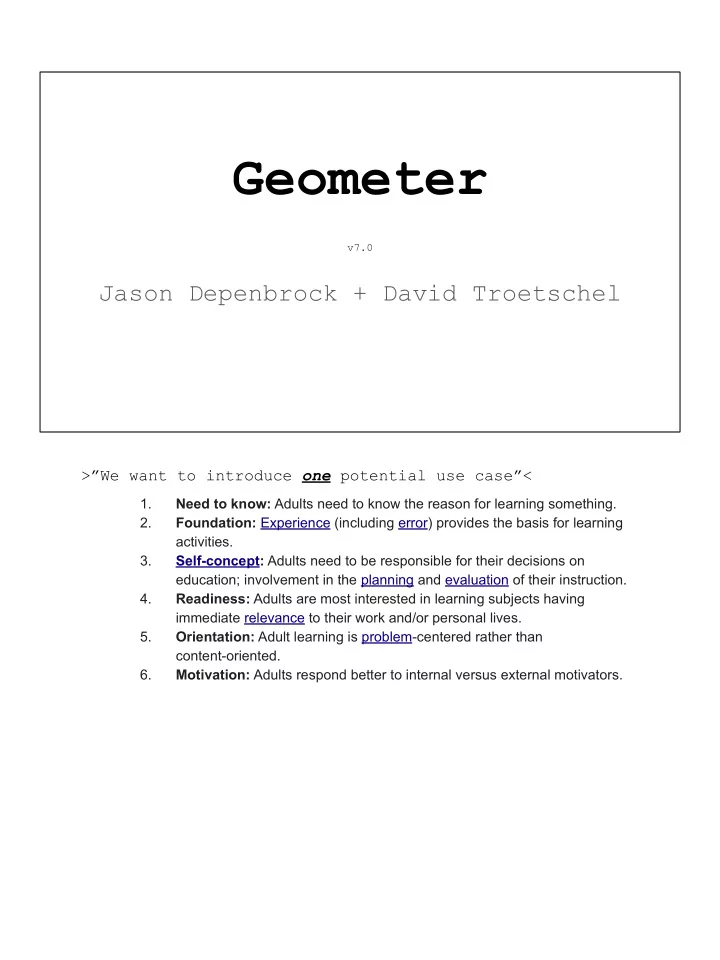
Geometer

v7.0

Jason Depenbrock + David Troetschel

>”We want to introduce one potential use case”<

1. Need to know: Adults need to know the reason for learning something. 2. Foundation: Experience (including error) provides the basis for learning activities. 3. Self-concept: Adults need to be responsible for their decisions on education; involvement in the planning and evaluation of their instruction. 4. Readiness: Adults are most interested in learning subjects having immediate relevance to their work and/or personal lives. 5. Orientation: Adult learning is problem-centered rather than content-oriented. 6. Motivation: Adults respond better to internal versus external motivators.

slide-2
SLIDE 2

What is Geometer?

A Holistic Design Tool for Creating, Communicating and Manufacturing Advanced Human-Scale Forms.

“We made geometer as a….

  • (1) A kit of robust physical and digital components

with unique names and specific geometry which can be combined in a modular fashion. (2) A system of communicating the interactions of these components. (3) A way to easily physically manufacture complex assemblies made up of modules, in a variety of materials reliably of considerable size.

slide-3
SLIDE 3

Because while we all want things, sometimes it’s easiest to just buy them; but many people find that there is a kind of satisfaction in having conceived of and then built something themselves. With makerspaces, instructional content on the internet in the form of blogs, videos and more, we’re seeing more individuals participating in DIY or Maker culture every day.

slide-4
SLIDE 4

A desire for realistic, meaningful things over gadgets and novelties as the output of this effort drives many makers towards high level craft processes. Most people bite off more than they can chew. (While much can be learned from failure, we think this is

  • ne are Geometer can help)
slide-5
SLIDE 5

Geometer has been optimized to help beginner and expert designers alike to( design and )make human-scale scale structures in a variety of materials using open ended molds and casting. Each module has a corresponding mold which can connect to

  • thers to form assemblies.
slide-6
SLIDE 6

We took care of the math and underlying system so users can easily adopt and adapt geometer into their workflow (while still being in the loop).

slide-7
SLIDE 7

So they can more easily make something like this: (cost compare? We know how much the real deal costs.)

slide-8
SLIDE 8
slide-9
SLIDE 9
slide-10
SLIDE 10

Seth Moczydlowski

Industrial Designer / Mechanical Engineer at Sherpa Design, Inc. “Find a way to simplify. If people get a kit of parts and don’t come up with anything quickly- they are going to get frustrated and put it down.” “If you give them an example to build then they will be able to make more things, if i can build a cube then i can build something else”

Jeff Bare

Product development associate BDI Furniture “I’ve always been impressed With some Designers that employ code and parametric design Ie. Nervous System, But i’ve never had any desire to learn to code and do it myself.”

Key Collaborators:

slide-11
SLIDE 11

So, we want to run through a description of potential user; they are involved in the DIY and maker communities and recently decided that they would like to join a co-working space with access to tools and other like-minded people.

slide-12
SLIDE 12
  • On tour/orientation: While on tour of Nextfabs facilities

they learn about many tools, many of which they have never worked with before. The tour guide shows them plasma cutters, 3D printers and more, Geometer is one of these many tools. The tour guide explains the benefits and drawbacks of each of these tools

slide-13
SLIDE 13
  • On tour: inspecting Geometer box. ____ makes mental notes
  • f which tools they are interested in and daydreams about

what they might make given the time and energy.

slide-14
SLIDE 14
  • Working: ___ enjoys their new work environment, as time

allows they learn to use tools, some of which cost money and others which have little to no operating cost.

slide-15
SLIDE 15

They dabble in making things like cutting boards.

  • Cutting board slide
slide-16
SLIDE 16
  • Working: One of the benefits of nextfab is access to
  • therwise cost prohibitive software; ____ may or may not

have prior cad experience but they notice that on all of the Nextfab desktops there is a folder labeled Geometer.

slide-17
SLIDE 17
  • On lunch break: They notice a small box of toy like

building modules in the break area labeled Geometer and make a small scale model sculpture.

slide-18
SLIDE 18

Others comment that it looks cool and that these toy versions are just half scale and that they could build it easily downstairs.

slide-19
SLIDE 19
  • Evaluating options: Time passes and ____ slowly expands

their knowledge of tools available to them. They want to learn how to use the CNC because the things it makes are really cool but are off-put by the hours involved and

  • complexity. (admiring CNC)
slide-20
SLIDE 20
  • Working, bored: “One day while working on one of the

nextfab computers” they get bored and decide to explore the Geometer folder.

slide-21
SLIDE 21
slide-22
SLIDE 22
  • Finds documentation page: one of the files in the

Geometer folder links to documentation which they also saw in passing during their google searches and starts to see examples of other people's work, they shift from just gestural examples to practical ideas as well.

slide-23
SLIDE 23
  • Complex assembly: On breaks ____ gets progressively

better and others start to notice. (showing others screen)

slide-24
SLIDE 24
  • Another nextfab member introduction: Another member is

making something with Geometer downstairs and after ___ asks about it, gets invited to help. They find it kind of fun, and surprisingly easy!

slide-25
SLIDE 25
  • Finished example: <removing mold casing, exposing the

finished design) The artifact ____ helped build is done and pretty cool, ____ feels a kind of satisfaction for having helped and decides it’s time to make something of their own.

slide-26
SLIDE 26

Mycelium:

slide-27
SLIDE 27

Concrete:

slide-28
SLIDE 28

Hydrocal:

slide-29
SLIDE 29

Making Assemblies

Show how molds connect to reproduce a design assemblies are made using stainless steel clamps to provide stong, adjustable uniform pressure

slide-30
SLIDE 30

Disassembly

Show how molds connect to reproduce a design

  • The reveal: ____ is excited an removes the molds on their lunch break after material

is cured and is satisfied with their results! The rest is history, they start making more and more interesting things and start to learn lots of other skills along the way.

slide-31
SLIDE 31

Skill Translation:

Skills translate easily to other practices and processes ensuring that as a users needs change their experiences retain value. It also makes it very convenient to make documentation open source so that anyone may try out geometer with minimal effort and adapt it as needed. This combination of features puts geometer in a class all its

  • wn; more than the novelty of 3D printing, more accessible than (sending it to the

boys in china.) learning a specialized craft and far cheaper than conventional small scale manufacturing.

slide-32
SLIDE 32

Thank You.