Geochemistry the of the Animas River after the Gold King Mine Spill, - - PowerPoint PPT Presentation

geochemistry the of the animas river after the gold king
SMART_READER_LITE
LIVE PREVIEW

Geochemistry the of the Animas River after the Gold King Mine Spill, - - PowerPoint PPT Presentation

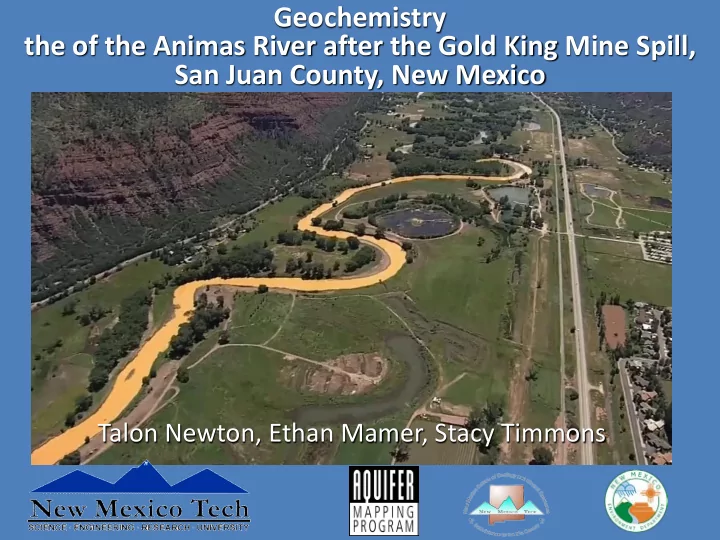
Geochemistry the of the Animas River after the Gold King Mine Spill, San Juan County, New Mexico Talon Newton, Ethan Mamer, Stacy Timmons Gold King Mine Spill August 5, 2015 ~3 million gallons of mine-waste water, and 540 tons of


slide-1
SLIDE 1

Talon Newton, Ethan Mamer, Stacy Timmons

Geochemistry the of the Animas River after the Gold King Mine Spill, San Juan County, New Mexico

slide-2
SLIDE 2

Gold King Mine Spill

  • August 5, 2015
  • ~3 million gallons of mine-waste water, and 540 tons of

mine-waste sediment were released into the Animas near Silverton, CO – Dissolved contaminants flowed past Farmington within a week of the spill – Contaminated sediments were deposited and left behind

  • Immediate Response

– Collaborative data collection (USEPA, USGS, NMED, NMBGMR, NMOSE) – Water levels in over 100 wells – Water samples collected from private domestic wells

slide-3
SLIDE 3

Groundwater study

  • Water levels
  • Manual
  • Continuous
  • Water Chemistry
  • Field

parameters

  • Major ions
  • Trace Metals
  • Environmental

Tracers

slide-4
SLIDE 4

Objectives

  • Characterize

hydrogeologic system

– Recharge components – Flow directions – Important hydrogeologic and geochemical processes

  • Assess impacts of GKM

spill to shallow groundwater

– Potential for impact – Identify evidence of impact

slide-5
SLIDE 5

Potential interactions and processes that affect groundwater quality

slide-6
SLIDE 6

Regional Geology

  • Nacimiento Formation (~60-

65 Ma) – fluvial sandstone and gray shale

  • Kirtland Shale (~75 Ma) –

siltstone, shale, claystone, and sandstone

slide-7
SLIDE 7

Sampling schedule

slide-8
SLIDE 8

Sample locations

slide-9
SLIDE 9

Spatial trends

slide-10
SLIDE 10

Controls on water chemistry

  • Water/mineral

interactions

– Dissolution of limestone and gypsum – Cation exchange

  • Mixing of river

water with regional groundwater

Calcium Bicarbonate Sulfate

slide-11
SLIDE 11

Irrigation recharge

slide-12
SLIDE 12

Regional recharge

slide-13
SLIDE 13

Mixing model

slide-14
SLIDE 14

Water quality

  • Secondary maximum contaminant level

(SMCL) – non-enforceable guideline regarding cosmetic or aesthetic effects

  • High TDS due to high solubility of calcite

and gypsum

  • High sulfate due to mixing of regional

groundwater

**The USEPA water quality standards discussed are provided simply for comparison of privately

  • wned domestic well water samples and are not

enforceable for private wells

slide-15
SLIDE 15

Gold King Mine spill

USEPA SMCL (mg/L) Minimum Median Maximum % non- detects Iron 0.3 0.022 0.274 3.34 50 Manganese 0.05 0.001 0.016 6.48 23 Aluminum 0.05 0.0005 0.0007 0.161 50 Lead 0.015 (AL)

  • 100

Copper 1.0 0.0005 0.0014 0.018 12 Arsenic 0.01 0.0005 0.0031 0.0051 89 Zinc 5 0.0005 0.0076 0.0466 2 Cadmium 0.005 (e)

  • 100

Mercury 0.002 (e)

  • 100
slide-16
SLIDE 16

Geochemical conditions

slide-17
SLIDE 17

Impact of the Gold King Mine spill

  • No evidence of impact to groundwater quality

– Limited “before the spill” chemistry data for comparison – Constant leakage of contaminated water from headwater region – Metals of concern exist naturally in aquifer

  • Due to geochemical conditions (pH, Eh), impacts

to groundwater quality are unlikely

  • Contaminated river sediments in irrigation

ditches may still pose a threat

slide-18
SLIDE 18

Future work

  • Continued monitoring

– Specific areas of concern – Methods of assessing processes of interest

  • More research to better understand controls
  • n redox conditions

– Why do manganese and iron concentrations vary spatially?

  • Differentiate mine water sources from in-place

aquifer sources

slide-19
SLIDE 19

Acknowledgments

  • Very kind landowners
  • NM Environment Department - Dennis

McQuillan, Diane Agnew, Patrick Longmire, Kris Pintado

  • U.S. EPA – Funding to NMED
  • USGS - Jesse Driscoll, Lauren Sherson,

Nicole Thomas, Amy Gallanter

  • NMOSE – Doug Rappuhn, Rob Pine,

Shawn Williams

  • NMBGMR/NMT - Trevor Kludt, Scott

Christenson, Kitty Pokorny, Brigitte Felix, Sara Chudnoff, Bonnie Frey, Dustin Baca, Geoff Rawling, Mark Mansell, Kylian Robinson

NM Bureau of Geology and Mineral Resources NM Bureau of Geology and Mineral Resources