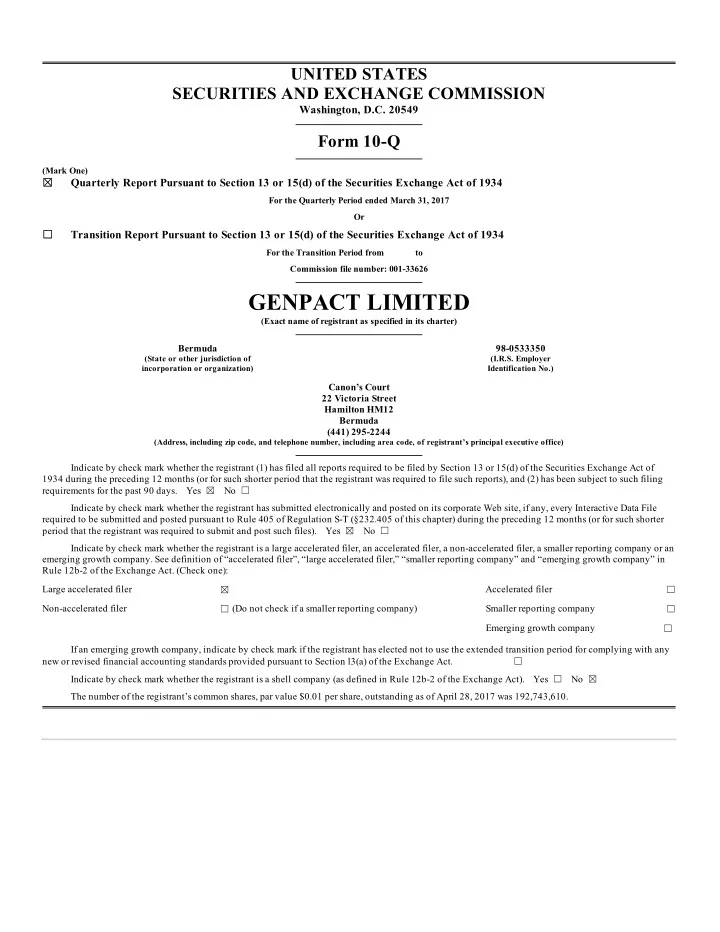
GENPACT LIMITED (Exact name of registrant as specified in its - - PDF document

genpact limited
SMART_READER_LITE
LIVE PREVIEW

GENPACT LIMITED (Exact name of registrant as specified in its - - PDF document

UNITED STATES SECURITIES AND EXCHANGE COMMISSION Washington, D.C. 20549 Form 10-Q (Mark One) Quarterly Report Pursuant to Section 13 or 15(d) of the Securities Exchange Act of 1934 For the Quarterly Period ended March 31, 2017 Or


slide-1
SLIDE 1

UNITED STATES SECURITIES AND EXCHANGE COMMISSION

Washington, D.C. 20549

Form 10-Q

(Mark One)

☒ ☒ Quarterly Report Pursuant to Section 13 or 15(d) of the Securities Exchange Act of 1934

For the Quarterly Period ended March 31, 2017 Or

☐ ☐ Transition Report Pursuant to Section 13 or 15(d) of the Securities Exchange Act of 1934

For the Transition Period from to Commission file number: 001-33626

GENPACT LIMITED

(Exact name of registrant as specified in its charter)

Bermuda 98-0533350

(State or other jurisdiction of incorporation or organization) (I.R.S. Employer Identification No.)

Canon’s Court 22 Victoria Street Hamilton HM12 Bermuda (441) 295-2244

(Address, including zip code, and telephone number, including area code, of registrant’s principal executive office)

Indicate by check mark whether the registrant (1) has filed all reports required to be filed by Section 13 or 15(d) of the Securities Exchange Act of 1934 during the preceding 12 months (or for such shorter period that the registrant was required to file such reports), and (2) has been subject to such filing requirements for the past 90 days. Yes ☒ No ☐ Indicate by check mark whether the registrant has submitted electronically and posted on its corporate Web site, if any, every Interactive Data File required to be submitted and posted pursuant to Rule 405 of Regulation S-T (§232.405 of this chapter) during the preceding 12 months (or for such shorter period that the registrant was required to submit and post such files). Yes ☒ No ☐ Indicate by check mark whether the registrant is a large accelerated filer, an accelerated filer, a non-accelerated filer, a smaller reporting company or an emerging growth company. See definition of “accelerated filer”, “large accelerated filer,” “smaller reporting company” and “emerging growth company” in Rule 12b-2 of the Exchange Act. (Check one): Large accelerated filer ☒ Accelerated filer ☐ Non-accelerated filer ☐ (Do not check if a smaller reporting company) Smaller reporting company ☐ Emerging growth company ☐ If an emerging growth company, indicate by check mark if the registrant has elected not to use the extended transition period for complying with any new or revised financial accounting standards provided pursuant to Section l3(a) of the Exchange Act. ☐ Indicate by check mark whether the registrant is a shell company (as defined in Rule 12b-2 of the Exchange Act). Yes ☐ No ☒ The number of the registrant’s common shares, par value $0.01 per share, outstanding as of April 28, 2017 was 192,743,610.

slide-2
SLIDE 2

TABLE OF CONTENTS

Item No. Page No.

PART I Financial Statements 1. Unaudited Consolidated Financial Statements Consolidated Balance Sheets as of December 31, 2016 and March 31, 2017 1 Consolidated Statements of Income for the three months ended March 31, 2016 and 2017 2 Consolidated Statements of Comprehensive Income (Loss) for the three months ended March 31, 2016 and 2017 3 Consolidated Statements of Equity and Redeemable Non-controlling Interest for the three months ended March 31, 2016 and 2017 5 Consolidated Statements of Cash Flows for the three months ended March 31, 2016 and 2017 6 Notes to the Consolidated Financial Statements 7 2. Management’s Discussion and Analysis of Financial Condition and Results of Operations 30 3. Quantitative and Qualitative Disclosures About Market Risk 42 4. Controls and Procedures 42 PART II Other Information 1. Legal Proceedings 43 1A. Risk Factors 43 2. Unregistered Sales of Equity Securities and Use of Proceeds 44 3. Defaults upon Senior Securities 44 5. Other Information 44 6. Exhibits 45 SIGNATURES 46

slide-3
SLIDE 3

GENPACT LIMITED AND ITS SUBSIDIARIES Consolidated Balance Sheets (Unaudited) (In thousands, except per share data and share count)

Notes As of December 31, 2016 As of March 31, 2017

Assets Current assets Cash and cash equivalents 4 $ 422,623 $ 388,186 Accounts receivable, net 5 615,265 602,871 Prepaid expenses and other current assets 8 189,149 227,635 Total current assets $ 1,227,037 $ 1,218,692 Property, plant and equipment, net 9 200,115 212,562 Deferred tax assets 23 70,143 61,029 Investment in equity affiliates 24 4,800 769 Intangible assets, net 10 72,049 69,070 Goodwill 10 1,069,408 1,097,329 Other assets 242,328 252,279 Total assets $ 2,885,880 $ 2,911,730 Liabilities and equity Current liabilities Short-term borrowings 11 $ 160,000 $ 15,000 Current portion of long-term debt 12 39,181 39,192 Accounts payable 9,768 9,086 Income taxes payable 23 24,159 33,091 Accrued expenses and other current liabilities 13 498,247 426,953 Total current liabilities $ 731,355 $ 523,322 Long-term debt, less current portion 12 698,152 1,035,778 Deferred tax liabilities 23 2,415 1,815 Other liabilities 14 162,790 165,561 Total liabilities $ 1,594,712 $ 1,726,476 Redeemable non-controlling interest 4,520 3,610 Shareholders' equity Preferred shares, $0.01 par value, 250,000,000 authorized, none issued — — Common shares, $0.01 par value, 500,000,000 authorized, 198,794,052 and 192,727,001 issued and outstanding as of December 31, 2016 and March 31, 2017, respectively 1,984 1,924 Additional paid-in capital 1,384,468 1,347,265 Retained earnings 358,121 219,776 Accumulated other comprehensive income (loss) (457,925) (387,321) Total equity $ 1,286,648 $ 1,181,644 Commitments and contingencies 25 Total liabilities, redeemable non-controlling interest and equity $ 2,885,880 $ 2,911,730 See accompanying notes to the Consolidated Financial Statements. 1

slide-4
SLIDE 4

GENPACT LIMITED AND ITS SUBSIDIARIES Consolidated Statements of Income (Unaudited) (In thousands, except per share data and share count)

Three months ended March 31, Notes 2016 (1) 2017

Net revenues $ 609,703 $ 622,995 Cost of revenue 19, 24 372,848 383,337 Gross profit $ 236,855 $ 239,658 Operating expenses: Selling, general and administrative expenses 20, 24 160,149 160,858 Amortization of acquired intangible assets 10 6,145 7,242 Other operating (income) expense, net 21 (5,061) (7,538) Income from operations $ 75,622 $ 79,096 Foreign exchange gains (losses), net (998) (4,913) Interest income (expense), net 22 (2,838) (5,493) Other income (expense), net 878 553 Income before equity-method investment activity, net and income tax expense $ 72,664 $ 69,243 Equity-method investment activity, net (2,145) (4,558) Income before income tax expense $ 70,519 $ 64,685 Income tax expense 23 12,014 12,245 Net income $ 58,505 $ 52,440 Net loss (income) attributable to redeemable non-controlling interest 289 898 Net income attributable to Genpact Limited shareholders $ 58,794 $ 53,338 Net income available to Genpact Limited common shareholders 18 $ 58,794 $ 53,338 Earnings per common share attributable to Genpact Limited common shareholders 18 Basic $ 0.28 $ 0.27 Diluted $ 0.27 $ 0.26 Weighted average number of common shares used in computing earnings per common share attributable to Genpact Limited common shareholders Basic 210,780,165 199,069,528 Diluted 213,892,964 202,655,937

(1) Income taxes, net income, and basic and diluted net income per common share for the three months ended March 31, 2016 have been restated due to the adoption of ASU No. 2016-09 in 2016 with effect from January 1, 2016.

See accompanying notes to the Consolidated Financial Statements. 2

slide-5
SLIDE 5

GENPACT LIMITED AND ITS SUBSIDIARIES Consolidated Statements of Comprehensive Income (Loss) (Unaudited) (In thousands, except per share data and share count)

Three months ended March 31, 2016 (1) 2017 Genpact Limited Shareholders Redeemable Non- controlling interest Genpact Limited Shareholders Redeemable Non- controlling interest

Net Income (loss) $ 58,794 $ (289) $ 53,338 $ (898) Other comprehensive income: Currency translation adjustments 5,217 — 51,627 (12) Net income (loss) on cash flow hedging derivatives, net of taxes (Note 7) 1,970 — 18,858 — Retirement benefits, net of taxes 153 — 119 — Other comprehensive income (loss) $ 7,340 $ — $ 70,604 $ (12) Comprehensive income (loss) $ 66,134 $ (289) $ 123,942 $ (910)

(1) Net income for the three months ended March 31, 2016 has been restated due to the adoption of ASU No. 2016-09 in 2016 with effect from January 1, 2016.

See accompanying notes to the Consolidated Financial Statements. 3

slide-6
SLIDE 6

GENPACT LIMITED AND ITS SUBSIDIARIES Consolidated Statements of Equity and Redeemable Non-controlling Interest (Unaudited) (In thousands, except share count)

Accumulated Common shares Other Redeemable

  • No. of Shares

Amount Additional Paid- in Capital (1) Retained Earnings (1) Comprehensive Income (Loss) Total Equity non-controlling interest

Balance as of January 1, 2016 211,472,312 $ 2,111 $ 1,342,022 $ 411,508 $ (451,285) $1,304,356 $

  • Issuance of common shares on

exercise of options (Note 16) 248,316 2 4,210

  • 4,212
  • Issuance of common shares under the

employee stock purchase plan (Note 16) 30,487

  • 725
  • 725
  • Net settlement on vesting of

restricted share units (Note 16) 95,191 1 (50)

  • (49)
  • Stock repurchased and retired

(Note 17) (1,356,199) (14)

  • (33,003)
  • (33,017)
  • Deferred tax assets recognized on early

adoption of ASU 2016-09

  • 24,912
  • 24,912
  • Expenses related to stock purchase

(Note 17)

  • (27)
  • (27)
  • Stock-based compensation expense

(Note 16)

  • 5,336
  • 5,336
  • Acquisition of redeemable non-

controlling interest

  • 3,910

Comprehensive income: Net income

  • 58,794
  • 58,794

(289) Other comprehensive income

  • Balance as of March 31, 2016

210,490,107 $ 2,100 $ 1,352,243 $ 462,185 $ (451,285) $1,365,243 $ 3,621

(1) Net income, additional paid-in capital and retained earnings for the three months ended March 31, 2016 have been restated due to the adoption of ASU No. 2016-09 in 2016 with effect from January 1, 2016.

See accompanying notes to the Consolidated Financial Statements. 4

slide-7
SLIDE 7

GENPACT LIMITED AND ITS SUBSIDIARIES Consolidated Statements of Equity and Redeemable Non-controlling Interest (Unaudited) (In thousands, except share count)

Accumulated Common shares Other Redeemable

  • No. of

Shares Amount Additional Paid- in Capital Retained Earnings Comprehensive Income (Loss) Total Equity non-controlling interest

Balance as of January 1, 2017 198,794,052 $ 1,984 $ 1,384,468 $ 358,121 $ (457,925) $1,286,648 $ 4,520 Issuance of common shares on exercise of options (Note 16) 455,835 5 6,540 —

  • 6,545
  • Issuance of common shares under the

employee stock purchase plan (Note 16) 55,788 1 1,217 — — 1,218 — Net settlement on vesting of restricted share units (Note 16) 76,865 1 (1) — —

Net settlement on vesting of performance units (Note 16) 731,701 7 (9,946) — — (9,939) — Stock repurchased and retired (Note 17) (7,387,240) (74) (40,000) (179,710) — (219,784) — Expenses related to stock purchase (Note 17) — — — (16) — (16) — Stock-based compensation expense (Note 16)

  • 4,986

4,986

  • Comprehensive income:

Net income

53,338 — 53,338 (898) Other comprehensive income — $ — — — 70,604 70,604 (12) Dividend (Note 17)

(11,957) — (11,957) — Balance as of March 31, 2017 192,727,001 $ 1,924 $ 1,347,265 $ 219,776 $ (387,321) $1,181,644 $ 3,610 See accompanying notes to the Consolidated Financial Statements. 5

slide-8
SLIDE 8

GENPACT LIMITED AND ITS SUBSIDIARIES Consolidated Statements of Cash Flows (Unaudited) (In thousands)

Three months ended March 31, 2016 (1) 2017

Operating activities Net income attributable to Genpact Limited shareholders $ 58,794 $ 53,338 Net income (loss) attributable to redeemable non-controlling interest (289) (898) Net income $ 58,505 $ 52,440 Adjustments to reconcile net income to net cash provided by (used for) operating activities: Depreciation and amortization 13,155 14,139 Amortization of debt issuance costs 385 375 Amortization of acquired intangible assets 6,145 7,242 Intangible assets write-down 4,943

  • Reserve for doubtful receivables

3,120

  • Unrealized loss on revaluation of foreign currency asset/liability

354 8,757 Equity-method investment activity, net 2,145 4,558 Stock-based compensation expense 5,336 4,986 Deferred income taxes (3,184) (2,890) Others, net 63 (4,301) Change in operating assets and liabilities: Decrease (increase) in accounts receivable (17,697) 19,649 Increase in prepaid expenses, other current assets and other assets (27,123) (12,025) Decrease in accounts payable (70) (928) Decrease in accrued expenses, other current liabilities and other liabilities (64,360) (69,131) Increase in income taxes payable 8,660 8,157 Net cash provided by (used for) operating activities $ (9,623) $ 31,028 Investing activities Purchase of property, plant and equipment (25,495) (19,698) Proceeds from sale of property, plant and equipment 132 389 Investment in equity affiliates (3,783) (467) Payment for business acquisitions, net of cash acquired (2,339) (9,237) Net cash used for investing activities $ (31,485) $ (29,013) Financing activities Repayment of capital lease obligations (454) (494) Payment of debt issuance costs

  • (1,481)

Proceeds from long-term debt

  • 350,000

Repayment of long-term debt (10,000) (10,000) Proceeds from short-term borrowings 60,000 40,000 Repayment of short-term borrowings

  • (185,000)

Proceeds from issuance of common shares under stock-based compensation plans 4,937 7,761 Payment for net settlement of stock-based awards (49) (9,939) Payment of earn-out/deferred consideration (965) (1,097) Dividend paid

  • (11,957)

Payment for stock purchased and retired (33,017) (219,784) Payment for expenses related to stock purchase (27) (16) Net cash provided by (used for) financing activities $ 20,425 $ (42,007) Effect of exchange rate changes (429) 5,555 Net increase (decrease) in cash and cash equivalents (20,683) (39,992) Cash and cash equivalents at the beginning of the period 450,907 422,623 Cash and cash equivalents at the end of the period $ 429,795 $ 388,186 Supplementary information Cash paid during the period for interest $ 3,968 $ 5,324 Cash paid during the period for income taxes $ 23,229 $ 16,426 Property, plant and equipment acquired under capital lease obligations $ 283 $ 576

(1) Income taxes, net income and cash flows for the three months ended March 31, 2016 have been restated due to the adoption of ASU No. 2016-09 in 2016 with effect from. January 1, 2016.

See accompanying notes to the Consolidated Financial Statements. 6

slide-9
SLIDE 9

GENPACT LIMITED AND ITS SUBSIDIARIES Notes to the Consolidated Financial Statements (Unaudited) (In thousands, except per share data and share count)

  • 1. Organization

The Company is a global professional services firm focused on delivering digital transformation for its clients. The Company’s Lean DigitalSM approach integrates lean principles, design thinking, analytics and digital technologies with its domain and industry expertise. The Company delivers value to its clients in two ways – through digital-led, domain-enabled solutions that drive innovation, and through digitally-enabled intelligent operations that design, transform and run clients’ operations. The Company employs over 77,000 people in more than 20 countries. Prior to December 30, 2004, the business of the Company was conducted through various entities and divisions of GE. On December 30, 2004, in a series of transactions referred to as the “2004 Reorganization,” GE transferred such operations to the Company. In August 2007, the Company completed an initial public offering of its common shares. On October 25, 2012, Glory Investments A Limited, formerly known as South Asia Private Investments, an affiliate of Bain Capital Investors, LLC (“Bain Capital”), became the Company’s largest shareholder when, together with its affiliated assignees and two additional co-investors, it purchased 67,750,678 common shares of the Company from the Company’s initial investors.

  • 2. Summary of significant accounting policies

(a) Basis of preparation and principles of consolidation The unaudited interim consolidated financial statements have been prepared in accordance with U.S. generally accepted accounting principles (U.S. GAAP) for interim financial information and the rules and regulations of the Securities and Exchange Commission for reporting on Form 10-Q. Accordingly, they do not include certain information and note disclosures required by generally accepted accounting principles for annual financial reporting and should be read in conjunction with the consolidated financial statements included in the Company’s Annual Report on Form 10-K for the year ended December 31, 2016. The unaudited interim consolidated financial statements reflect all adjustments that management considers necessary for a fair presentation of the results of operations for these periods. The results of operations for interim periods are not necessarily indicative of results for the full year. The accompanying unaudited interim consolidated financial statements have been prepared on a consolidated basis and reflect the financial statements of Genpact Limited, a Bermuda company, and all of its subsidiaries that are more than 50% owned and controlled. When the Company does not have a controlling interest in an entity but exerts significant influence on the entity, the Company applies the equity method of accounting. All intercompany transactions and balances are eliminated in consolidation. Non-controlling interest in subsidiaries that is redeemable outside of the Company’s control for cash or other assets is reflected in the mezzanine section between liabilities and equity in the consolidated balance sheets at the redeemable value, which approximates fair value. Redeemable non- controlling interest is adjusted to its fair value at each balance sheet date. Any resulting increases or decreases in the estimated redemption amount are affected by corresponding changes to additional paid-in capital. The share of non-controlling interest in subsidiary earnings is reflected in net loss (income) attributable to redeemable non-controlling interest in the consolidated statements of income. (b) Use of estimates The preparation of consolidated financial statements in accordance with U.S. GAAP requires management to make estimates and assumptions that affect the amounts reported in the consolidated financial statements. Significant items subject to such estimates and assumptions include the useful lives of property, plant and equipment, intangibles and goodwill, revenue recognition, reserves for doubtful receivables, valuation allowances for deferred tax assets, the valuation of derivative financial instruments, measurements of stock-based compensation, assets and obligations related to employee benefits, and income tax uncertainties and other contingencies. Management believes that the estimates used in the preparation of the consolidated financial statements are reasonable. Although these estimates are based upon management’s best knowledge of current events and actions, actual results could differ from these

  • estimates. Any changes in estimates are adjusted prospectively in the Company’s consolidated financial statements.

7

slide-10
SLIDE 10

GENPACT LIMITED AND ITS SUBSIDIARIES Notes to the Consolidated Financial Statements (Unaudited) (In thousands, except per share data and share count)

  • 2. Summary of significant accounting policies (Continued)

(c) Business combinations, goodwill and other intangible assets The Company accounts for its business combinations using the acquisition method of accounting in accordance with ASC 805, Business Combinations, by recognizing the identifiable tangible and intangible assets acquired and liabilities assumed, and any non-controlling interest in the acquired business, measured at their acquisition date fair values. Contingent consideration is included within the acquisition cost and is recognized at its fair value on the acquisition date. A liability resulting from contingent consideration is remeasured to fair value as of each reporting date until the contingency is

  • resolved. Changes in fair value are recognized in earnings. All assets and liabilities of the acquired businesses, including goodwill, are assigned to reporting
  • units. Acquisition-related costs are expensed as incurred under Selling, General and Administrative Expenses.

Goodwill represents the cost of acquired businesses in excess of the fair value of identifiable tangible and intangible net assets purchased. Goodwill is not amortized but is tested for impairment at least on an annual basis on December 31, based on a number of factors, including operating results, business plans and future cash flows. The Company performs an assessment of qualitative factors to determine whether the existence of events or circumstances leads to a determination that it is more likely than not that the fair value of a reporting unit is less than its carrying amount. Based on the assessment of events or circumstances, the Company performs a quantitative assessment of goodwill impairment if it determines that it is more likely than not that the fair value of a reporting unit is less than its carrying amount. If, based on the quantitative impairment analysis, the carrying value of the goodwill of a reporting unit exceeds the fair value of such goodwill, an impairment loss is recognized in an amount equal to the excess. In addition, the Company performs a qualitative assessment of goodwill impairment between annual tests if an event occurs or circumstances change that would more likely than not reduce the fair value of a reporting unit below its carrying amount. See Note 10 for information and related disclosures. Intangible assets acquired individually or with a group of other assets or in a business combination are carried at cost less accumulated amortization based on their estimated useful lives as follows: Customer-related intangible assets 1-14 years Marketing-related intangible assets 1-10 years Other intangible assets 2-9 years Intangible assets are amortized over their estimated useful lives using a method of amortization that reflects the pattern in which the economic benefits

  • f the intangible assets are consumed or otherwise realized.

In business combinations where the fair value of identifiable tangible and intangible net assets purchased exceeds the cost of the acquired business, the Company recognizes the resulting gain under “Other operating (income) expense, net” in the Consolidated Statements of Income. (d) Financial instruments and concentration of credit risk Financial instruments that potentially subject the Company to concentration of credit risk are reflected principally in cash and cash equivalents, derivative financial instruments and accounts receivable. The Company places its cash and cash equivalents and derivative financial instruments with corporations and banks with high investment grade ratings, limits the amount of credit exposure with any one corporation or bank and conducts ongoing evaluations of the creditworthiness of the corporations and banks with which it does business. To reduce its credit risk on accounts receivable, the Company conducts ongoing credit evaluations of its clients. GE accounted for 15% and 12% of receivables as of December 31, 2016 and March 31, 2017, respectively. GE accounted for 16% and 11% of revenues for the three months ended March 31, 2016 and 2017, respectively. (e) Recently adopted accounting pronouncements The authoritative bodies release standards and guidance which are assessed by management for impact on the Company’s consolidated financial statements. 8

slide-11
SLIDE 11

GENPACT LIMITED AND ITS SUBSIDIARIES Notes to the Consolidated Financial Statements (Unaudited) (In thousands, except per share data and share count)

  • 2. Summary of significant accounting policies (Continued)

The following recently released accounting standard has been adopted by the Company: In March 2016, the FASB issued ASU 2016-09, Compensation - Stock Compensation (Topic 718): Improvement to Employee Share-Based Payment

  • Accounting. The new standard contains several amendments that will simplify the accounting for employee share-based payment transactions, including the

accounting for income taxes, forfeitures, statutory tax withholding requirements, classification of awards as either equity or liabilities, and classification on the statement of cash flows. The changes in the new standard eliminate the requirement for excess tax benefits to be recognized in additional paid-in capital and tax deficiencies recognized either in income tax expense or in additional paid-in capital. In the quarter ended December 31, 2016, the Company elected to early adopt ASU 2016-09 effective January 1, 2016 and will apply ASU 2016-09 using a modified retrospective approach. The treatment of forfeitures has not changed as the Company is electing to continue its current process of estimating the number of forfeitures. With the early adoption of ASU 2016-09, the Company has elected to present the cash flow statement on a prospective transition method and no prior periods have been adjusted. As a result, the Company’s, income taxes, net income, cash flows, retained earnings, additional paid-in capital, and basic and diluted net income per common share for the first quarter of 2016 have been restated due to the adoption of ASU No. 2016-09. In addition, the following recently released accounting standards have been adopted by the Company. Adoption of these standards did not have a material impact on the Company’s consolidated results of operations, cash flows, financial position or disclosures: Effective January 1, 2016, the Company adopted FASB ASU 2015-01 (Topic 225), Simplifying Income Statement Presentation by Eliminating the Concept of Extraordinary Items (“ASU 2015-01”). Such items are defined as transactions or events that are both unusual in nature and infrequent in

  • ccurrence, and, currently, are required to be presented separately in the income statement, net of income tax, after income from continuing operations. The

changes eliminate the concept of an extraordinary item and, therefore, the presentation of such items will no longer be required. Notwithstanding this change, the Company will still be required to present and disclose a transaction or event that is both unusual in nature and infrequent in occurrence in the notes to the financial statements. Effective January 1, 2016, the Company adopted FASB ASU 2015-05 (Topic 350), Customer’s Accounting for Fees Paid in a Cloud Computing Arrangement (“ASU 2015-05”), which provides explicit guidance to evaluate the accounting for fees paid by a customer in a cloud computing arrangement. The new guidance clarifies that if a cloud computing arrangement includes a software license, the customer should account for the license consistent with its accounting for other software licenses. If the arrangement does not include a software license, the customer should account for the arrangement as a service contract. Effective January 1, 2016, the Company adopted FASB ASU 2015-16 (Topic 805), Business Combinations (“ASU 2015-16”), which eliminates the requirement for an acquirer in a business combination to account for measurement-period adjustments retrospectively. The guidance requires that the acquirer shall recognize adjustments to provisional amounts that are identified during the measurement period in the reporting period in which the adjustment amounts are determined. Effective January 1, 2016, the Company adopted FASB ASU 2015-02. In February 2015, the FASB issued ASU No. 2015-02, Amendment to the Consolidation Analysis, which specifies changes to the analysis that an entity must perform to determine whether it should consolidate certain types of legal

  • entities. These changes (i) modify the evaluation of whether limited partnerships and similar legal entities are variable interest entities or voting interest

entities, (ii) eliminate the presumption that a general partner should consolidate a limited partnership, (iii) affect the consolidation analysis of reporting entities that are involved with variable interest entities, particularly those that have fee arrangements and related party relationships, and (iv) provide a scope exception from consolidation guidance for reporting entities with interests in legal entities that are required to comply with or operate in accordance with requirements that are similar to those in Rule 2a-7 of the Investment Company Act of 1940 for registered money market funds. Effective January 1, 2017, the Company adopted FASB ASU 2016-06, Derivatives and Hedging (Topic 815). The amendments in this update clarify the requirements for assessing whether contingent call (put) options that can accelerate the payment of principal on debt instruments are clearly and closely related to their debt hosts. An entity performing the assessment under the amendments in this update is required to assess the embedded call (put) options solely in accordance with a four-step decision sequence. 9

slide-12
SLIDE 12

GENPACT LIMITED AND ITS SUBSIDIARIES Notes to the Consolidated Financial Statements (Unaudited) (In thousands, except per share data and share count)

  • 3. Business acquisitions

Certain acquisitions (a) LeaseDimensions, Inc. On February 15, 2017, the Company acquired 100% of the outstanding equity interest in LeaseDimensions, Inc. (“LeaseDimensions”), an Oregon

  • corporation. The preliminary estimated total purchase consideration for LeaseDimensions is $11,626, subject to adjustment for closing date working capital

and net debt. This amount includes the estimated fair value of contingent earn-out consideration, cash consideration of $9,089, net of cash acquired of $217, and a preliminary adjustment for working capital and net debt. As of March 31, 2017, the total consideration paid by the Company to the sellers is $9,454, resulting in a receivable of $148. The purchase agreement also provides for contingent earn-out consideration ranging from $0 to $3,000, payable by the Company to the sellers based on the future performance of the business relative to the thresholds specified in the earn-out calculation. This acquisition enhances the Company’s capabilities in commercial lending and leasing. In connection with the transaction, the Company recorded $2,400 in customer-related intangibles and $1,000 in marketing-related intangibles, which have a weighted average amortization period of three years. Goodwill arising from the acquisition amounted to $8,307, which has been allocated to the Company’s Americas reporting unit and is not deductible for tax purposes. The goodwill represents primarily the capabilities, operating synergies and other benefits expected to result from combining the acquired operations with those of the Company. Acquisition-related costs of $422 have been included in selling, general and administrative expenses as incurred. Through the transaction the Company acquired assets with a value of $2,277, assumed liabilities amounting to $1,038, and recognized a net deferred tax liability of $1,320. The results

  • f operations of the acquired business and the fair value of the acquired assets and assumed liabilities are included in the Company’s consolidated financial

statements with effect from the date of the acquisition. (b) Endeavour Software Technologies Private Limited On April 13, 2016, the Company acquired 100% of the outstanding equity interest in Endeavour Software Technologies Private Limited (“Endeavour”), an Indian private limited company. The total purchase consideration paid by the Company to acquire Endeavour is $14,788. This amount includes the estimated fair value of the contingent earn-out consideration, cash consideration of $10,345, net of cash acquired of $2,373, and an adjustment for working capital and net debt. Of this amount, $95 is payable by the Company to one of the sellers. During the quarter ended March 31, 2017, the Company recorded a measurement period adjustment that resulted in a $346 increase in the purchase consideration as a result of an adjustment to closing date working capital and net debt. The adjustments included an increase of $161 in assets acquired, a decrease of $118 in liabilities assumed and a corresponding impact on goodwill of $67. These measurement period adjustments did not have a significant impact on the Company’s consolidated statements of income, balance sheets or cash flows. In connection with the transaction, the Company recorded $800 in customer-related intangibles, $900 in marketing-related intangibles and $950 in

  • ther intangible assets, which have a weighted average amortization period of three years. Goodwill arising from the acquisition amounted to $8,936, which

has been allocated to the Company’s India reporting unit and is not deductible for tax purposes. The goodwill represents primarily the capabilities in end-to- end mobility services, operating synergies and other benefits expected to result from combining the acquired operations with those of the Company. In connection with the transaction, the Company also acquired certain assets with a value of $5,854 and assumed certain liabilities amounting to $1,735. (c) Strategic Sourcing Excellence Limited On January 8, 2016, the Company acquired 51% of the outstanding equity interest in Strategic Sourcing Excellence LLC (“SSE”), a Delaware limited liability company. The total consideration paid by the Company to the selling equityholders for the acquired interest in SSE was $14,541. This amount includes the fair value of earn-out consideration, cash consideration of $2,550, and an adjustment for working capital, transaction expenses and

  • indebtedness. During the quarter ended December 31, 2016, the Company recorded a measurement period adjustment that resulted in a $51 increase in the

purchase consideration through the recognition of $69 in current assets and $16 in non-current assets, with a corresponding impact on goodwill of $34. These measurement period adjustments did not have a significant impact on the Company’s consolidated statements of income, balance sheets or cash flows in any

  • period. The equity purchase agreement between the Company and the selling equityholders of SSE also provides for contingent earn-out consideration of up

to $20,000, payable by the Company to the selling equityholders based on future performance of the acquired business relative to the thresholds specified in the earn-out calculation. Up to $9,800 of the total potential earn-out consideration, representing the selling equityholders’ 49% interest in SSE, is payable

  • nly if either the put or call option, each as described below, is exercised.

10

slide-13
SLIDE 13

GENPACT LIMITED AND ITS SUBSIDIARIES Notes to the Consolidated Financial Statements (Unaudited) (In thousands, except per share data and share count)

  • 3. Business acquisitions (Continued)

The equity purchase agreement grants the Company a call option to purchase the remaining 49% equity interest in SSE, which option the Company has the right to exercise between January 1, 2018 and January 31, 2018. If the Company does not exercise its call option during such period, the selling equityholders have the right to exercise a put option between March 1, 2018 and April 30, 2018 to require the Company to purchase their 49% interest in SSE at a price ranging from $2,450 to $2,950. This acquisition enhances the Company’s sourcing and procurement consulting domain expertise. Acquisition-related costs of $164 have been included in selling, general and administrative expenses as incurred. Through this transaction, the Company acquired assets with a value of $412 and assumed liabilities amounting to $617. The results of operations of the acquired business, the fair value of the acquired assets and assumed liabilities, and redeemable non-controlling interest are included in the Company’s Consolidated Financial Statements with effect from the date of the acquisition. In connection with the transaction, the Company recorded $300 in customer-related intangible assets with an amortization period of five years. Goodwill arising from the acquisition amounted to $14,445, which has been allocated to the Company’s India reporting unit and is deductible for tax

  • purposes. The goodwill represents future economic benefits the Company expects to derive from its expanded presence in the sourcing and procurement

consulting domains, operating synergies and other anticipated benefits of combining the acquired operations with those of the Company.

  • 4. Cash and cash equivalents

Cash and cash equivalents as of December 31, 2016 and March 31, 2017 are set out in the table below:

As of December 31, As of March 31, 2016 2017

Cash and other bank balances 422,623 388,186 Total $ 422,623 $ 388,186

  • 5. Accounts receivable, net of reserve for doubtful receivables

The following table provides details of the Company’s reserve for doubtful receivables:

Year ended December 31, Three months ended 2016 March 31, 2017

Opening balance as of January 1 $ 11,530 $ 15,519 Additions charged to cost and expense 7,282

  • Deductions/Effect of exchange rate fluctuations

(3,293) 121 Closing balance $ 15,519 $ 15,640 Accounts receivable were $630,784 and $618,511, and the reserves for doubtful receivables were $15,519 and $15,640, resulting in net accounts receivable balances of $615,265 and $602,871 as of December 31, 2016 and March 31, 2017, respectively. In addition, accounts receivable due after one year of $3,272 and $1,182 as of December 31, 2016 and March 31, 2017, respectively, are included under other assets in the Consolidated Balance Sheets. Accounts receivable from related parties were $2,490 and $2,130 as of December 31, 2016 and March 31, 2017, respectively. There are no reserves for doubtful receivables in respect of amounts due from related parties. 11

slide-14
SLIDE 14

GENPACT LIMITED AND ITS SUBSIDIARIES Notes to the Consolidated Financial Statements (Unaudited) (In thousands, except per share data and share count)

  • 6. Fair value measurements

The Company measures certain financial assets and liabilities, including derivative instruments, at fair value on a recurring basis. The fair value measurements of these derivative instruments were determined using the following inputs as of December 31, 2016 and March 31, 2017:

As of December 31, 2016 Fair Value Measurements at Reporting Date Using Quoted Prices in Active Markets for Identical Assets Significant Other Observable Inputs Significant Other Unobservable Inputs Total (Level 1) (Level 2) (Level 3)

Assets Derivative instruments (Notes a, c) $ 55,386 $ — $ 55,386 $ — Total $ 55,386 $ — $ 55,386 $ — Liabilities Earn-out consideration (Notes b, d) $ 22,435 $ — $ — $ 22,435 Derivative instruments (Notes b, c) $ 17,353 $ — $ 17,353 $ — Total $ 39,788 $ — $ 17,353 $ 22,435 Redeemable non-controlling interest (Note e) $ 4,520 $ — $ — $ 4,520

As of March 31, 2017 Fair Value Measurements at Reporting Date Using Quoted Prices in Active Markets for Identical Assets Significant Other Observable Inputs Significant Other Unobservable Inputs Total (Level 1) (Level 2) (Level 3)

Assets Derivative instruments (Notes a, c) $ 87,395 $ — $ 87,395 $ — Total $ 87,395 $ — $ 87,395 $ — Liabilities Earn-out consideration (Notes b, d) $ 21,262 — — $ 21,262 Derivative instruments (Notes b, c) $ 12,762 $ — $ 12,762 $ — Total $ 34,024 $ — $ 12,762 $ 21,262 Redeemable non-controlling interest (Note e) $ 3,610 $ — $ — $ 3,610 (a) Included in prepaid expenses and other current assets and other assets in the consolidated balance sheets. (b) Included in accrued expenses and other current liabilities and other liabilities in the consolidated balance sheets. (c) The Company values its derivative instruments based on market observable inputs, including both forward and spot prices for the relevant currencies and interest rate indices for relevant interest rates. The quotes are taken from an independent market database. (d) The fair value of earn-out consideration, calculated as the present value of expected future payments to be made to the sellers of acquired businesses, was derived by estimating the future financial performance of the acquired businesses using the earn-out formula and performance targets specified in each purchase agreement and adjusting the result to reflect the Company’s estimate of the likelihood of achievement of such targets. Given the significance of the unobservable inputs, the valuations are classified in level 3 of the fair value hierarchy. (e) The Company’s estimate of the fair value of redeemable non-controlling interest is based on unobservable inputs considering the assumptions that market participants would make in pricing the obligation. Given the significance of the unobservable inputs, the valuation was classified in level 3 of the fair value hierarchy. See Note 3—Business Acquisitions. 12

slide-15
SLIDE 15

GENPACT LIMITED AND ITS SUBSIDIARIES Notes to the Consolidated Financial Statements (Unaudited) (In thousands, except per share data and share count)

  • 6. Fair value measurements (Continued)

The following table provides a roll-forward of the fair value of earn-out consideration categorized as level 3 in the fair value hierarchy for the three months ended March 31, 2016 and 2017:

As of March

31, As of March 31,

2016 2017

Opening balance $ 22,820 $ 22,435 Earn-out consideration payable in connection with acquisitions 8,120 2,320 Payments made on earn-out consideration (1,557) (1,206) Changes in fair value of earn-out consideration (note a) (9,507) (3,138) Others (note b) 978 852 Ending balance $ 20,853 $ 21,262 a) Changes in the fair value of earn-out consideration are reported in other operating (income) expense, net in the consolidated statements of income b) Interest expense is included in interest income (expense), net and the impact of changes in foreign exchange is reported in foreign exchange gains (losses), net in the consolidated statements of income. The cumulative translation adjustment is reported as a component of other comprehensive income (loss).

  • 7. Derivative financial instruments

The Company is exposed to the risk of rate fluctuations on its foreign currency assets and liabilities and on foreign currency denominated forecasted cash flows. The Company has established risk management policies, including the use of derivative financial instruments to hedge foreign currency assets and liabilities, foreign currency denominated forecasted cash flows and interest rate risk. These derivative financial instruments are largely deliverable and non-deliverable forward foreign exchange contracts and interest rate swaps. The Company enters into these contracts with counterparties that are banks or

  • ther financial institutions, and the Company considers the risk of non-performance by such counterparties not to be material. The forward foreign exchange

contracts and interest rate swaps mature during a period of up to 57 months and the forecasted transactions are expected to occur during the same period. 13

slide-16
SLIDE 16

GENPACT LIMITED AND ITS SUBSIDIARIES Notes to the Consolidated Financial Statements (Unaudited) (In thousands, except per share data and share count)

  • 7. Derivative financial instruments (Continued)

The following table presents the aggregate notional principal amounts of outstanding derivative financial instruments together with the related balance sheet exposure:

Notional principal amounts (note a) Balance sheet exposure asset (liability) (note b) As of December 31, 2016 As of March 31, 2017 As of December 31, 2016 As of March 31, 2017

Foreign exchange forward contracts denominated in: United States Dollars (sell) Indian Rupees (buy) $ 1,108,400 $ 1,080,900 $ 6,669 $ 56,945 United States Dollars (sell) Mexican Peso (buy) 9,120 6,840 (187) 663 United States Dollars (sell) Philippines Peso (buy) 70,050 57,600 (1,036) (1,492) Euro (sell) United States Dollars (buy) 138,613 118,018 9,180 7,201 Pound Sterling (buy) United States Dollars (sell)

  • 22,333
  • 151

Euro (sell) Romanian Leu (buy) 29,805 22,354 (152) (66) Japanese Yen (sell) Chinese Renminbi (buy) 77,267 10,373 (742) (2,873) Pound Sterling (sell) United States Dollars (buy) 104,142 106,246 14,228 9,838 Australian Dollars (sell) United States Dollars (buy) 114,412 108,097 2,328 (3,974) Interest rate swaps (floating to fixed) 456,810 456,810 7,746 8,240 38,034 74,633 (a) Notional amounts are key elements of derivative financial instrument agreements but do not represent the amount exchanged by counterparties and do not measure the Company’s exposure to credit or market risks. However, the amounts exchanged are based on the notional amounts and other provisions of the underlying derivative financial instrument agreements. (b) Balance sheet exposure is denominated in U.S. dollars and denotes the mark-to-market impact of the derivative financial instruments on the reporting date. FASB guidance on derivatives and hedging requires companies to recognize all derivative instruments as either assets or liabilities at fair value in the balance sheet. In accordance with the FASB guidance on derivatives and hedging, the Company designates foreign exchange forward contracts and interest rate swaps as cash flow hedges. Foreign exchange forward contracts are entered into to cover the effects of future exchange rate variability on forecasted revenues and purchases of services, and interest rate swaps are entered into to cover interest rate fluctuation risk. In addition to this program, the Company uses derivative instruments that are not accounted for as hedges under the FASB guidance in order to hedge foreign exchange risks related to balance sheet items, such as receivables and intercompany borrowings, that are denominated in currencies other than the Company’s underlying functional currency. The fair value of the Company’s derivative instruments and their location in the Company’s financial statements are summarized in the table below:

Cash flow hedges Non-designated As of December 31, 2016 As of March 31, 2017 As of December 31, 2016 As of March 31, 2017

Assets Prepaid expenses and other current assets $ 33,921 $ 51,638 $ 809 $ 7,034 Other assets $ 20,657 $ 28,723 $ — $ — Liabilities Accrued expenses and other current liabilities $ 4,540 $ 4,673 $ 237 $ 74 Other liabilities $ 12,576 $ 8,015 $ — $ — 14

slide-17
SLIDE 17

GENPACT LIMITED AND ITS SUBSIDIARIES Notes to the Consolidated Financial Statements (Unaudited) (In thousands, except per share data and share count)

  • 7. Derivative financial instruments (Continued)

Cash flow hedges For derivative instruments that are designated and qualify as cash flow hedges, the effective portion of the gain (loss) on the derivative instrument is reported as a component of other comprehensive income (loss) and reclassified into earnings in the same period or periods during which the hedged transaction is recognized in the consolidated statements of income. Gains (losses) on the derivatives, representing either hedge ineffectiveness or hedge components excluded from the assessment of effectiveness, are recognized in earnings as incurred. In connection with cash flow hedges, the gains (losses) recorded as a component of other comprehensive income (loss), or OCI, and the related tax effects are summarized below:

Three months ended March 31, 2016 2017 Before-Tax amount Tax (Expense) or Benefit Net of tax Amount Before-Tax amount Tax (Expense) or Benefit Net of tax Amount

Opening balance $ (30,090) $ 9,830 $ (20,260) $ 37,461 $ (13,979) $ 23,482 Net gains (losses) reclassified into statement of income on completion of hedged transactions (2,902) 702 (2,200) 9,295 (3,432) 5,863 Changes in fair value of effective portion of

  • utstanding derivatives, net

(79) (151) (230) 39,508 (14,787) 24,721 Gain (loss) on cash flow hedging derivatives, net 2,823 (853) 1,970 30,213 (11,355) 18,858 Closing balance $ (27,267) $ 8,977 $ (18,290) $ 67,674 $ (25,334) $ 42,340 The gains or losses recognized in other comprehensive income (loss) and their effects on financial performance are summarized below:

Amount of Gain (Loss) Amount of Gain (Loss) reclassified from OCI into recognized in OCI on Location of Gain (Loss) Statement of Income Derivatives in Derivatives (Effective Portion) reclassified (Effective Portion) Cash Flow Three months ended from OCI into Three months ended Hedging March 31, Statement of Income March 31, Relationships 2016 2017 (Effective Portion) 2016 2017

Forward foreign exchange contracts $ 1,847 $ 39,296 Revenue $ 3,871 $ 3,760 Interest rate swaps (1,926) 212 Cost of revenue (5,312) 4,570 Selling, general and administrative expenses (1,461) 1,248 Interest expense — (283) $ (79) $ 39,508 $ (2,902) $ 9,295 Gain (loss) recognized in income on the ineffective portion of derivatives and the amount excluded from effectiveness testing is $0 for the three months ended March 31, 2016 and 2017, respectively. 15

slide-18
SLIDE 18

GENPACT LIMITED AND ITS SUBSIDIARIES Notes to the Consolidated Financial Statements (Unaudited) (In thousands, except per share data and share count)

  • 7. Derivative financial instruments (Continued)

Non-designated Hedges

Amount of Gain (Loss) recognized in Statement of Derivatives not Location of Gain (Loss) Income on Derivatives designated as hedging recognized in Statement of Three months ended March 31, instruments Income on Derivatives 2016 2017

Forward foreign exchange contracts (Note a) Foreign exchange gains (losses), net $ 1,134 $ 8,910 $ 1,134 $ 8,910 (a) These forward foreign exchange contracts were entered into to hedge fluctuations in foreign exchange rates for recognized balance sheet items such as receivables and intercompany borrowings, and were not originally designated as hedges under FASB guidance on derivatives and hedging. Realized gains (losses) and changes in the fair value of these derivatives are recorded in foreign exchange gains (losses), net in the consolidated statements of income.

  • 8. Prepaid expenses and other current assets

Prepaid expenses and other current assets consist of the following:

As of December 31, As of March 31, 2016 2017

Advance income and non-income taxes $ 50,676 $ 62,792 Deferred transition costs 45,252 47,659 Derivative instruments 34,730 58,672 Prepaid expenses 22,222 21,816 Customer acquisition cost 11,126 11,733 Employee advances 6,880 6,526 Deposits 2,688 4,427 Advances to suppliers 10,059 7,142 Others 5,516 6,868 $ 189,149 $ 227,635

  • 9. Property, plant and equipment, net

Property, plant and equipment, net consist of the following:

As of December 31, As of March 31, 2016 2017

Property, plant and equipment, gross $ 607,451 $ 634,577 Less: Accumulated depreciation and amortization (407,336) (422,015) Property, plant and equipment, net $ 200,115 $ 212,562 Depreciation expense on property, plant and equipment for the three months ended March 31, 2016 and 2017 was $11,104 and $11,230, respectively. Computer software amortization for the three months ended March 31, 2016 and 2017 amounted to $2,345 and $2,679, respectively. The depreciation and amortization expenses set forth above include the effect of the reclassification of foreign exchange (gains) losses related to the effective portion of foreign currency derivative contracts, amounting to $294 and $(228) for the three months ended March 31, 2016 and 2017, respectively. 16

slide-19
SLIDE 19

GENPACT LIMITED AND ITS SUBSIDIARIES Notes to the Consolidated Financial Statements (Unaudited) (In thousands, except per share data and share count)

  • 10. Goodwill and intangible assets

The following table presents the changes in goodwill for the year ended December 31, 2016 and three months ended March 31, 2017:

As of December 31, As of March 31, 2016 2017

Opening balance $ 1,038,346 $ 1,069,408 Goodwill relating to acquisitions consummated during the period 51,535 8,307 Goodwill relating to divestitures consummated during the period (2,226)

  • Impact of measurement period adjustments

(59) 67 Effect of exchange rate fluctuations (18,188) 19,547 Closing balance $ 1,069,408 $ 1,097,329 The total amount of goodwill deductible for tax purposes was $39,032 and $38,027 as of December 31, 2016 and March 31, 2017, respectively. The Company’s intangible assets acquired either individually or with a group of other assets or in a business combination are as follows:

As of December 31, 2016 As of March 31, 2017 Gross carrying amount Accumulated amortization & Impairment Net Gross carrying amount Accumulated amortization & Impairment Net

Customer-related intangible assets $ 310,277 $ 259,460 $ 50,817 $ 317,225 $ 269,000 $ 48,225 Marketing-related intangible assets 42,587 29,277 13,310 42,856 30,527 12,329 Other intangible assets 33,266 25,344 $ 7,922 35,896 27,380 8,516 $ 386,130 $ 314,081 $ 72,049 $ 395,977 $ 326,907 $ 69,070 Amortization expenses for intangible assets disclosed in the consolidated statements of income under amortization of acquired intangible assets for the three months ended March 31, 2016 and 2017 were $6,145 and $7,242, respectively. During the three months ended March 31, 2016, the Company tested an intangible software asset for recoverability as a result of a downward revision to the forecasted cash flows to be generated by the intangible asset. The Company previously recorded a charge to this asset in the third quarter of 2015. Based on the results of its testing, the Company determined that the carrying value of the intangible asset exceeded the estimated undiscounted cash flows by $4,943 and recorded an additional charge to further reduce the carrying value by this amount. The Company used a combination of the income and cost approaches to determine the fair value of the intangible asset for the purpose of calculating the charge. This charge has been recorded in other operating (income) expenses, net in the consolidated statement of income. 17

slide-20
SLIDE 20

GENPACT LIMITED AND ITS SUBSIDIARIES Notes to the Consolidated Financial Statements (Unaudited) (In thousands, except per share data and share count)

  • 11. Short-term borrowings

The Company has the following borrowing facilities: (a) Fund-based and non-fund-based credit facilities with banks, which are available for operational requirements in the form of overdrafts, letters of credit, guarantees and short-term loans. As of December 31, 2016 and March 31, 2017, the limits available were $15,382 and $15,827, respectively, of which $10,980 and $11,037 was utilized, constituting non-funded drawdown. (b) A fund-based and non-fund based revolving credit facility of $350,000, which the company obtained in June 2015 as described in note 12. This facility replaced the Company’s $250,000 facility initially entered into in August 2012 and subsequently amended in June 2013. As of December 31, 2016 and March 31, 2017, a total of $160,978 and $15,978, respectively, was utilized, of which $160,000 and $15,000, respectively, constituted funded drawdown and $978 and $978, respectively, constituted non-funded drawdown. The revolving facility expires in June 2020. The funded drawdown amount bore interest at a rate equal to LIBOR plus a margin of 1.50% per annum as of December 31, 2016. As of March 31, 2017, the revolving facility bore interest at a rate equal to LIBOR plus a margin of 1.50% per annum. The unutilized amount

  • n the revolving facility bore a commitment fee of 0.25% and 0.25% as of December 31, 2016 and March 31, 2017, respectively. The credit

agreement contains certain customary covenants, including a maximum leverage covenant and a minimum interest coverage ratio. For the three months ended March 31, 2017, the Company was in compliance with the financial covenants.

  • 12. Long-term debt

In June 2015, the Company refinanced its 2012 credit facility through a new credit facility comprised of an $800,000 term loan and a $350,000 revolving credit facility. Borrowings under the new facility bear interest at a rate equal to, at the election of the Company, either LIBOR plus an applicable margin equal to 1.50% per annum or a base rate plus an applicable margin equal to 0.50% per annum, in each case subject to adjustment based on the Company’s debt ratings provided by Standard & Poor’s Rating Services and Moody’s Investors Service, Inc. Based on the Company’s election and current credit rating, the applicable interest rate is equal to LIBOR plus 1.50% per annum. As a result of the June 2015 refinancing, the gross outstanding term loan under the previous facility, which amounted to $663,188 as of June 30, 2015, was extinguished, and the Company expensed $10,050, representing accelerated amortization of the existing unamortized debt issuance costs related to the prior facility. Additionally, the refinancing of the revolving facility resulted in the accelerated amortization of $65 relating to the existing unamortized debt issuance cost. The remaining unamortized costs for the revolving facility, together with the fees paid to the Company’s lenders and third parties in connection with the new term loan and revolving facility, will be amortized

  • ver the term of the refinanced facility, which ends on June 30, 2020. For the three months ended March 31, 2017, the Company was in compliance with the

financial covenants of the credit agreement. As of December 31, 2016 and March 31, 2017, the amount outstanding under the term loan, net of debt amortization expense of $2,667 and $2,461, was $737,333 and $727,539, respectively. As of December 31, 2016 and March 31, 2017, the term loan bore interest at a rate equal to LIBOR plus a margin of 1.50% per annum based on the Company’s election and current credit rating. Indebtedness under the refinanced facility is unsecured. The amount

  • utstanding on the term loan as of March 31, 2017 will be repaid through quarterly payments of $10,000, and the balance will be repaid upon the maturity of

the term loan on June 30, 2020. The maturity profile of the term loan, net of debt amortization expense, is as follows:

Year ended Amount

2017 $ 29,387 2018 39,226 2019 39,272 2020 619,654 Total $ 727,539 18

slide-21
SLIDE 21

GENPACT LIMITED AND ITS SUBSIDIARIES Notes to the Consolidated Financial Statements (Unaudited) (In thousands, except per share data and share count)

  • 12. Long-term debt (Continued)

In March 2017, the Company issued $350,000 aggregate principal amount of 3.70% senior notes in a private offering, resulting in cash proceeds of approximately $348,519 and an underwriting fee of $1,481. In connection with the offering, the Company incurred other debt issuance costs of $1,093. The total debt issuance cost of $2,574 is being amortized over the life of the notes as an additional interest expense. As of March 31, 2017, the amount

  • utstanding under the notes, net of debt amortization expense of $2,569, was $347,431, which is payable on April 1, 2022. The Company will pay interest on

the notes semi-annually in arrears on April 1 and October 1 of each year, ending on the maturity date of April 1, 2022. The Company, at its option, may redeem the notes at any time in whole or in part, at a redemption price equal to (i) 100% of the principal amount of the notes redeemed, together with accrued and unpaid interest on the redeemed amount, and (ii) if the notes are redeemed prior to March 1, 2022, a specified “make-whole” premium. The notes are subject to certain customary covenants, including limitations on the ability of the Company and certain of its subsidiaries to incur debt secured by liens, engage in certain sale and leaseback transactions and consolidate, merge, convey or transfer their assets. Upon certain change of control transactions, the Company will be required to make an offer to repurchase the notes at a price equal to 101% of the aggregate principal amount of such notes, plus accrued and unpaid interest. The interest rate payable on the notes is subject to adjustment if the credit rating of the notes is downgraded up to a maximum increase of 2.0%. The Company is required to offer to exchange the notes for registered notes or have one or more shelf registration statements declared effective within 455 days after the issue date of the notes and, if such exchange offer fails to be consummated or such registration statement fails to be effective by June 25, 2018, then the interest payable on the notes will increase by 0.25% per annum during the 90-day period immediately following such date and will further increase by 0.25% per annum at the end of each subsequent 90-day period up to a maximum increase of 0.50%. The notes are senior unsecured obligations of the Company and will rank equally with all other senior unsecured indebtedness of the Company outstanding from time to time.

  • 13. Accrued expenses and other current liabilities

Accrued expenses and other current liabilities consist of the following:

As of December 31, As of March 31, 2016 2017

Accrued expenses $ 163,400 $ 155,889 Accrued employee cost 179,360 109,006 Deferred transition revenue 50,552 48,301 Statutory liabilities 36,878 46,670 Retirement benefits 17,616 18,347 Derivative instruments 4,777 4,747 Advance from customers 21,969 26,270 Earn-out consideration 6,885 6,502 Other liabilities 15,461 9,697 Capital lease obligations 1,349 1,524 $ 498,247 $ 426,953 19

slide-22
SLIDE 22

GENPACT LIMITED AND ITS SUBSIDIARIES Notes to the Consolidated Financial Statements (Unaudited) (In thousands, except per share data and share count)

  • 14. Other liabilities

Other liabilities consist of the following:

As of December 31, As of March 31, 2016 2017

Accrued employee cost $ 3,976 $ 12,934 Deferred transition revenue 72,560 69,414 Retirement benefits 39,020 42,159 Derivative instruments 12,576 8,015 Amount received from GE under indemnification arrangement, pending adjustment 3,159 3,318 Advance from customers 2,371 325 Earn-out consideration 15,550 14,760 Others 11,078 11,872 Capital lease obligations 2,500 2,764 $ 162,790 $ 165,561

  • 15. Employee benefit plans

The Company has employee benefit plans in the form of certain statutory and other schemes covering its employees. Defined benefit plans In accordance with Indian law, the Company maintains a defined benefit retirement plan covering substantially all of its Indian employees. In accordance with Mexican law, the Company provides termination benefits to all of its Mexican employees. In addition, certain of the Company’s subsidiaries in the Philippines and Japan sponsor defined benefit retirement programs. Net defined benefit plan costs for the three months ended March 31, 2016 and 2017 include the following components:

Three months ended March 31, 2016 2017

Service costs $ 1,403 $ 1,720 Interest costs 698 734 Amortization of actuarial loss 56 205 Expected return on plan assets (486) (492) Net defined benefit plan costs $ 1,671 $ 2,167 Defined contribution plans During the three months ended March 31, 2016 and 2017, the Company contributed the following amounts to defined contribution plans in various jurisdictions:

Three months ended March 31, 2016 2017

India $ 4,303 $ 5,217 U.S. 3,532 4,280 U.K. 1,652 1,720 China 3,753 3,828 Other regions 1,265 1,130 Total $ 14,505 $ 16,175 20

slide-23
SLIDE 23

GENPACT LIMITED AND ITS SUBSIDIARIES Notes to the Consolidated Financial Statements (Unaudited) (In thousands, except per share data and share count)

  • 16. Stock-based compensation

The Company has issued options under the Genpact Global Holdings 2005 Plan (the “2005 Plan”), the Genpact Global Holdings 2006 Plan (the “2006 Plan”), the Genpact Global Holdings 2007 Plan (the “2007 Plan”) and the Genpact Limited 2007 Omnibus Incentive Compensation Plan (the “2007 Omnibus Plan”) to eligible persons, who are employees, directors and certain other persons associated with the Company. With respect to options granted under the 2005, 2006 and 2007 Plans before the date of adoption of the 2007 Omnibus Plan, if an award granted under any such plan is forfeited or otherwise expires, terminates, or is cancelled without the delivery of shares, then the shares covered by the forfeited, expired, terminated, or cancelled award will be added to the number of shares otherwise available for grant under the respective plans. Beginning on July 13, 2007, the date of adoption of the 2007 Omnibus Plan, share-based awards forfeited, expired, terminated, or cancelled under any

  • f the plans are added to the number of shares otherwise available for grant under the 2007 Omnibus Plan. The 2007 Omnibus Plan was amended and restated
  • n April 11, 2012 to increase the number of common shares authorized for issuance by 5,593,200 shares to 15,000,000 shares.

During the year ended December 31, 2012, the number of common shares authorized for issuance under the 2007 Omnibus Plan and the 2005 Plan was increased by 8,858,823 and 495,915 shares, respectively, as the result of an adjustment to outstanding unvested share awards. Stock-based compensation costs relating to the foregoing plans during the three months ended March 31, 2016 and 2017 were $5,250 and $4,845,

  • respectively. These costs have been allocated to cost of revenue and selling, general, and administrative expenses.

Stock options Options granted are subject to a vesting requirement. Options granted under the plans are exercisable into common shares of the Company, have a contractual period of ten years and vest over four to five years unless specified otherwise in the applicable award agreement. The Company recognizes the compensation cost over the vesting period of the option. Compensation cost is determined as of the date of grant by estimating the fair value of an option using the Black-Scholes option-pricing model. The following table shows the significant assumptions used in connection with the determination of the fair value of options granted in the three months ended March 31, 2017. No options were granted in the three months ended March 31, 2016.

Three months ended March 31, 2017

Dividend yield 0.97% Expected life (in months) 84 Risk-free rate of interest 2.25% Volatility 24.28% 21

slide-24
SLIDE 24

GENPACT LIMITED AND ITS SUBSIDIARIES Notes to the Consolidated Financial Statements (Unaudited) (In thousands, except per share data and share count)

  • 16. Stock-based compensation (Continued)

A summary of stock option activity during the three months ended March 31, 2017 is set out below:

Three months ended March 31, 2017 Shares arising

  • ut of options

Weighted average exercise price Weighted average remaining contractual life (years) Aggregate intrinsic value

Outstanding as of January 1, 2017 5,707,690 $ 18.65 5.8 $ — Granted 250,000 24.74 — — Forfeited (55,000) 21.22 — — Expired — — — — Exercised (455,835) 14.36 — 4,742 Outstanding as of March 31, 2017 5,446,855 $ 19.27 6.2 $ 31,829 Vested as of March 31, 2017 and expected to vest thereafter (Note a) 5,183,854 $ 19.01 6.2 $ 31,395 Vested and exercisable as of March 31, 2017 2,365,356 $ 15.89 4.5 $ 20,970 Weighted average grant date fair value of grants during the period $ 6.62 (a) Options expected to vest reflect an estimated forfeiture rate. As of March 31, 2017, the total remaining unrecognized stock-based compensation cost for options expected to vest amounted to $12,130, which will be recognized over the weighted average remaining requisite vesting period of 2.7 years. Restricted share units The Company has granted restricted share units, or RSUs, under the 2007 Omnibus Plan. Each RSU represents the right to receive one Company common share at a future date. The fair value of each RSU is the market price of a Company common share on the date of the grant. RSUs granted to date have graded vesting schedules of three months to four years. The compensation expense is recognized on a straight-line basis over the vesting term. A summary of RSUs granted during the three months ended March 31, 2017 is set out below:

Three months ended March 31, 2017 Number of Restricted Share Units Weighted Average Grant Date Fair Value

Outstanding as of January 1, 2017 117,905 $ 20.65 Granted 24,000 24.74 Vested (Note a) (6,464) 16.68 Forfeited — — Outstanding as of March 31, 2017 135,441 $ 21.56 Expected to vest (Note b) 123,798 (a) RSUs that vested during the period were net settled upon vesting by issuing 6,040 shares (net of minimum statutory tax withholding). (b) The number of RSUs expected to vest reflects an estimated forfeiture rate. 53,546 RSUs vested in the year ended December 31, 2015, in respect of which 53,023 shares were issued during three months ended March 31, 2017 after withholding shares to the extent of minimum statutory withholding taxes. 34,035 RSUs vested in the year ended December 31, 2016, in respect of which 17,802 shares were issued during three months ended March 31, 2017 after withholding shares to the extent of minimum statutory withholding taxes. 22

slide-25
SLIDE 25

GENPACT LIMITED AND ITS SUBSIDIARIES Notes to the Consolidated Financial Statements (Unaudited) (In thousands, except per share data and share count)

  • 16. Stock-based compensation (Continued)

As of March 31, 2017, the total remaining unrecognized stock-based compensation cost related to RSUs amounted to $1,801, which will be recognized over the weighted average remaining requisite vesting period of 2.9 years. Performance units The Company also grants stock awards in the form of performance units, or PUs, under the 2007 Omnibus Plan. Each PU represents the right to receive one Company common share at a future date based on the Company’s performance against specified targets. PUs granted to date have vesting schedules of six months to three years. The fair value of each PU is the market price of one common share of the Company

  • n the date of grant and assumes that performance targets will be achieved. PUs granted under the plan are subject to cliff vesting. The compensation expense

for such awards is recognized on a straight-line basis over the vesting terms. Over the performance period, the number of shares to be issued is adjusted upward or downward depending on the probability of achievement of the performance targets. The ultimate number of shares issued and the related compensation cost recognized is based on a comparison of the final performance metrics to the specified targets. A summary of PU activity during the three months ended March 31, 2017 is set out below:

Three months ended March 31, 2017 Number of Performance Units Weighted Average Grant Date Fair Value Maximum Shares Eligible to Receive

Outstanding as of January 1, 2017 3,772,128 $ 23.04 5,524,114 Granted 707,092 24.74 1,414,184 Vested (Note a) (1,136,047) 16.78 (1,136,047) Forfeited (Note b) (1,485,337) 27.82 (1,489,737) Adjustment upon final determination of level of performance goal achievement (Note c) (1,747,586) Outstanding as of March 31, 2017 1,857,836 $ 23.69 2,564,928 Expected to vest (Note d) 1,624,573 (a) PUs that vested during the period were net settled upon vesting by issuing 731,701 shares (net of minimum statutory tax withholding). (b) Includes 1,443,624 target shares underlying PUs granted in 2016 which were forfeited for failure to achieve all of the threshold performance targets under such awards as certified by the compensation committee based on the Company’s audited financial statements for the year ended December 31, 2016. (c) Represents the difference between the maximum number of shares achievable under the PUs granted in 2016 and the number of target shares underlying the PUs granted in 2016, which were forfeited for failure to achieve all of the threshold performance targets under such awards as certified by the compensation committee based on the Company’s audited financial statements for the year ended December 31, 2016. (d) The number of PUs expected to vest is based on the probable achievement of the performance targets after considering an estimated forfeiture rate. As of March 31, 2017, the total remaining unrecognized stock-based compensation costs related to PUs amounted to $20,044, which will be recognized over the weighted average remaining requisite vesting period of 2.1 years. 23

slide-26
SLIDE 26

GENPACT LIMITED AND ITS SUBSIDIARIES Notes to the Consolidated Financial Statements (Unaudited) (In thousands, except per share data and share count)

  • 16. Stock-based compensation (Continued)

Employee Stock Purchase Plan (ESPP) On May 1, 2008, the Company adopted the Genpact Limited U.S. Employee Stock Purchase Plan and the Genpact Limited International Employee Stock Purchase Plan (together, the “ESPP”). The ESPP allows eligible employees to purchase the Company’s common shares through payroll deductions at 90% of the closing price of the Company’s common shares on the last business day of each purchase interval. The dollar amount of common shares purchased under the ESPP must not exceed 15% of the participating employee’s base salary, subject to a cap of $25 per employee per calendar year. With effect from September 1, 2009, the

  • ffering periods commence on the first business day in March, June, September and December of each year and end on the last business day of the subsequent

May, August, November and February. 4,200,000 common shares have been reserved for issuance in the aggregate over the term of the ESPP. During the three months ended March 31, 2016 and 2017, 30,487 and 55,788 common shares, respectively, were issued under the ESPP. The ESPP is considered compensatory under the FASB guidance on Compensation-Stock Compensation. The compensation expense for the ESPP is recognized in accordance with the FASB guidance on Compensation-Stock Compensation. The compensation expense for the ESPP during three months ended March 31, 2016 and 2017 was $86 and $141, respectively, and has been allocated to cost of revenue and selling, general, and administrative expenses. 24

slide-27
SLIDE 27

GENPACT LIMITED AND ITS SUBSIDIARIES Notes to the Consolidated Financial Statements (Unaudited) (In thousands, except per share data and share count)

  • 17. Capital stock

Share repurchases As of December 31, 2016, the Company’s board of directors (the “Board”) had authorized the Company to repurchase up to $750,000 in value of the Company’s common shares under its share repurchase program first announced in February 2015. On February 10, 2017 the Board approved up to an additional $500,000 in share repurchases, bringing the total authorization under the Company’s existing program to $1,250,000. The Company’s share repurchase program does not obligate it to acquire any specific number of shares. Under the program, shares may be purchased in privately negotiated and/or

  • pen market transactions, including under plans complying with Rule 10b5-1 under the Securities Exchange Act of 1934, as amended.

On March 29, 2017, the Company entered into an accelerated share repurchase (“ASR”) agreement with Morgan Stanley & Co. LLC (the “Dealer”) to repurchase Company common shares for an aggregate purchase price of $200,000. The Company paid the aggregate purchase price to the Dealer and received an initial delivery of 6,578,947 common shares at a price of $24.32 per share. The purchase price was recorded as a reduction in shareholders’ equity through a $160,000 decrease in retained earnings and a $40,000 decrease in additional paid-in capital. The final settlement of the transaction under the ASR agreement is expected to be completed by the end of the fourth quarter of 2017. The final number of common shares to be repurchased by the Company under the ASR agreement will be based on the volume-weighted average share price of the Company’s common shares during the term of the applicable transaction, less a discount and subject to adjustments pursuant to the terms of the ASR

  • agreement. At settlement, under certain circumstances, the Company may be entitled to receive additional common shares from the Dealer or may be required

either to deliver its common shares or to make a cash payment to the Dealer. The ASR agreement contains customary provisions, including, among other things, with respect to mechanisms to determine the number of shares or the amount of cash that will be delivered at settlement, the required timing of delivery upon settlement, specific circumstances under which adjustments may be made to the repurchase transaction, and specific circumstances under which the repurchase transaction may be canceled prior to the scheduled maturity. During the three months ended March 31, 2016, the Company purchased 1,356,199 of its common shares on the open market at a weighted average price of $24.35 per share for an aggregate cash amount of $33,017. During the three months ended March 31, 2017, the Company made payments in an aggregate cash amount of $219,784 toward share repurchases. Of this amount, the Company paid (i) $19,784 to repurchase 808,293 of its common shares on the open market at a weighted average price of $24.48 per share, (ii) $160,000 to the Dealer for the initial delivery of 6,578,947 of its common shares under the ASR agreement at a weighted average price of $24.32 per share, and (iii) $40,000 to the Dealer for shares to be delivered at the final settlement of the transaction under the ASR agreement as described above. All repurchased shares have been retired. The Company records repurchases of its common shares on the settlement date of each transaction. Shares purchased and retired are deducted to the extent of their par value from common stock and from retained earnings for the excess over par value. Direct costs incurred to acquire the shares are included in the total cost of the shares purchased. For the three months ended March 31, 2016 and March 31, 2017, $27 and $16, respectively, was deducted from retained earnings in direct costs related to share repurchases. Dividend In February 2017, the Company’s board of directors approved a dividend program under which the Company intends to pay a regular quarterly cash dividend of $0.06 per share to holders of its common shares, representing a planned annual dividend of $0.24 per share. On March 28, 2017, the Company paid a dividend of $0.06 per share, amounting to $11,957 in the aggregate, to shareholders of record as of March 10, 2017. 25

slide-28
SLIDE 28

GENPACT LIMITED AND ITS SUBSIDIARIES Notes to the Consolidated Financial Statements (Unaudited) (In thousands, except per share data and share count)

  • 18. Earnings per share

The Company calculates earnings per share in accordance with FASB guidance on earnings per share. Basic and diluted earnings per common share give effect to the change in the number of Company common shares outstanding. The calculation of basic earnings per common share is determined by dividing net income available to common shareholders by the weighted average number of common shares outstanding during the respective periods. Potentially dilutive shares, consisting of outstanding options on common shares, restricted share units, performance units and common shares to be issued under the employee stock purchase plan, have been included in the computation of diluted net earnings per share and the weighted average shares

  • utstanding, except where the result would be anti-dilutive.

The number of stock awards outstanding but not included in the computation of diluted earnings per common share because their effect was anti- dilutive is 317,081 and 1,003,048 for the three months ended March 31, 2016 and 2017, respectively.

Three months ended March 31, 2016 2017

Net income available to Genpact Limited common shareholders $ 58,794 $ 53,338 Weighted average number of common shares used in computing basic earnings per common share 210,780,165 199,069,528 Dilutive effect of stock-based awards 3,112,799 3,586,409 Weighted average number of common shares used in computing dilutive earnings per common share 213,892,964 202,655,937 Earnings per common share attributable to Genpact Limited common shareholders Basic $ 0.28 $ 0.27 Diluted $ 0.27 $ 0.26

  • 19. Cost of revenue

Cost of revenue consists of the following:

Three months ended March 31, 2016 2017

Personnel expenses $ 254,028 $ 269,189 Operational expenses 107,542 102,716 Depreciation and amortization 11,278 11,432 $ 372,848 $ 383,337

  • 20. Selling, general and administrative expenses

Selling, general and administrative expenses consist of the following:

Three months ended March 31, 2016 2017

Personnel expenses $ 108,400 $ 122,569 Operational expenses 49,578 35,813 Depreciation and amortization 2,171 2,476 $ 160,149 $ 160,858 26

slide-29
SLIDE 29

GENPACT LIMITED AND ITS SUBSIDIARIES Notes to the Consolidated Financial Statements (Unaudited) (In thousands, except per share data and share count)

  • 21. Other operating (income) expense, net

Three months ended March 31, 2016 2017

Other operating (income) expense $ (498) $ (4,400) Provision for Impairment of intangible assets 4,943

  • Change in fair value of earn out consideration and deferred

consideration (relating to business acquisitions) $ (9,506) $ (3,138) Other operating (income) expense, net $ (5,061) $ (7,538)

  • 22. Interest income (expense), net

Three months ended March 31, 2016 2017

Interest income $ 2,364 $ 1,131 Interest expense (5,202) (6,624) Interest income (expense), net $ (2,838) $ (5,493)

  • 23. Income taxes

The Company determines its tax provision for interim periods using an estimate of its annual effective tax rate adjusted for discrete items, if any, that are taken into account in the relevant period. Each quarter, the Company updates its estimate of the annual effective tax rate, and if its estimated tax rate changes, the Company makes a cumulative adjustment. As of December 31, 2016, the Company had unrecognized tax benefits amounting to $23,467, including an amount of $22,469, which, if recognized, would impact the effective tax rate. The following table summarizes activities related to the Company’s unrecognized tax benefits for uncertain tax positions from January 1, 2017 to March 31, 2017:

2017

Opening balance at January 1 $ 23,467 Increase related to prior year tax positions, including recorded in acquisition accounting 515 Decrease related to prior year tax positions (309) Decrease related to prior year tax position due to lapse of applicable statute

  • f limitation

(132) Effect of exchange rate changes 942 Closing balance at March 31 $ 24,483 The Company’s unrecognized tax benefits as of March 31, 2017 include an amount of $23,484, which, if recognized, would impact the effective tax

  • rate. As of December 31, 2016 and March 31, 2017, the Company had accrued approximately $3,856 and $4,068, respectively, for interest relating to

unrecognized tax benefits. During the year ended December 31, 2016 and the three months ended March 31, 2017, the company recognized approximately $(206) and $34, respectively, excluding the impact of exchange rate differences, in interest on unrecognized tax benefits. As of December 31, 2016 and March 31, 2017, the Company had accrued approximately $977 and $1,000, respectively, for penalties. 27

slide-30
SLIDE 30

GENPACT LIMITED AND ITS SUBSIDIARIES Notes to the Consolidated Financial Statements (Unaudited) (In thousands, except per share data and share count)

  • 24. Related party transactions

The Company has entered into related party transactions with its non-consolidating affiliates. The Company has also entered into related party transactions with a significant shareholder and its affiliates. The Company’s related party transactions can be categorized as follows: Revenue from services For the three months ended March 31, 2016 and 2017, the Company recognized net revenues of $79 and $83, respectively, from a client that is a significant shareholder of the Company. For the three months ended March 31, 2016 and 2017, the Company recognized net revenues of $1,652 and $3,211 from a client that is a non- consolidating affiliate of the Company. $2,102 of this amount is receivable as of March 31, 2017. Cost of revenue from services The Company purchases certain services from its non-consolidating affiliates, mainly relating to training and recruitment, which are included in cost

  • f revenue. For the three months ended March 31, 2016 and 2017, cost of revenue includes an amount of $498 and $575, respectively, attributable to the cost
  • f services provided by the Company’s non-consolidating affiliates.

Selling, general and administrative expenses The Company purchases certain services from its non-consolidating affiliates, mainly relating to training and recruitment, the costs of which are included in selling, general and administrative expenses. For the three months ended March 31, 2016 and 2017, selling, general and administrative expenses includes an amount of $67 and $94, respectively, attributable to the cost of services provided by the Company’s non-consolidating affiliates. During the three months ended March 31, 2016, the Company engaged a significant shareholder to provide a service to the Company at a cost of $15. Investment in equity affiliates During the three months ended March 31, 2017, the Company invested $467 in its non-consolidating affiliates. During the three months ended March 31, 2017, the Company recorded a $2,821 charge related to an investment in one of its non-consolidating affiliates, which has been included in equity-method investment activity, net in the Company’s consolidated statement of income. As of December 31, 2016 and March 31, 2017, the Company’s investments in its non-consolidating affiliates amounted to $4,800 and $769 respectively. Others During the three months ended March 31, 2016 and 2017, the Company also entered into transactions with one of its non-consolidating affiliates for certain cost reimbursements amounting to $329 and $238, respectively, of which $238 is receivable and has been included in prepaid expenses and other current assets in the Company’s consolidated balance sheet as of March 31, 2017. During the three months ended March 31, 2017, the Company made a payment of $1,307 to one of its non-consolidating affiliates under a tax-sharing arrangement in the U.K. As of March 31, 2017, $2,000 is payable under the tax-sharing arrangement and has been included in accrued expenses and other current liabilities in the Company’s consolidated balance sheet. The amount represents a portion of the non-consolidated affiliate’s net operating losses surrendered to the Company under the tax sharing arrangement for the years 2015 and 2016. 28

slide-31
SLIDE 31

GENPACT LIMITED AND ITS SUBSIDIARIES Notes to the Consolidated Financial Statements (Unaudited) (In thousands, except per share data and share count)

  • 25. Commitments and contingencies

Capital commitments As of December 31, 2016 and March 31, 2017, the Company has committed to spend $5,185 and $6,843, respectively, under agreements to purchase property, plant and equipment. This amount is net of capital advances paid in respect of these purchases. Bank guarantees The Company has outstanding bank guarantees amounting to $11,958 and $12,015 as of December 31, 2016 and March 31, 2017, respectively. Bank guarantees are generally provided to government agencies and excise and customs authorities for the purpose of maintaining a bonded warehouse. These guarantees may be revoked if the government agencies suffer any losses or damages through the breach of any of the covenants contained in the agreements governing such guarantees. Other commitments The Company’s business process delivery centers in India are 100% export oriented units or Software Technology Parks of India (“STPI”) units under the STPI guidelines issued by the Government of India. These units are exempt from customs, central excise duties, and levies on imported and indigenous capital goods, stores, and spares. The Company has undertaken to pay custom duties, service taxes, levies, and liquidated damages payable, if any, in respect

  • f imported and indigenous capital goods, stores, and spares consumed duty free, in the event that certain terms and conditions are not fulfilled.
  • 26. Subsequent Events

Acquisitions On April 13, 2017, the Company acquired 100% of the outstanding equity interest in Rage Frameworks, Inc., a provider of knowledge-based automation technology and services, for estimated cash consideration of $125,000, subject to adjustment for cash and cash equivalents, working capital, closing debt and other items. This acquisition will enhance the Company’s artificial intelligence capabilities in line with its strategy to drive digital transformation for its clients. On May 3, 2017, the Company acquired 100% of the outstanding equity interest in BrightClaim, LLC and its associated Company National Vendor, LLC, both Delaware limited liability companies, for estimated cash consideration of $55,000, subject to adjustment for cash and cash equivalents, working capital, net debt and other items. This acquisition will enhance the Company’s breadth and depth of service offerings for clients in the insurance industry. Genpact Limited 2017 Omnibus Incentive Compensation Plan On May 9, 2017, the Company’s shareholders approved the adoption of the Genpact Limited 2017 Omnibus Incentive Compensation Plan (the “2017 Plan”), pursuant to which 15,000,000 Company common shares are available for issuance to Company employees, directors and consultants. As a result of the shareholders’ approval of the 2017 Plan, no further awards will be made under the Company’s 2007 Omnibus Plan. All awards outstanding under the 2007 Omnibus Plan will continue to remain outstanding under the 2007 Omnibus Plan in accordance with their terms. 29

slide-32
SLIDE 32

Item 2. Management’s Discussion and Analysis of Financial Condition and Results of Operations The following discussion should be read in conjunction with our consolidated financial statements and the related notes that appear elsewhere in this Quarterly Report on Form 10-Q and in our Annual Report on Form 10-K for the year ended December 31, 2016 and with the information under the heading “Management’s Discussion and Analysis of Financial Condition and Results of Operations” in our Annual Report on Form 10-K for the year ended December 31, 2016. In addition to historical information, this discussion includes forward-looking statements and information that involves risks, uncertainties and assumptions, including but not limited to those listed below and under “Risk Factors” in this Quarterly Report on Form 10-Q for the quarter ended March 31, 2017 and in our Annual Report on Form 10-K for the year ended December 31, 2016. Special Note Regarding Forward-Looking Statements We have made statements in this Quarterly Report on Form 10-Q (the “Quarterly Report”) in, among other sections, Part I, Item 2—“Management’s Discussion and Analysis of Financial Condition and Results of Operations” that are forward-looking statements. In some cases, you can identify these statements by forward-looking terms such as “expect,” “anticipate,” “intend,” “plan,” “believe,” “seek,” “estimate,” “could,” “may,” “shall,” “will,” “would” and variations of such words and similar expressions, or the negative of such words or similar expressions. These forward-looking statements, which are subject to risks, uncertainties and assumptions about us, may include projections of our future financial performance, which in some cases may be based on

  • ur growth strategies and anticipated trends in our business. These statements are only predictions based on our current expectations and projections about

future events. There are important factors that could cause our actual results, level of activity, performance or achievements to differ materially from those expressed or implied by the forward-looking statements. In particular, you should consider the numerous risks outlined in Part II, Item 1A—“Risk Factors” in this Quarterly Report on Form 10-Q for the quarter ended March 31, 2017 and in Part I, Item 1A—“Risk Factors” in our Annual Report on Form 10-K for the year ended December 31, 2016. These forward-looking statements include, but are not limited to, statements relating to:

  • ur ability to retain existing clients and contracts;
  • ur ability to win new clients and engagements;
  • the expected value of the statements of work under our master service agreements;
  • ur beliefs about future trends in our market;
  • political, economic or business conditions in countries where we have operations or where our clients operate;
  • expected spending on business process outsourcing and information technology services by clients;
  • foreign currency exchange rates;
  • ur ability to convert bookings to revenue;
  • ur rate of employee attrition;
  • ur effective tax rate; and
  • competition in our industry.

Factors that may cause actual results to differ from expected results include, among others:

  • ur ability to grow our business and effectively manage growth and international operations while maintaining effective internal controls;
  • ur dependence on revenues derived from clients in the United States and Europe and clients that operate in certain industries, such as the

financial services industry;

  • ur dependence on favorable tax legislation and tax policies that may be amended in a manner adverse to us or be unavailable to us in the

future;

  • ur ability to successfully consummate or integrate strategic acquisitions;
  • ur ability to maintain pricing and asset utilization rates;
  • ur ability to hire and retain enough qualified employees to support our operations;
  • increases in wages in locations in which we have operations;

30

slide-33
SLIDE 33
  • ur relative dependence on the General Electric Company (GE) and our ability to maintain our relationships with divested GE businesses;
  • financing terms, including, but not limited to, changes in the London Interbank Offered rate, or LIBOR, and changes in our credit ratings;
  • ur ability to meet our corporate funding needs, pay dividends and service debt, including our ability to comply with the restrictions that apply

to our indebtedness that may limit our business activities and investment opportunities;

  • restrictions on visas for our employees traveling to North America and Europe;
  • fluctuations in exchange rates between the U.S. dollar, the euro, U.K. pound sterling, Chinese renminbi, Hungarian forint, Japanese yen, Indian

rupee, Australian dollar, Philippines peso, Norwegian krone, Mexican peso, Polish zloty, Romanian leu, South African rand, Hong Kong dollar, Singapore dollar, Arab Emirates dirham, Brazilian real, Swiss franc, Swedish krona, Danish krone, Kenyan shilling, Czech koruna, Israeli new shekel, Colombian peso, Guatemalan quetzal, Macau pataca, Malaysian ringgit, Moroccan dirham and Canadian dollar;

  • ur ability to retain senior management;
  • the selling cycle for our client relationships;
  • ur ability to attract and retain clients and our ability to develop and maintain client relationships on attractive terms;
  • legislation in the United States or elsewhere that adversely affects the performance of business process outsourcing and information technology

services offshore;

  • increasing competition in our industry;
  • telecommunications or technology disruptions or breaches, or natural or other disasters;
  • ur ability to protect our intellectual property and the intellectual property of others;
  • ur ability to maintain the security and confidentiality of personal and other sensitive data of our clients, employees or others;
  • deterioration in the global economic environment and its impact on our clients, including the bankruptcy of our clients;
  • regulatory, legislative and judicial developments, including the withdrawal of governmental fiscal incentives;
  • the international nature of our business;
  • technological innovation;
  • ur ability to derive revenues from new service offerings; and
  • unionization of any of our employees.

Although we believe the expectations reflected in any forward-looking statements are reasonable at the time they are made, we cannot guarantee future results, level of activity, performance or achievements. Achievement of future results is subject to risks, uncertainties, and potentially inaccurate

  • assumptions. Should known or unknown risks or uncertainties materialize, or should underlying assumptions prove inaccurate, actual results could differ

materially from past results and those anticipated, estimated or projected. You should bear this in mind as you consider forward-looking statements. We undertake no obligation to update any of these forward-looking statements after the date of this filing to conform our prior statements to actual results or revised expectations. You are advised, however, to consult any further disclosures we make on related subjects in our Forms 10-K, Forms 10-Q and Form 8-K reports to the SEC. Overview We are a global professional services firm focused on delivering digital transformation for our clients. Our Lean DigitalSM approach integrates lean principles, design thinking, analytics and digital technologies with our domain and industry expertise. We deliver value to our clients in two ways – through digital-led, domain-enabled solutions that drive innovation, and through digitally-enabled intelligent operations that design, transform and run our clients’

  • perations. We employ over 77,000 people in more than 20 countries and have key offices in New York City, Palo Alto, London and Delhi. Our registered
  • ffice is located at Canon’s Court, 22 Victoria Street, Hamilton HM 12, Bermuda.

31

slide-34
SLIDE 34

In the quarter ended March 31, 2017, we had net revenues of $623.0 million, of which $553.7 million, or 88.9%, was from clients other than GE, which we refer to as Global Clients, with the remaining $69.3 million, or 11.1%, coming from GE. Acquisitions On February 15, 2017, we acquired 100% of the outstanding equity interest in LeaseDimensions, Inc. (“LeaseDimensions”), an Oregon corporation. The preliminary estimated total purchase consideration for LeaseDimensions is $11.6 million, subject to adjustment for closing date working capital and net

  • debt. This amount includes the estimated fair value of the contingent earn-out consideration and cash consideration of $9.1 million, net of cash acquired of

$0.2 million, and a preliminary adjustment for working capital and net debt. As of March 31, 2017, we had paid the sellers total consideration of $9.5 million, resulting in a receivable of $0.1 million. The purchase agreement between us and the sellers also provides for contingent earn-out consideration ranging from $0 to $3.0 million, payable by us to the sellers based on the future performance of LeaseDimensions relative to the thresholds specified in the earn-out

  • calculation. This acquisition enhances our capabilities in commercial lending and leasing. Goodwill arising from the acquisition amounted to $8.3 million,

which has been allocated to our Americas reporting unit and is not deductible for tax purposes. The goodwill represents primarily the capabilities, operating synergies and other benefits expected to result from combining the acquired operations with those of the Company. On April 13, 2016, we acquired 100% of the outstanding equity interest in Endeavour Software Technologies Private Limited (“Endeavour”), an Indian private limited company. The total purchase consideration we paid the sellers to acquire Endeavour was $14.8 million. This amount includes the estimated fair value of the contingent earn-out consideration, cash consideration of $10.3 million, net of cash acquired of $2.4 million, and an adjustment for working capital and net debt. Goodwill arising from the acquisition amounted to $8.9 million, which has been allocated to our India reporting unit and is not deductible for tax purposes. The goodwill represents primarily the capabilities in end-to-end mobility services, operating synergies and other benefits expected to result from combining the acquired operations with those of the Company. On January 8, 2016, we acquired 51% of the outstanding equity interest in Strategic Sourcing Excellence LLC (“SSE”), a Delaware limited liability company, for initial cash consideration of $2.6 million, subject to adjustment for working capital, transaction expenses and indebtedness. This acquisition strengthens our procurement consulting, transformation and strategic sourcing capabilities. The equity purchase agreement between us and the selling equityholders provides for contingent earn-out consideration of up to $20.0 million, payable by us to the selling equityholders based on the future performance of SSE relative to the thresholds specified in the earn-out calculation. Up to $9.8 million of the total potential earn-out consideration, representing the selling equityholders’ 49% interest in SSE, is payable by us to the selling equityholders only if either the put or call option, each as described below, is exercised. Goodwill arising from the acquisition amounted to $14.4 million, which has been allocated to our India reporting unit and is deductible for tax purposes. The equity purchase agreement grants us a call option to purchase the remaining 49% equity interest in SSE, which option we have the right to exercise between January 1, 2018 and January 31, 2018. If we do not exercise our call option during such period, the selling equityholders have the right to exercise a put option between March 1, 2018 and April 30, 2018 to require us to purchase their 49% interest in SSE at a price ranging from $2.5 million to $3.0 million. The goodwill represents future economic benefits we expect to derive from our expanded presence in the sourcing and procurement consulting domains, operating synergies and other anticipated benefits of combining the acquired operations with our existing operations. Critical Accounting Policies and Estimates For a description of our critical accounting policies, see Note 2—“Summary of significant accounting policies” under Part I, Item 1—“Financial Statements” above, Part II, Item 7—“Management’s Discussion and Analysis of Financial Condition and Results of Operations—Critical Accounting Policies and Estimates,” and Note 2—“Summary of significant accounting policies” under Part IV, Item 15—“Exhibits and Financial Statement Schedules” in our Annual Report on Form 10-K for the year ended December 31, 2016. 32

slide-35
SLIDE 35

Results of Operations The following table sets forth certain data from our consolidated statements of income for the three months ended March 31, 2016 and 2017.

Three months ended March 31, Percentage Change Increase/(Decrease) 2016 2017 2017 vs. 2016 (dollars in millions)

Net revenues—GE* $ 95.5 $ 69.3 (27.5)% Net revenues—Global Clients* 514.2 553.7 7.7 % Total net revenues 609.7 623.0 2.2 % Cost of revenue 372.8 383.3 2.8 % Gross profit 236.9 239.7 1.2 % Gross profit margin 38.8 % 38.5 % Operating expenses Selling, general and administrative expenses 160.1 160.9 0.4 % Amortization of acquired intangible assets 6.1 7.2 17.9 % Other operating (income) expense, net (5.1) (7.5) 48.9 % Income from operations 75.6 79.1 4.6 % Income from operations as a percentage of net revenues 12.4 % 12.7 % Foreign exchange gains (losses), net (1.0) (4.9) 392.3 % Interest income (expense), net (2.8) (5.5) 93.6 % Other income (expense), net 0.9 0.6 (37.0)% Income before equity-method investment activity, net and income tax expense 72.7 69.2 (4.7)% Equity-method investment activity, net (2.1) (4.6) 112.5 % Income before income tax expense 70.5 64.7 (8.3)% Income tax expense 12.0 12.2 1.9 % Net income 58.5 52.4 (10.4)% Net loss (income) attributable to redeemable non-controlling interest 0.3 0.9 100.0 % Net income attributable to Genpact Limited common shareholders $ 58.8 $ 53.3 (9.3)% Net income attributable to Genpact Limited common shareholders as a percentage of net revenues 9.6 % 8.6 % * At the end of each fiscal year, we reclassify revenue from certain divested GE businesses as Global Client revenue as of the dates of divestiture. Such reclassifications are reflected in the revenue results and growth rates presented in the table above. 33

slide-36
SLIDE 36

Three Months Ended March 31, 2017 Compared to the Three Months Ended March 31, 2016 Net revenues. Our net revenues were $623.0 million in the first quarter of 2017, up $13.3 million, or 2.2%, from $609.7 million in the first quarter of

  • 2016. The growth in net revenues was driven by an increase in business process outsourcing, or BPO, services delivered to our Global Clients. Adjusted for

foreign exchange, primarily the impact of changes in the values of the U.K. pound sterling, euro and Australian dollar against the U.S. dollar, our net revenues grew 3% compared to the first quarter of 2016 on a constant currency basis. We provide information about our revenue growth on a constant currency basis so that our revenue may be viewed without the impact of foreign currency exchange rate fluctuations, thereby facilitating period-to-period comparisons of our business performance. Total net revenues on a constant currency basis are calculated by restating current-period activity using the prior fiscal period’s foreign currency exchange rates and hedging gains/losses. Our average headcount increased by 6.6% to approximately 74,900 in the first quarter of 2017 from approximately 70,300 in the first quarter of 2016.

Percentage Change Three months ended March 31, Increase/(Decrease) 2016 2017 2017 vs. 2016 (dollars in millions)

Global Clients: BPO services $ 417.9 $ 462.3 10.6 % IT services 96.2 91.4 (5.0) Total net revenues from Global Clients $ 514.2 $ 553.7 7.7 % GE: BPO services 71.2 48.9 (31.3)% IT services 24.3 20.3 (16.5) Total net revenues from GE $ 95.5 $ 69.3 (27.5)% Total net revenues from BPO services 489.1 511.3 4.5 Total net revenues from IT services 120.6 111.7 (7.4) Total net revenues $ 609.7 $ 623.0 2.2 % At the end of each fiscal year, we reclassify revenue from certain divested GE businesses as Global Client revenue as of the dates of divestiture. Such reclassifications are reflected in the revenue results and growth rates presented below and in the table above. In addition, to provide a consistent view of the trends underlying our business, we have also presented below revenue results and growth rates adjusted to assume that all 2016 revenue reclassifications

  • ccurred on January 1, 2016.

Net revenues from Global Clients were $553.7 million in the first quarter of 2017, up $39.6 million, or 7.7%, from $514.2 million in the first quarter of

  • 2016. This increase was primarily driven by growth in our targeted verticals, including consumer product goods, banking and financial services and high
  • tech. As a percentage of total net revenues, net revenues from Global Clients increased from 84.3% in the first quarter of 2016 to 88.9% in the first quarter of
  • 2017. If all 2016 revenue reclassifications had occurred on January 1, 2016, revenue from Global Clients would have increased 5% year over year.

Net revenues from GE were $69.3 million in the first quarter of 2017, down $26.3 million, or 27.5%, from the first quarter of 2016. The decline in net revenues from GE was in line with expected decreases in services delivered to GE in the first quarter of 2017, largely due to phase-outs of work we do for GE Capital due to continued dispositions by GE of GE Capital businesses. Net revenues from GE declined as a percentage of our total net revenues from 15.7% in the first quarter of 2016 to 11.1% in the first quarter of 2017. If all 2016 revenue reclassifications had occurred on January 1, 2016, revenue from GE would have decreased 17% year over year. Net revenues from BPO services were $511.3 million, up $22.2 million, or 4.5%, from $489.1 million in the first quarter of 2016. This increase was primarily attributable to an increase in services delivered to our Global Clients, particularly core industry vertical operations services, finance and accounting services, and analytics services. Net revenues from IT services were $111.7 million in the first quarter of 2017, down $8.9 million, or 7.4%, from $120.6 million in the first quarter of 2016 due to a decline in revenues from Global Clients in the capital markets and healthcare verticals. Net revenues from BPO services as a percentage of total net revenues increased to 82.1% in the first quarter of 2017 from 80.2% in the first quarter of 2016 with a corresponding decline in the percentage of total net revenues attributable to IT services. 34

slide-37
SLIDE 37

Cost of revenue and gross margin. The following table sets forth the components of our cost of revenue and our resulting gross margin:

Three Months Ended March 31, As a Percentage of Total Net Revenues 2016 2017 2016 2017 (dollars in millions)

Personnel expenses $ 254.0 $ 269.2 41.7 % 43.2 % Operational expenses 107.5 102.7 17.6 16.5 Depreciation and amortization 11.3 11.4 1.8 1.8 Cost of revenue $ 372.8 $ 383.3 61.2 % 61.5 % Gross margin 38.8% 38.5% Cost of revenue was $383.3 million, up $10.5 million, or 2.8%, from the first quarter of 2016. Wage inflation, an increase in our operational headcount and an increase in infrastructure expenses in the first quarter of 2017 compared to the first quarter of 2016 all contributed to the increase in cost of revenue. The increase in cost of revenue was partially offset by improved operational efficiencies, lower travel expenses and favorable foreign exchange, primarily the impact of changes in the values of the Indian rupee and U.K. pound sterling against the U.S. dollar. Foreign exchange fluctuations cause gains and losses on

  • ur foreign currency hedges and have a translation impact when we convert our non-U.S. dollar income statement items to the U.S. dollar, our reporting

currency. Our gross margin decreased marginally from 38.8% in the first quarter of 2016 to 38.5% in the first quarter of 2017 due to the factors described above as well as lower headcount utilization on billable projects due to a decline in IT services engagements. Personnel expenses. Personnel expenses as a percentage of total net revenues increased from 41.7% in the first quarter of 2016 to 43.2% in the first quarter of 2017. Personnel expenses in the first quarter of 2017 were $269.2 million, up $15.2 million, or 6.0%, from $254.0 million in the first quarter of

  • 2016. Personnel expenses increased primarily due to wage inflation and an approximately 3,200-person, or 5.2%, increase in our operational headcount in

the first quarter of 2017 compared to the first quarter of 2016. These increases were partially offset by favorable foreign exchange. Operational expenses. Operational expenses as a percentage of total net revenues decreased from 17.6% in the first quarter of 2016 to 16.5% in the first quarter of 2017. Operational expenses were $102.7 million, down $4.8 million, or 4.5%, from the first quarter of 2016. This decrease is primarily due to lower travel and IT expenses and favorable foreign exchange in the first quarter of 2017 compared to the first quarter of 2016. This decrease was partially

  • ffset by higher infrastructure expenses.

Depreciation and amortization expenses. Depreciation and amortization expenses as a percentage of total net revenues were 1.8%, unchanged from the first quarter of 2016. Depreciation and amortization expenses as a component of cost of revenue were $11.4 million, up $0.2 million, or 1.4%, from the first quarter of 2016. This marginal increase was primarily due to the expansion of certain existing facilities in India, partially offset by favorable foreign exchange. Selling, general and administrative expenses. The following table sets forth the components of our selling, general and administrative, or SG&A, expenses:

Three Months Ended March 31, As a Percentage of Total Net Revenues 2016 2017 2016 2017 (dollars in millions)

Personnel expenses $ 108.4 $ 122.6 17.8 % 19.7 % Operational expenses 49.6 35.8 8.1 5.7 Depreciation and amortization 2.2 2.5 0.4 0.4 Selling, general and administrative expenses $ 160.1 $ 160.9 26.3 % 25.8 % SG&A expenses as a percentage of total net revenues decreased from 26.3% in the first quarter of 2016 to 25.8% in the first quarter of 2017. SG&A expenses were $160.9 million, up $0.7 million, or 0.4%, from the first quarter of 2016. Our sales and marketing expenses as a percentage of net revenues were approximately 6.4% in the first quarter of 2017, down from 7.3% in the first quarter of 2016. Wage inflation, higher infrastructure expenses, higher stock- based compensation expense, and ongoing investments in digital and domain capabilities all contributed to higher SG&A expenses in the first quarter of 2017 compared to the first quarter of 2016. This increase was partially offset by lower travel expenses, a lower reserve for doubtful receivables and favorable foreign exchange, primarily the impact of changes in the values of the Indian rupee and U.K. pound sterling against the U.S. dollar in the first quarter of 2017 compared to the first quarter of 2016. 35

slide-38
SLIDE 38

Personnel expenses. As a percentage of total net revenues, personnel expenses increased from 17.8% in the first quarter of 2016 to 19.7% in the first quarter of 2017. Personnel expenses as a component of SG&A expenses were $122.6 million, up $14.2 million, or 13.1%, from the first quarter of 2016. The increase is primarily due to wage inflation, ongoing investments in digital and domain capabilities, higher stock-based compensation expense and a 0.5% increase in our sales-team personnel expenses in the first quarter of 2017 compared to the first quarter of 2016, partially offset by favorable foreign exchange. Operational expenses. As a percentage of total net revenues, operational expenses decreased from 8.1% in the first quarter of 2016 to 5.7% in the first quarter of 2017. Operational expenses as a component of SG&A expenses were $35.8 million, down $13.8 million, or 27.8%, from the first quarter of 2016. This decrease is primarily due to reduced travel expenses, a lower reserve for doubtful receivables and favorable foreign exchange, partially offset by higher infrastructure expenses in the first quarter of 2017 compared to the first quarter of 2016. Depreciation and amortization. Depreciation and amortization expenses as a percentage of total net revenues were 0.4% in the first quarter of 2017, unchanged from the first quarter of 2016. Depreciation and amortization expenses as a component of SG&A expenses were $2.5 million, up $0.3 million, or 14.0%, from the first quarter of 2016. This marginal increase was primarily due to the expansion of certain existing facilities in India, partially offset by favorable foreign exchange. Amortization of acquired intangibles. Non-cash charges on account of amortization of acquired intangibles were $7.2 million, up $1.1 million, or 17.9%, from the first quarter of 2016. This increase was primarily due to the amortization of intangibles acquired after the first quarter of 2016. Other operating (income) expense, net. The following table sets forth the components of other operating (income) expense, net:

Percentage Change Three months ended March 31, Increase/(Decrease) 2016 2017 2017 vs. 2016 (dollars in millions)

Other operating (income) expense $ (0.5) $ (4.4) 783.5 % Impairment of intangible assets 4.9 — (100.0) Change in the fair value of earn-out consideration, deferred consideration (relating to business acquisitions) (9.5) (3.1) (67.0) Other operating (income) expense, net $ (5.1) $ (7.5) 48.9 % Other operating (income) expense, net as a percentage of total net revenues (0.8) % (1.2)% Other operating income, net of expense, was $7.5 million, compared to $5.1 million in the first quarter of 2017, primarily due to a $3.1 million gain in the first quarter of 2017 compared to a $9.5 million gain in the first quarter of 2016 as a result of changes in the fair value of earn-out consideration payable in connection with certain acquisitions. We also recorded $4.4 million in other operating income in the first quarter of 2017 primarily due to a gain on the sale of certain real property, compared to $0.5 million in other operating income in the first quarter of 2016. Additionally, we recorded a $4.9 million non- recurring charge in the first quarter of 2016 relating to a software intangible asset, which charge we discuss in Note 10—“Goodwill and intangible assets” under Part I, Item 1—“Financial Statements” above. No such charge was recorded in the first quarter of 2017. Income from operations. As a result of the foregoing factors, income from operations as a percentage of total net revenues increased from 12.4% in the first quarter of 2016 to 12.7% in the first quarter of 2017. Income from operations increased by $3.5 million to $79.1 million in the first quarter of 2017 from $75.6 million in the first quarter of 2016. Foreign exchange gains (losses), net. Foreign exchange gains (losses), net represents the impact of the re-measurement of our non-functional currency assets and liabilities and related foreign exchange contracts. We recorded a net foreign exchange loss of $4.9 million in the first quarter of 2017, up from $1.0 million in the first quarter of 2016. The loss in the first quarter of 2017 was primarily a result of the appreciation of the Indian rupee against the U.S. dollar during the quarter. The loss in the first quarter of 2016 was primarily a result of the appreciation of the Philippine peso, Brazilian real, euro, and Japanese yen against the U.S. dollar, and the depreciation of the U.K. pound sterling against the U.S. dollar during that quarter. 36

slide-39
SLIDE 39

Interest income (expense), net. The following table sets forth the components of interest income (expense), net:

Percentage Change Three months ended March 31, Increase/(Decrease) 2016 2017 2017 vs. 2016 (dollars in millions)

Interest income $ 2.4 $ 1.1 (52.2)% Interest expense (5.2) (6.6) 27.3 Interest income (expense), net $ (2.8) $ (5.5) 93.6 % Interest income (expense), net as a percentage of total net revenues (0.5) % (0.9)% Our net interest expense increased by $2.7 million in the first quarter of 2017 compared to the first quarter of 2016, primarily due to a $1.4 million increase in interest expense. The increase in interest expense is primarily due to (i) a higher interest rate on the term loan under our credit facility in the first quarter of 2017 compared to the first quarter of 2016, which we discuss in the section titled “Liquidity and Capital Resources—Financial Condition” below, (ii) higher drawdown on our revolving credit facility in the first quarter of 2017 compared to the first quarter of 2016, (iii) $0.4 million in interest on interest rate swaps which we entered into after the first quarter of 2016 and (iv) $0.2 million in interest on the senior notes we issued in March 2017. Our interest income decreased by $1.2 million in the first quarter of 2017 compared to the first quarter of 2016 primarily due to lower account balances in India, where we earn higher interest rates on our deposits. The weighted average rate of interest on debt under our credit facility increased from 1.9% in the first quarter of 2016 to 2.5% in the first quarter of 2017, including interest on interest rate swaps. Other income (expense), net. Our net other income was $0.6 million in the first quarter of 2017, down $0.3 million from $0.9 million in the first quarter

  • f 2016.

Equity-method investment activity, net. Equity-method investment activity, net represents our share of loss in our non-consolidated affiliates and a charge related to one of our non-consolidated affiliates. Income tax expense. Our income tax expense was $12.2 million in the first quarter of 2017, up from $12.0 million in the first quarter of 2016 (as restated due to the adoption of ASU No. 2016-09 in 2016 with effect from January 1, 2016), representing an effective tax rate, or ETR, of 18.7%, up from 17.0% in the first quarter of 2016. The increase in our effective tax rate is primarily due to certain special economic zones units in India becoming partially taxable, partly offset by certain discrete items. Net income attributable to redeemable non-controlling interest. Non-controlling interest primarily refers to the profit or loss associated with the redeemable non-controlling interest in the operations of SSE, which we acquired in the first quarter of 2016. See Note 3—“Business acquisitions” under Part I, Item 1—“Financial Statements” above. Net income attributable to Genpact Limited common shareholders. As a result of the foregoing factors, net income attributable to Genpact Limited common shareholders as a percentage of total net revenues was 8.6% in the first quarter of 2017, down from 9.6% in the first quarter of 2016. Net income attributable to Genpact Limited common shareholders decreased by $5.5 million from $58.8 million in the first quarter of 2016 to $53.3 million in the first quarter of 2017. Liquidity and Capital Resources Overview Information about our financial position as of December 31, 2016 and March 31, 2017 is presented below:

As of December 31, 2016 As of March 31, 2017 Percentage Change Increase/(Decrease) (dollars in millions) 2017 vs. 2016

Cash and cash equivalents $ 422.6 $ 388.2 (8.1)% Short-term borrowings 160.0 15.0 (90.6) Long-term debt due within one year 39.2 39.2 — Long-term debt other than the current portion 698.2 1,035.8 48.4 Genpact Limited total shareholders’ equity $ 1,286.6 $ 1,181.6 (8.2)% 37

slide-40
SLIDE 40

Financial Condition We have historically financed our operations and our expansion, including acquisitions, with cash from operations and borrowing facilities. In March 2017, we issued $350.0 million aggregate principal amount of 3.70% senior notes in a private offering. As of March 31, 2017, the amount outstanding under the notes, net of debt amortization expense of $2.6 million, was $347.4 million, which is payable on April 1, 2022. We will pay interest on the notes semi- annually in arrears on April 1 and October 1 of each year, ending on the maturity date of April 1, 2022. For additional information, see Note 12—“Long-term debt” under Part I, Item 1—“Financial Statements” above. In February 2017, our board of directors approved a dividend program under which we intend to pay a regular quarterly cash dividend of $0.06 per share to holders of our common shares, representing a planned annual dividend of $0.24 per share. On March 28, 2017, we paid a dividend of $0.06 per share, amounting to $12.0 million in the aggregate, to shareholders of record as of March 10, 2017. As of March 31, 2017, $379.2 million of our $388.2 million in cash and cash equivalents was held by our foreign (non-Bermuda) subsidiaries. $18.8 million of this cash was held by a foreign subsidiary for which we expect to incur a tax liability and have accordingly accrued a deferred tax liability on the repatriation of $10.3 million of retained earnings. $85.9 million of the cash and cash equivalents held by our foreign subsidiaries is held in jurisdictions where no tax is expected to be imposed upon repatriation. We currently intend to permanently reinvest the remaining $274.5 million in cash and cash equivalents held by certain of our foreign subsidiaries. As of December 31, 2016, our board of directors had authorized repurchases of up to $750.0 million in value of our common shares under our share repurchase program first announced in February 2015. On February 10, 2017, our board of directors approved up to an additional $500.0 million in share repurchases, bringing the total authorization under our existing program to $1,250.0 million. On March 29, 2017, we entered into an accelerated share repurchase, or ASR, agreement with Morgan Stanley & Co. LLC to repurchase an aggregate of $200.0 million of our common shares. For additional information, see Note 17—“Capital Stock” under Part I, Item 1—“Financial Statements” above. During the three months ended March 31, 2016, we purchased 1,356,199 of our common shares on the open market at a weighted average price of $24.35 per share for an aggregate cash amount of $33.0 million. During the three months ended March 31, 2017, we made payments in an aggregate cash amount of $219.8 million toward share repurchases. Of this amount, we paid (i) $19.8 million to repurchase 808,293 of our common shares on the open market at a weighted average price of $24.48 per share, (ii) $160.0 million to the Dealer for the initial delivery of 6,578,947 of our common shares under the ASR agreement at a weighted average price of $24.32 per share, and (iii) $40.0 million to the Dealer for shares to be delivered to us at the final settlement of the transaction under the ASR agreement as described above. All repurchased shares have been retired. We expect that in the future our cash from operations, cash reserves and debt capacity will be sufficient to finance our operations, our growth and expansion plans, dividend payments and additional share repurchases we may make under our share repurchase program. In addition, we may raise additional funds through public or private debt or equity financings. Our working capital needs are primarily to finance our payroll and other administrative and information technology expenses in advance of the receipt of accounts receivable. Our primary capital requirements include opening new delivery centers, expanding related operations to support our growth, and financing acquisitions. Cash flows from operating, investing and financing activities, as reflected in our consolidated statements of cash flows, are summarized in the following table:

Percentage Change Three months ended March 31, Increase/(Decrease) 2016 2017 2017 vs. 2016 (dollars in millions)

Net cash provided by (used for) Operating activities $ (9.6) $ 31.0 (422.4)% Investing activities (31.5) (29.0) (7.9) Financing activities 20.4 (42.0) (305.7) Net increase (decrease) in cash and cash equivalents $ (20.7) $ (40.0) 93.4 % Cash flows from operating activities. Net cash generated from operating activities was $31.0 million in the three months ended March 31, 2017, compared to net cash used for operating activities of $9.6 million in the three months ended March 31, 2016. This 38

slide-41
SLIDE 41

increase is primarily due to a $46.3 million net change in our operating assets and liabilities in the three months ended March 31, 2017 compared to the three months ended March 31, 2016, mainly driven by (i) a decrease in investments in trade receivables in the first quarter of 2017 primarily due to a decrease in days sales outstanding and a reduction in revenue volume in the first quarter of 2017 compared to the fourth quarter of 2016 and (ii) a $6.8 million decrease in net income tax payments primarily due to certain tax payments in the first quarter of 2016 relating to a prior year. This was partially offset by $5.7 million decrease in net income adjusted for amortization, depreciation and other non-cash items in the first quarter of 2017 compared to the first quarter of 2016. Cash flows from investing activities. Our net cash used for investing activities was $29.0 million in the three months ended March 31, 2017, down $2.5 million from the three months ended March 31, 2016. This decrease was primarily due to lower payments for purchases of property, plant and equipment (net of sales proceeds) of $6.1 million in the first quarter of 2017 compared to the first quarter of 2016. Additionally, the value of an investment in one of our non-consolidated affiliates was $3.3 million lower in the first quarter of 2017 than in the first quarter of 2016. This decrease was partially offset by a $6.9 million increase in payments related to acquisitions consummated in the first quarter of 2017 compared to the first quarter of 2016. Cash flows from financing activities. Our net cash used for financing activities was $42.0 million in the three months ended March 31, 2017, compared to net cash generated from financing activities of $20.4 million in the three months ended March 31, 2016. In March 2017, we issued $350.0 million aggregate principal amount of 3.70% senior notes in a private offering. We also repaid $10.0 million in long-term debt payments in the first quarters

  • f 2017 and 2016. We made net repayments of $145.0 million in the first quarter of 2017 compared to the receipt of $60.0 million in proceeds from short-

term borrowings in the first quarter of 2016. For additional information, see notes 11 and 12 to our consolidated financial statements. Additionally, we made payments in connection with the issuance of common shares under stock-based compensation plans (net of proceeds) of $2.2 million in the first quarter of 2017 compared to proceeds from the issuance of common shares under stock-based compensation plans (net of payments) of $4.9 million in the first quarter

  • f 2016. In the first quarter of 2017, we paid a cash dividend in an aggregate amount of $12.0 million. No dividends were paid in the first quarter of 2016.

Payments for share repurchases were $220.0 million in the first quarter of 2017 compared to $33.0 million in the first quarter of 2016. Financing Arrangements In June 2015, we refinanced our 2012 credit facility through a new credit facility comprised of a term loan of $800 million and a revolving credit facility of $350 million. As of December 31, 2016 and March 31, 2017, our outstanding term loan debt, net of debt amortization expense of $2.7 million and $2.5 million, respectively, was $737.3 million and $727.5 million, respectively. We also have fund-based and non-fund based credit facilities with banks, which are available for operational requirements in the form of overdrafts, letters of credit, guarantees and short-term loans. As of December 31, 2016 and March 31, 2017, the limits available under such facilities were $15.4 million and $15.8 million, respectively, of which $11.0 million, constituting non- funded drawdown, was utilized as of both dates. As of December 31, 2016 and March 31, 2017, a total of $161.0 million and $16.0 million, respectively, of

  • ur revolving credit facility was utilized, of which $160.0 million and $15.0 million, respectively, constituted funded drawdown and $1.0 million

constituted non-funded drawdown in both periods. In March 2017, we issued $350.0 million aggregate principal amount of 3.70% senior notes in a private offering, resulting in cash proceeds of approximately $348.5 million and an underwriting fee of approximately $1.5 million. In addition, there were other debt issuance related costs of $1.1 million which are unpaid as of March 31, 2017. The total debt issuance cost of $2.6 million incurred in connection with the offering of the notes is being amortized

  • ver the life of the notes as additional interest expense. As of March 31, 2017, the amount outstanding under the notes, net of debt amortization expense of

$2.6 million, was $347.4 million, which is payable on April 1, 2022 when the notes mature. For additional information about our financing arrangements, see notes 11 and 12 to our consolidated financial statements. 39

slide-42
SLIDE 42

Off-Balance Sheet Arrangements Our off-balance sheet arrangements consist of foreign exchange contracts and certain operating leases. For additional information, see Part I, Item 1A —Risk Factors—“Currency exchange rate fluctuations in various currencies in which we do business, especially the Indian rupee, the U.S. dollar and the euro, could have a material adverse effect on our business, results of operations and financial condition” in our Annual Report on Form 10-K for the year ended December 31, 2016, the section titled “Contractual Obligations” below, and Note 7 in Part I, Item 1—“Financial Statements” above. Contractual Obligations The following table sets forth our total future contractual obligations as of March 31, 2017:

Total Less than 1 year 1-3 years 3-5 years After 5 years (dollars in millions)

Long-term debt $ 1,195.4 $ 70.3 $ 137.8 $ 639.9 $ 347.4 — Principal payments 1,074.9 39.2 78.5 609.8 347.4 — Interest payments* 120.5 31.1 59.3 30.1 0.0 Short-term borrowings 15.1 15.1 — — — — Principal payments 15.0 15.0 — — — — Interest payments** 0.1 0.1 — — — Capital leases 5.3 2.0 2.6 0.7 — — Principal payments 4.3 1.5 2.2 0.6 — — Interest payments 1.0 0.5 0.4 0.1 — Operating leases 181.9 36.0 59.2 42.2 44.5 Purchase obligations 30.5 24.0 6.3 0.2 — Capital commitments net of advances 6.8 6.8 — — — Earn-out consideration 24.1 6.7 12.3 5.1 — — Reporting date fair value 21.3 5.7 10.8 4.8 — — Interest 2.8 1.0 1.5 0.3 — Other liabilities 26.3 17.4 8.7 0.2 — Total contractual obligations $ 1,485.4 $ 178.3 $ 226.9 $ 688.3 $ 391.9 * Our interest payments on long-term debt are calculated based on our current debt rating at a rate equal to LIBOR plus a margin of 1.50% per annum as

  • f March 31, 2017 which exclude the impact of interest rate swaps. Interest payments on long-term debt include interest on our senior notes due 2022

at a rate of 3.70% per annum, which is not based on LIBOR. ** Our interest payments on short-term debt are calculated based on our current debt rating at a rate equal to LIBOR plus a margin of 1.50% per annum as

  • f March 31, 2017 and our expectation for the repayment of such debt.

Recent Accounting Pronouncements Recently adopted accounting pronouncements For a description of recently adopted accounting pronouncements, see Note 2—“Recently adopted accounting pronouncements” under Item 1 —“Financial Statements” above and Part II, Item 7—“Management’s Discussion and Analysis of Financial Condition and Results of Operations”—“Critical Accounting Policies and Estimates” in our Annual Report on Form 10-K for the year ended December 31, 2016. Recently issued accounting pronouncements In May 2014, the FASB issued ASU No. 2014-09, Revenue from Contracts with Customers, which will replace most existing revenue recognition guidance in U.S. GAAP. The core principle of the ASU is that an entity should recognize revenue for the transfer of goods or services equal to the amount that it expects to be entitled to receive for those goods or services. The ASU requires additional disclosure about the nature, amount, timing and uncertainty of revenue and cash flows arising from customer contracts, including significant judgments and changes in judgments. Subsequently, the FASB issued ASU No. 2016-08, “Principal versus Agent Considerations (Reporting Gross versus Net),” in March 2016, ASU No. 2016-10, “Identifying performance obligations and licensing,” in April 2016, and ASU 2016-20 “Technical Corrections and Improvements to Topic 606, Revenue from Contracts with Customers” in December 2016, which amend and clarify ASU 2014-09. These ASUs will be effective for us beginning January 1, 2018, including interim periods in our fiscal year 2018, and allow for both retrospective and prospective adoption. We expect to 40

slide-43
SLIDE 43

complete our assessment of the cumulative effect of adopting ASU No. 2014-09 as well as the selection of a transition approach during the first half of 2017. We do not believe there will be a material impact to our revenues upon adoption, although there may be an impact on the recognition of timing of contract

  • costs. We are continuing to evaluate the impact on our consolidated results of operations, cash flows, financial position and disclosures of our pending

adoption of ASU 2014-09 and our preliminary assessments are subject to change. In January 2016, the FASB issued ASU No. 2016-01, “Financial Instruments—Overall: Recognition and Measurement of Financial Assets and Financial Liabilities,” which primarily affects accounting for equity investments, financial liabilities under the fair value option, and the presentation and disclosure requirements for financial instruments. In addition, the ASU clarifies guidance related to the valuation allowance assessment when recognizing deferred tax assets resulting from unrealized losses on available-for-sale debt securities. The ASU will be effective for us beginning January 1, 2018, including interim periods in our fiscal year 2018. Early adoption is permitted. We are in the process of determining the method of adoption and assessing the impact of this ASU on our consolidated results of operations, cash flows, financial position and disclosures. In February 2016, the FASB issued ASU No. 2016-02, “Leases.” The core principle of the ASU is that a lessee should recognize the assets and liabilities that arise from its leases other than those that meet the definition of a short-term lease. The ASU requires extensive qualitative and quantitative disclosures, including with respect to significant judgments made by management. The ASU will be effective for us beginning January 1, 2019, including interim periods in our fiscal year 2019. Early adoption is permitted. We are in the process of determining the method of adoption and assessing the impact of this ASU on our consolidated results of operations, cash flows, financial position and disclosures. In June 2016, the FASB issued ASU No. 2016-13, “Measurement of credit losses on financial instruments,” The ASU requires measurement and recognition of expected credit losses for financial assets held. The ASU will be effective for us beginning January 1, 2020, including interim periods in our fiscal year 2020. We are in the process of assessing the impact of this ASU on our consolidated results of operations, cash flows, financial position and disclosures. In August 2016, the FASB issued ASU 2016-15, "Statement of Cash Flows: Classification of Certain Cash Receipts and Cash Payments." The new guidance is intended to reduce diversity in how certain transactions are classified in the statement of cash flows. The ASU is effective for us beginning January 1, 2018, including interim periods in our fiscal year 2018. Early adoption is permitted. We are in the process of assessing the impact of this ASU on

  • ur consolidated results of operations, cash flows, financial position and disclosures.

In October 2016, the FASB issued ASU 2016-16, “Intra-Entity Transfers of Assets Other Than Inventory.” The new guidance eliminates the exception for deferment of tax recognition until the transferred asset is sold to a third party or otherwise recovered through use for all intra-entity sales of assets other than inventory. The ASU is effective for us beginning January 1, 2018, including interim periods in our fiscal year 2018. Early adoption is permitted. We are in the process of assessing the impact of this ASU on our consolidated results of operations, cash flows, financial position and disclosures. In January 2017, the FASB issued ASU 2017-01, “Business Combinations (Topic 805): Clarifying the Definition of a Business.” The new guidance revises the definition of a business. The definition of a business affects many areas of accounting (e.g., acquisitions, disposals, goodwill impairment, consolidation). The ASU is effective for us beginning January 1, 2018, including interim periods in our fiscal year 2018. Early adoption is permitted. We are in the process of assessing the impact of this ASU on our consolidated results of operations, cash flows, financial position and disclosures. In January 2017, the FASB issued ASU 2017-04, “Simplifying the Test for Goodwill Impairment,” which removes step two from the goodwill impairment test. As a result, under the ASU, an entity should perform its annual, or interim, goodwill impairment test by comparing the fair value of a reporting unit with its carrying amount and should recognize an impairment charge for the amount by which the carrying amount exceeds the reporting unit’s fair value; however, the loss recognized should not exceed the total amount of goodwill allocated to that reporting unit. Also, an entity should consider income tax effects from any tax deductible goodwill on the carrying amount of the reporting unit when measuring the goodwill impairment loss, if

  • applicable. The ASU is effective for us beginning January 1, 2020, including interim periods in our fiscal year 2020. Early adoption is permitted. We are in

the process of assessing the impact of this ASU on our consolidated results of operations, cash flows, financial position and disclosures. In March 2017, the FASB issued ASU 2017-07, “Improving the Presentation of Net Periodic Pension Cost and Net Periodic Postretirement Benefit Cost.” The ASU requires entities to (1) disaggregate the current-service-cost component from the other components of net benefit cost (the “other components”) and present it with other current compensation costs for related employees in the income statement and (2) present the other components elsewhere in the income statement and outside of income from operations if that subtotal is presented. In addition, the ASU requires entities to disclose the income statement lines that contain the other components if they are not presented on appropriately described separate lines. The ASU is effective for us beginning January 1, 2018, including interim periods in our fiscal year 2018. We are in the process of assessing the impact of this ASU on our consolidated results of operations, cash flows, financial position and disclosures. 41

slide-44
SLIDE 44

Item 3. Quantitative and Qualitative Disclosures About Market Risk We are exposed to interest rate risk arising from changes in interest rates on the floating rate indebtedness under our term loan. Borrowings under our term loan bear interest at floating rates based on LIBOR, but in no event less than the floor rate of 0.0% plus an applicable margin. Accordingly, fluctuations in market interest rates may increase or decrease our interest expense which will, in turn, increase or decrease our net income and cash flow. We manage a portion of our interest rate risk related to floating rate indebtedness by entering into interest rate swaps under which we receive floating rate payments based on the greater of LIBOR and the floor rate under our term loan and make payments based on a fixed rate. As of March 31, 2017, we were party to interest rate swaps covering a total notional amount of $456.8 million. Under these swap agreements, the rate that we pay to banks in exchange for LIBOR ranges between 0.88% and 1.20%. For a discussion of our market risk associated with foreign currency risk, interest rate risk and credit risk, see Part II, Item 7A—“Quantitative and Qualitative Disclosures about Market Risk” in our Annual Report on Form 10-K for the year ended December 31, 2016. Item 4. Controls and Procedures Evaluation of Disclosure Controls and Procedures Disclosure controls and procedures are the Company’s controls and other procedures which are designed to ensure that information required to be disclosed by us in the reports that we file or submit under the Exchange Act is recorded, processed, summarized and reported, within the time periods specified in the SEC’s rules and forms. Disclosure controls and procedures include, without limitation, controls and procedures designed to ensure that information required to be disclosed by us in the reports that we file or submit under the Securities Exchange Act of 1934 (“Exchange Act”) is accumulated and communicated to our management, including our Chief Executive Officer and Chief Financial Officer, as appropriate, to allow timely decisions regarding required disclosure. As of the end of the period covered by this report, the Company carried out an evaluation, under the supervision and with the participation of the Company’s management, including the Company’s Chief Executive Officer along with the Company’s Chief Financial Officer, of the effectiveness of the design and operation of the Company’s disclosure controls and procedures pursuant to the Exchange Act Rule 13a-15(b). Based upon that evaluation, the Company’s Chief Executive Officer along with the Company’s Chief Financial Officer concluded that the Company’s disclosure controls and procedures are effective in timely alerting them to material information relating to the Company (including its consolidated subsidiaries) required to be included in the Company’s periodic SEC filings. Changes in Internal Control over Financial Reporting There were no changes in the Company’s internal control over financial reporting (as defined in Rules 13a-15(f) and 15d-15(f) under the Exchange Act) during the quarterly period ended March 31, 2017 that have materially affected, or are reasonably likely to materially affect, the Company’s internal control over financial reporting. In making its assessment of the changes in internal controls over financial reporting during the quarterly period ended March 31, 2017, management excluded an evaluation of the internal controls over financial reporting in respect of any acquisition made in the three months ended March 31, 2017. See Note 3 to the Unaudited Consolidated Financial Statements for a discussion of acquisitions consummated during such period. 42

slide-45
SLIDE 45

PART II Item 1. Legal Proceedings There are no legal proceedings pending against us that we believe are likely to have a material adverse effect on our business, results of operations and financial condition. Item 1A. Risk Factors We have disclosed under the heading “Risk Factors” in our Annual Report on Form 10-K for the year ended December 31, 2016 the risk factors that materially affect our business, financial condition or results of operations. You should carefully consider the risk factors set forth in our Annual Report on Form 10-K for the year ended December 31, 2016, the risk factors set forth below and the other information that appears elsewhere in our Annual Report on Form 10-K for the year ended December 31, 2016 and in this Quarterly Report on Form 10-Q. You should be aware that these risk factors and other information may not describe every risk facing our Company. Additional risks and uncertainties not currently known to us also may materially adversely affect our business, financial condition and/or results of operations. We may be unable to service our debt or obtain additional financing on competitive terms. On June 30, 2015, we entered into a five-year credit agreement with certain financial institutions as lenders which replaced our prior credit facility. The credit agreement provides for an $800 million term credit facility and a $350 million revolving credit facility, and may be increased by us by up to $150 million (or a greater amount based on certain conditions). The credit agreement obligations are unsecured, and guaranteed by certain subsidiaries. As of December 31, 2016, the total amount due under the credit facility, including the amount utilized under the revolving facility, was $900 million. The credit agreement contains covenants that require maintenance of certain financial ratios, including consolidated leverage and interest coverage ratios, and also, under certain conditions, restrict our ability to incur additional indebtedness, create liens, make certain investments, pay dividends or make certain other restricted payments, repurchase common shares, undertake certain liquidations, mergers, consolidations and acquisitions and dispose of certain assets or subsidiaries, among other things. If we breach any of these restrictions and do not obtain a waiver from the lenders, subject to applicable cure periods the

  • utstanding indebtedness (and any other indebtedness with cross-default provisions) could be declared immediately due and payable, which could adversely

affect our liquidity and financial condition. In addition, we may have limited ability to increase our borrowings under our existing credit agreement without increased pricing. On March 27, 2017, we issued $350.0 million aggregate principal amount of 3.70% senior notes in a private offering. As of March 31, 2017, the amount outstanding under the notes, net of debt amortization expense of $2.6 million, was $347.4 million, which is payable on April 1, 2022 when the notes

  • mature. We are required to pay interest on the notes semi-annually in arrears on April 1 and October 1 of each year, ending on the maturity date. The notes

are subject to certain customary covenants, including limitations on our ability to incur debt secured by liens, engage in certain sale and leaseback transactions and consolidate, merge, convey or transfer our assets. Upon certain change of control transactions, we would be required to make an offer to repurchase the notes at a price equal to 101% of the aggregate principal amount of such notes, plus accrued and unpaid interest. The interest rate payable on the notes is subject to adjustment if the credit rating of the notes is downgraded up to a maximum increase of 2.0%. We are required to offer to exchange the notes for registered notes or have one or more shelf registration statements declared effective within 455 days after the issue date of the notes and, if such exchange offer fails to be consummated or such registration statement fails to be effective by June 25, 2018, then the interest payable on the notes would increase by 0.25% per annum during the 90-day period immediately following such date and would further increase by 0.25% per annum at the end of each subsequent 90-day period up to a maximum increase of 0.50%. We may redeem the notes at any time in whole or in part, at a redemption price equal to 100%

  • f the principal amount of the notes redeemed, together with accrued and unpaid interest or, if the notes are redeemed prior to March 1, 2022, a specified

“make-whole” premium. The notes are our senior unsecured obligations and rank equally with all our other senior unsecured indebtedness outstanding from time to time. Our indebtedness and related debt service obligations can have negative consequences, requiring us to dedicate significant cash flow from operations to the payment of principal and interest on our debt, which reduces the funds we have available for other purposes such as acquisitions and capital investment; limiting our ability to obtain additional financing and limiting our ability to undertake strategic acquisitions; increasing our vulnerability to adverse economic and industry conditions, including by reducing our flexibility in planning for or reacting to changes in our business and market conditions; and exposing us to interest rate risk since a portion of our debt obligations are at variable rates. We may incur more debt in the future, and there can be no assurance that our cost of funding will not substantially increase. 43

slide-46
SLIDE 46

Our ability to make scheduled payments, refinance our obligations or obtain additional financing will depend on our future operating performance and on economic, financial, competitive and other factors beyond our control. Our business may not generate sufficient cash flow to meet our obligations. In addition, we may in the future require additional financing to fund one or more acquisitions, pay dividends or repurchase shares and may not be able to

  • btain such additional financing on competitive terms, which could restrict our ability to complete such transactions.

If we are unable to service our debt, refinance our existing debt or obtain additional financing, we may be forced to delay strategic acquisitions, capital expenditures or research and development expenditures, which could adversely affect our business and financial condition. If we incur additional debt, the risks described above could increase. Item 2. Unregistered Sale of Equity Securities and Use of Proceeds Unregistered Sales of Equity Securities None. Use of Proceeds None. Purchase of Equity Securities by the Issuer and Affiliated Purchasers As of December 31, 2016, our board of directors had authorized repurchases of up to $750.0 million in value of our common shares under our share repurchase program first announced in February 2015. On February 10, 2017, our board of directors approved up to an additional $500.0 million in share repurchases, bringing the total authorization under our existing program to $1,250.0 million. On March 29, 2017, we entered into an accelerated share repurchase, or ASR, agreement with Morgan Stanley & Co. LLC to repurchase an aggregate of $200.0 million in value of our common shares. For additional information, see Note 17—“Capital Stock” under Part I, Item 1—“Financial Statements” above. Our share repurchase program does not obligate us to acquire any specific number of shares and does not specify an expiration date. All shares repurchased under the program, including under the ASR agreement, will be cancelled. Share repurchase activity during the three months ended March 31, 2017 was as follows:

Period Total Number of Shares Purchased Average Price Paid per Share ($) Total Number of Shares Purchased as Part of Publicly Announced Plan or Program Approximate Dollar Value

  • f Shares that May Yet Be

Purchased Under the Plan

  • r Program ($)

January 1-January 31, 2017 606,145 24.42 606,145 163,082,776 February 1-February 28, 2017 202,148 24.65 202,148 658,099,759 March 1-March 31, 2017 6,578,947 24.32 6,578,947 498,099,759 Item 3. Defaults Upon Senior Securities None. Item 5. Other Information None. 44

slide-47
SLIDE 47

Item 6. Exhibits 3.1 Memorandum of Association of the Registrant (incorporated by reference to Exhibit 3.1 to Amendment No. 2 of the Registrant’s Registration Statement on Form S-1 (File No. 333-142875) filed with the SEC on July 16, 2007). 3.3 Bye-laws of the Registrant (incorporated by reference to Exhibit 3.3 to Amendment No. 4 of the Registrant’s Registration Statement on Form S-1 (File No. 333-142875) filed with the SEC on August 1, 2007). 4.1 Base Indenture, dated as of March 27, 2017, by and among the Registrant, Genpact Luxembourg S.à r.l. and Wells Fargo Bank, National Association, as trustee (incorporated by reference to Exhibit 4.1 to the Registrant’s Current Report on Form 8-K (File No. 001-33626) filed with the SEC on March 28, 2017). 4.2 First Supplemental Indenture, dated as of March 27, 2017, by and among the Registrant, Genpact Luxembourg S.à r.l. and Wells Fargo Bank, National Association, as trustee (incorporated by reference to Exhibit 4.2 to the Registrant’s Current Report on Form 8-K (File No. 001- 33626) filed with the SEC on March 28, 2017). 4.3 Form of 3.700% Senior Note due 2022 (incorporated by reference to Exhibit 4.3 to the Registrant’s Current Report on Form 8-K (File No. 001-33626) filed with the SEC on March 28, 2017). 4.4 Registration Rights Agreement, dated March 27, 2017, by and among the Registrant, Genpact Luxembourg S.à r.l. and Citigroup Global Markets Inc., Morgan Stanley & Co. LLC and Wells Fargo Securities, LLC (incorporated by reference to Exhibit 4.4 to the Registrant’s Current Report on Form 8-K (File No. 001-33626) filed with the SEC on March 28, 2017). 31.1 Certification of the Chief Executive Officer pursuant to Rule 13a-14(a) or 15d-14(a) of the Securities Exchange Act of 1934, as adopted pursuant to Section 302 of the Sarbanes-Oxley Act of 2002.* 31.2 Certification of the Chief Financial Officer pursuant to Rule 13a-14(a) or 15d-14(a) of the Securities Exchange Act of 1934, as adopted pursuant to Section 302 of the Sarbanes-Oxley Act of 2002.* 32.1 Certification of the Chief Executive Officer pursuant to 18 U.S.C. Section 1350, as adopted pursuant to Section 906 of the Sarbanes-Oxley Act of 2002.* 32.2 Certification of the Chief Financial Officer pursuant to 18 U.S.C. Section 1350, as adopted pursuant to Section 906 of the Sarbanes-Oxley Act

  • f 2002.*

101.INS XBRL Instance Document (1) 101.SCH XBRL Taxonomy Extension Schema Document (1) 101.CAL XBRL Taxonomy Extension Calculation Linkbase Document (1) 101.DEF XBRL Taxonomy Extension Definition Linkbase Document (1) 101.LAB XBRL Taxonomy Extension Label Linkbase Document (1) 101.PRE XBRL Taxonomy Extension Presentation Linkbase Document (1) * Filed with this Quarterly Report on Form 10-Q. (1) Filed as Exhibit 101 to this report are the following documents formatted in XBRL (Extensible Business Reporting Language): (i) Consolidated Balance Sheets as of December 31, 2016 and March 31, 2017, (ii) Consolidated Statements of Income for the three months ended March 31, 2016 and March 31, 2017, (iii) Consolidated Statements of Comprehensive Income (Loss) for the three months ended March 31, 2016 and March 31, 2017, (iv) Consolidated Statements of Equity and Redeemable Non-controlling Interest for the three months ended March 31, 2016 and March 31, 2017, (v) Consolidated Statements of Cash Flows for the three months ended March 31, 2016 and March 31, 2017, and (vi) Notes to the Consolidated Financial Statements. 45

slide-48
SLIDE 48

SIGNATURES Pursuant to the requirements of Section 13 or 15(d) of the Securities Exchange Act of 1934, the Registrant has duly caused this report to be signed on its behalf by the undersigned, thereunto duly authorized. Date: May 10, 2017 GENPACT LIMITED By: /s/ N.V. TYAGARAJAN N.V. Tyagarajan Chief Executive Officer By: /s/ EDWARD J. FITZPATRICK Edward J. Fitzpatrick Chief Financial Officer 46

slide-49
SLIDE 49

EXHIBIT INDEX

Exhibit Number Description

3.1 Memorandum of Association of the Registrant (incorporated by reference to Exhibit 3.1 to Amendment No. 2 of the Registrant’s Registration Statement on Form S-1 (File No. 333-142875) filed with the SEC on July 16, 2007). 3.3 Bye-laws of the Registrant (incorporated by reference to Exhibit 3.3 to Amendment No. 4 of the Registrant’s Registration Statement on Form S-1 (File No. 333-142875) filed with the SEC on August 1, 2007). 4.1 Base Indenture, dated as of March 27, 2017, by and among the Registrant, Genpact Luxembourg S.à r.l. and Wells Fargo Bank, National Association, as trustee (incorporated by reference to Exhibit 4.1 to the Registrant’s Current Report on Form 8-K (File No. 001-33626) filed with the SEC on March 28, 2017). 4.2 First Supplemental Indenture, dated as of March 27, 2017, by and among the Registrant, Genpact Luxembourg S.à r.l. and Wells Fargo Bank, National Association, as trustee (incorporated by reference to Exhibit 4.2 to the Registrant’s Current Report on Form 8-K (File No. 001-33626) filed with the SEC on March 28, 2017). 4.3 Form of 3.700% Senior Note due 2022 (incorporated by reference to Exhibit 4.3 to the Registrant’s Current Report on Form 8-K (File No. 001- 33626) filed with the SEC on March 28, 2017). 4.4 Registration Rights Agreement, dated March 27, 2017, by and among the Registrant, Genpact Luxembourg S.à r.l. and Citigroup Global Markets Inc., Morgan Stanley & Co. LLC and Wells Fargo Securities, LLC (incorporated by reference to Exhibit 4.4 to the Registrant’s Current Report on Form 8-K (File No. 001-33626) filed with the SEC on March 28, 2017). 31.1 Certification of the Chief Executive Officer pursuant to Rule 13a-14(a) or 15d-14(a) of the Securities Exchange Act of 1934, as adopted pursuant to Section 302 of the Sarbanes-Oxley Act of 2002.* 31.2 Certification of the Chief Financial Officer pursuant to Rule 13a-14(a) or 15d-14(a) of the Securities Exchange Act of 1934, as adopted pursuant to Section 302 of the Sarbanes-Oxley Act of 2002.* 32.1 Certification of the Chief Executive Officer pursuant to 18 U.S.C. Section 1350, as adopted pursuant to Section 906 of the Sarbanes-Oxley Act of 2002.* 32.2 Certification of the Chief Financial Officer pursuant to 18 U.S.C. Section 1350, as adopted pursuant to Section 906 of the Sarbanes-Oxley Act of 2002.* 101.INS XBRL Instance Document (1) 101.SCH XBRL Taxonomy Extension Schema Document (1) 101.CAL XBRL Taxonomy Extension Calculation Linkbase Document (1) 101.DEF XBRL Taxonomy Extension Definition Linkbase Document (1) 101.LAB XBRL Taxonomy Extension Label Linkbase Document (1) 101.PRE XBRL Taxonomy Extension Presentation Linkbase Document (1) * Filed with this Quarterly Report on Form 10-Q. (1) Filed as Exhibit 101 to this report are the following documents formatted in XBRL (Extensible Business Reporting Language): (i) Consolidated Balance Sheets as of December 31, 2016 and March 31, 2017, (ii) Consolidated Statements of Income for the three months ended March 31, 2016 and March 31, 2017, (iii) Consolidated Statements of Comprehensive Income (Loss) for the three months ended March 31, 2016 and March 31, 2017, (iv) Consolidated Statements of Equity and Redeemable Non-controlling Interest for the three months ended March 31, 2016 and March 31, 2017, (v) Consolidated Statements of Cash Flows for the three months ended March 31, 2016 and March 31, 2017, and (vi) Notes to the Consolidated Financial Statements. 47

slide-50
SLIDE 50

Exhibit 31.1 CHIEF EXECUTIVE OFFICER CERTIFICATION I, N.V. Tyagarajan, certify that: 1. I have reviewed this Quarterly Report on Form 10-Q of Genpact Limited for the period ended March 31, 2017, as filed with the Securities and Exchange Commission on the date hereof; 2. Based on my knowledge, this report does not contain any untrue statement of a material fact or omit to state a material fact necessary to make the statements made, in light of the circumstances under which such statements were made, not misleading with respect to the period covered by this report; 3. Based on my knowledge, the financial statements, and other financial information included in this report, fairly present in all material respects the financial condition, results of operations and cash flows of the registrant as of, and for, the periods presented in this report; 4. The registrant’s other certifying officer and I are responsible for establishing and maintaining disclosure controls and procedures (as defined in Exchange Act Rules 13a-15(e) and 15d-15(e)) and internal control over financial reporting (as defined in Exchange Act Rules 13a-15(f) and 15d-15(f)) for the registrant and have: a. Designed such disclosure controls and procedures, or caused such disclosure controls and procedures to be designed under our supervision, to ensure that material information relating to the registrant, including its consolidated subsidiaries, is made known to us by others within those entities, particularly during the period in which this report is being prepared; b. Designed such internal control over financial reporting, or caused such internal control over financial reporting to be designed under

  • ur supervision, to provide reasonable assurance regarding the reliability of financial reporting and the preparation of financial

statements for external purposes in accordance with generally accepted accounting principles; c. Evaluated the effectiveness of the registrant’s disclosure controls and procedures and presented in this report our conclusions about the effectiveness of the disclosure controls and procedures, as of the end of the period covered by this report based on such evaluation; and d. Disclosed in this report any change in the registrant’s internal control over financial reporting that occurred during the registrant’s most recent fiscal quarter (the registrant’s fourth fiscal quarter in the case of an annual report) that has materially affected, or is reasonably likely to materially affect, the registrant’s internal control over financial reporting; and 5. The registrant’s other certifying officer(s) and I have disclosed, based on our most recent evaluation of internal control over financial reporting, to the registrant’s auditors and the audit committee of the registrant’s board of directors (or persons performing the equivalent functions): a. All significant deficiencies and material weaknesses in the design or operation of internal control over financial reporting which are reasonably likely to adversely affect the registrant’s ability to record, process, summarize and report financial information; and b. Any fraud, whether or not material, that involves management or other employees who have a significant role in the registrant’s internal control over financial reporting. Date: May 10, 2017 /s/ N.V. Tyagarajan N.V. Tyagarajan Chief Executive Officer

slide-51
SLIDE 51

Exhibit 31.2 CHIEF FINANCIAL OFFICER CERTIFICATION I, Edward J. Fitzpatrick, certify that: 1. I have reviewed this Quarterly Report on Form 10-Q of Genpact Limited for the period ended March 31, 2017, as filed with the Securities and Exchange Commission on the date hereof; 2. Based on my knowledge, this report does not contain any untrue statement of a material fact or omit to state a material fact necessary to make the statements made, in light of the circumstances under which such statements were made, not misleading with respect to the period covered by this report; 3. Based on my knowledge, the financial statements, and other financial information included in this report, fairly present in all material respects the financial condition, results of operations and cash flows of the registrant as of, and for, the periods presented in this report; 4. The registrant’s other certifying officer and I are responsible for establishing and maintaining disclosure controls and procedures (as defined in Exchange Act Rules 13a-15(e) and 15d-15(e)) and internal control over financial reporting (as defined in Exchange Act Rules 13a-15(f) and 15d-15(f)) for the registrant and have: a. Designed such disclosure controls and procedures, or caused such disclosure controls and procedures to be designed under our supervision, to ensure that material information relating to the registrant, including its consolidated subsidiaries, is made known to us by others within those entities, particularly during the period in which this report is being prepared; b. Designed such internal control over financial reporting, or caused such internal control over financial reporting to be designed under

  • ur supervision, to provide reasonable assurance regarding the reliability of financial reporting and the preparation of financial

statements for external purposes in accordance with generally accepted accounting principles; c. Evaluated the effectiveness of the registrant’s disclosure controls and procedures and presented in this report our conclusions about the effectiveness of the disclosure controls and procedures, as of the end of the period covered by this report based on such evaluation; and d. Disclosed in this report any change in the registrant’s internal control over financial reporting that occurred during the registrant’s most recent fiscal quarter (the registrant’s fourth fiscal quarter in the case of an annual report) that has materially affected, or is reasonably likely to materially affect, the registrant’s internal control over financial reporting; and 5. The registrant’s other certifying officer(s) and I have disclosed, based on our most recent evaluation of internal control over financial reporting, to the registrant’s auditors and the audit committee of the registrant’s board of directors (or persons performing the equivalent functions): a. All significant deficiencies and material weaknesses in the design or operation of internal control over financial reporting which are reasonably likely to adversely affect the registrant’s ability to record, process, summarize and report financial information; and b. Any fraud, whether or not material, that involves management or other employees who have a significant role in the registrant’s internal control over financial reporting. Date: May 10, 2017 /s/ Edward J. Fitzpatrick Edward J. Fitzpatrick Chief Financial Officer

slide-52
SLIDE 52

Exhibit 32.1 Certification of the Chief Executive Officer Pursuant to 18 U.S.C. Section 1350, As Adopted Pursuant to Section 906 of the Sarbanes-Oxley Act of 2002 In connection with the Quarterly Report of Genpact Limited (the “Company”) on Form 10-Q for the period ended March 31, 2017 as filed with the Securities and Exchange Commission on the date hereof (the “Report”), I, N.V. Tyagarajan, Chief Executive Officer of the Company, certify, pursuant to 18 U.S.C. §1350, as adopted pursuant to Section 906 of the Sarbanes-Oxley Act of 2002, that: 1. The Report fully complies with the requirements of Section 13(a) or 15(d) of the Securities Exchange Act of 1934; and 2. The information contained in the Report fairly presents, in all material respects, the financial condition and results of operations of the Company. Date: May 10, 2017 /s/ N.V. Tyagarajan N.V. Tyagarajan Chief Executive Officer

slide-53
SLIDE 53

Exhibit 32.2 Certification of the Chief Financial Officer Pursuant to 18 U.S.C. Section 1350, As Adopted Pursuant to Section 906 of the Sarbanes-Oxley Act of 2002 In connection with the Quarterly Report of Genpact Limited (the “Company”) on Form 10-Q for the period ended March 31, 2017 as filed with the Securities and Exchange Commission on the date hereof (the “Report”), I, Edward J. Fitzpatrick, Chief Financial Officer of the Company, certify, pursuant to 18 U.S.C. §1350, as adopted pursuant to Section 906 of the Sarbanes-Oxley Act of 2002, that: 1. The Report fully complies with the requirements of Section 13(a) or 15(d) of the Securities Exchange Act of 1934; and 2. The information contained in the Report fairly presents, in all material respects, the financial condition and results of operations of the Company. Date: May 10, 2017 /s/ Edward J. Fitzpatrick Edward J. Fitzpatrick Chief Financial Officer Genpact Limited

slide-54
SLIDE 54