Genetic Frequency & Natural Selection Project Golden Girls Plus - - PowerPoint PPT Presentation

genetic frequency amp natural selection project
SMART_READER_LITE
LIVE PREVIEW

Genetic Frequency & Natural Selection Project Golden Girls Plus - - PowerPoint PPT Presentation

Genetic Frequency & Natural Selection Project Golden Girls Plus Alex Media Room B Group Presentation Date: 140523 Presenters: Alex Bentley 288531 Nancy Bocanegra 320379 Cathy Odom 128180 Christina


slide-1
SLIDE 1

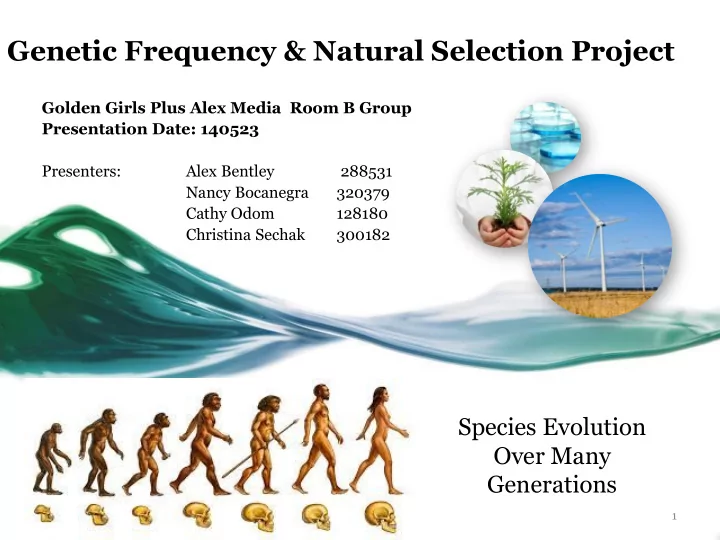
Genetic Frequency & Natural Selection Project

Golden Girls Plus Alex Media Room B Group Presentation Date: 140523 Presenters: Alex Bentley 288531 Nancy Bocanegra 320379 Cathy Odom 128180 Christina Sechak 300182

Species Evolution Over Many Generations

1

slide-2
SLIDE 2

Project Overview

  • What is gene frequency?
  • How was this proven by the monk Gregor

Mendel through Mendel’s law of segregation?

  • What is natural selection?
  • What did Charles Darwin learn on the ship

“The Beagle” in the 1830’s?

2

slide-3
SLIDE 3

Gene Frequency (Lab #10 with beads)

  • What did we do on Lab#10?

1.

We mixed different selections of beads, red and white, and performed 6 generations of gene mixtures to calculate genotype frequency.

2.

We mixed red, white, and black beads to test genotype frequency.

3.

We used Excel to test out through 12 generations.

3

Genotype: the entire set of genes in an

  • rganism; a set of

alleles that determines the expression of a particular characteristic or trait Phenotype: the expression of a particular trait, like skin color, height, behavior, according to the individual’s genetic makeup and environment
slide-4
SLIDE 4

Natural Selection (Lab#11 with dots)

  • What did we do in Lab#11?

1.

We each placed 20 dots on a patterned mat

2.

Victor, our predator , removed dots to simulate natural selection

4

Victor, the “Predator” Natural Selection of the English Peppered Moth in 1800’s Industrial Revolution

slide-5
SLIDE 5

Natural Selection: Darwinism

Darwinism Probability

Chance

Adaption Nature Offspring

5

South American Finches and different beaks on Galapagos Islands

slide-6
SLIDE 6

Results: Gene Frequency: two strong genes thrive, survive, and reproduce, and four die off

6

  • 60.0%
  • 40.0%
  • 20.0%

0.0% 20.0% 40.0% 60.0% 80.0% 100.0% 120.0% Gen 1 Gen 2 Gen 3 Gen 4 Gen 5 Gen 6 Gen 7 Gen 8 Gen 9 Gen 10 Gen 11 Gen 12 P e r c e n t a g e s

Generations

+100%M 6 Generations and Projections Through 12th Generation

RR Rw ww RB wB BB Linear (RR) Linear (Rw) Linear (ww) Linear (RB) Linear (wB) Linear (BB)

slide-7
SLIDE 7

Mendel’s Law of Independent Assortment

7

> 4 generations Recessive traits Dominant Traits

Gregor Mendel

slide-8
SLIDE 8

Conclusions and Observations

  • Organisms change with time: EVOLUTION
  • Thriving = SURVIVING = OFFSPRING
  • Sexual Selection: MATING

8

Female peafowl Male peacock

slide-9
SLIDE 9

Gene Frequency & Natural Selection Project

Questions, Comments, Concerns? Thank you! Christina, Nancy, Cathy, Alex

9