
SLIDE 1
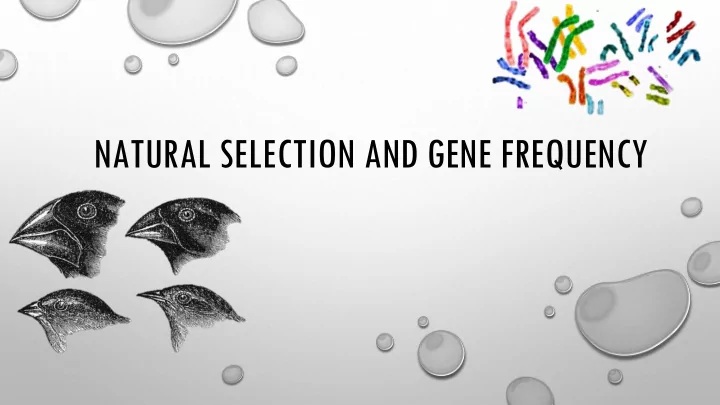
NATURAL SELECTION AND GENE FREQUENCY WHAT IS THAT? Natural - - PowerPoint PPT Presentation
NATURAL SELECTION AND GENE FREQUENCY WHAT IS THAT? Natural selection is a key mechanism of Gene frequency demonstrates the evolution. occurrence of an allele compared to other alleles of the same gene in a population. It is
evolution.
certain heritable traits survive and reproduce at higher rates than other individuals without those traits.
environmental pressures, favoring their survival and passing on of those suitable traits to succeeding generations, thereby altering allele frequencies.
alleles of the same gene in a population.
frequencies will remain the same through generations in a population: with extremely large in size, that randomly mates, and with the absence of mutations, gene flow, and natural selection.
Purpose: The natural selection lab aims to simulate the process by which biological traits become more or less prevalent in a population that has a changing
to show the relationship between predators and prey. Hypothesis: We predict that the predator will naturally pick out the prey that is most contrasting in color to its
environment in color will thrive and reproduce to make more generations of offspring.
Purpose: To create a population and demonstrate how consistent Hardy-Weinberg's principle really is. To observe the survival rates in genotypes and phenotypes of a population over a span of 6 generations. Hypothesis: Since there are mutations, certain allele frequencies will decrease dramatically due to the circumstances of the mutation standards. For other cases of mutation, new species will emerge.
Spec ecim imens: ens:
represent the prey
predators that kill the species. Spec ecim imens: ens:
alleles. Ma Mater erials ials:
in.
Mater erials ials:
represented different environments for your dots
1. Provided by the instructor, obtain one of the bottles of colored dots and gather 40 paper colored dots of one color per each individual in your group. 2. The instructor will then provide a fabric board that will serve as an “environment” for your species. 3. Place your colored species around the board in any order. Next, designate a predator for each group and send them to another environment where they will simulate the killing of a species by “eating them” for an allotted time set by the instructor. 4. After the event has occurred, calculate how many could survive, and add in the offspring produced in that generation to the population . 5. Repeat this process with multiple claws, environments, and various conditions in order to simulate natural selection.
The different colored dots represented the genetic variation between species. We predicted that those species that stood
species that adapted to their environment over time had a better chance at survival.
survive and which do not. Those species newly introduced thrive because the predators are not yet familiar with them as shown in the previous slide the newly introduced dark green dots thrived more than any of the other populations.
able to successfully survive in the old environment may not be able to adjust so quickly to the new environment because they have not yet adapted.
Case 1-2 1. Gather all materials and count out 50 white beads and 50 red beads. 2. Put the red and white beads into a single cup so that the beads will mix. 3. Have 3 separate cups available for your RR, Rw, and ww bead combinations. 4. Have a member of the group randomly grab two beads at a time and put the appropriate bead combinations into its corresponding cup. 5. Once the team member has randomly picked all the beads, have someone count and record on your excel document how many of each combination was acquired. 6. Depending on which case you’re doing have a team member calculate the amount of white beads that should be eliminated from the next generation. 7. Repeat steps 2-6 until you have reached generation 6. 8. For cases 3-4 repeat steps from case 1-2 but with different beads and different mutation standards.
selected for, represented by the homozygous dominant RR and heterozygous dominant Rw. This favored trait is passed on to more offspring, increasing its allele frequency.
Rw genotype that codes for the favored phenotype.
And natural selection consistently increases the allele frequencies of of favorable phenotypes over time, leading to adaptive evolution.
Our hypotheses were validated because the mutations affected allele frequencies significantly. The positive mutations led to an increase in population % whereas the negative mutations lead to a decrease in population %. Also, new species emerged with the introduction of the dominant black allele producing favored phenotypes of black and dark red.
advantageous to a species survival and reproductive abilities. If they somehow produce a phenotype that is not a selective advantage, their frequency will decrease.
population evolves as “better” alleles increase in frequency in the gene pool.
gene makes it better suited for natural selection, while simultaneously, natural selection chooses which genes are going to be selected against.
Campbell, Neil A., and Jane B. Reece. Campbell Biology. San Francisco, CA: Benjamin Cummings, 2011. Print. Darwin, Charles. "On The Origin of Species." The Origin of Species by Charles
Darwin’s Finches: http://www1.northbrook28.net/~pamendelson/Mrs._Mendelsons_Site/Natural_Selection_Classification_files/shapeimage_3.png Colorful Chromosomes: http://genetics.thetech.org/sites/default/files/KaryColor.gif Natural Selection Banner: http://i.ytimg.com/vi/aTftyFboC_M/maxresdefault.jpg Hardy Weinberg Penguins: http://i.ytimg.com/vi/oG7ob-MtO8c/maxresdefault.jpg NS Cartoon Fish: http://media-cache-ak0.pinimg.com/736x/1d/d1/34/1dd13452486e4fd130930d50d2acbb53.jpg Gene Frequency Goats: http://farm7.staticflickr.com/6128/5916685986_f891ba6255.jpg Natural Selection Birds and Beetles: http://uedata.berkeley.edu//media/3/52571_evo_resources_resource_image_380_original.gif All other photography were done by SCC Biology 3 Students
Photo Credits