Generation of Non-Uniform Random Numbers Generation of Non-Uniform - - PowerPoint PPT Presentation

generation of non uniform random numbers
SMART_READER_LITE
LIVE PREVIEW

Generation of Non-Uniform Random Numbers Generation of Non-Uniform - - PowerPoint PPT Presentation

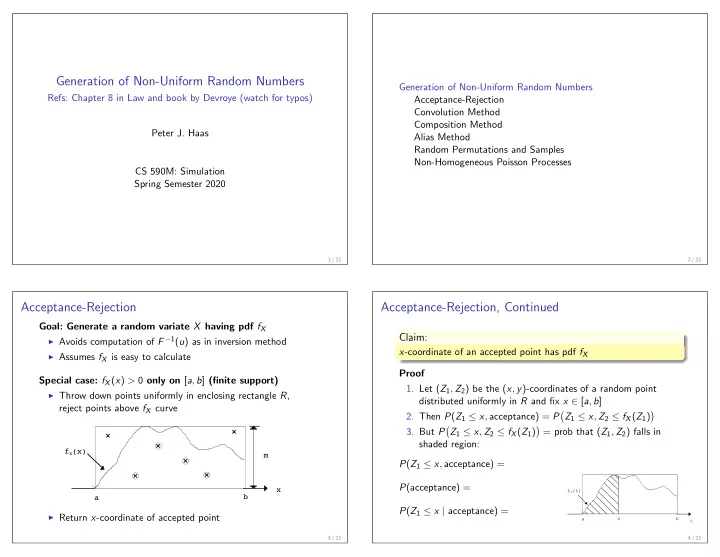
Generation of Non-Uniform Random Numbers Generation of Non-Uniform Random Numbers Refs: Chapter 8 in Law and book by Devroye (watch for typos) Acceptance-Rejection Convolution Method Composition Method Peter J. Haas Alias Method Random


slide-1
SLIDE 1

Generation of Non-Uniform Random Numbers

Refs: Chapter 8 in Law and book by Devroye (watch for typos) Peter J. Haas CS 590M: Simulation Spring Semester 2020

1 / 21

Generation of Non-Uniform Random Numbers Acceptance-Rejection Convolution Method Composition Method Alias Method Random Permutations and Samples Non-Homogeneous Poisson Processes

2 / 21

Acceptance-Rejection

Goal: Generate a random variate X having pdf fX

◮ Avoids computation of F −1(u) as in inversion method ◮ Assumes fX is easy to calculate

Special case: fX(x) > 0 only on [a, b] (finite support)

◮ Throw down points uniformly in enclosing rectangle R,

reject points above fX curve

fX(x) a b x m

◮ Return x-coordinate of accepted point

3 / 21

Acceptance-Rejection, Continued

Claim:

x-coordinate of an accepted point has pdf fX Proof

  • 1. Let (Z1, Z2) be the (x, y)-coordinates of a random point

distributed uniformly in R and fix x ∈ [a, b]

  • 2. Then P(Z1 ≤ x, acceptance) = P
  • Z1 ≤ x, Z2 ≤ fX(Z1)
  • 3. But P
  • Z1 ≤ x, Z2 ≤ fX(Z1)
  • = prob that (Z1, Z2) falls in

shaded region: P(Z1 ≤ x, acceptance) = P(acceptance) = P(Z1 ≤ x | acceptance) =

4 / 21

x a fX(t) t b

slide-2
SLIDE 2

Acceptance-Rejection, Continued

Acceptance-Rejection Algorithm (Finite Support)

  • 1. Generate U1, U2

D

∼ Uniform(0, 1) (U1 and U2 are independent)

  • 2. Set Z1 = a + (b − a)U1 and Z2 = mU2 (inversion method)
  • 3. if Z2 ≤ fX(Z1), return X = Z1, else go to step 1

How many (U1, U2) pairs must we generate?

◮ N (= number pairs generated) has geometric dist’n:

P(N = k) = p(1 − p)k−1 where p = 1/(area of R)

◮ So E[N] = 1/p = (area of R) = (b − a)m ◮ So make m as small as possible

5 / 21

fX(x) a b x m

Generalized Acceptance-Rejection: Infinite Support

Find density g that majorizes fX

◮ There exists a constant c such that fX(x)/c ≤ g(x) for all x ◮ Smallest such constant is c = sup x

  • fX(x)/g(x)
  • Generalized Acceptance-Rejection Algorithm
  • 1. Generate Z D

∼ g and U D ∼ Uniform(0, 1) (Z, U independent)

  • 2. if U g(Z) ≤ fX(Z)/c, return X = Z, else go to step 1

Expected number of (Z, U) pairs generated: E[N] = c

6 / 21

Convolution Method

Goal: Generate X where X = Y1 + · · · + Ym [Y1, . . . , Ym i.i.d.]

◮ fX = fY1 ∗ fY2 ∗ · · · ∗ fYm ◮ Where the convolution f ∗ g is defined by

(f ∗ g)(x) = ∞

−∞ f (x − y)g(y) dy

Convolution Algorithm

◮ Generate Y1, . . . , Ym ◮ Return X = Y1 + · · · + Ym

Example: Binomial Distribution

◮ Suppose X D

∼ Binom(m, p)

◮ Then X = Y1 + · · · + Ym where Yi D

∼ Bernoulli(p)

◮ Often part of a more complex algorithm

(e.g., do something else if m large)

7 / 21

Composition Method

Suppose that we can write

◮ FX(x) = p1FY1(x) + p2FY2(x) + · · · + pmFYm(x) or ◮ fX(x) = p1fY1(x) + p2fY2(x) + · · · + pmfYm(x)

where pi’s are nonnegative and m

i=1 pi = 1

Composition Method

  • 1. Generate a discrete RV J where P(J = j) = pj for 1 ≤ j ≤ m
  • 2. Generate YJ from FYJ or fYJ
  • 3. Return X = YJ

Can lead to very fast generation algorithms

8 / 21

slide-3
SLIDE 3

Composition Method: Example

b a fX(x) c R1 R2 R3

◮ Let pi = area of Ri for 1 ≤ i ≤ 3 ◮ Then fX = p1fY1 + p2fY2 + p3fY3, where

fY1(x) = 2(x−a)

(b−a)2

if a ≤ x ≤ b;

  • therwise

fY2(x) = 2(c−x)

(c−b)2

if b ≤ x ≤ c;

  • therwise

fY3(x) = (1/p3)

  • fX(x) − p1fY1(x) − p2fY2(x)
  • ◮ Easy to generate Y1 and Y2 (the “usual case”):

◮ Y1 = max(U1, U2) and Y2 = min(U1, U2) or use inversion 9 / 21

Alias Method for Discrete Random Variables

Goal: Generate X with P(X = xi) = pi for 1 ≤ i ≤ n Easy case: p1 = p2 = · · · = pn 1 2 4 3

1/4 4

Algorithm

  • 1. Generate U D

∼ Uniform(0, 1)

  • 2. Return xJ, where J = ⌈nU⌉

⌈x⌉ = smallest integer ≥ x (ceiling function)

10 / 21

Alias Method: General Case

1/6 1/3 1/2 x1 x2 x3 1/6 1/3 1/2 x1 x2 x2 x3

i xi pi ai ri 1 x1 1/6 x2 0.5 2 x2 1/2 x2 1.0 3 x3 1/3 x3 1.0

Alias Algorithm

  • 1. Generate U1, U2

D

∼ Uniform(0, 1)

  • 2. Set I = ⌈nU1⌉
  • 3. If U2 ≤ rI return X = xI else return X = aI

11 / 21

Alias Method: Another Example

1/7 2/7 3/7 x1 x2 x3 7/21 5/21 3/21 9/21

i xi pi ai ri 1 x1 3/7 2 x2 3/7 3 x3 1/7

12 / 21

slide-4
SLIDE 4

Generation of Non-Uniform Random Numbers Acceptance-Rejection Convolution Method Composition Method Alias Method Random Permutations and Samples Non-Homogeneous Poisson Processes

13 / 21

Random Permutations: Fisher-Yates Shuffle

Goal: Create random permutation of array x of length n

Fisher-Yates Algorithm

  • 1. Set i ← n
  • 2. Generate random integer N between 1 and i (e.g., as ⌈iU⌉)
  • 3. Swap x[N] and x[i]
  • 4. Set i ← i − 1
  • 5. If i = 1 then exit

a b c d a b c d a b c d a b c d

Q: What about this algorithm: For i = 1 to n: swap x[i] with random entry Other random objects: graphs, matrices, random vectors, ...

14 / 21

Sequential Bernoulli Sampling

◮ Stream of items x1, x2, . . . , ◮ Insert each item into sample with probability p ◮ Expected sample size after nth item = np ◮ Fast implementation: generate skips directly

(geometrically distributed)

Bernoulli Sampling:

Generate U D ∼ Uniform(0, 1) Set ∆ ← 1 + ⌊ln U/ ln(1 − p)⌋ [Geometric on {1, 2, . . .}, HW #4] Set m ← ∆ Upon arrival of xi:

◮ if i = m, then

◮ Include xi in sample ◮ Generate U

D

∼ Uniform(0, 1)

◮ Set ∆ ← 1 + ⌊ln U/ ln(1 − p)⌋ ◮ set m ← m + ∆ 15 / 21

Reservoir Sampling

◮ Stream of items x1, x2, . . . , ◮ Maintain a uniform random sample of size N w.o.replacement

Reservoir Sampling:

Upon arrival of xi:

◮ if i ≤ N, then include xi in sample ◮ if i > N, then ◮ Generate U D

∼ Uniform(0, 1)

◮ If U ≤ N/i, then include xi in sample,

replacing randomly chosen victim

◮ Can generate skips directly using acceptance-rejection

[JS Vitter, ACM Trans. Math. Softw., 11(1): 37–57, 1985]

16 / 21

slide-5
SLIDE 5

Reservoir Sampling: Simple Example

◮ Sample size = 1 ◮ Si = sample state after processing jth item (called ij) ◮ accept item i1 into S1 with probability 1

P(i1 ∈ S1) = 1

◮ accept item i2 into S2 with probability 1/2

P(i1 ∈ S2) = P(i1 ∈ S1) × P(i2 ∈ S2) = (1)(1/2) = 1/2 P(i2 ∈ S2) = 1/2

◮ accept item i3 into S3 with probability 1/3

P(i1 ∈ S3) = P(i1 ∈ S2) × P(i3 ∈ S3) = (1/2)(2/3) = 1/3 P(i2 ∈ S3) = P(i2 ∈ S2) × P(i3 ∈ S3) = (1/2)(2/3) = 1/3 P(i3 ∈ S2) = 1/3

17 / 21

Generation of Non-Uniform Random Numbers Acceptance-Rejection Convolution Method Composition Method Alias Method Random Permutations and Samples Non-Homogeneous Poisson Processes

18 / 21

Non-Homogeneous Poisson Processes: Thinning

Ordinary (Homogeneous) Poisson process

◮ Times between successive events are i.i.d. Exp(λ) ◮ Event probabilities for disjoint time intervals

are independent (Markov property)

◮ P(event in t + ∆t) ≈ λ∆t for ∆t very small ◮ P(Tn > y + z | Tn−1 = y) = e−λz

Non-Homogeneous Poisson process

◮ Event probabilities for disjoint time intervals are independent ◮ P(event in t + ∆t) ≈ λ(t)∆t for ∆ very small

[λ(t) is sometimes called a hazard function]

◮ P(Tn > y + z | Tn−1 = y) = e− y+z

y

λ(u) du ◮ Can capture, e.g., time-of-day effects

19 / 21

P(n events in [t, t + ∆t]) = (λ∆t)ne−λ∆t/n!

Thinning, Continued

Suppose that λ(t) ≤ λmax for t ∈ [0, τ]

◮ Idea: Generate “too many”

events according to a Poisson(λmax) process, then reject some of the events

Thinning Algorithm:

  • 1. Set T0 = 0 , V = 0, and n = 0
  • 2. Set n ← n + 1

[Generate Tn]

  • 3. Generate E D

∼ Exp(λmax) and U D ∼ Uniform(0, 1)

  • 4. Set V ← V + E

[Proposed event time]

  • 5. If U ≤ λ(V )/λmax then set Tn = V else go to Step 3
  • 6. If Tn < τ then go to Step 2 else exit

20 / 21

slide-6
SLIDE 6

Thinning, Continued

Ross’s Improvement

◮ Piecewise-constant upper-bounding to reduce rejections ◮ Correction for event times that span segments

Many other approaches

◮ Inversion (see HW #4) ◮ Idiosyncratic methods:

Exploit special properties of Poisson process

21 / 21