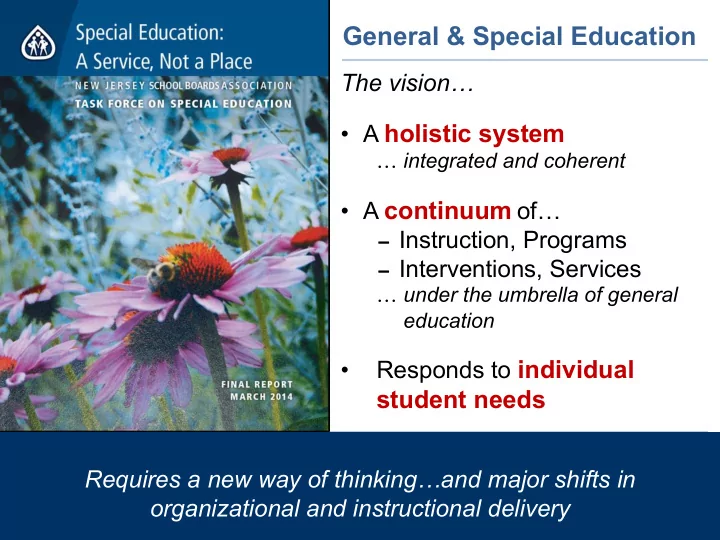
SLIDE 1 General & Special Education
The vision…
… integrated and coherent
Instruction, Programs Interventions, Services
… under the umbrella of general education
student needs
Requires a new way of thinking…and major shifts in
- rganizational and instructional delivery
SLIDE 2
and delivery nationwide
practices
alternative funding
The NJSBA Special Education Task Force
– Dr. Lawrence S. Feinsod NJSBA Executive Director
- Recommend changes in state and federal statute/
regulation and NJSBA policy
GOAL:
Reduce costs without diminishing quality
Charge:
SLIDE 3 NJSBA Special Education Task Force
Membership
- Dr. Gerald Vernotica, Chairman, Associate Professor, Montclair State
Lynne E. Crawford, South Orange-Maplewood Board of Education Sheli Dansky, River Edge BOE Carol Grossi, Superintendent, Hanover Park Regional School District
- Dr. Leon B. Kaplan, Lawrence Township BOE (Mercer)
Michael Lee, Tabernacle BOE Irene LeFebvre, Boonton Town BOE Charles T. Miller, East Amwell BOE Valerie Wilson, School Business Administrator, Newark School District John Bulina, President, New Jersey School Boards Association
SLIDE 4
NJSBA Special Education Task Force
Staff Support John Burns, Counsel Barbara Deveney, Executive
Assistant to General Counsel
Frank Belluscio, Deputy
Executive Director/Director of Communications
SLIDE 5 A Service, Not a Place:
Final Report of the NJSBA Special Education Task Force
Work of the Task Force
(January 2013-March 2014)
- Exhaustive study of trends in special education
programming, funding, and effective practices
- Consultation with 30+ experts, advocates and state
and federal officials
- Focus group meetings with county supervisors of
child study and directors of special services
– Nationwide survey | alternative methods of funding – Statewide survey | trends, expenditures and staffing
SLIDE 6 A Service, Not a Place:
Final Report of the NJSBA Special Education Task Force
FOCUS I: Proactive and Preventive Programs, Deliberative Practice, Early Intervention
What we looked at…
- Support for all students in all environments that
averts over-classification
- Methods that advance academic achievement and
address needs at an early stage
- Themes and practices associated with effective,
inclusive schools
SLIDE 7
Special Education:
A Conceptual Map to a More Integrated Approach
SLIDE 8 FOCUS I: Proactive and Preventive Programs, Deliberative Practice, Early Intervention
Recommendation
- Multi-tiered frameworks of support
… For example, RTI, I&RS, PBS
Results:
- Improves student outcomes
- Addresses disproportionate classification of minority
students
- Reduces overall classification rate, costs
A Service, Not a Place:
Final Report of the NJSBA Special Education Task Force
SLIDE 9 A Service, Not a Place:
Final Report of the NJSBA Special Education Task Force
FOCUS I: Proactive and Preventive Programs, Deliberative Practice, Early Intervention
Recommendation
- Use of federal special education funding for
supplemental literacy and math in inclusive settings
Results:
- Nathan Levenson: “Relentless focus on reading”
- When reading improves, classification rates drop
SLIDE 10
A Service, Not a Place:
Final Report of the NJSBA Special Education Task Force
FOCUS I: Proactive and
Preventive Programs, Deliberative Practice, Early Intervention High-quality special education = Inclusive practices + Cohesive system of supports + Integration with general education
SLIDE 11 A Service, Not a Place:
Final Report of the NJSBA Special Education Task Force
FOCUS II: Financing
What we looked at…
- Special education funding in New Jersey and
nationwide – how funding relates to outcomes
- Reauthorization of IDEA – opportunities to
improve outcomes
- Equitable, adequate and fair funding mechanisms
- Expected outcomes and meeting them in cost-
effective manner
SLIDE 12 A Service, Not a Place:
Final Report of the NJSBA Special Education Task Force
FOCUS II: Financing
Recommendations
- Center state & federal funding on student outcomes
– Reward schools that meet learning goals and decrease achievement gaps – Give educators opportunity to manage resources
- Improve state and district data collection on staffing,
service levels, and coding of expenditures
- Lower threshold for receipt of extraordinary-cost aid
SLIDE 13 A Service, Not a Place:
Final Report of the NJSBA Special Education Task Force
FOCUS II: Financing
Recommendations
- Provide state assistance to facilitate cost savings
- Explore alternative funding, e.g., lottery, grants
- Categorize certain services as “medical,” not
educational, so they become eligible for health insurance reimbursement Results Outcome-based funding that promotes best practices and controls costs
SLIDE 14 A Service, Not a Place:
Final Report of the NJSBA Special Education Task Force
FOCUS III: Shared Services
What we looked at…
- 2. Shared services in other states
- New York State BOCES
- Pennsylvania Intermediate Units
- 1. Current and future role of NJ special services
districts, ESCs, jointure commissions, and district consortia
SLIDE 15 A Service, Not a Place:
Final Report of the NJSBA Special Education Task Force
FOCUS III: Shared Services Recommendations
- Explore county and regional-level related services
– Child Study Team and diagnostic functions – Professional development, pre-school, technology and other support services – Support for implementation and evaluation of
inclusive practices and multi-tiered frameworks
- Create consortia to file for federal Medicaid (SEMI)
reimbursement
SLIDE 16 A Service, Not a Place:
Final Report of the NJSBA Special Education Task Force
FOCUS III: Shared Services Recommendations
- Provide financial incentives to
share services
- Eliminate regulatory impediments
- Eliminate obstacles to shared transportation
Results:
Direct available resources to classroom programs; improve quality of services; increase federal funding
SLIDE 17 A Service, Not a Place:
Final Report of the NJSBA Special Education Task Force
FOCUS IV: Training Who we looked at… Child Study Teams Teachers, Administrators, Paraprofessionals and Other Staff Board Members
Image from www.springfieldschool.org, Springfield Twp., Burlington County
SLIDE 18 A Service, Not a Place:
Final Report of the NJSBA Special Education Task Force
FOCUS IV: Training Recommendations
- Provide targeted professional development for child
study teams and other educators on IEP development and implementation and IDEA requirements
- Require that teacher preparation programs address
adapting curriculum, instruction and assessment to the inclusive classroom
SLIDE 19 A Service, Not a Place:
Final Report of the NJSBA Special Education Task Force
FOCUS IV: Training
Recommendations
- Provide board member training on the legal, fiscal
and programmatic aspects of special education, with the goal of improving outcomes. RESULTS
- Reduce IEP-related conflicts, and procedural errors
- Develop a culture of trust and cooperation among
districts, parents and students
- Meet the needs of all students in the inclusive
classroom
SLIDE 20
A Service, Not a Place:
Final Report of the NJSBA Special Education Task Force
What we should expect from our students…
In best practice districts, the general education teacher is the primary teacher for students with mild to moderate special needs. Instead of decreasing the scope or rigor, classes for struggling students must teach the standard curriculum. The expectations for these students should be the mastery of the same grade level content as their peers.
– Nathan Levenson A Win-Win Approach to Reducing Special Education Costs
SLIDE 21
The complete report is available online at www.njsba.org/ specialeducation2014
The NJSBA Special Education Task Force thanks you for your interest!
After a short break, we will return to answer your questions about the report and its recommendations.
SLIDE 22 A Service, Not a Place:
Final Report of the NJSBA Special Education Task Force
Panel Discussion: Findings and Recommendations
- Dr. Gerald Vernotica, chairman
- Michael Lee
- Irene LeFebvre
- Dr. Leon B. Kaplan
- Charles Miller
www.njsba.org/specialeducation2014