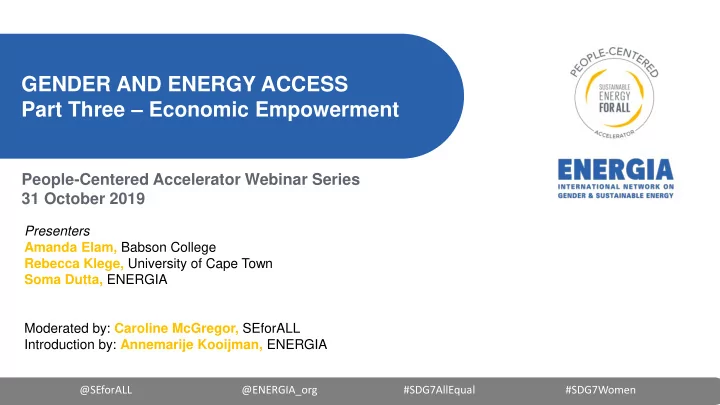
SLIDE 1 People-Centered Accelerator Webinar Series 31 October 2019
GENDER AND ENERGY ACCESS Part Three – Economic Empowerment
Presenters Amanda Elam, Babson College Rebecca Klege, University of Cape Town Soma Dutta, ENERGIA Moderated by: Caroline McGregor, SEforALL Introduction by: Annemarije Kooijman, ENERGIA
@SEforALL @ENERGIA_org #SDG7AllEqual #SDG7Women
SLIDE 2 Webinar series Gender and Energy Access
Part One - Impacts 3 October 2019
Video link
Part Two - Productive uses 17 October 2019
Video link
Part Three - Economic empowerment Today: Thursday, 31 October 2019, 9am ET / 2pm CEST
SLIDE 3
Gender and Energy Research Programme
➢ 5-year research project (2014-2019) funded by DFID Aim: Provide robust evidence on the interactions between gender, energy and poverty, to inform policy and practice ➢ 9 teams, 12 countries, 29 partners Topics: impacts of energy access, political economy, subsidies, productive uses, gender approaches, women in supply, trends ➢ Research uptake (2019-2020) reaching out to policy and practice
SLIDE 4 Presenters of today’s webinar
RA7 Amanda Elam Babson College
RA5 Rebecca Klege University of Cape Town
WEE Soma Dutta ENERGIA
SLIDE 5
For r more in information, ple lease vi visit: www.energia.org/RA5 www.energia.org/RA7 www.energia.org/research https://www.energia.org/what-we-do/womens-economic- empowerment/
SLIDE 6 Building the Evidence Base for Women’s Energy Entrepreneurship
Amanda Elam, Babson College Anita Shankar, Johns Hopkins University Allie Glinksi, International Center for Research on Women
Presented by webinar on October 31, 2019
SLIDE 7 1. Evidence that women’s energy entrepreneurship advances energy access for all? 2. Evidence that women’s energy entrepreneurship is good for women’s equality and their families? 3. Best practices to support women’s entrepreneurship within the energy sector?
Systematic Literature Review
- Academic literature and policy reports
1998-2018
- Searched 15 databases
- 15 pre-defined keywords
- Result = 190 publications
Key Research Questions
SLIDE 8 Key Findings
- Few academic publications -- mostly prescriptive and descriptive -- little theoretical or methodological rigor.
Beware ghost citations!
- Little/no attention to universal business concepts, like market factors, business model, customer value
proposition, and technology adoption.
- Insights available from larger entrepreneurship literature – e.g., varieties of entrepreneurship, clear concepts,
best practices, social impact & fundraising.
- Women entrepreneurs emphasize social value which has important implications for profitability, social and
economic impact, and industry/occupational patterns.
- Women’s entrepreneurship may upset household power dynamics and men’s support is critical resource,
especially in male-dominated industries.
- Personal agency is key to overcoming social domination.
SLIDE 9 Community- based self- help groups Community- cooperatives in energy businesses Micro-energy entrepreneurs Sales agents Small and medium-sized energy enterprises High-potential energy enterprises
Women’s Engagement in the Energy Sector
Employees
1 2 3 5 4
SLIDE 10 Considerations for Research and Policy-making
- Type of entrepreneurship – high potential, local business, subsistence – entirely different resource
environments, markets, and customer value propositions required.
- Gender concentration by industry and business types -- women generally start businesses in less
profitable markets.
- Family power dynamics influence business ownership and control
- Educate based on the evidence that women make excellent business leaders
- Personal agency and empowerment training important for women and last mile groups
SLIDE 11
Inclusion of women in the energy supply sector, impact on business performance and livelihoods Rebecca Klege
SLIDE 12
Business Model
SLIDE 13 Insights
Social status for women Competitiveness and risk taking Entrepreneurs bevioural measures Similar Performance Business Performance a)Market price vs subsidies b) Centralized locations Barriers affecting Uptake Shift from kerosene lamps Energy Transition Children study time, income, security Welfare indicators
SLIDE 14 Women as energy entrepreneurs
- 1. Equal business performance
- 2. Household Expenditures
5500 6000 6500 7000 Expenditure
HH food expenditures per week in RWF
Treatment Control
SLIDE 15 Women as energy entrepreneurs
- 1. Working in teams
- Risk taking
- 2. Competitiveness
SLIDE 16 Spill over effects of women inclusion:
- 1. Supplementary income
- 2. Social Status
- 3. Increase in aspirations for their
children
Melanie narrating her experience as an entrepreneur “…because I am a VLE I get to now meet a lot of people and
- thers come for advice from me.
I am trusted, and I think I can now contest for the position of a village leader.”
SLIDE 17
https://www.energia.org/research/gender-energy- research-programme/research-area-5-the-role-of-the- private-sector-in-scaling-up-energy-access/
SLIDE 18 ENERGIA’s Women’s Economic Empowerment Programme
Supporting last Mile Women Energy Entrepreneurship Soma Dutta
SLIDE 19 Has reached over 2.9 million households to date
4,153 women entrepreneurs
- 70% recorded a positive profit margin
- > 95% have no defaults on loans
- > 90% have been in operation
for an average of 1.9 yrs
5,311 people employed 663,097 quality energy products sold
Icons made by Gregor Cresnar from www.flaticon.com
The WEE programme
Scales up proven women-centric energy business models in clean energy and productive uses
SLIDE 20
Integrated support package: technical, business and leadership Ongoing mentoring Access to finance Linkage with relevant actors in value chain Strengthen enabling environment
The WEE approach
SLIDE 21 Building entrepreneurs and helping them grow
A successful entrepreneur
- Women who are part
- f social networks
- Level of education is
not a deciding factor
important
groups
Teaching entrepreneurship
business skills
leadership
entrepreneurs to attend training not recommended
“sisterhoods” Mentorship services
mentorship
action planning
services as businesses grow
SLIDE 22 Marketing, distribution and finance
Marketing
trust-based selling
demonstration- based selling
sales through data management tools
Distribution
supplier with a good distribution network
entrepreneurs
families
Finance
Access to finance is not a silver bullet
confidence is critical
financing mechanisms
SLIDE 23
- Build and strengthen the enabling
environment
- WEE programmes cannot be built
without multi year, flexible support
- Aggregate, aggregate, aggregate
- Engage men and families
- Calibrated, growth-oriented
strategies
Five programmatic lessons ENERGIA learned
SLIDE 24
Partners
SLIDE 25
THANK YOU!
https://www.energia.org/
SLIDE 26 @SEforALL @ENERGIA_org #SDG7AllEqual #SDG7Women
Please use the Q&A function to submit your questions to the panel.
Discussion session
SLIDE 27 For more information visit: www.energia.org/research
@SEforALL @ENERGIA_org #SDG7AllEqual #SDG7Women
GENDER AND ENERGY ACCESS Part Three Economic Empowerment
THANK YOU
Keep in touch with us and see our reports and briefs on evidence and experience in gender and energy