
SLIDE 1
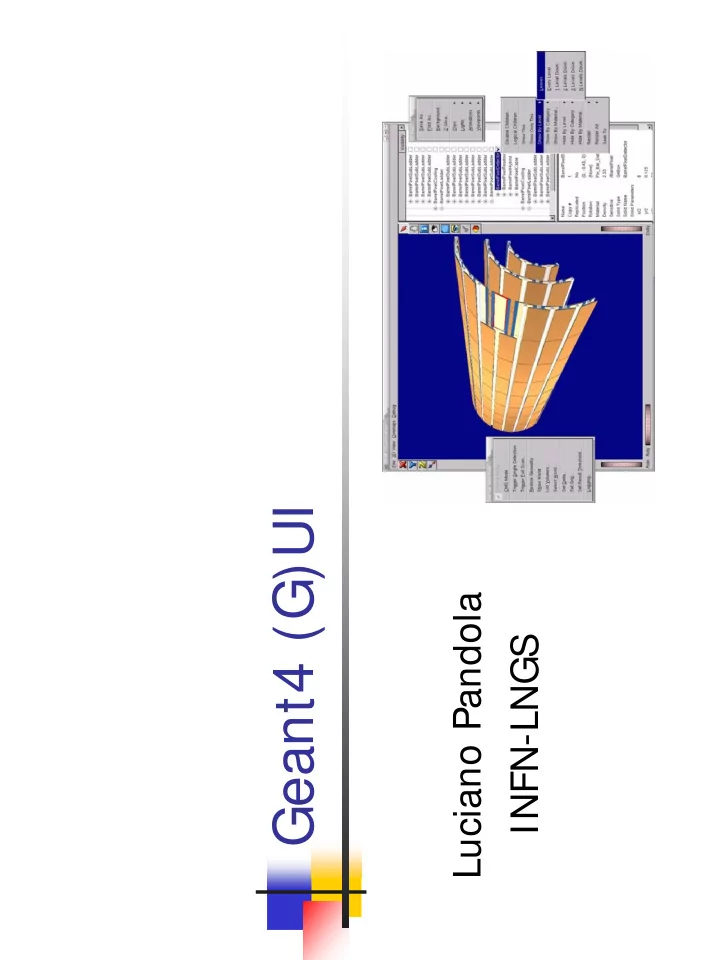
Geant4 (G)UI Luciano Pandola INFN-LNGS Steering the simulation - 1 - - PDF document
Geant4 (G)UI Luciano Pandola INFN-LNGS Steering the simulation - 1 A Geant4 simulation can be steered in three ways : everything hard-coded in the C+ + source (also the number of events to be shot). You need to re-compile for any
A Geant4 simulation can be steered in
everything hard-coded in the C+ + source
batch session (via a ASCII macro) commands captured from an interactive
Setting up batch mode (namely, read
G4UImanager* UI = G4UImanager::GetUIpointer(); G4String command = “/control/execute”; G4String fileName = argv[1]; UI->applyCommand(command+fileName);
Your executable can be run as
To execute a macro interactively:
takes the first argument after the executable as the macro name and runs it
Setting up interactive mode is also easy – but
All of them must be derived from the abstract
Geant4 provides several implementations
In the main(), according to the computer
For instance: in the main()
G4UIsession* session=0; if (argc==1) { session = new G4UIterminal; session->SessionStart(); delete session; }
Create a (null) pointer to the base session class If there are no arguments after the executable, starts an interactive session Define the session as a dumb terminal, and starts it Don’t forget to delete it
Geant4 provides several interfaces for various (G)UI:
G4UIterminal: C-shell like character terminal G4UItcsh: tcsh-like character terminal with command
G4UIGAG: Java based graphic UI (GUI) G4UIXm: Motif-based GUI, command completion G4UIQt: GUI based on Qt libraries
Define and invoke them like G4UIterminal
session = new G4UIGAG(); session->StartSession();
Note for G4UItcsh, it must be defined as
session = new G4UIterminal (new G4UItcsh);
Users can select and plug in (G)UI by
setenv G4UI_USE_GUINAME
Example:
setenv G4UI_USE_TERMINAL 1 (default) setenv G4UI_USE_GAG 1 setenv G4UI_USE_XM 1
G4UIterminal – C-shell-like character terminal
runs on all Geant4-supported platforms
G4UItcsh – tcsh-like character terminal with
runs only on Solaris and Linux
G4UIXm, G4UIXaw, G4UIXWin32 –
runs on Unix/Linux and Windows, respectively
G4UIGAG – Java-based GUI
runs on all Geant4 platforms
From Geant4 9.3 there is an automatic tool,
G4UIExecutive* ui = new G4UIExecutive(argc,argv); if (ui->IsGUI()) G4cout << “Graphical UI” << G4endl; else G4cout << “Non-graphical UI” << G4endl; ui->SessionStart();
GGE: Geometry editor based on Java GUI
http://erpc1.naruto-u.ac.jp/~ geant4
GPE: Physics editor based on Java GUI
http://erpc1.naruto-u.ac.jp/~ geant4
OpenScientist: interactive environment for
http://www.lal.in2p3.fr/OpenScientist
Geant4 provides a number of general-purpose
interactively via a (G)UI
in a macro file
within C+ + code using the ApplyCommand()
A complete list of built-in commands is available in the
If built-in commands are not enough, you can
Geant4 provides several command classes, all
G4UIcmdWithoutParameter G4UIcmdWithABool G4UIcmdWithADouble G4UIcmdWithADoubleAndUnit ...
Commands have to be defined in messenger classes, that
Define the command in the constructor:
G4UIcmdWithADoubleAndUnit* fThetaCmd = new G4UIcmdWithADoubleAndUnit ("/prim/angle",this);
fThetaCmd->SetGuidance(“Opening angle of source"); fThetaCmd->SetDefaultUnit("deg"); fThetaCmd->SetUnitCandidates(“deg rad”);
Delete the command in the destructor
Command taking as argument a double and a unit, called /prim/angle Sets guidance, default unit, etc.
Define the action of the command in the
void MyMessenger::SetNewValue (G4UIcommand* cmd,G4String string) { if (cmd == fThetaCmd) { G4double value = fThetaCmd
...->DoSomething(value); } }
Retrieve a G4double value from the (string) argument given to the command
Use the value in the way it is
needed (e.g. pass it to other classes: opening angle for primary generator)
Interactive sessions where user can give
A number of general-purpose commands are