
SLIDE 1
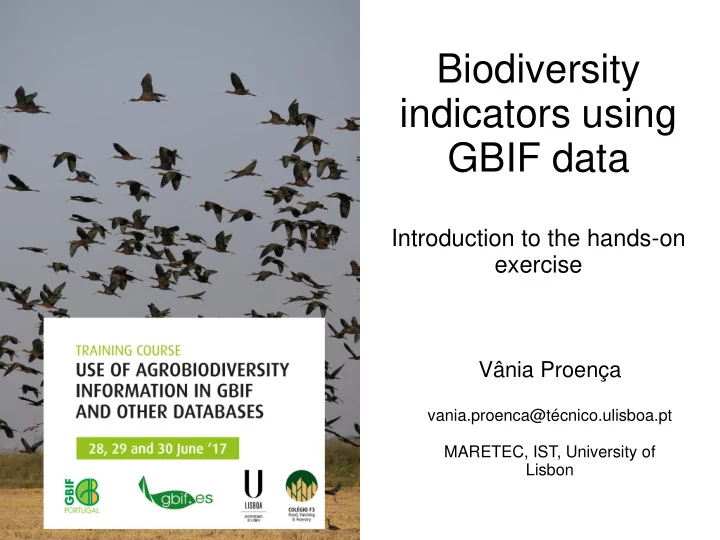
Biodiversity indicators using GBIF data
Introduction to the hands-on exercise
Vânia Proença
vania.proenca@técnico.ulisboa.pt MARETEC, IST, University of Lisbon
GBIF data Introduction to the hands-on exercise Vnia Proena - - PowerPoint PPT Presentation
Biodiversity indicators using GBIF data Introduction to the hands-on exercise Vnia Proena vania.proenca@tcnico.ulisboa.pt MARETEC, IST, University of Lisbon TRAINING COURSE: USE OF AGROBIODIVERSITY INFORMATION 28, 29 AND 30 JUNE '17
vania.proenca@técnico.ulisboa.pt MARETEC, IST, University of Lisbon
TRAINING COURSE: USE OF AGROBIODIVERSITY INFORMATION IN GBIF AND OTHER DATABASES 28, 29 AND 30 JUNE '17
Genetic Species Ecosystems Individual species or taxa (i.e., species groups) Species communities (i.e., interacting popul.)
Biodiversity indicators are measures of biodiversity. Indicators respond to drivers of change and are used to assess and monitor the state and trends of biodiversity in all its dimensions.
Trends in conservation status Red List Index (e.g., pollinators) Living Planet Index Trends in invasive species (…) Protected Area Coverage % forest under certified management (…) Species diversity & evenness % Endemics, or rare species Trends in similarity % declining or increasing spcs. (…) Breed and cultivar diversity Crop origin (…)
TRAINING COURSE: USE OF AGROBIODIVERSITY INFORMATION IN GBIF AND OTHER DATABASES 28, 29 AND 30 JUNE '17
Cultivated species Non-cultivated species
Support/Regulation Threats Cultural value Indicators Biological control Pollinators Decomposers Soil fertility Nutrient cycling
etc.
Invasive sp. Pathogens Herbivores
etc.
Mushrooms Medicinal plants Charismatic sp.
etc.
Habitat specialists Rare/threatened sp. Lichens
etc.
Genetic Species Ecosystems
TRAINING COURSE: USE OF AGROBIODIVERSITY INFORMATION IN GBIF AND OTHER DATABASES 28, 29 AND 30 JUNE '17
Adapted from Hortal et al. 2007 Conservation Biology Volume 21, No. 3, 853–863; DOI: 10.1111/j.1523-1739.2007.00686.x
Extract biodiversity data from GBIF Check quality of records
Assess sampling effort (survey completeness) Identify well-sampled cells Use in biodiversity assessment and modelling Discard records with errors Revise extraction filters and / or add new data to GBIF if few
none Protocol to obtain reliable species community data from GBIF Alternative: model the distribution of individual species and assemble comunities with
TRAINING COURSE: USE OF AGROBIODIVERSITY INFORMATION IN GBIF AND OTHER DATABASES 28, 29 AND 30 JUNE '17
Hortal et al. 2007 Conservation Biology Volume 21, No. 3, 853–863; DOI: 10.1111/j.1523-1739.2007.00686.x
Relationship between sampling effort and observed species in grid cells
TRAINING COURSE: USE OF AGROBIODIVERSITY INFORMATION IN GBIF AND OTHER DATABASES 28, 29 AND 30 JUNE '17
Gotelli, Nicholas J., and Robert K. Colwell. "Estimating species richness." Biological diversity: frontiers in measurement and assessment 12 (2011): 39-54.
Species accumulation curves and rarefaction curves
TRAINING COURSE: USE OF AGROBIODIVERSITY INFORMATION IN GBIF AND OTHER DATABASES 28, 29 AND 30 JUNE '17
Williams, N. M., R. L. Minckley, and F. A. Silveira. 2001. Variation in native bee faunas and its implications for detecting community changes. Conservation Ecology 5(1): 7. [online] URL: http://www.consecol.org/vol5/iss1/art7/
Rarefaction curves for bee communities from different surveys around the world
TRAINING COURSE: USE OF AGROBIODIVERSITY INFORMATION IN GBIF AND OTHER DATABASES 28, 29 AND 30 JUNE '17
Coddington, Jonathan A., et al. "Undersampling bias: the null hypothesis for singleton species in tropical arthropod surveys." Journal of animal ecology 78.3 (2009): 573-584.; DOI: 10.1111/j.1365-2656.2009.01525.x
Survey completeness = (observed/estimated) * 100
If completeness > 75% accept as well-surveyed
Singletons Doubletons Estimated 352 species 443 species (352/443)* 100 = 79% OK! Estimation of species richness & Assessment of survey completeness Observed
TRAINING COURSE: USE OF AGROBIODIVERSITY INFORMATION IN GBIF AND OTHER DATABASES 28, 29 AND 30 JUNE '17
Bird data: 80 well-surveyed cells for 2010 in Alentejo GBIF Search query
no known issues
TRAINING COURSE: USE OF AGROBIODIVERSITY INFORMATION IN GBIF AND OTHER DATABASES 28, 29 AND 30 JUNE '17
Bird data: 35 well-surveyed cells for 2005 in Alentejo GBIF Search query
no known issues
TRAINING COURSE: USE OF AGROBIODIVERSITY INFORMATION IN GBIF AND OTHER DATABASES 28, 29 AND 30 JUNE '17
Free software packages with tools for estimating species richness from sample data: EstimateS (Colwell 2009): http://purl.oclc.org/estimates EcoSim (Gotelli & Entsminger 2009): http://garyentsminger.com/ecosim/index.htm SPADE: http://chao.stat.nthu.edu.tw/softwareCE.html VEGAN (for R): http://cc.oulu.fi/∼jarioksa/softhelp/vegan.html
Gotelli, Nicholas J., and Robert K. Colwell. "Estimating species richness." Biological diversity: frontiers in measurement and assessment 12 (2011): 39-54.
TRAINING COURSE: USE OF AGROBIODIVERSITY INFORMATION IN GBIF AND OTHER DATABASES 28, 29 AND 30 JUNE '17
Adapted from Hortal et al. 2007 Conservation Biology Volume 21, No. 3, 853–863; DOI: 10.1111/j.1523-1739.2007.00686.x
Extract biodiversity data from GBIF Check quality of records
Assess sampling effort (survey completeness) Identify well-sampled cells Use in biodiversity assessment and modelling Discard records with errors Revise extraction filters and / or add new data to GBIF if few
none Protocol to obtain reliable species community data from GBIF