
SLIDE 1
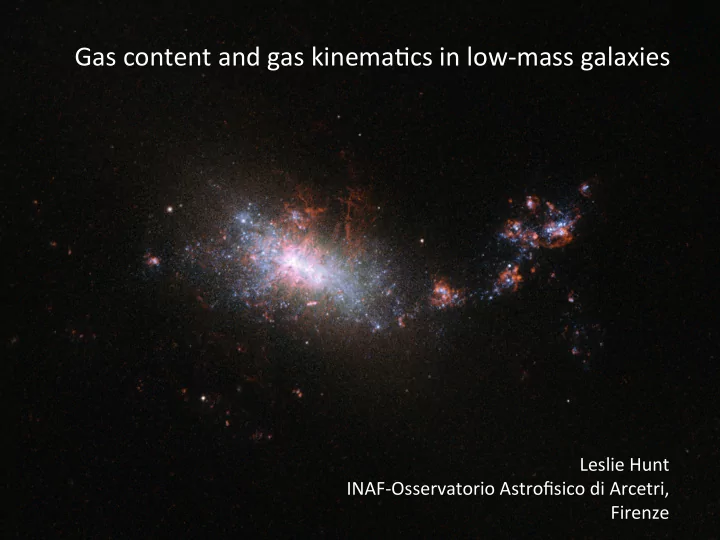
Gas content and gas kinema/cs in low-mass galaxies Leslie Hunt - - PowerPoint PPT Presentation
Gas content and gas kinema/cs in low-mass galaxies Leslie Hunt INAF-Osservatorio Astrofisico di Arcetri, Firenze why low-mass (metal-poor) galaxies? UV luminosity func/onsz~4, z~8 low mass galaxies are the most Bouwens+ 2011 numerous at
(e.g., Bouwens+ 2011, 2012; Atek+ 2015; Sun & FurlaneUo 2016)
Galaxy Stellar Mass func/ons to z~4 from Ilbert+ 2013, data from z~0 Moustakas+ 2013, Baldry+ 2012) UV luminosity func/onsz~4, z~8 Bouwens+ 2011 Specific star forma/on rate as func/on of look- back /me for galaxies of varying masses (Thomas+ 2010)
Behroozi+ 2013a, 2013b (see also Moster+ 2013, Genel+ 2014) star-forma/on efficiency (SFE) peaks at 5x10¹¹ M¤, characteris/c mass “sweet spot” for galaxy forma/on z=0
Hopkins+ 2014, FIRE simula/ons Stellar mass (M¤) Halo mass (M¤) Stellar /baryonic “sweet spot” at 5x10¹¹ M¤ Stellar /baryonic Stellar /baryonic Halo mass (M¤)
Stellar /baryonic Stellar /baryonic Halo mass (M¤)
models without feedback are in severe conflict with observa/ons, especially at low masses Stellar mass (M¤) Halo mass (M¤) Stellar /Baryonic “sweet spot” at 5x10¹¹ M¤ Hopkins+ 2014, FIRE simula/ons
Hopkins+ 2014 KennicuU-Schmidt (KS) law rela/ng SFR and gas surface densi/es; observa/ons (KennicuU 1998; Bigiel+ 2008; Genzel+ 2010; Daddi + 2010) indicated by yellow shaded region. Simula/ons including various recipes for feedback (see previous slide) shown by points. Instantaneous SFE (here SF per dynamical /me) in dense gas is 100%, but global SFE is ~2%.
100 101 102 103 104 10−4 10−3 10−2 10−1 100 101 102 103 Σgas [Msun pc−2] ΣSFR [Msun yr−1 kpc−2]
10Gyr 1Gyr 100Myr SMGs Genzel+ (2010) SFGs Tacconi+ (2010, 2013) BzKs Daddi+ (2010) Spirals Kennicutt (1998) Starbursts Kennicutt (1998)
All resolved measurements (except Kennicutt)
False colors: Bigiel+ (2008)
K r u m h
z + ( 2 9 )
100 101 102 103 104 10−4 10−3 10−2 10−1 100 101 102 103 Σgas [Msun pc−2] ΣSFR [Msun yr−1 kpc−2]
10Gyr 1Gyr 100Myr
SFGs Tacconi+ (2010, 2013) BzKs Daddi+ (2010) Spirals Kennicutt (1998) Starbursts Kennicutt (1998)
All resolved measurements (except Kennicutt)
LITTLE THINGS (HI only) SHIELD dwarfs (HI only) FIGGS dwarfs (HI only) VLA−ANGST dwarfs (HI only)
Hunt+ in prep high ΣSFR and high ΣHI common in blue compact dwarf galaxies (BCDs), and some LiUle THINGS dwarfs, despite their low metallicity dwarfs may not all be inefficient at forming stars compare with high-redshiG popula/ons to consider the best local analogs
Hunt+ in prep 100 101 102 103 104 10−4 10−3 10−2 10−1 100 101 102 103 Σgas [Msun pc−2] ΣSFR [Msun yr−1 kpc−2]
10Gyr 1Gyr 100Myr
NGC1140
SBS0035−052 DDO87 NGC1569 IC10
SMGs Genzel+ (2010) SFGs Tacconi+ (2010, 2013) BzKs Daddi+ (2010) Spirals Kennicutt (1998) Starbursts Kennicutt (1998)
All resolved measurements (except Kennicutt)
LITTLE THINGS (HI only) SHIELD dwarfs (HI only) FIGGS dwarfs (HI only) VLA−ANGST dwarfs (HI only)
Ruby (Canameras+ 2017) high ΣSFR and high ΣHI common in blue compact dwarf galaxies (BCDs), and some LiUle THINGS dwarfs, despite their low metallicity IIZw40 from Kepley+ (2014, 2016): rightmost es/mate includes H2 from ALMA; NGC5253, NGC1569, IC10 also include H2 in rightmost point dwarfs may not all be inefficient at forming stars compare with high-redshiG popula/ons, some approach maximal starbursts
7.5 8.0 8.5 9.0 10−11 10−10 10−9 10−8 10−7
12+Log(O/H) SFR/Mstar
Mstar
LVL 0.0 0.1 0.2 0.3 0.4 0.5 0.6 0.7 0.8 0.9
Gas fraction
Local Volume Legacy (LVL, KennicuU+ 2008, Lee+ 2009, Dale+ 2009, Cook+ 2014) within 11 Mpc COLDGASS (CO, followup of HI sample, Saintonge+ 2011, Huang+ 2014)
8.0 8.5 9.0 10−11 10−10 10−9 10−8 10−7
12+Log(O/H) SFR/Mstar
Iorio+ (2017) Hunt+ (in prep)
DDO87
NGC1140 SBS0335−052 IZw18
106 107 108 109 1010 1011
Mstar
LVL 0.0 0.1 0.2 0.3 0.4 0.5 0.6 0.7 0.8 0.9
Gas fraction
Local Volume Legacy (LVL, KennicuU+ 2008, Lee+ 2009, Dale+ 2009, Cook+ 2014) within 11 Mpc COLDGASS (CO, followup of HI sample, Saintonge+ 2011, Huang+ 2014)
0.2 0.4 0.6 0.8 1.0 10−11 10−10 10−9 10−8 SFR/Mstar Mgas/Mbaryonic
Thuan+ (2016) Lelli+ (2014) Iorio+ (2017) Teich+ (2016) Hunt+ (in prep)
Thuan+ (2016) includes single- dish HI
extremely metal- poor (XMP) dwarf galaxies, all of which are extremely gas rich
8.0 8.5 9.0 0.0 0.2 0.4 0.6 0.8 1.0
12+Log(O/H) Mgas/Mbaryonic
Lelli+ (2014) Iorio+ (2017) Hunt+ (in prep)
107 108 109 1010 1011
Mstar
102 106 107 108 109 1010 1011 Vrot [km s−1] Mbaryonic [Msun]
NGC5253 NGC4163 UGC6456 SBS1415+437 NGC4449
Lelli+ (2014) Lelli+ (2016) McGaugh (2012) Iorio+ (2017) McNichols+ (2016) Hunt+ (in prep)
Reyes+ (2011) Lelli+ (2016)
0.0 0.1 0.2 0.3 0.4 0.5 0.6 0.7 0.8 0.9
Gas fraction
Hunt+ (in prep)
102 106 107 108 109 1010 1011 Vrot [km s−1] Mbaryonic [Msun]
NGC5253 NGC4163 UGC6456 SBS1415+437 NGC4449
Lelli+ (2014) Lelli+ (2016) McGaugh (2012) Iorio+ (2017) McNichols+ (2016) Hunt+ (in prep)
Reyes+ (2011) Lelli+ (2016)
0.0 0.1 0.2 0.3 0.4 0.5 0.6 0.7 0.8 0.9
Gas fraction
Hunt+ (in prep)
EAGLE/APOSTLE simula/ons (feedback via stochas/c thermal energy injec/on) by Sales+ (2017) log Vrot (km/s) log Mbaryonic (M¤) cri/cal issue where to measure Vrot?
102 106 107 108 109 1010 1011 Vrot [km s−1] Mbaryonic [Msun]
NGC5253 NGC4163 UGC6456 SBS1415+437 NGC4449
Lelli+ (2014) Lelli+ (2016) McGaugh (2012) Iorio+ (2017) McNichols+ (2016) Hunt+ (in prep)
Sales+ (2017) EAGLE/APOSTLE Reyes+ (2011) Lelli+ (2016)
0.0 0.1 0.2 0.3 0.4 0.5 0.6 0.7 0.8 0.9
Gas fraction
102 106 107 108 109 1010 1011 Vrot [km s−1] Mbaryonic [Msun]
NGC5253 NGC4163 UGC6456 SBS1415+437 NGC4449
Lelli+ (2014) Lelli+ (2016) McGaugh (2012) Iorio+ (2017) McNichols+ (2016) Hunt+ (in prep)
Sales+ (2017) EAGLE/APOSTLE Reyes+ (2011) Lelli+ (2016)
0.0 0.1 0.2 0.3 0.4 0.5 0.6 0.7 0.8 0.9
Gas fraction
NGC 5253, NGC 4449, SBS1415+437 all contain ionized-gas
(Heckman+ 2015, 2016; Chisholm+ 2015, 2016): trouble with feedback! Is Vrot truly tracing halo virializa/on? *correc/on =
2 + 2 σ2) (e.g.,
Genzel 2010)
log Vrot (km/s) log M* (M¤) mass of disk transi/on
2 + σ2), see Simons, Kassin+
109.5 M¤
Wisnioski+ (2015), see also Green+ (2010, 2014) Moiseev+ (2015) While Hα traces rota/on through central velocity posi/on, it does not trace true turbulence in the gas, but rather bulk mo/ons of the individual HII regions unresolved spa/ally
Log(SFR) Log[L(Hα)] σ (km/s) velocity dispersion σ correlates with SFR in dwarf galaxies, giant spirals, U/LIRGs σ also increases with redshiG (because of increasing gas frac/ons, but remember scaling rela/ons, sSFR)
UGC8508 DDO53
10−2 10−1 100 101 102 SFR [Msun yr−1] σHI [km s−1] SFR ~ σ5.3
Lelli+ (2014) Iorio+ (2017) McNichols+ (2016)
0.0 0.1 0.2 0.3 0.4 0.5 0.6 0.7 0.8 0.9
Gas fraction
UGC8508 DDO53
10−2 10−1 100 101 102 SFR [Msun yr−1] σHI [km s−1] SFR ~ σ5.3
Lelli+ (2014) Iorio+ (2017) McNichols+ (2016)
0.0 0.1 0.2 0.3 0.4 0.5 0.6 0.7 0.8 0.9
Gas fraction
White+ (2017): CO measurements of DYNAMO galaxies at z~0.2 selected for high SFRs as local analogues for z~2 clumpy disks
100 10−1 100 Mgas/Mbaryonic σ/Vrot
NGC5253
Iorio+ (2017) McNichols+ (2016) Q = 1 (White+ 2017)
HI dwarf samples (starbursts, LITTLE THINGS, SHIELD): HI velocity dispersion rela/vely constant with gas frac/on
Mogotski+ 2016 Caldu-Primo+ 2013
σ(HI)/σ(CO)
σ(HI)/σ(CO)
Hunt, Garcia-Burillo, Combes, et al. , in prep
high CO velocity dispersion (~ 40 km/s) coincides with highest dust ex/nc/on (Cairos+ 2010)