Garry Lavis Diploma of Health Science Diploma of Remedial Massage. - - PowerPoint PPT Presentation

garry lavis
SMART_READER_LITE
LIVE PREVIEW

Garry Lavis Diploma of Health Science Diploma of Remedial Massage. - - PowerPoint PPT Presentation

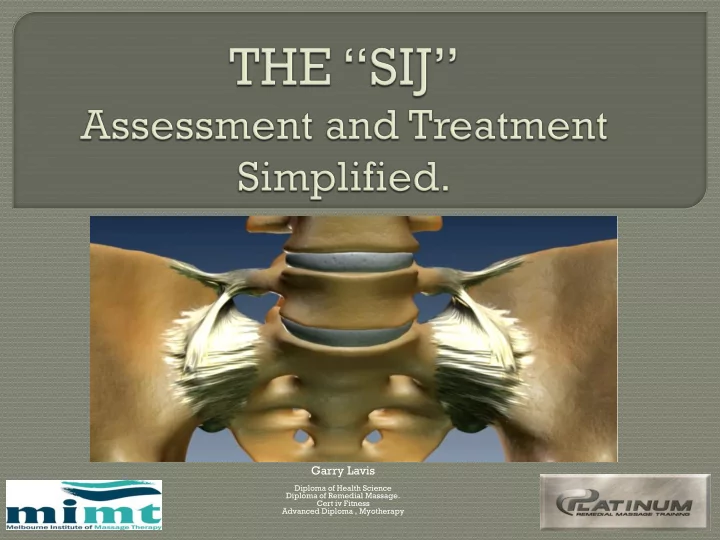
Garry Lavis Diploma of Health Science Diploma of Remedial Massage. Cert iv Fitness Advanced Diploma , Myotherapy STRUCTURE BIOMECHANICS Movement produced by The connection between distal locations of the body. the lumbar spine and


slide-1
SLIDE 1

Garry Lavis

Diploma of Health Science Diploma of Remedial Massage. Cert iv Fitness Advanced Diploma , Myotherapy
slide-2
SLIDE 2
slide-3
SLIDE 3
slide-4
SLIDE 4
slide-5
SLIDE 5
slide-6
SLIDE 6

STRUCTURE BIOMECHANICS

 The connection between

the lumbar spine and the pelvis.

 The SI Joint is a load

bearing joint and distribute weight from the spine to the lower extremities via the hip joints.

 Concave sacral surface.  Convex illiac surface.  Highly ligamentus joint.  Movement produced by

distal locations of the body.

 Approx 5 degrees rotation.  Approx 2mm translation.  Vulnerable to shear during

rotation and translation.

 Joint compresses during

body movement.(loadbearing)

 Although normal SIJ

movement is small, it is essential for pain free functionality.

slide-7
SLIDE 7

SIJ Dysfunction refers to the abnormal

function of the SIJ, (Hypomobility or Hypermobility) at the Joint which places stresses on structures in or around it.

Therefor SIJ Dysfunction may contribute

to lumbar, buttock, hamstring or groin pain.

Brukner & Khan CSM 4th edition

slide-8
SLIDE 8

CONCAVE SACRAL SURFACE CONVEX ILIAC SURFACE

https://www.youtube.com/watch?v=D6NTMgWCSaU

slide-9
SLIDE 9

NUTATION COUNTER NUTATION

 A forward tilt/rotation

(flexion)of the sacrum in reference to the adjacent ilium.

 Nutation of the Sacrum is

considered a locked/ loadbearing position for stability

 A Backwards

tilt/rotation(extension) of the sacrum in reference to the adjacent ilium.

 Counter Nutation is

considered an unlocked position and allows articulation of the inominate.

slide-10
SLIDE 10
slide-11
SLIDE 11

Nutation Counternutation

https://www.google.com.au/search?hl=en&site=imghp&tbm=isch &source=hp&biw=1366&bih=643&q=articulations+of+the+SIJ&oq= articulations+of+the+SIJ&g

Locked Unlocked

slide-12
SLIDE 12

TRANSLATION GAIT.

 In the normal gait cycle,

combined movements

  • ccur conversely in the

right and left innominate and spine.

 Translation or forced

closure (locking) occurs on the weight bearing side and an unlocking occurs on the opposite side during the swing phase.

slide-13
SLIDE 13

Integral to the biomechanics of SIJ stability is the self locking mechanism.

The ability of the SIJ to self lock, occurs through two types of closure. Form Closure and Force Closure.

Form Closure describes how specifically shaped, closely fitting contacts provide inherent stability independent of external load.

Force Closure describes how external compression forces add additional stability.

The combination of form closure and force closure establishes stability in the sacroiliac joint.

slide-14
SLIDE 14

https://www.youtube.com/watch?v=D6NTMgWCSaU

slide-15
SLIDE 15

https://www.youtube.com/watch?v=D6NTMgWCSaU

slide-16
SLIDE 16

SACROTUBEROUS LIGAMENT. LONG DORSAL SACROILIAC LIGAMENT.

 Sacrum to Ischial

Tuberosity.

 A tort or tight

Sacrotuberous Ligament will restrict nutation of the sacrum.

 Direct attachment to the

biceps Femoris muscle.

 3rd and 4th Sacrum to PSIS  A tort or tight Long

Sacroiliac Ligament will restrict counternutation of the sacrum.

 Direct attachment to TLF

and Multifitus.

Self Bracing

slide-17
SLIDE 17

STABILIZERS

https://www.youtube.com/watch?v=D6NTMgWCSaU

slide-18
SLIDE 18

 Multifidus.  Transverse

Abdominis.

 Internal Oblique.  Pelvic Floor.

slide-19
SLIDE 19
slide-20
SLIDE 20
slide-21
SLIDE 21

Lumbar Hip SIJ

slide-22
SLIDE 22
slide-23
SLIDE 23
slide-24
SLIDE 24
slide-25
SLIDE 25
slide-26
SLIDE 26
  • If it is SHORT– LENGTHEN it.
  • If it is HARD – SOFTEN it.
  • If it is LAZY – STIMULATE it.
  • If it is STIFF – MOBILISE it.
  • If is WEAK – STRENGTHEN it.
slide-27
SLIDE 27
slide-28
SLIDE 28
slide-29
SLIDE 29
slide-30
SLIDE 30
slide-31
SLIDE 31
slide-32
SLIDE 32
slide-33
SLIDE 33
slide-34
SLIDE 34
slide-35
SLIDE 35
slide-36
SLIDE 36
slide-37
SLIDE 37
slide-38
SLIDE 38
slide-39
SLIDE 39
slide-40
SLIDE 40
slide-41
SLIDE 41
slide-42
SLIDE 42