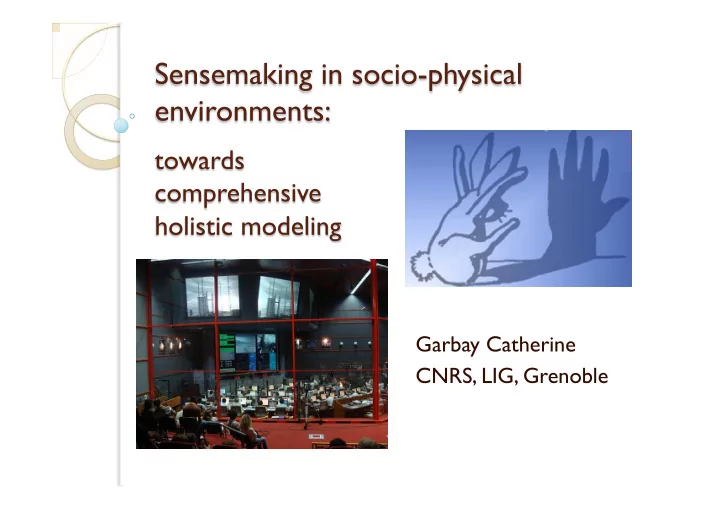
SLIDE 1
Garbay Catherine CNRS, LIG, Grenoble Sensors capturing world-wide - - PowerPoint PPT Presentation
Garbay Catherine CNRS, LIG, Grenoble Sensors capturing world-wide information in the physical, cyber or social realms Open data initiatives, Web 4.0, crowdsourcing Multi-sensory immersion: skinput, novel generation contact
SLIDE 2
SLIDE 3
Grid-like service agencies with various embodiements that self-
- rganize, learn and evolve their courses of action, self-improving
their performances
Different types of subspaces interacting with, reflecting or
influencing each other directly or through the cyber, physical, social and mental spheres
Versatile individuals and social roles coexisting, evolving and
transforming, providing appropriate on-demand information, knowledge and services for each other, interacting through various links, self-organizing according to socio value chains
From Jean-Luc Dormoy, EDF, Yellow Strom
SLIDE 4
« How individuals and organizations make sense of their
experience »
« An active two-way process of fitting data into a frame and fitting
a frame around the data »
Deals with
- Situations of equivocality, ambiguity or uncertainty
- Lack of fit, dissonance between what is expected and what is
encountered, interruptions, discontinuities
- Situations where it is unsure whether there is even a decision to be
made
Involves
- The whole body of human cognition (emotion, affect, esthetics…)
- Discussion and consensus building at social level
- Creating shared meaning and experience, mutual awareness, common
references and deixis
Constitutive of human action, governance and organization
SLIDE 5
Properties
- Enactive of sensible environment: continuously refined,
constituted and reconstituted through the dynamic, reciprocal, and iterative processing of environmental information
- Embedded in what binds the organization together: ideology,
shared beliefs, values, norms…
Needs
- Face time stress and information overload
- Past experiences - ready-made formulas for action
- Sustained attentionality and engagement, incentives : monetary,
hedonic, socio-psychological…
- Modify the attentional resources within the organization, define
where there is need for shared interpretation
- Build on site and rapidly redirect or reconfigure the
- rganization, perform role switching, transfer of authorities
SLIDE 6
General Goal Proposed Topics
Building a comprehensive vision
- f sensemaking
In the realm of cross-cultural
physical, digital and social worlds
Under heterogeneous
knowledge corpora,
- rganizations, policies and
norms
Broad-spectrum
interdisciplinary efforts tying a wide range of disciplines/ domains
Transnational comparative
approaches
1.
Supporting Mutual Attention
2.
Shaping and Framing
3.
Combining Analytical and Naturalistic Modeling
4.
Embedding Sensemaking
5.
Thinking the Organizational Structure
6.
Providing Valuable Information and Assessed Sensemaking
SLIDE 7
Communication artefacts
embodying a tangible, consistent and credible presence
Designed with capacities of
mutual attention, providing actual guarantees that our intentions have been understood, making clear our values and norms
Coping with the social,
economic, technological, spiritual, moral dimensions underpinning
- ur social structure
Mandatory to the credibility and
robustness of information processing
SLIDE 8
Event detection
- Develop attention to weak, poorly discernable signals,
amplify them to become early alert signs
Situation awareness
- Develop abilities to build integrated views, perceive the
individual elements within a volume of space and time, understand their meaning and project their status
Framing
- Unspoken, informal individual and organizational
procedures, communication styles that
- Shape the flow/content of information, expectations and
search, belief formation
- Filter / amplify information according to new perspectives,
dynamically decontextualize and recontextualize events according to novel, original frames and viewpoints
SLIDE 9
Time-critical decision making favors the intuitive
approach over the analytical
- Each situation encountered is unique in some way and there
is no perfect solution
Narratives as a native mode to sense-making
- Scenarios that link causes to effects and actions to
- utcomes, providing support to explanation and verification
- Narratives as a powerful way to shape and frame reporting
- Central to forge and ground the identity of community
members, favor community of practice
SLIDE 10
Autonomy (autos : self; nomos : law)
as the capacity or right to decide or act according to ones own laws in the framework of and with reference to surrounding organizations and wholes
Understand and model the
heterogeneous and interrelated systems of norms that shape individual and social sensemaking
How they mutually evolve and
intervien to shape sensemaking
Address the full spectrum of domains
from security to political and economic
SLIDE 11
Evaluate the bias resulting from individual’s subjectivity Understand how organizations, processes and regulations
mediate and facilitate sensemaking under critical constraints
Understand how organizations are altered and made to
evolve along this process
Anticipate the future mutations of socio-technical
- rganization
Several multidimensional multicultural factors to be
considered simultaneously
SLIDE 12
Gaps in information collection
- Data controlled by multiple, independent and autonomous organizations
- People using data they did not collect themselves
Gaps to reality
- There is no complete and consistent description of the world, even
with a heavy cost
- There is no « truth » but representations, i.e. mediations to reality
- The technical artefact as mediating the relation to reality