Fundamental University Values for ASEAN success A workshop led by - - PowerPoint PPT Presentation

fundamental university values for asean success
SMART_READER_LITE
LIVE PREVIEW

Fundamental University Values for ASEAN success A workshop led by - - PowerPoint PPT Presentation

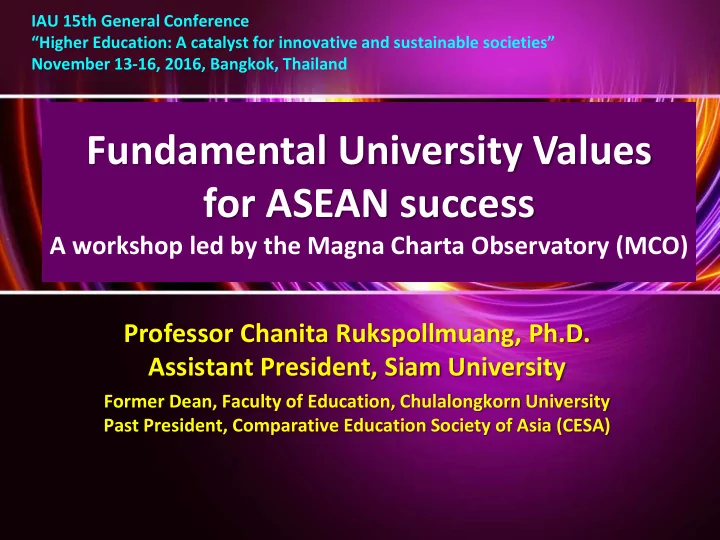
IAU 15th General Conference Higher Education: A catalyst for innovative and sustainable societies November 13-16, 2016, Bangkok, Thailand Fundamental University Values for ASEAN success A workshop led by the Magna Charta Observatory (MCO)


slide-1
SLIDE 1

Fundamental University Values for ASEAN success

A workshop led by the Magna Charta Observatory (MCO)

Professor Chanita Rukspollmuang, Ph.D. Assistant President, Siam University

Former Dean, Faculty of Education, Chulalongkorn University Past President, Comparative Education Society of Asia (CESA)

IAU 15th General Conference “Higher Education: A catalyst for innovative and sustainable societies” November 13-16, 2016, Bangkok, Thailand

slide-2
SLIDE 2

University Values ASEAN Values

What values are cherished? What have researches told us?

slide-3
SLIDE 3

Article: What are the youth values of ASEAN members?

Submitted by editor2 on Fri, 31/10/2014 . Retrieved from http://prachatai.com/english/node/4456

slide-4
SLIDE 4
slide-5
SLIDE 5
slide-6
SLIDE 6

Notes

The most commonly found values:  Unity and nationalistic values  Ethics and civil duty  Respect towards Head of the State  development, education, and health  Multiculturalism and diversity  Political ideology  Values reflect “culture”  Values are “public propaganda” directed towards the youth in

  • rder to shape

and maintain certain ideologies

slide-7
SLIDE 7

PROPOSED GUIDELINES FOR PROMOTING THE ASEAN IDENTITY FOR THE INTEGRATION OF THE ASEAN COMMUNITY 

 To analyze and propose guidelines for

promoting ASEAN identities.

 ASEAN identities as perceived by youth in

universities.

 Methodology: documentary research,

focus group discussion. Research 1

Jaruwan Puangmalee (2015). Doctoral dissertation, Development Education, Department of Educational Policy, Management, and Leadership, Faculty of Education, Chulalongkorn University. (in Thai). Main Advisor: Chanita Rukspollmuang

slide-8
SLIDE 8

Findings:

 Goals (Signifiers):  sense of belonging,  we feeling,  awareness  mutual understanding.  Top 5 identities: 1) peace and harmony 2) stability and solidarity 3) unity 4) cooperation on the basis of mutual benefit 5) interdependence.

slide-9
SLIDE 9

Promotion of ASEAN identity: 3 Stages

First stage: Identity formation

 to promote self-understanding, communication

skills, ASEAN knowledge and international understanding.

Second stage: Identity construction

 to promote collaborative work through

diversities.

Third stage: Identity negotiation

 to promote sense of empathy, dealing with

conflict positively, and effective analysis and evaluation of “others”. (better understanding, sense of belonging to ASEAN, oneness)

slide-10
SLIDE 10

Factors and conditions

 Public sector

 Policy: national/institutional  Appropriate and effective measures

 Private sector and International Organizations

 Financial, nonfinancial support  Staff, volunteers who have ASEAN background

 “Learning” agents

 Formal: Academic sector (University)

 Policy, personnel (administrators and staff)

 Non-formal/ informal: Family, Friends, Media

(Mass media, social media)

slide-11
SLIDE 11

Research 2

How have we implemented Global Citizenship (GC) in Youth ?

Selected findings from Chanita Rukspollmuang, et al. (2015). “Guidelines for Promoting Global Citizenship: International Experiences”. Research Project funded by the Office of Education Council, Thailand. (in Thai)

slide-12
SLIDE 12

Characteristics I D I-D (I-D) x I Rank Skills 4.676 2.8523 1.824 8.530 1 Literacy 4.629 2.9213 1.708 7.904 2 Values and Attitudes 4.692 3.0646 1.627 7.634 3 Knowledge 4.571 3.0962 1.475 6.743 4

Note: Findings from focus group discussion and questionnaire using Modified Priority Needs Index (PNI modified)

slide-13
SLIDE 13

Literacy

What we have done well

  • Aesthetic (arts) literacy
  • Information literacy
  • Health literacy
  • Cultural and multicultural

literacy

  • Moral and ethical literacy

What we should do more

  • Political literacy
  • Environment and ecological

literacy

  • Economic and financial

literacy

  • Civic literacy
slide-14
SLIDE 14

Knowledge

What we have done well

  • International Order
  • Thainess and positioning in

regional/global context

  • Multi-culture
  • Globalization and

Interdependency

  • Global trends and issues

What we should do more

  • Sustainable development
  • Law and legal process
  • Equality and social justice
  • Peace and conflict
  • Rights, liberty and

responsibility

slide-15
SLIDE 15

Skills

What we have done well

  • Career readiness and

competence

  • Flexibility and adaptability to

changes and differences

  • Social and intercultural

collaboration

  • Leadership skill
  • Communication skill

What we should do more

  • Responsible mind (oneself

and society)

  • Multi-lingual skills
  • Information, Media &

Technology competency

  • Critical thinking
  • Conflict management
slide-16
SLIDE 16

Values and Attitudes

What we have done well

  • Empathy
  • Respect others from other

culture

  • Positive thinking/attitudes

(belief in oneself & goodness

  • f people)
  • Self-identity and values
  • Possibility to change the world

What we should do more

  • Concern for environment
  • Capable of multiple

belongings

  • Valuing and respecting

diversities

  • Belief in social justice and

equality

  • Curiosity for knowledge and

information

slide-17
SLIDE 17

University Core Values

Chulalongkorn University Core Values:

  • C (Courage)
  • H (Honor)
  • U (Unity)
  • L (Leading with Vision)
  • A (Appreciation)(Acceptance of differences)
  • Needed Skills:
  • Leadership Skills and Styles,
  • Communication Skills,
  • Conflict Resolution,
  • Negotiation Skills
slide-18
SLIDE 18

Mahidol University

  • Core Values
  • M = Mastery
  • A = Altruism
  • H = Harmony
  • I = Integrity
  • D = Determination
  • O = Originality
  • L = Leadership
  • Siam University
  • Employability
  • Diversity
  • Sustainability
  • Values are set in accordance with the nature and culture of

universities

  • Similar values, different practices
slide-19
SLIDE 19

University and ASEAN Community

Aim:

  • Promoting of ASEAN Awareness and a Sense of Community
  • Preservation and Promotion of ASEAN Cultural Heritage

Roles:

  • Academic : The Bologna Declaration. 1999
  • Curriculum and instruction (Accreditation: credit transfer?, Open Access Platform)
  • Students/faculty exchange
  • Research
  • Research collaboration and networking
  • Community engagement/service
  • Special Projects e.x. H.R.H. projects in Cambodia
  • Chulalongkorn University “One faculty, One Project”
  • Cultural preservation and promotion
  • Cultural exchange for better understanding (appreciation of one’s own and
  • ther cultures)
slide-20
SLIDE 20

Conditions: 3 A

Autonomy Academic Freedom Accountability

slide-21
SLIDE 21

POSSIBLE MEASURES

  • Administrative Measures
  • Policy
  • Plan : enhancing “Fundamental university values

for ASEAN success” from awareness to implementation = cultural learning and appreciation

  • People: Staff, Students
  • Partnership: AUN, ACD University Network
  • Preparation: Needed infrastructure
  • Legal Measures
slide-22
SLIDE 22

JAPAN BASIC ACT ON EDUCATION

(ACT NO. 120 OF DECEMBER 22, 2006)

Article 7 (1) Universities, as the core of scholarship activities, shall cultivate advanced knowledge and specialized skills, inquire deeply into the truth and create new knowledge, while contributing to the development of society by broadly disseminating the results of their activities. (2) University autonomy, independence, and other unique characteristics of university education and research shall be respected. Article 14 (1) The political literacy necessary for sensible citizenship shall be valued in education. (2) The schools prescribed by law shall refrain from political education or other political activities for or against any specific political party.

slide-23
SLIDE 23

FRAMEWORK ACT ON EDUCATION

[ENFORCEMENT DATE: JUN. 22, 2008] [ACT NO. 8915, MAR. 21, 2008, PARTIAL AMENDMENT]

Article 6 (Educational Neutrality) (1) Education shall be operated to perform its functions according to the purpose of the education per se and it shall not be used as a tool for propagating any political, factional or individual biased views. (2) No school founded by the State or local governments shall conduct religious education in favor of any particular religion.

slide-24
SLIDE 24

THAILAND

  • Constitution
  • National Education Act
slide-25
SLIDE 25

CONSTITUTION OF THE KINGDOM OF THAILAND, 1997

Section 42. A person shall enjoy an academic freedom. Education, learning, teaching, researching and disseminating such research according to academic principles shall be protected; provided that it is not contrary to his civic duties or good morals.

slide-26
SLIDE 26

Draft Constitution of the Kingdom of Thailand, 2016

Section 34. A person shall enjoy the liberty to express his

  • pinion, make speech, write, print, publicize, and make

expression by other means. Restriction on such liberty shall not be permitted, except by virtue of the provisions of the law specifically enacted for the purpose of maintaining the security of the State, protecting the rights or liberties of other persons, maintaining public order or good morals of people,

  • r safeguarding the health of the people.

Academic freedom shall be protected, provided that the exercise of such freedom shall not be contrary to the duties of Thai people or good morals of people and shall respect and not impede differing opinions of other persons.

slide-27
SLIDE 27

NATIONAL EDUCATION ACT B.E. 2542 (1999)

Section 19. The provision of higher education shall be provided in the university, institution, college,

  • r other organization under other names in

accordance with the law on establishment of education in higher education level, the law on a founding of such establishment of education and relating laws.

slide-28
SLIDE 28

 Section 45. A private establishment of education shall provide

all level and types of education as prescribed by law. The state shall clearly determine a policy and measure regarding a participation of private sector in education.

 The determination of policy and provision of education plan by

the State, by education service area, or by local administration shall take into account an effect of the provision

  • f education by private sector. The Minister, the education

service area commission, or the local administration shall listen to the opinion of private sector and people and therefore taking into consideration.

 The private establishment of education providing education in

degree level shall operate its business with freedom, be capable of developing its own administration and management system, be flexible, have academic freedom and be under the supervision of the establishment of education council in accordance with the law on private institution of higher education.
slide-29
SLIDE 29

 Section 46. The State shall support a subsidy, a

deduction and exemption of tax, and other privileges which are beneficial to the education of private establishment of education as appropriate as well as promote and support in academic aspect so that the private establishment of education shall achieve a standard and be capable of self-reliance.

slide-30
SLIDE 30

Draft 2017??

THE REVISED NATIONAL EDUCATION ACT (DRAFT)

Note: Still in the process of approval. Not to be quoted.

slide-31
SLIDE 31

Section 8. Principles of educational provision (7) Education shall refrain from politics or be used for political purposes. Educational institutions prescribed by law shall refrain from political bias or beliefs that will lead to social unrest.

slide-32
SLIDE 32

 Section 17. Those involved in national education policy making, ministers, and administrators of MOE must be responsible to formulate policy and measures with concern of continuity and in accordance with the rationale, principles, and guidelines for educational provision stated in this act.  Section 20: educational institutions are responsible for the provision of education that meet the minimum criteria of quality and standards set by the State.  Section 30 educational plans and outcomes must be reported to the public. Interested persons shall have access to these information.

SEPARATE SECTION ON ACCOUNTABILITY OF “ALL”

[FROM POLITICIANS TO SCHOOLS, STUDENTS, PARENTS, SOCIETY]

  • SECTION 17 - 31
slide-33
SLIDE 33

THANK YOU FOR YOUR ATTENTION