Functional Skill ICT Double Study Module 7: Combining and Time - - PDF document

functional skill ict
SMART_READER_LITE
LIVE PREVIEW

Functional Skill ICT Double Study Module 7: Combining and Time - - PDF document

Functional Skill ICT Double Study Module 7: Combining and Time Lesson presenting information: presentation 19-20 Note Two 60-minut e lessons are allocat ed for t he act ivit ies in t his block. Please adj ust overall- and sect ion-specific


slide-1
SLIDE 1

Functional Skill ICT

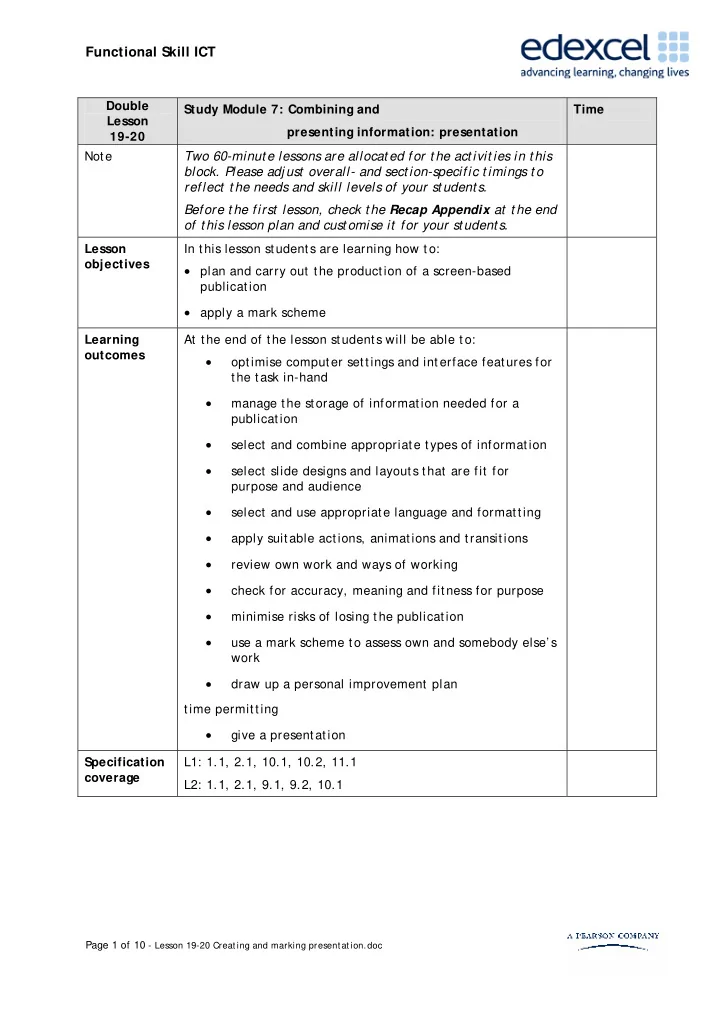
Double Lesson 19-20 Study Module 7: Combining and presenting information: presentation Time Note Two 60-minut e lessons are allocat ed for t he act ivit ies in t his

  • block. Please adj ust overall- and sect ion-specific t imings t o

reflect t he needs and skill levels of your st udent s. Before t he first lesson, check t he Recap Appendix at t he end

  • f t his lesson plan and cust omise it for your st udent s.

Lesson

  • bjectives

In this lesson students are learning how to:

  • plan and carry out the production of a screen-based

publication

  • apply a mark scheme

Learning

  • utcomes

At the end of the lesson students will be able to:

  • ptimise computer settings and int erface features for

the task in-hand

  • manage the storage of information needed for a

publication

  • select and combine appropriate types of information
  • select slide designs and layouts that are fit for

purpose and audience

  • select and use appropriate language and formatting
  • apply suitable actions, animations and transitions
  • review own work and ways of working
  • check for accuracy, meaning and fitness for purpose
  • minimise risks of losing the publicat ion
  • use a mark scheme to assess own and somebody else’ s

work

  • draw up a personal improvement plan

time permit ting

  • give a presentation

Specification coverage L1: 1.1, 2.1, 10.1, 10.2, 11.1 L2: 1.1, 2.1, 9.1, 9.2, 10.1

Page 1 of 10 - Lesson 19-20 Creating and marking presentation.doc

slide-2
SLIDE 2

Functional Skill ICT

Double Lesson 19-20 Study Module 7: Combining and presenting information: presentation Time Starter S how students the image L19.1-5slides or display a similar image with your presentation software. Explain to students that their task is to plan, produce and mark a screen-based presentation for councillors - topic: t he Bentley Charity Ball. If time permits, some will give their presentation to the group representing the councillors. Which software application should I use? The question is, in this case, easier to answer, as S kill Builder 7.9 states specific requirements, including five slides. Share lesson objectives Introduce the lesson and share learning obj ectives and

  • utcomes. Consider mentioning that students will draw up a

personal act ion plan at t he end of the second lesson. 5-10 mins Resources

S tudy Module 7 S AM and Mark S cheme Images: L19.1-5slides L18.3-Bear1- for-your-text L18.4-Bear2- for-your-text L18.5-Bear3- for-your-text L18.6-group-of- bears L18.7-2bears- standing L18.8-2bears- sitting1 L18.9-2bears- sitting2 L18.10-bear1 L18.11-bear2 L18.12-bear3 L18.13-bear4

Creating a publication Write on the board (in the same way as in Lesson 17): (1) understanding requirements (2) planning, then doing (3) reviewing, checking and improving Tell student s that – before they start work - they will, as a group, briefly check key points in relation to this specific presentation. 5 mins

Page 2 of 10 - Lesson 19-20 Creating and marking presentation.doc

slide-3
SLIDE 3

Functional Skill ICT

Double Lesson 19-20 Study Module 7: Combining and presenting information: presentation Time (1) Understanding requirements Ask student s to recall t he requirements for the presentation. Remind them: reduce t he risk of getting it wrong by checking the instructions, do not rely solely on what you think you remember from first reading them! Explain to students that they do not have to work with numbers to create a chart – this has been done for them. Graphs are provided but it is up to them to select the most appropriate. Ask student s how many graphs are provided and how many of those show the break-even point. S poilt for choice? Remind them to rank the graphs, at least mentally. Remind students of the image bank for their posters and inform them it is available for their presentation. Same event – different audience Ask student s how the target audience for the presentation differs from the target audience for the poster. What does that mean for their use of language, style, colour, etc? Move from language fit-for-councillors to other aspects of planning and getting ready to produce a publication. Tell student s that – as with the print ed poster - you play the role of the event organisers: if students have questions, they should address them to you in class. 5-10 mins

Page 3 of 10 - Lesson 19-20 Creating and marking presentation.doc

slide-4
SLIDE 4

Functional Skill ICT

Double Lesson 19-20 Study Module 7: Combining and presenting information: presentation Time (2) Planning Ask student s what slide layout is fit for this particular purpose and audience? S how students the choice of ready-made slide-layout s or show them image L19.2- Slides-Layout or a similar display in the presentation software. Ask student s which category is most appropriate for the task in-hand. Before they answer, point out that there are even more, e.g. Other

  • Layouts. As the requirements specify

text, e.g. details about the organiser and the taxi firm’ s offer, and content (meaning images), e.g. a graph, students should not opt for text-only or cont ent-

  • nly layouts.

Remind students of the criteria they used when looking at newslet ters and posters. The same questions apply to this

  • presentation. There are many aspects to

consider, e.g. writing st yle (key words NOT full sentences), selecting and formatting t ext and images, use of colours, text styles, etc. Given the time limits, advise students not to be over-ambitious but to keep there presentation appropriately straight

  • forward. Spending some minutes t o map
  • ut the presentation first will help them

to structure their presentation and fit all required information on five slides. 5-10 mins Key vocabulary

Presentation Master slide S lide S lide design S lide Layout Background S lide sorter Hide slide S peaker notes S lideshow S lide Transition Action buttons Timings Animation Custom animation Printouts Handouts Notes ages Outline view

Before moving on, remind students that optimising system settings and interface features is part of planning and getting ready. Not e: If st udent s work on t heir present at ion over t wo lessons:

  • conclude Lesson 19 (Plenary) by encouraging st udent s

t o revisit t heir Act ion Plan (homework t ask, Lesson 18) before t hey st art t oday’ s homework: which of t heir act ions will help t hem wit h t he new t ask?

  • use sect ion (3) as t he S

t art er of Lesson 20 5-10 mins

Page 4 of 10 - Lesson 19-20 Creating and marking presentation.doc

slide-5
SLIDE 5

Functional Skill ICT

Double Lesson 19-20 Study Module 7: Combining and presenting information: presentation Time (3) Reviewing, checking and improving Remind students that in their planning they need to allow quality time for all three. Encourage students to quietly recall personal lessons learnt from making the poster and marking it. Do they feel they need to improve on (a) how and (b) when to review and check t heir work? If so, how? Did they have sufficient time to make improvements to their work, especially at the end? If not, how can they improve their time-keeping? Can they use the computer? Presentation software Use the terms in the Key Vocabulary for this lesson to remind students of important t ools and features and how to use them. 5 mins Optional: recap Study Modules 1 – 7 If st udent s need or will benefit from recaps of earlier S t udy Modules, t hen use t he sect ions under Planning in t he double lesson 18 & 19. Creating the Bentley Charity Ball presentation to councillors Write on the board: Functional Skill ICT Evidence needed at end:

  • 1. Final or latest version of presentation file saved as read-
  • nly
  • 2. S

creenshot of folder structure with file names and file types in a t ext document with, in t he footer,

  • candidate name
  • candidate number (if allocated else made up)
  • centre number (if known else made up)

S et a time limit that will challenge your students. Advise them that you will warn them when they have j ust five minutes of working time left. 20-30 mins

Page 5 of 10 - Lesson 19-20 Creating and marking presentation.doc

slide-6
SLIDE 6

Functional Skill ICT

Double Lesson 19-20 Study Module 7: Combining and presenting information: presentation Time 5-minutes warning Announce t hat students have j ust 5 minutes left. When the five minutes are over, call stop. If you see students using t he keyboard or mouse after you have called stop, explain to them that if they did this in the test they would be in breach

  • f examinat ion conditions –

not worth the risk, the harshest sanction would be disqualification. 5 mins Applying the mark scheme S how students the image L19.3-Mark-Scheme-Categories. Remind them that some marks available in Task 3 depend on the successful completion of Task 1 during the first 15 minutes

  • f the test: finding, selecting and saving information from t he

internet, and then inserting it appropriately into a publication (Task 3). 5 mins

Page 6 of 10 - Lesson 19-20 Creating and marking presentation.doc

slide-7
SLIDE 7

Functional Skill ICT

Double Lesson 19-20 Study Module 7: Combining and presenting information: presentation Time Assessing own and a partners presentation Hand out print-outs of t he document L19-Mark-Scheme- presentation or ask students to open it. Give students time to read all entries under the heading Answers. Pair-up students. (Depending on the group it might be better not to have the same pairs as for the printed poster.) Self-assessment Ask student s to honestly assess their own presentation and enter the marks they award themselves in the Own Marks column. Peer-assessment Ask student s to exchange mark sheets, fairly assess their partner’ s presentation and enter marks they award in the Peer Marks column. Ask student s to compare and discuss their decisions. Feed-back on assessments Ask student s for feed-back. Use a show of hands to establish how many pairs agreed

  • 1. 80%
  • 100 %
  • 2. 60%
  • 79%
  • 3. 40%
  • 59%
  • 4. 39%
  • r less?

Note: adj ust the boundaries to reflect the group’ s skill level. Conclude this section by summarising key lessons and introducing the next section. 10 mins Personal improvement plan Ask student s to identify weaknesses (a) in their work, and (b) their ways of working, from underst anding of requirements to saving the final version. Ask them to draw up a personal improvement plan with targets and time scales. 5-10 mins Optional and time permitting: Ask st udent s t o give t heir present at ion t o a group (role- playing t he councillors) – ideally using a dat a proj ect or and big screen. Plenary Remind students of the learning obj ectives and learning

  • utcomes of the double lesson.

5-10 mins

Page 7 of 10 - Lesson 19-20 Creating and marking presentation.doc

slide-8
SLIDE 8

Functional Skill ICT

Double Lesson 19-20 Study Module 7: Combining and presenting information: presentation Time Homework Lesson 19 Ask student s to:

  • 1. revisit the Skill Check on page 13
  • 2. plan and start work on the digital poster as specified in

S kill Builder 7.9

  • 3. keep a log of:
  • a. time spent
  • b. things found easy to do
  • c. things found difficult to do
  • d. actions for improvement plan.

30 mins Homework Lesson 20 Ask student s to:

  • 1. Improve their presentation, save it under a new file

name, and remark it themselves

  • 2. Draw up an personal improvement plan from lessons

learnt creat ing and marking the presentation covering:

  • a. the quality and effectiveness of what they

produce, e.g. the poster

  • b. their own ways of working
  • 3. Complete the digital poster

40 mins

Page 8 of 10 - Lesson 19-20 Creating and marking presentation.doc

slide-9
SLIDE 9

Functional Skill ICT

Appendix: Recap of previous Study Modules General points Group-specific points: Study Module 1: Making the most of your computer

  • Desktop, icons –

put the icon of the software you use frequently into quick launch bar and save time.

  • Windows –

mention resizing to have more than one window as they have to copy information from files provided into their own

  • System setting –

is language set to UK English?

  • Mouse –

need to customise click-speed, for left-handed use?

  • Screen resolution –

is it fit for presentation-work?

  • Printer –

is the default printer fit for purpose or do you have to select another one if they need to print out slide, speaker notes and/ or handouts? Study Module 2: Managing information

  • Folder structures –

tell students they must create a folder specifically for Skill Builder 7.9, but they can decide what structure of subfolders to have underneath it, e.g. one folder per publication.

  • File name –

let three students suggest file names for the poster, then ask the group to comment on them. Remind them file names need to be meaningful and indicate which version of the publication it is.

  • Keeping control of information –

point out that setting a strong password is not appropriate for a piece of work that needs to be marked. How can they make sure that people can look at their work but not change it? Answer: make file read-only.

  • Risk to folders and files –

ask students if they think they need to back-up their work. If so, when they would back-up their files for t he first time, where would they store the back-up, and when would they do subsequent back-ups? (Suggest at important stages rather them every x days).

Page 9 of 10 - Lesson 19-20 Creating and marking presentation.doc

slide-10
SLIDE 10

Functional Skill ICT

General points Group-specific points: Tips for managing information storage (page 11) Point out to students that they gain their first marks by j ust creating a suitable folder struct ure – provided they can provide the necessary evidence. Recap with students how to take a screenshot using Prt S

  • c. Remind them of Lesson 5 and the

advice to use a personalised screenshot template. Reiterate the message t hat typing information into the header and footer every time they take a screenshot is not an efficient way of working as it (1) wastes time and (b) increases the likelihood how making mistakes – t yping in the wrong candidate number will cause problems. Study Module 3: Finding and selecting information Not e: Focus on select ing as st udent s do not have t o find informat ion on t he int ernet .

  • Information overload –

slows you down …

  • be selective - the wording of the last bullet point of S

kill Builder 7.9 says you can, not you must use all information provided

  • when faced with choice, rank information

Study Module 4: Working with structured data Study Module 5: Working with numbers and charts Note: less relevant for producing this printed poster. Study Module 6: Working with text and images

  • Formatting –

different features e.g. font, font size, colour, borders, shading, background, etc.; specific for images: cropping, resizing, compressing

  • Ask student s in what type of file the information is

provided for S kill Builder 7.9 and what that tells them (text file = plain text = needs formatting) Other points:

Page 10 of 10 - Lesson 19-20 Creating and marking presentation.doc