Function Optimization with Local Search Sven Koenig, USC Russell - - PDF document

function optimization with local search
SMART_READER_LITE
LIVE PREVIEW

Function Optimization with Local Search Sven Koenig, USC Russell - - PDF document

12/18/2019 Function Optimization with Local Search Sven Koenig, USC Russell and Norvig, 3 rd Edition, Sections 4.1 and 4.2 These slides are new and can contain mistakes and typos. Please report them to Sven (skoenig@usc.edu). 1 Gradient


slide-1
SLIDE 1

12/18/2019 1

Function Optimization with Local Search

Sven Koenig, USC

Russell and Norvig, 3rd Edition, Sections 4.1 and 4.2 These slides are new and can contain mistakes and typos. Please report them to Sven (skoenig@usc.edu).

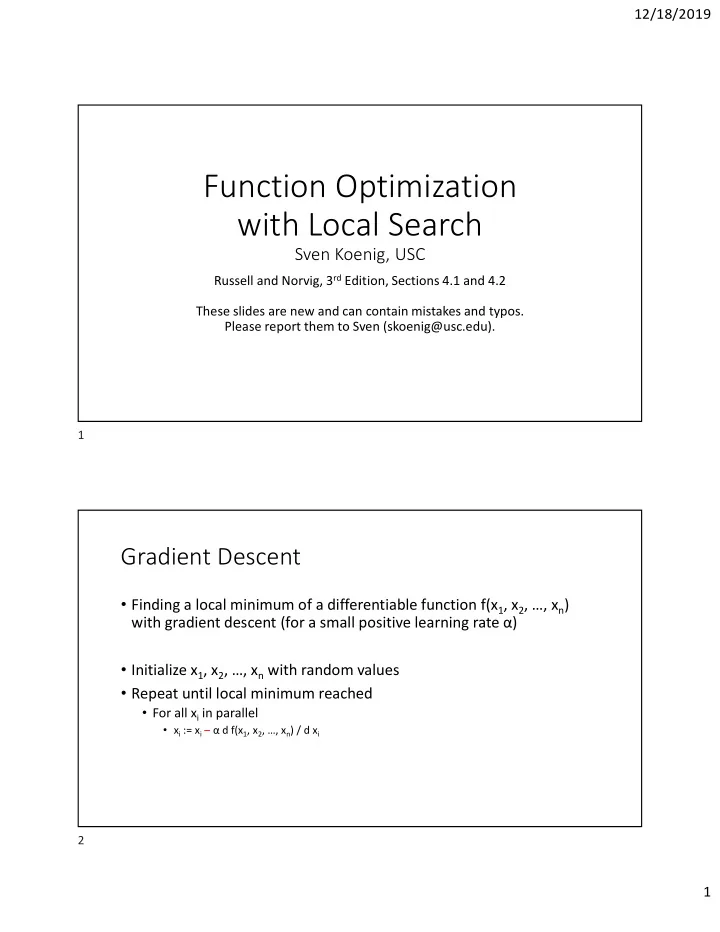
Gradient Descent

  • Finding a local minimum of a differentiable function f(x1, x2, …, xn)

with gradient descent (for a small positive learning rate α)

  • Initialize x1, x2, …, xn with random values
  • Repeat until local minimum reached
  • For all xi in parallel
  • xi := xi – α d f(x1, x2, …, xn) / d xi

1 2

slide-2
SLIDE 2

12/18/2019 2

Gradient Descent

  • Problems and solution approaches
  • Overshooting the local minimum: momentum term
  • Local minima: random restarts, simulated annealing, STAGE
  • Plateaus (one of the issues of threshold activation functions): random restarts
  • Ridges: momentum term

Local minimum Plateau

STAGE (by Boyan and Moore)

  • 1. Use gradient descent with random restarts and remember all

local minima

  • 2. Estimate a function of the local minima
  • 3. Stage 1: use the ending point of gradient descent on the given

function as starting point for gradient descent on the function of the local minima

  • 4. Stage 2: use the ending point of gradient descent on the function
  • f the local minima as starting point for gradient descent on the

given function

  • 5. Go to 2.

3 4

slide-3
SLIDE 3

12/18/2019 3

STAGE STAGE

5 6

slide-4
SLIDE 4

12/18/2019 4

Local Search for Function Optimization

  • From now on
  • Function maximization instead of minimization

(called gradient ascent or hillclimbing)

  • discrete rather than continuous functions

Hillclimbing

  • Combine with random restarts

7 8

slide-5
SLIDE 5

12/18/2019 5

Hillclimbing

  • Example applications (typically NP-hard problems)
  • Map coloring: color all states of a given country with 4 colors so that no

neighboring states have the same color

  • Boolean SATisfiability: find an interpretation that makes a given propositional

sentence true

  • Traveling salesperson problem: visit all given cities in the plane with a shortest

tour (= with the smallest round-trip distance)

Hillclimbing

  • Example applications
  • Map coloring: assign random colors to states, then repeatedly change the color of

some state to decrease the number of neighboring states that have the same color

  • Boolean SATisfiability: transform the propositional sentence into conjunctive normal

form, assign random truth values to all propositional symbols, then repeatedly switch the truth value of some symbol to decrease the number of clauses that evaluate to false

  • Traveling salesperson problem: pick a random tour, then repeatedly perform a “path

reversal” for some pair of cities to shorten the tour (called two-opt algorithm)

A B C D E A B C D E Pick D→E

9 10

slide-6
SLIDE 6

12/18/2019 6

Simulated Annealing

  • Annealing: the process of gradually cooling a liquid until it freezes

If the temperature is lowered sufficiently slowly, the material attains a lowest-energy (= perfect ordered) configuration.

Go downhill with a probability that is the higher the

  • less one goes downhill (∆E) and
  • the fewer iterations (t) simulated

annealing has run = the higher the temperature (T) is decrease the temperature (T) over time VALUE[x] = total energy of the atoms in the material = Hillclimbing with going downhill from time to time

Simulated Annealing

  • Example application: VLSI layout

[www.eg.bucknell.edu/~ee342/recognition/flipflop.gif]

11 12

slide-7
SLIDE 7

12/18/2019 7

Genetic Algorithms

= Hillclimbing with parallel search and going downhill from time to time

Children are “genetic mixtures” of their parents A small number of random mutations occur (to maintain diversity within the population) Individuals get to reproduce the more, the “fitter” they are (= the higher their solution quality is) Individuals are solutions

repeat the hillclimbing iteration

(higher is better) probability of selection increases with fitness (encoded as bit strings)

Genetic Algorithms

  • Problems and solution approaches
  • Forgetting good solutions: retain the best solutions
  • Good encodings are crucial: cross-over of solutions should lead to solutions

most of the time, cross-over of good solutions should have a chance to lead to even better solutions

13 14

slide-8
SLIDE 8

12/18/2019 8

Genetic Algorithms

  • “Genetic algorithms are the 3rd best way of doing just about anything”
  • Example application: the traveling salesperson problem
  • Is ABDCEA a good encoding for a tour? For example, what happens when
  • ne recombines ABD|CEA with BED|CAB?
  • What is a better encoding for a tour?

A B C D E

Genetic Algorithms

  • Example application: evolutionary programming

+ * z x y

  • *

x x y

  • z

x + * * x y x y Cross-over point x*y + z x – y*x x*y + y*x x - z

15 16

slide-9
SLIDE 9

12/18/2019 9

Local Search

  • Want to play around with local search algorithms for constraint

satisfaction?

  • Go here: http://aispace.org/hill/

17