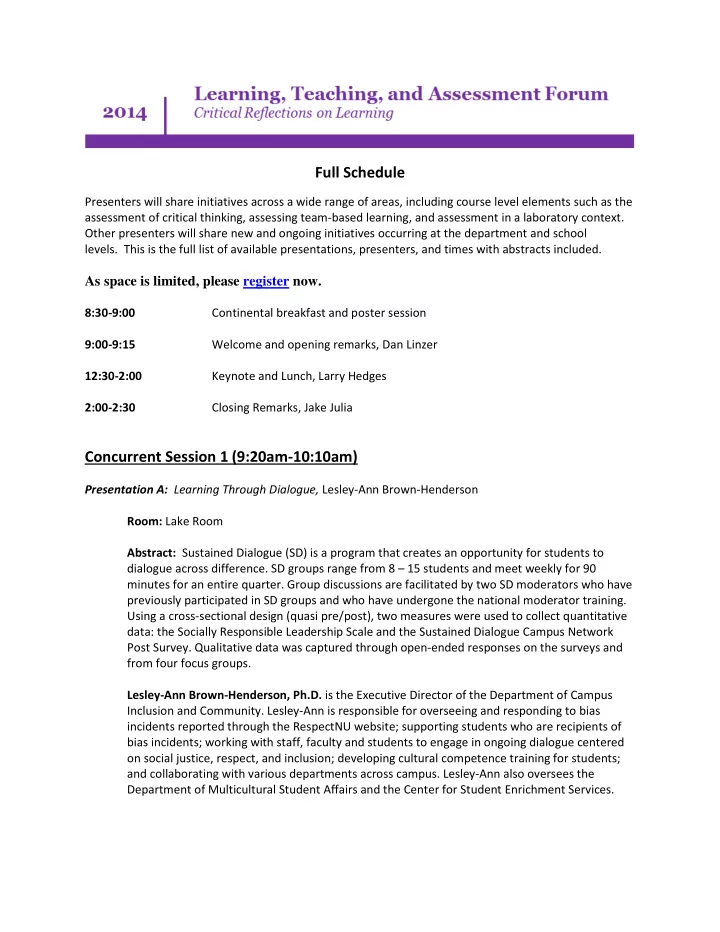
Full Schedule Presenters will share initiatives across a wide range - - PDF document

full schedule
SMART_READER_LITE
LIVE PREVIEW

Full Schedule Presenters will share initiatives across a wide range - - PDF document

Full Schedule Presenters will share initiatives across a wide range of areas, including course level elements such as the assessment of critical thinking, assessing team-based learning, and assessment in a laboratory context. Other presenters


slide-1
SLIDE 1

Full Schedule

Presenters will share initiatives across a wide range of areas, including course level elements such as the assessment of critical thinking, assessing team-based learning, and assessment in a laboratory context. Other presenters will share new and ongoing initiatives occurring at the department and school

  • levels. This is the full list of available presentations, presenters, and times with abstracts included.

As space is limited, please register now.

8:30-9:00 Continental breakfast and poster session 9:00-9:15 Welcome and opening remarks, Dan Linzer 12:30-2:00 Keynote and Lunch, Larry Hedges 2:00-2:30 Closing Remarks, Jake Julia

Concurrent Session 1 (9:20am-10:10am)

Presentation A: Learning Through Dialogue, Lesley-Ann Brown-Henderson Room: Lake Room Abstract: Sustained Dialogue (SD) is a program that creates an opportunity for students to dialogue across difference. SD groups range from 8 – 15 students and meet weekly for 90 minutes for an entire quarter. Group discussions are facilitated by two SD moderators who have previously participated in SD groups and who have undergone the national moderator training. Using a cross-sectional design (quasi pre/post), two measures were used to collect quantitative data: the Socially Responsible Leadership Scale and the Sustained Dialogue Campus Network Post Survey. Qualitative data was captured through open-ended responses on the surveys and from four focus groups. Lesley-Ann Brown-Henderson, Ph.D. is the Executive Director of the Department of Campus Inclusion and Community. Lesley-Ann is responsible for overseeing and responding to bias incidents reported through the RespectNU website; supporting students who are recipients of bias incidents; working with staff, faculty and students to engage in ongoing dialogue centered

  • n social justice, respect, and inclusion; developing cultural competence training for students;

and collaborating with various departments across campus. Lesley-Ann also oversees the Department of Multicultural Student Affairs and the Center for Student Enrichment Services.

slide-2
SLIDE 2

Presentation B: A Curriculum Reflecting National Standards and Students’ Self-Efficacy Belief in Second Language Education, Ihnhee Kim Room: Rock Room Abstract: Recently, effective curricular design that meets the goals outlined by the National Standards in Foreign Language Education has become a more pressing issue. This presentation introduces ideas on how language instructors incorporate the standards into the syllabus and assessment of the outcomes reflecting students’ perception and their needs in language

  • learning. In sharing the results of implementing “Backward Design” and adapting “Self-Efficacy”

in curriculum design, the presenter will discuss a better way to meet students’ learning needs as well as achieve the goals of the national standards. Ihnhee Kim, Ed.D. is an assistant professor of Korean at the department of Asian Languages and

  • Cultures. Her specialties are bilingualism, second language education and curricular

development. Presentation C: The Value of Active Learning, Candy Lee Room: Northwestern Room Abstract: Active learning is a popular term that connotes the higher order thinking skills articulated in Bloom's taxonomy and is manifested in a classroom environment promoting students becoming active in the learning process. Active learning showcases students doing work that engages them in the process of learning, synthesis and evaluation. The presentation has some examples of current active learning activities that students produced to show that the learning objectives were met. Candy Lee is a professor at Medill, teaching in journalism and in integrated marketing

  • communications. She was Teacher of the Year in 2012 for Integrated Marketing
  • Communications. Previously she was vice president of marketing at The Washington Post,
  • verseeing multiple functions, from marketing to research, and originating innovative programs.

Before joining The Washington Post, Lee was president of ULS Loyalty Services, the sister company of United Airlines. Lee oversaw a range of businesses that included united.com; the Mileage Plus credit card group; Mileage Plus program and its partners; media on planes and

  • ther business arenas. Just prior to United Airlines, Lee was managing director at iFormation

Group, formed by Goldman Sachs, Boston Consulting Group and General Atlantic Partners. Presentation D: Assessing Student Learning in Inquiry-Based Biology Laboratory Courses, John Mordacq Room: Arch Room Abstract: In 2012-2013, we redesigned the Introductory Biology Courses (~300 students) to include inquiry-based projects. In these courses, students engage in somewhat open-ended projects that they design through a guided process. These courses promote skills such as experimental design, research proposal development, and scientific presentation. A

slide-3
SLIDE 3

combination of student surveys was used to access the student’s perception of their scientific

  • skills. The pre- and post-course survey data show that while some commonly accepted

perceptions (among students) remain the same, the course does result in a positive shift/change in perceptions of their ability to design experiments and perform research. The discussion will include how the assessment data informed the redesign/improvement of the courses over a two-year period. John Mordacq, Ph.D. Associate Professor of Instruction, Northwestern University

Concurrent Session 2 (10:15am-11:05am)

Presentation E: Creating a Community Safety Net for Individuals in Distress: Assessing Effectiveness of the Question-Persuade-Refer (QPR) Suicide Prevention Gatekeeper Training Program, Courtney Albinson and Monika Gutkowska Room: Rock Room Abstract: The Question-Persuade-Refer (QPR) learning assessment project explores the immediate and longer-term effects of participation in a suicide prevention gatekeeper training program on students, faculty, and staff members’ knowledge, attitudes, and behaviors related to suicide prevention. More than 2000 members of the Northwestern community have completed QPR training, with 310 participants (44% undergraduate students , 35% graduate/professional students, 20% faculty/staff) completing pre- and post-test measures assessing their basic knowledge of suicide prevention, their confidence and willingness to intervene with persons who could be considering suicide, perceptions of their abilities to effectively ask someone about suicide and persuade him/her to get help, and their knowledge of national/local referral resources. Overall, the results suggest that QPR is a significant learning

  • experience. Participants were more accurate in their knowledge of suicide facts and warning
  • signs. They also perceived themselves as significantly more confident, willing, and more likely to

intervene with potentially suicidal persons. Courtney Albinson, PhD Staff Psychologist and Associate Director of Outreach and Education Counseling and Psychological Services Abstract Monika Gutkowska, PsyD is a Staff Psychologist and Coordinator of Suicide Prevention Programming in Counseling and Psychological Services Presentation F: Fostering Meaningful, Purposeful, and Goal-Directed Discourse with iPad Technology, Franziska Lys Room: Lake Room Abstract: This presentation will explain how iPad technology was used in an advanced conversation class to fostering meaningful, purposeful, and goal-directed discourse among

  • students. A detailed analysis of pre-course and post-course recorded speech samples analyzes
slide-4
SLIDE 4

language development. Results of tracking of the use of the technology shows how often and how long students engaged in face-time and recording activities. Results from an extensive questionnaire reveals student attitudes towards the technology and self-perceived learning

  • utcomes.

Professor Franziska Lys, PhD is Professor and former chair of the Department of German. She is the co-producer and co-director of four documentaries and has developed several online learning environments. She has published a wide variety of material at the intersection of second language acquisition and computer-assisted language instruction. Dr. Lys has received numerous awards for her work, and most recently, she held the Alumnae of Northwestern Teaching Professorship at Northwestern University. Presentation G: Modular Learning - The Playwriting Module, Laura Schellhardt Room: Arch Room Abstract: Four years ago, the School of Communication launched modular education - an initiative designed to comprehensively immerse students in a specific learning objective over the course of four years. Each module pairs formal instruction with on and off campus events and professional attention in a chosen field, which culminates in a capstone project designed to celebrate and assess the work. The Playwriting Module was among the first to launch, and we are just beginning to see the results. This discussion will take a closer look at the module's success, where we hope it can improve, and how it has helped us assess long term learning. Laura Schellhardt is a Northwestern alumna, Laura Schellhardt earned her M.F.A. at Brown University under the direction of Paula Vogel before returning to the University in 2008 where she is currently Senior Lecturer in the Department of Theatre. She has enhanced and organized the playwriting curriculum offered as part of the School of Communication’s module-based education initiative. Her courses range from introductory and genre courses to the Advanced Playwriting Sequence. She co-teaches the New Play Collaboration class, which culminates in staged readings of undergraduate plays at Northwestern’s own Agnes Nixon Playwriting Festival, and she has recently devised an opportunity for advanced students to script a play based on a request from a local professional theatre. Schellhardt designs her classes to facilitate the “alchemy” of student playwriting—the balance between discussion and action, between time alone and time in workshop, between public display and private experimentation. Her efforts have led to an increased demand for the Advanced Playwriting Sequence and to the professional successes of her students after graduation. Last year she received the Charles Deering McCormick Distinguished Lecturer Award. Presentation H: Assessing Academic Advising in Weinberg College, Liz Trubey, Laura Panko, and Jim O’Laughlin Room: Northwestern Room Abstract: A guiding principle of Weinberg College Advising is that advising is teaching, and that students are learning from their advisers not just information about the curriculum but how to

slide-5
SLIDE 5

approach the questions and problems at hand. We have long used an annual student satisfaction survey, analogous to the CTEC questions, to get feedback from students. In Fall 2014, Weinberg Advising expanded our mission to include first-year students at the start of their second quarter, while in the past we began advising them at the start of the second year. We wanted to assess student response to the new system, as well as improve the survey through which we have gauged satisfaction in the past, especially in the wake of that new population of students, whose needs had previously been met by advisers with a very small cohort of

  • advisees. We revised our survey questions and how we delivered it; key questions asked about

adviser availability, adviser knowledge, and the extent to which students felt comfortable talking to their adviser. Our presentation will discuss our specific work with the satisfaction survey in light of our larger plans to assess the work we do in Weinberg Advising. Liz Trubey is Director of Academic Advising and Associate Professor of Instruction in English. Laura Panko is a College Adviser and Lecturer in Biological Sciences. Jim O'Laughlin is a College Adviser and Associate Professor of Instruction in the Writing Program.

Concurrent Session 3 (11:30am-12:20pm)

Presentation I: Teaching and Assessing Residents in the Operating Room, Jonathan Fryer and Mary Schuller Room: Rock Room Abstract: There is significant concern among professional surgery societies and surgeons that general surgery residency programs are not adequately preparing residents for independent surgical practice. Surgical faculty in teaching hospitals must balance their responsibility to patients to ensure optimal operative outcomes with their responsibility to prepare residents for independent practice. The shortened resident work hours that were put in place nationally and the emphasis on turning over operative rooms quickly to reduce hospital costs restrict the amount of teaching time available between teacher (attending) and learner (resident). To date no system has been developed that monitors and supports resident growth to independent practitioner that is timely, easy and simple to complete. This session will describe a 1- dimensional behaviorally-anchored ordinal scale researched and developed by a team at NU(including the presenters), Massachusetts General Hospital and the University of Kentucky to assess the degree of guidance an expert provides to a trainee or learner during the most critical portion of a procedure. This scale is known as the Zwisch scale. We will also introduce participates to the smart-phone based dissemination and data aggregating system known as PASS(Procedural Autonomy and Supervision System) that facilitates gathering and analyzing the Zwisch learner data. We implemented the system in 2013 and gathered data for 1490 procedures performed with 31 residents over the course of 6 months. In this workshop we will 1)demonstrate the Zwisch scale and PASS system 2) relay our research findings on the reliability and validity of the system 3) explore the utility and feasibility of the system as it applies to other disciplines developing learners to become independent practitioners.

slide-6
SLIDE 6
  • Dr. Jonathan Fryer obtained his MD and his general surgery resident training at the University of

Manitoba in Canada. He completed his fellowship training in transplant surgery at the University

  • f Minnesota and the University of Western Ontario. He subsequently started his career as a

transplant surgeon at Northwestern University where he has remained for 20 years and is currently a Professor of Surgery and Director of the Liver transplant program. He was recently appointed to Vice Chair of Education for the Department of Surgery. Mary Schuller obtained her MSEd at Northwestern University. She started her career at Northwestern University in the Division of Academic Technologies where she led the support and training for several instructional technologies including the University's course management

  • system. In 2008 she transitioned to the Department of Surgery at the Feinberg School of

Medicine and Northwestern Memorial Hospital where she serves as the manager of surgical

  • education. Mary's major career focus has been in education since serving as an education

volunteer with the American Peace Corps. Her primary focus is the use of technology to facilitate teaching and learning. She has been a key player in the development of the PASS(Procedural Autonomy and Supervision System) a strategy for enhancing operative teaching and assessment based on progressive resident autonomy. Presentation J: Real-Time Learning Via Discussion Pods: Implications for Teaching Online and in The Classroom, Daniel Gruber Room: Arch Room Abstract: I hope this topic will be interesting to anybody who has small group discussion as part

  • f their course learning objectives as well as faculty teaching online. It will be focused on two

questions: How to effectively engage students in small group discussions online in order to solidify learning goals? How can the techniques used in an online learning environment be brought into the classroom? The opportunity for real-time peer-to-peer learning can be a wonderful addition to a class, but it can also be challenging to determine the best way to manage the discussion. I will describe my experiences using the discussion pods on the Adobe Connect platform as part of an online graduate student class that I teach. I expect there are faculty across campus who can share their experiences with this technology (and others) in

  • rder to create a set of additional tools for attendees at the session.

Daniel Gruber is an Assistant Professor of Integrated Marketing Communications in the Medill School and Courtesy Professor of Management & Organizations in the Kellogg School at Northwestern University. Before joining the faculty in 2009, Dan completed his Ph.D. at the University of Michigan’s Ross School of Business. Dan’s research focuses on organizational resilience, the media industry, and managing integration. His teaching centers on strategic communications, organizational change, and media management. Dan has worked for media and financial services companies and has won teaching awards at Northwestern University and the University of Michigan. Presentation K: Switched On, Tuned In: Engaging Students in Critical Thinking in Lectures, Anna

slide-7
SLIDE 7

Parkinson Room: Northwestern Room Abstract: Initiating and maintaining student engagement in lecture courses requires more than interesting course content. Using “pedagogies of engagement” (Smith et al.) to encourage students’ critical engagement in class, my classes included punctual questions, group work (think-pair-share), and group discussion in the lecture setting. In addition to implementing these, I felt that more attention needed to be paid to critical writing due to the course’s emphasis on analytical papers as a primary mode of assessment. Thus, a lecture session was devoted to a critical writing workshop focusing on peer review. In spite of the unorthodox move

  • f conducting a writing workshop in this setting, a post-workshop survey indicated that the

majority of students support the inclusion of critical writing of this kind in the lecture setting for both intellectual and social reasons. Anna Parkinson is an assistant professor in the Department of German, an affiliate of the Gender and Sexuality Program, and a member of the advisory board of the Critical Theory

  • Cluster. Her teaching and research interests include postwar German literature and film,

psychoanalysis and affect theory, gender and sexuality studies, critical theory, and Holocaust and memory studies. Her book An Emotional State: The Politics of Emotion in Postwar West German Culture is forthcoming in Fall 2015 with the University of Michigan Press. Presentation L: A Course in Emotional Intelligence, David Shor and Joe Holtgreive Room: Lake Room Abstract: Emotional intelligence (EI) is defined as an ability to recognize and effectively manage emotions in ourselves and with others (Mayer, Caruso, & Salovey, 2000). Emotionally intelligent people are able to accurately perceive emotions, access, understand, and generate emotions, and reflectively regulate emotions to promote growth (Mayer, Salovey, & Caruso, 2004). The purpose of PRDV 395 is to introduce EI theories and concepts to increase knowledge of the topic and to provide applicable tools for skill building in the realms of peak performance, stress management, intrapersonal and interpersonal awareness, resilience/adaptability, and general

  • mood. Learning outcomes are assessed using the EQ-i 2.0, a scientifically validated and widely

used EI assessment as a pre-test/post-test instrument. Further information is gathered from CTEC feedback, written assignments, and retrospective interviews with class participants.

  • Dr. David Shor is Director of Clinical Services at Counseling and Psychological Services (CAPS) at

NU where he has served for 15 years. Dr. Shor's areas of specialization include emotional intelligence, peak performance, male development, healthy relationships, mental health consultation, and counseling center scope of practice. He earned his doctorate in counseling psychology at Northwestern University Joe Holtgreive is Assistant Dean, Lecturer, and Director of the McCormick Office of Personal

  • Development. Joe has spent the past 20 years helping undergraduate engineering students
  • vercome challenges to achieve success. He has also collaborated with colleagues across

campus to create and deliver curriculum on mindfulness, emotional intelligence, and design

slide-8
SLIDE 8
  • thinking. Prior to joining McCormick he worked as both a change management and systems

consultant for Andersen Consulting, now Accenture Consulting, and is also a trained mediator. Joe earned a B.S. in Industrial Engineering from Northwestern University and an Ed.M. in Education from Harvard University with an emphasis in leadership and adult development.

Poster Session and Coffee Break (11:05 - 11:30)

Poster A: Northwestern University Student Learning Outcomes Assessment Framework, Northwestern University Assessment & Accreditation Council Abstract: This poster demonstrates the Learning Outcomes Assessment Framework that was created by Northwestern University’s Assessment & Accreditation Council. This assessment framework is designed to serve as a tool to build upon the work that has been done by those with well developed assessment programs to contextualize them within the larger assessment goals and structures of the institution as well as those just beginning to employ more systematic assessment mechanisms, and to help develop and guide those initiatives. The framework should be seen as a resource providing a rough blueprint to be fleshed out according to the specific needs of the program. The groundwork already laid at Northwestern need not be re-created, thus enabling the assessment efforts to begin a few steps further along. How assessment within a unit or program or college links to and furthers the larger goals of the institution will become clearer when it can be placed within this framework. Poster B: Cataract Surgery Training to Achieve Mastery: The Northwestern System, Robert Feder, Dmitry Pyatetsky, and Nicholas Volpe Abstract: Our goal is to have every resident master the skills involved in cataract surgery by the end of residency. Recognizing the variation in learning styles we have implemented a multifaceted training program which includes pre and post tests, computer simulation, supervised wet labs, assigned readings, surgical planning conferences, role play informed consent, certification of lens implant measurement, video recording of resident cataract surgery with self reflection and rating of each step, rating of each step by the supervising attending surgeon according to the same rubric, analysis of postoperative results relative to intended target results, video conferences, and presentation at Grand Rounds. We will evaluate written test scores, simulator scores, video ratings, and outcome by individual, by class, over a 3-year training program, or over time. This comprehensive approach could be adapted by other departments, hoping to create a more uniform training for mastery of surgical skills and judgment. Robert S. Feder, MD, MBA is a Professor and Chief of Cornea and External Eye Disease in the Department of Ophthalmology, Northwestern University Feinberg School of Medicine. Dr. Feder is a member of the Feinberg Academy of Medical Educators, an elite teaching group at

  • Northwestern. He has served as a consultant for the FDA and is a regular examiner for the

American Board of Ophthalmology. He is currently the chair of the Preferred Practice Pattern Committee for the American Academy of Ophthalmology (AAO). He has received the AAO Senior Achievement Award, the Illinois Eye Bank Gift of Sight Award, and multiple service

  • awards. He is a coauthor of the Basic and Clinical Science Curriculum texts on cataract surgery
slide-9
SLIDE 9

and refractive surgery. The second edition of his best-selling book, The LASIK Handbook: a Case- based Approach is currently in print. He has lectured nationally and internationally on topics related to corneal disease and refractive surgery. Dmitry Pyatetsky, MD is an Assistant Professor of Ophthalmology at the Northwestern Feinberg School of Medicine and Director of the Ophthalmology Residency program at Northwestern. In that role he has completely revamped the ophthalmology training program. He serves as Ophthalmology Chief at the Jesse Brown Veteran's Hospital. Dr. Pyatetsky has special expertise in inflammatory diseases of the eye. Nicholas J. Volpe, MD is the George and Edwina Tarry Professor and Chairman of the Department of Ophthalmology at Northwestern Feinberg School of Medicine. He is recognized as a national and international leader in the field of resident graduate medical education. He has published more than 100 scientific and numerous book chapters. He recently published the second edition of his textbook, Neuro-ophthalmology- -Diagnosis and Management, which is the definitive single volume text in the field of neuro-ophthalmology. In addition to many awards received throughout his career for both his clinical work and resident education, he has received the Senior Achievement Award from the American Academy of Ophthalmology, the Straatsma Award for excellence in resident education from the AAO and the Association of University Professors of Ophthalmology. He has lectured around the world on topics related to neuro-

  • phthalmology and ophthalmology education.

Poster C: Can iPads in the Language Classroom Enhance Student Assessment: Interim Results From an Ongoing Course, Uri Horesh Abstract: In the Fall 2014 quarter, iPads have been introduced to Arabic language classrooms (3rd & 4th years) for the first time at Northwestern. They are being used to enhance immersion, to help facilitate typing in the target language, to use audiovisual materials, integrate with Canvas and provide intimate feedback to students. This poster provides an interim evaluation of the efficacy of this experience in terms of assessment and student involvement. Also integrated will be students’ reactions to the project as collected through a Small Group Analysis conducted by Searle Center teaching consultants halfway into the quarter. This interim evaluation of the iPad project will be followed by a more rigorous evaluation to be presented once the course has come to completion. Uri Horesh (PhD, Linguistics, Essex, 2014) is Assistant Professor of Instruction in the Program in Middle East and North African Studies, where he also serves as Language Coordinator. His research interests are in Arabic sociolinguistics, language contact across Semitic languages and the integration of dialect instruction in the teaching of contemporary Arabic. Poster D: Project Wildcat – A Powerful Learning Experience Personal Transformation and Growth through Experiential Learning in the Wilderness, John Huston and Jason Hanson Abstract: Project Wildcat is an eight-day hiking and backpacking trip for new students, which

  • ccurs just before Wildcat Welcome. This assessment project explores what students learned

about themselves, others, and Northwestern through this unique experience. Although this is a year of transition in how we assess this program, survey data collected at two points in time (on the way home from the camping trip and two months later) and focus groups conducted nine

slide-10
SLIDE 10

months later suggest that, in addition to facilitating the transition to college, this program has a powerful impact on personal development, interpersonal competence, cognitive and practical skills, and the ability to work with people from different backgrounds. John Huston is the Project Wildcat Safety and Program Advisor, he works out of the Center for Student Involvement. John is a wilderness professional, outdoor educator, motivational speaker, polar explorer, and safety consultant. He received his Bachelor's degree from Northwestern University in 1999, where as a student he co-founded Project Wildcat. He worked as a wilderness instructor for Outward Bound for six years and then moved onto a career as a professional polar explorer. John has completed major expeditions on Greenland, to the South Pole, to the North Pole, and in the Canadian Arctic. He is also a published author. In 2011 Northwestern University hired John to oversee the Project Wildcat program. Jason Hanson is the Assistant Director for Leadership Development programs and Social Justice in the Center for Student Involvement. Prior to joining CSI in 2010, he worked in Northwestern’s Residential Services as the Area Coordinator for Foster Walker and Seabury. Jason earned his Bachelor’s degree from Northern Michigan University and completed his Master’s degree in Northwestern University’s Sports Administration program. Outside of working with students, Jason’s passions center on being active in the outdoors. Poster E: Enhancing Problem Solving in a Biomedical Engineering Class, Reva Johnson, and Robert Linsenmeier Abstract: Engineers need to solve problems systematically, but the necessary skills are not

  • ften explicitly taught or evaluated. In this preliminary work, we implemented new teaching

methods and evaluations that focused on problem-solving skills. First, we centered a discussion section on a multi-step word problem unrelated to course content. The unfamiliar problem separated problem-solving skills from content material and allowed students to focus on the problem-solving process. Second, we devoted several follow-up discussion sections on guided multi-step problems that incorporated course content material. These sessions gave students problem-solving practice with immediate feedback available from teaching assistants. Third, we

  • btained data on students' attitudes towards problem-solving and their perceived education on

problem-solving. This data will be used to guide future initiatives on problem-solving education and strategies. Reva Johnson is a PhD candidate in Biomedical Engineering, and is completing her doctoral research in the Center for Bionic Medicine at the Rehabilitation Institute of Chicago. Her research interests include learning and adaptation during prosthesis control, human-machine interfaces, and STEM education. Robert Linsenmeier, PhD. is Professor of Biomedical Engineering, Neurobiology, and Ophthalmology as well as the Director of the Northwestern Center for Engineering Education Research and Leader of the Northwestern component of the national Center for the Integration

  • f Research, Teaching, and Learning (CIRTL.net). His main interests are in mammalian retinal

physiology and education research. Poster F: The Challenges of Teaching a Less-Commonly-Taught Language (LCTL), Richard Lepine

slide-11
SLIDE 11

Abstract: Poster presentation on teaching Swahili and other LCTLs at Northwestern, with emphasis on the pedagogical uses of Learning Management Systems (LMS).

  • Dr. Richard Lepine is a senior lecturer in the Program of African Studies. His current

appointment involves serving as the coordinator and sole instructor of Swahili language and cultural studies. Previously, he also taught courses on African-language oral traditions, literatures and film studies, and was the director of the Program of African & Asian Languages from 1993-2005. For more than 25 years he has also been an active contributor to the MultiMedia Learning Center, Academic and Research Technologies, the Council on Language Instruction, and the Residential College system. Poster G: Experiential Learning The German Research Project: Exploring Hamburg, Franziska Lys, and Peter Brandes Abstract: The Department of German has designed a new two-quarter program for undergraduate students to engage in guided, supervised research in the Humanities combining the active use of a foreign language with research in cultural, political, and historical subject

  • areas. The goal of the German Research Project: Exploring Hamburg is to combine classroom

learning with productive fieldwork in the city of Hamburg, Germany, all carried out in the foreign language. Franziska Lys is professor of German in the Department of German. In her research she is concerned with the application and evaluation of the effectiveness of technological innovations to improve the learning of foreign languages as reflected in her most recent publications, The Development of Oral Proficiency in Advanced Learners Using iPads (LL&T. 2013. 17(3), 94-116) and Computer-Mediated Grammar Teaching and its Effect on Different Language Tasks (Learner- Computer Interaction in Language Education. CALICO. 2013. 166-186). Peter Brandes is DAAD visiting professor in the Department of German at Northwestern. His research and teaching interests include Visual Arts studies, media theory, aesthetics, Goethe era, history of knowledge, narratology. Poster H: Mentored Discussions of Teaching, Robert Linsenmeier, Nancy Ruggeri, and Louise Edwards Nieman Abstract: Northwestern is a member of the NSF-sponsored Center for the Integration of Research, Teaching, and Learning (CIRTL.net), whose mission is to improve undergraduate STEM education by preparing PhD students and postdocs for their eventual role as faculty members. CIRTL has a number of online programs, and “CIRTL at Northwestern” offers other programs locally in collaboration with the Searle Center for Advancing Learning and Teaching. In Spring quarter of 2013 we initiated a new program called Mentored Discussions of Teaching, which is now in its fourth iteration. The main objectives were to 1) allow PhD students and postdocs to

  • btain some new perspectives on teaching in an activity that has a low barrier to participation,

and 2) build a learning community about teaching that involves STEM faculty members directly. This presentation will report assessment data, largely from the 2013-14 academic year, that show the strong positive benefits of this program, and the remaining challenges.

slide-12
SLIDE 12

Robert Linsenmeier, PhD. is Professor of Biomedical Engineering, Neurobiology, and Ophthalmology as well as the Director of the Northwestern Center for Engineering Education Research and Leader of the Northwestern component of the Center for the Integration of Research, Teaching, and Learning. His main interests are in mammalian retinal physiology and education research. Nancy Ruggeri, Ph.D. is Associate Director of the Searle Center for Advancing Learning and Teaching, where she directs the Graduate and Postdoctoral programs. She is also institutional co-leader for the Center for the Integration of Research, Teaching, and Learning at Northwestern, which aims to improve student learning in STEM by providing professional development for future faculty. Her disciplinary background is in the biological sciences and her research interests are in assessing student learning and critical thinking in STEM. Louise Edwards Neiman is an advanced graduate student in the Interdisciplinary Ph.D. in Theatre and Drama. She has assisted with several programs at the Searle Center, and in 2013- 14, she helped to improve and administer Mentored Discussions of Teaching Poster I: Debate in the Classroom: Implementation and Assessment, Désirée Weber Abstract: I explore the role that debate activities can play in the humanities and social science

  • classroom. After establishing the basic parameters of debate, the following issues are

addressed: firstly, the range of suitable debate activities/methods for the classroom (which vary by characteristics such as level of preparation, time required, number of participants etc.) and their benefits. Secondly, I address how two variations of debate activities are best implemented in a classroom setting, drawing on evidence from my own teaching experience. Thirdly, I explore best practices for assessment and how to integrate debate activities into larger learning

  • bjectives.

Désirée Weber is a Ph.D. Candidate in Political Science with concentrations in contemporary political theory and international relations. She also works with the Chicago Debate League to administer academic debate tournaments and has developed qualitative assessment benchmarks for the teaching of academic policy debate. Her seven years as a high school debate coach serve as excellent experience to integrate debate activities into the classroom. Her interest in teaching has been rewarded with a Searle Center Graduate Teaching Fellowship and TGS/Weinberg Graduate Teaching Award. Poster J: Using CTECs to enhance learning and teaching at Northwestern, Alison Lanser Phillips, Susanna Calkins, and Muveddet Harris Abstract: The study described here details a pilot initiative in which questions related to learning

  • bjectives were added to university CTECs. It demonstrates how assessment and evaluation can

be used to support student learning, but is only indirectly about student learning. Our project focuses on getting faculty to reflect critically on the learning objectives that they develop for their courses and modules. In Fall 2012, the University Registrar and the Searle Center for Advancing Learning and Teaching, under the auspices of the University assessment council and the University CTEC committee, collaborated in a pilot study to add four new questions to the University CTECs related to the assessment of learning objectives (3 quantitative and 1 open- ended qualitative). The study was conducted between Fall 2012 and Spring 2014. We believe

slide-13
SLIDE 13

that including questions that focus on learning objectives in the CTECs is crucial for creating an environment that focuses on learning at the university. We think it is important for instructors to identify what they want their students to learn, by specifying what they want their students to be able to do, know or value by the end of the course, and make those expectations

  • transparent. By adding questions about learning objectives, students will provide meaningful

information to instructors about their experience of learning in the course. By asking questions about learning objectives, we are not seeking to make judgments about teaching, but rather to help faculty gather information about how well the course was aligned around learning. Alison Lanser Phillips, MLA works in the Office of the Registrar as an Assistant Registrar for Course and Teacher Evaluations. Susanna Calkins, Ph.D. directs the Faculty Programs at the Searle Center for Advancing Learning and Teaching. Muveddet Harris, M.S. is Faculty Programs Associate at Searle Center for Advancing Learning and Teaching