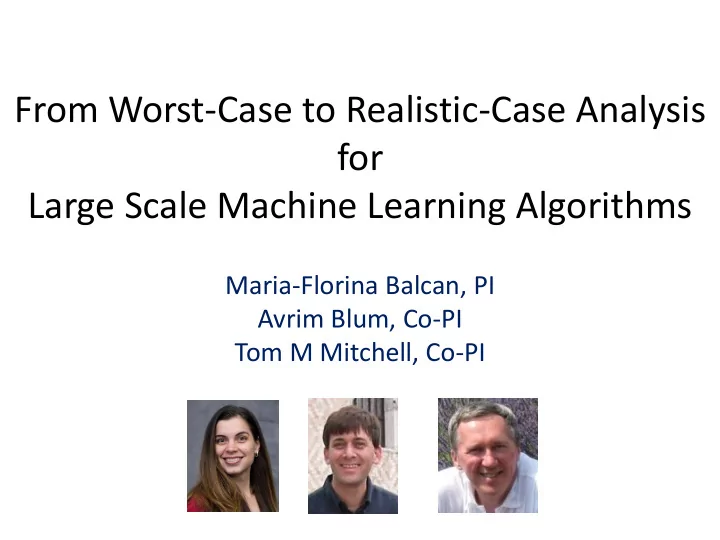
From Worst-Case to Realistic-Case Analysis for Large Scale Machine - - PowerPoint PPT Presentation

from worst case to realistic case analysis for large
SMART_READER_LITE
LIVE PREVIEW

From Worst-Case to Realistic-Case Analysis for Large Scale Machine - - PowerPoint PPT Presentation

From Worst-Case to Realistic-Case Analysis for Large Scale Machine Learning Algorithms Maria-Florina Balcan, PI Avrim Blum, Co-PI Tom M Mitchell, Co-PI Students Travis Dick Nika Haghtalab Hongyang Zhang Motivation Machine learning


slide-1
SLIDE 1

From Worst-Case to Realistic-Case Analysis for Large Scale Machine Learning Algorithms

Maria-Florina Balcan, PI Avrim Blum, Co-PI Tom M Mitchell, Co-PI

slide-2
SLIDE 2

Students

Travis Dick Nika Haghtalab Hongyang Zhang

slide-3
SLIDE 3

Motivation

  • Machine learning increasingly in use everywhere
  • Significant advances in theory and application
  • Yet large gap between the two

– Practical success on theoretically-intractable problems – Theory focused on learning single targets. Large-scale systems aim to learn many tasks, and to use synergies among them to learn faster and better

“it may work in practice but it will never work in theory”?

slide-4
SLIDE 4

Example: NELL system [Mitchell et al.]

(Never-Ending Language Learner)

  • Learns many (thousands) of categories

– river, city, athlete, sports team, country, attraction,…

  • And relations

– athletePlaysSport, cityInCountry, drugHasSideEffect,…

  • From mostly unlabeled data (reading the web)
  • ford makes the automobile escape
  • camden_yards is the home venue for the sports team baltimore_orioles
  • christopher_nolan directed the movie inception
slide-5
SLIDE 5

High level goals: address the gaps

  • Machine learning increasingly in use everywhere
  • Significant advances in theory and application
  • Yet large gap between the two

– Practical success on theoretically-intractable problems – Theory focused on learning single targets. Large-scale systems aim to learn many tasks, and to use synergies among them to learn faster and better

slide-6
SLIDE 6

Clustering

Maria-Florina Balcan, Nika Haghtalab, and Colin White. k-Center Clustering under Perturbation Resilience.

  • Int. Colloquium on Automata, Languages, and Programming (ICALP), 2016.

Core problem in making sense of data, including in NELL

Given a set of elements

  • Partition into 𝑙 clusters
  • Minimize distances within each cluster
  • Objective function: 𝑙-means, 𝑙-median, 𝑙-center

2 3 2 1 4 3 8 9 2

, with distances

slide-7
SLIDE 7

𝑙-Center Clustering

Minimize maximum radius of each cluster

  • NP-hard
  • 2-approx for symmetric distances, tight [Gonzalez 1985]
  • 𝑃(log∗ 𝑜)-approx for asymmetric distances [Vishwanathan 1996]
  • Ω(log∗ 𝑜)-hardness for asymmetric [Chuzhoy et al. 2005]

Issue: even if 𝑙-center is the “right” objective in that the optimal solution partitions data correctly, it’s not clear that a 2-apx or O(log∗ 𝑜)-apx will. To address, assume data has some reasonable non-worst-case

  • properties. In particular, perturbation-resilience [Bilu-Linial 2010]

Maria-Florina Balcan, Nika Haghtalab, and Colin White. k-Center Clustering under Perturbation Resilience.

  • Int. Colloquium on Automata, Languages, and Programming (ICALP), 2016.

Known theoretical results:

slide-8
SLIDE 8

𝑙-Center Clustering

Assumption: perturbing distances by up to a factor of 2 doesn’t change how the optimal 𝑙-center solution partitions the data. Results: under stability to factor-2 perturbations, can efficiently solve for optimal solution in both the symmetric and asymmetric case.

Maria-Florina Balcan, Nika Haghtalab, and Colin White. k-Center Clustering under Perturbation Resilience.

  • Int. Colloquium on Automata, Languages, and Programming (ICALP), 2016.
slide-9
SLIDE 9

A given person can be CEO

  • f only one firm

Inference from Data given Constraints

Person A is CEO

  • f firm

X Person B is CEO

  • f firm

X Person C is CEO

  • f firm

X Person B is CEO

  • f firm

Y

In case of “not both” constraints, the max log-likelihood set

  • f consistent beliefs = Max Weighted Independent Set

Firm X makes product Q Firm Y makes product R

NELL combines what it sees on the web with logical constraints that it knows about categories and relations

Only one person can be CEO of a given firm

Pranjal Awasthi, Avrim Blum, Chen Dan. In preparation.

slide-10
SLIDE 10

Max Weighted Independent Set

Very hard to approximate in worst case

Perso n A is CEO of firm X Perso n B is CEO of firm X Perso n C is CEO of firm X Perso n B is CEO of firm Y Firm X makes produ ct Q Firm Y makes produ ct R

  • Low degree
  • Instance is stable to bounded perturbations in vertex weights

But, under some reasonable conditions: Can show that natural heuristics will find correct solution

Pranjal Awasthi, Avrim Blum, Chen Dan. In preparation.

slide-11
SLIDE 11

High level goals: address the gaps

  • Machine learning increasingly in use everywhere
  • Significant advances in theory and application
  • Yet large gap between the two

– Practical success on theoretically-intractable problems – Theory focused on learning single targets. Large-scale systems aim to learn many tasks, and to use synergies among them to learn faster and better

slide-12
SLIDE 12

Multitask and Lifelong Learning

Modern applications often involve learning many things either in parallel, in sequence, or both.

  • Personalize an app to many concurrent users (recommendation

system, calendar manager, …) E.g., want to:

  • Use relations among tasks to learn with much less supervision

than would be needed for learning a task in isolation

  • Quickly identify the best treatment for new disease being

studied, by levaraging experience studying related diseases.

slide-13
SLIDE 13

Lifelong Matrix Completion

Consider a recommendation system where items (e.g., movies) arrive online over time

  • From a few entries in the new column, want to predict a good

approximation to the remainder

Maria-Florina Balcan and Hongyang Zhang. Noise-Tolerant Life-Long Matrix Completion via Adaptive Sampling. NIPS 2016.

  • ??
  • Traditionally studied in offline setting. Goal is to solve in
  • nline, noisy setting
slide-14
SLIDE 14

Lifelong Matrix Completion

Assumptions: Underlying clean matrix is low rank & incoherent column space. Corrupted by bounded worst-case noise or sparse random noise. Sampling model: can see a few random entries (cheap) or pay to get entire column (expensive). Extensions: low rank → mixture of low dim’l subspaces

  • ??
  • Ideas: build a basis to use for prediction, but need to be careful

to control error propagation!

Maria-Florina Balcan and Hongyang Zhang. Noise-Tolerant Life-Long Matrix Completion via Adaptive Sampling. NIPS 2016.

slide-15
SLIDE 15

Lifelong Matrix Completion

Theorems: algs with strong guarantees on output error from limited

  • bservations under two noise models

Experiments: Synthetic data with sparse random noise

White Region: Nuclear norm minimization succeeds. White and Gray Regions: Our algorithm succeeds. Black Region: Our algorithm fails.

50x500 100x1000

Maria-Florina Balcan and Hongyang Zhang. Noise-Tolerant Life-Long Matrix Completion via Adaptive Sampling. NIPS 2016.

slide-16
SLIDE 16

Lifelong Matrix Completion

Experiments: Real data, using mixture of subspaces

average relative error over 10 trials

Theorems: algs with strong guarantees on output error from limited

  • bservations under two noise models

Maria-Florina Balcan and Hongyang Zhang. Noise-Tolerant Life-Long Matrix Completion via Adaptive Sampling. NIPS 2016.

slide-17
SLIDE 17

Multiclass unsupervised learning

Error-Correcting Output Codes [Dietterich & Bakiri ‘95]: method for multiclass learning from labeled data. What if you only have unlabeled data? Idea: Separability + ECOC assumption implies structure that we can hope to use, even without labels! Thm: Learn from unlabeled data (plus very small labeled sample) when data comes from natural distributions

Maria-Florina Balcan, Travis Dick, and Yishay Mansour. Label Efficient Learning by Exploiting Multi-class Output Codes. AAAI 2017

slide-18
SLIDE 18

Multiclass unsupervised learning

A taste of the techniques:

Robust Linkage Clustering Hyperplane Detection

h fraction

Maria-Florina Balcan, Travis Dick, and Yishay Mansour. Label Efficient Learning by Exploiting Multi-class Output Codes. AAAI 2017

slide-19
SLIDE 19

Maria-Florina Balcan, Travis Dick, and Yishay Mansour. Label Efficient Learning by Exploiting Multi-class Output Codes. AAAI 2017

Experiments

Synthetic Datasets: Real-world Datasets

Iris MNIST Error Correcting One-vs-all Boundary Features

slide-20
SLIDE 20

Results in progress / under submission

  • Given a series of related learning tasks, want to extract commonalities to

learn new tasks more efficiently

  • E.g., decision trees (often used in medical diagnosis) that share common

substructures

  • Focus: using learned commonalities to reduce number of features that

need to be examined in training data Maria-Florina Balcan, Avrim Blum, and Vaishnavh Nagarajan. Lifelong Learning in Costly Feature Spaces. Avrim Blum and Nika Haghtalab. Generalized Topic Modeling.

  • Generalize co-training approach for semi/un-supervised learning to the

case that objects can belong to a mixture of classes Maria-Florina Balcan, Travis Dick, Yingyu Liang, Wenlong Mou, and Hongyang

  • Zhang. Differentially Private Clustering in High-Dimensional Euclidean Spaces
slide-21
SLIDE 21

Staged Curricular Learning

Maria-Florina Balcan, Avrim Blum, and Tom Mitchell. In progress

Recall the setting of NELL

  • Learns many (thousands) of categories

– river, city, athlete, sports team, country, attraction,…

  • And relations

– athletePlaysSport, cityInCountry, drugHasSideEffect,…

  • From mostly unlabeled data (reading the web)
  • ford makes the automobile escape
  • camden_yards is the home venue for the sports team baltimore_orioles
  • christopher_nolan directed the movie inception
slide-22
SLIDE 22

Staged Curricular Learning

NELL is aided by a given ontology, which helps it bootstrap from unlabeled data

– E.g., 𝑏𝑢ℎ𝑚𝑓𝑢𝑓 𝑦 ⇒ 𝑞𝑓𝑠𝑡𝑝𝑜(𝑦), 𝑑𝑗𝑢𝑧 𝑦 ⇒ 𝑞𝑚𝑏𝑑𝑓(𝑦), ¬(𝑑𝑗𝑢𝑧 𝑦 ∧ 𝑑𝑝𝑣𝑜𝑢𝑠𝑧 𝑦 ) Maria-Florina Balcan, Avrim Blum, and Tom Mitchell. In progress

Q: can you learn new implications as you learn categories and relations, in a self-improving way?

– E.g., 𝑞𝑚𝑏𝑧𝑡𝑃𝑜𝑈𝑓𝑏𝑛 𝑞, 𝑢 ∧ 𝑢𝑓𝑏𝑛𝑄𝑚𝑏𝑧𝑡𝑇𝑞𝑝𝑠𝑢 𝑢, 𝑡 ⇒ 𝑞𝑚𝑏𝑧𝑡𝑇𝑞𝑝𝑠𝑢(𝑞, 𝑡) – and 𝑞𝑚𝑏𝑧𝑡𝑃𝑜𝑈𝑓𝑏𝑛 𝑞, 𝑢 ∧ 𝑞𝑚𝑏𝑧𝑡𝑇𝑞𝑝𝑠𝑢 𝑞, 𝑡 ⇒ 𝑢𝑓𝑏𝑛𝑄𝑚𝑏𝑧𝑡𝑇𝑞𝑝𝑠𝑢(𝑢, 𝑡)

In this work we have been understanding conditions under which these can be effectively learned and used to improve the overall learning process