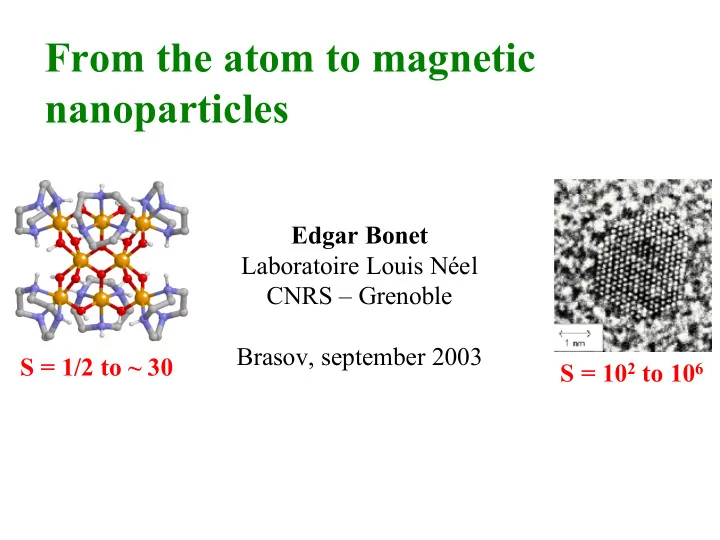
From the atom to magnetic nanoparticles Edgar Bonet Laboratoire - - PowerPoint PPT Presentation
From the atom to magnetic nanoparticles Edgar Bonet Laboratoire Louis Nel CNRS Grenoble Brasov, september 2003 S = 10 2 to 10 6 S = 1/2 to ~ 30 Magnetic scales S = 1 10 10 2 10 3 10 4 10 5 10 6 10 8 10 10 10 20 giant spin single -
Magnetic scales
S = 1 10 102 103 104 105 106 108 1010 1020
- 1
1
- 1
1 M/M
S
µ0 H(T)
Fe8
1K 0.1K 0.7K
giant spin quantum tunneling, quantization quantum interference
- 1
1
- 100
100 M/M
S
µ0 H(mT)
single - domain uniform rotation curling
- 1
1
- 40
- 20
20 40 M/M
S
µ0 H(mT)
multi - domain nucleation, propagation and annihilation of domain walls
Giant spin molecules
Mn12 (S = 10) V15 (S = ½) Ni12 (S = 12) Fe8 (S = 10)
- Single crystals
- high intra-molecular couplings
- low inter-molecular couplings
Collection of identical quantum systems
Giant spin model
Giant spin model
Landau-Zener tunneling
- Oscillation time
|S, m> |S, m> |S, m’> |S, m’>
- crossing time
- keeps the same state
- follows energy level
Landau-Zener tunneling
- general result for a single level crossing
- solution of the Schroedinger equation
- L. Landau, Phys. Z. Sowjetunion 2, 46 (1932); C. Zener, Proc. R. Soc. London, Ser. A 137, 696, (1932); E.C.G.
Stückelberg, Helv. Phys. Acta 5, 369 (1932); S. Miyashita, J. Phys. Soc. Jpn. 64, 3207 (1995); V.V. Dobrovitski and A.K. Zvezdin, Euro. Phys. Lett. 38, 377 (1997); L. Gunther, Euro. Phys. Lett. 39, 1 (1997); G.Rose and P.C.E. Stamp, Low Temp. Phys. 113, 1153 (1999); M. Leuenberger and D. Loss, Phys. Rev. B 61, 12200 (2000);
- M. Thorwart, M. Grifoni, and P. Hänggi, Phys. Rev. Lett. 85, 860 (2000); …
|S, m> |S, m> |S, m’> |S, m’>
- 1
- 0.5
0.5 1
- 1
- 0.5
0.5 1
v=140 mT/s v=70 mT/s v=14 mT/s v=2.8 mT/s
M/M S µ 0H(T)
40 mK
- 1
- 0.5
0.5 1
- 40
- 30
- 20
- 10
Energy (K) µ0Hz (T)
- 10
- 9
- 8
- 7
10 9 8 7
Magnetization steps
Fe8
with S = 10, D = 0.27 K, E = 0.046K A.-L. Barra et al. EPL (1996)
S = 10
Spin-parity dependent quantum tunneling
Kramers theorem: No matter how unsymmetric the crystal field, a system possessing an odd number of electrons must have a ground state that is at least doubly degenerate, even in the presence of crystal fields and spin-orbit interactions
- H. A. Kramers, Proc. Acad. Sci. Amsterdam 33, 959 (1930)
Mesoscopic systems:
- M. Enz and R. Schilling R.,J.Phys.C ,19 (1986) L711
J.L. Van Hemmen and S. Süto, Europhys. Lett. 1, 481 (1986)
- D. Loss, D.P. DiVincenzo, and G. Grinstein, Phys. Rev. Lett., 69, 3232 (1992)
- J. von Delft and C. L. Hendey, Phys. Rev. Lett., 69, 3236 (1992)
Htrans (a.u.) ∆ (a.u.) 1 10
Spin-parity dependent quantum tunneling
Environnemental effects
- hyperfine interaction (nuclear spins)
- dipolar interaction between molecules
- exchange interaction between molecules
etc.
- Phys. Rev. B 65,
180403 (2002)
S = 9/2 Ha = 4.6 T ∆0 = 1.9*10-7 K S = 8 Ha = 5.1 T ∆0 = 0.28*10-7 K S = 10 Ha = 4.0 T ∆0 = 0.94*10-7 K
Quantum phase interference (Berry phase) in single-molecule magnets
0.2 0.4 0.6 0.8 1 1.2 1.4 0.1 1 10 Tunnel splitting ²(10 -7 K) Transverse field (T) M = -10 10 ϕ - 90° ϕ - 0° ϕ - 7° ϕ - 20° ϕ - 50°
Z Y X
easy axis hard axis easy plane YZ
Htrans ϕ
Quantum phase interference (Berry phase) in single-molecule magnets
- W. Wernsdorfer and R. Sessoli, Science 284, 133 (1999)
Theory: A. Garg, Europhys. Lett. 22, 205 (1993)
0.2 0.4 0.6 0.8 1 1.2 1.4 0.1 1 10 Tunnel splitting ²(10 -7 K) Transverse field (T) M = -10 10 ϕ - 0° ϕ - 7° ϕ - 20° ϕ - 50° ϕ - 90°
Z Y X
easy axis hard axis easy plane YZ
Quantum phase interference (Berry phase) in single-molecule magnets
- W. Wernsdorfer and R. Sessoli, Science 284, 133 (1999)
Theory: A. Garg, Europhys. Lett. 22, 205 (1993)
Z Y X Htrans
easy axis hard axis easy plane
0.2 0.4 0.6 0.8 1 1.2 1.4 0.1 1 10 Tunnel splitting ²(10 -7 K) Transverse field (T) M = -10 10 ϕ - 0° ϕ - 7° ϕ - 20° ϕ - 50° ϕ - 90°
Parity of level crossings
- W. Wernsdorfer and R. Sessoli, Science 284, 133 (1999)
0.1 1 10 100
- 1
- 0.5
0.5 1 ² (10
- 7 K)
µ0Hx (T) M = -10 10 M = -10 9 M = -10 8
Intermolecular interactions
(dipolar and exchange)
J/D
SMM “ideal” MM 0.001 0.01 0.1 1 10 100 [Mn4]2 Mn4 (SB1) Fe8 Mn12ac doped Fe6 Fe5Ga ? spin chains, etc.
- R. Tiron,W. Wernsdorfer, C. Thirion, R. Giraud, E. Bonet, B. Barbara (LLN,
CNRS, Grenoble, France), A. Benoit (CRTBT, CNRS, Grenoble, France), D. Mailly (LPN, CNRS, Marcoussis, France), N. Aliaga, S. Bhaduri, C. Boskovic, C. Canada,
- M. Soler, G. Christou (Dept. of Chemistry, Uni. of Florida, USA), E. Yang,
- E. M. Rumberger, D. N. Hendrickson (Dept. of Chemistry, Uni. of California at San
Diego, USA)
Molecular dimers
Single molecule vs. Dimer
Hi = −D Si,z
2 + H i trans + gµ Bµ0
r S
i
r H
(2Si + 1) energie states Si = 9/2 : 10 levels mi = -Si, -Si+1, …, Si
H = H1 + H2 + J r S
1
r S
2
(2S1 + 1)(2S2 + 1) energie states Si = 9/2 : 100 levels m1 = -S1, -S1+1, …, S1 m2 = -S2, -S2+1, …, S2
Zeeman Diagram for the S = 9/2 dimer
Hi = −D Si,z
2 + H i trans +gµ Bµ0
r S
i
r H H = H1 + H2 + J r S
1
r S
2
100 energy states (m1,m2)
Exchange bias
bias fixed
Anisotropy & intermolecular coupling
D = g * µB/kB * X1 = 2 * 0.928/1.38 * 0.58 = 0.75 K Jtot = g * µB/kB * X2 / S = 2 * 0.928/1.38 * 0.34 / 4.5 = 0.10 K D = anisotropy constant; Jtot = coupling constant
- 1
- 0.5
0.5 1
- 1
- 0.5
0.5 1 M/M s µ0H (T) 0.04 K 0.14 T/s x1 x2
- 40
- 35
- 30
- 25
- 20
- 15
- 1.2
- 0.8
- 0.4
0.4 0.8 1.2 Energy(K) µ0Hz (T)
(-9/2,-9/2) (-9/2,9/2) (-9/2,7/2) (-7/2,9/2) (9/2,9/2) (9/2,7/2) (-9/2,5/2)
x2 x1
(1) (-9/2,-9/2) ? (-9/2, 9/2) ; (2) (-9/2,-9/2) ? (-9/2, 7/2) relaxes ? (-9/2, 9/2) ; (3) (-9/2, 9/2) ? ( 9/2, 9/2) ; (4) (-9/2,-9/2) ? (-9/2, 5/2) relaxes ? (-9/2, 9/2) ; (5) (-9/2, 9/2) ? ( 7/2, 9/2) relaxes ? ( 9/2, 9/2). Transitons
Tunneling in the dimer
3 3 4 4 5 5 2 2 1 1
(1) and (3) are symmetric relative to the origin;
- 1
- 0.5
0.5 1
- 1
- 0.5
0.5 1
0.560 T/s 0.140 T/s 0.035 T/s 0.008 T/s
M/M s µ0 H (T) NA11 0.04 K
- 1
- 0.5
0.5 1
- 1.2
- 0.8
- 0.4
0.4 0.8 1.2
0.280 T/s 0.140 T/s 0.035 T/s 0.008 T/s 0.004 T/s 0.002 T/s
M/M s µ0 H (T) 0.04 K
Inter Inter-
- molecular coupling is stronger in NA11 than in NA3;
molecular coupling is stronger in NA11 than in NA3; Easier to resolve resonances (2) from (3) and (4) from (5) Easier to resolve resonances (2) from (3) and (4) from (5)
- 45
- 40
- 35
- 30
- 25
- 20
- 15
- 10
- 1
- 0.5
0.5 1 Energy (K) µ0 H z(T) 5 1 3 2 4
(-9/2,-9/2) (9/2,9/2) (9/2,7/2) (-9/2,5/2) (-7/2,9/2) (-9/2,7/2) (-9/2,9/2)
1 2 3 4 5
2x 2x Mn Mn4O O3Cl Cl4(O (O2CEt) CEt)3(py) (py)3
3 NA3
NA3
2x 2x Mn Mn4O O3Cl Cl4(O (O2CH2Cl2) )3(py) (py)3
3 NA11
NA11
- 0.6
- 0.4
- 0.2
0.2 0.4 0.6
- 0.6
- 0.4
- 0.2
0.2 0.4 0.6 Energy (K) µ0H (T)
- 1/2
1/2
S = 1/2
- 1
- 0.5
0.5 1
- 0.6
- 0.4
- 0.2
0.2 0.4 0.6 M/M s µ0 H (T) 0.04 K
Absorption of microwaves
- 1
- 0.5
0.5 1
- 0.6
- 0.4
- 0.2
0.2 0.4 0.6
0 s 0.1 ms 0.5 ms 1 ms 2 ms 3 ms
M/M s µ0 H (T) 0.04 K 11 GHz 0.001 T/s
period: 10 ms
V15 S = 1/2 h ν
Frequency dependence of the absorption of microwaves in V15
0.2 0.4 0.6 0.8 1 0.1 0.2 0.3 0.4 0.5 0.6 M/M s µ0H (T)
16 GHz
0.04 K 0.2 0.4 0.6 0.8 1 0.1 0.2 0.3 0.4 0.5 0.6 M/M s µ0H (T)
15 GHz
0.04 K 0.2 0.4 0.6 0.8 1 0.1 0.2 0.3 0.4 0.5 0.6 M/M s µ0H (T)
14 GHz
0.04 K 0.2 0.4 0.6 0.8 1 0.1 0.2 0.3 0.4 0.5 0.6 M/M s µ0H (T)
13 GHz
0.04 K 0.2 0.4 0.6 0.8 1 0.1 0.2 0.3 0.4 0.5 0.6 M/M s µ0H (T)
12 GHz
0.04 K 0.2 0.4 0.6 0.8 1 0.1 0.2 0.3 0.4 0.5 0.6 M/M s µ0H (T)
11 GHz
0.04 K 0.2 0.4 0.6 0.8 1 0.1 0.2 0.3 0.4 0.5 0.6 M/M s µ0H (T)
10 GHz
0.04 K 0.2 0.4 0.6 0.8 1 0.1 0.2 0.3 0.4 0.5 0.6 M/M s µ0H (T)
9 GHz
0.04 K 0.2 0.4 0.6 0.8 1 0.1 0.2 0.3 0.4 0.5 0.6 M/M s µ0H (T)
8 GHz
0.04 K 0.2 0.4 0.6 0.8 1 0.1 0.2 0.3 0.4 0.5 0.6 M/M s µ0H (T)
7 GHz
0.04 K 0.2 0.4 0.6 0.8 1 0.1 0.2 0.3 0.4 0.5 0.6 M/M s µ0H (T)
6 GHz
0.04 K 0.2 0.4 0.6 0.8 1 0.1 0.2 0.3 0.4 0.5 0.6 M/M s µ0H (T)
5 GHz
0.04 K 0.2 0.4 0.6 0.8 1 0.1 0.2 0.3 0.4 0.5 0.6 M/M s µ0H (T)
4 GHz
0.04 K 0.2 0.4 0.6 0.8 1 0.1 0.2 0.3 0.4 0.5 0.6 M/M s µ0H (T)
3.5 GHz
0.04 K 0.2 0.4 0.6 0.8 1 0.1 0.2 0.3 0.4 0.5 0.6 M/M s µ0H (T)
3 GHz
0.04 K 0.2 0.4 0.6 0.8 1 0.1 0.2 0.3 0.4 0.5 0.6 M/M s µ0H (T)
2.5 GHz
0.04 K 0.2 0.4 0.6 0.8 1 0.1 0.2 0.3 0.4 0.5 0.6 M/M s µ0H (T)
2 GHz
0.04 K
Reducing intermolecular couplings
- 1
- 0.5
0.5 1
- 0.4
- 0.3
- 0.2
- 0.1
0.1 0.2 0.3 0.4
0.280 T/s 0.140 T/s 0.070 T/s 0.035 T/s 0.017 T/s
M/M s µ0 Hz (T)
0.04 K
- 0.4
- 0.2
0.2 0.4
- 5
- 4
- 3
- 2
- 1
1 Energy (K) µ0 Hz (T)
- 5/2
5/2
- 3/2
- 1/2
3/2 1/2
D = 0.5 K
Fe6 wheels: S = 0 Doping with Ga Fe5Ga : S = 5/2
- 1
- 0.5
0.5 1
- 0.4
- 0.3
- 0.2
- 0.1
0.1 0.2 0.3 0.4
8 dB 6 dB 5 dB 0.140 T/s
M/M s µ0 Hz (T)
0.04 K
0.00001 T/s
20 GHz
- 0.4
- 0.2
0.2 0.4
- 5
- 4
- 3
- 2
- 1
1 Energy (K) µ0 Hz (T)
- 5/2
5/2
- 3/2
- 1/2
3/2 1/2
hω D = 0.5 K
Reducing intermolecular couplings
Fe6 wheels: S = 0 Doping with Ga Fe5Ga : S = 5/2
Photon assisted tunneling
Absorption of circular polarized microwaves
- 10
- 5
5 10 Energy quantum number m
? M = +1
tunneling
? M = -1
H = 0
- 1
- 0.5
0.5
- 40
- 30
- 20
- 10
Energy (K) µ0Hz (T)
? M = ±1
- 10
- 9
- 8
- 7
10 9 8 7
h? h? h?
Absorption of circular polarized microwaves (115 GHz)
- 1
- 0.5
0.5 1
- 1
- 0.5
0.5 1 0.091 M/M s µ0H (T)
0.007 T/s
P/P0 =
- 1
- 0.5
0.5 1
- 1
- 0.5
0.5 1 0.119 M/M s µ0H (T)
0.007 T/s
P/P0 =
- 1
- 0.5
0.5 1
- 1
- 0.5
0.5 1 0.131 M/M s µ0H (T)
0.007 T/s
P/P0 =
- 1
- 0.5
0.5 1
- 1
- 0.5
0.5 1 0.151 M/M s µ0H (T)
0.007 T/s
P/P0 =
- 1
- 0.5
0.5 1
- 1
- 0.5
0.5 1 0.167 M/M s µ0H (T)
0.007 T/s
P/P0 =
- 1
- 0.5
0.5 1
- 1
- 0.5
0.5 1 0.190 M/M s µ0H (T)
0.007 T/s
P/P0 =
- 1
- 0.5
0.5 1
- 1
- 0.5
0.5 1 0.207 M/M s µ0H (T)
0.007 T/s
P/P0 =
- 1
- 0.5
0.5 1
- 1
- 0.5
0.5 1 0.237 M/M s µ0H (T)
0.007 T/s
P/P0 =
- 1
- 0.5
0.5 1
- 1
- 0.5
0.5 1 0.256 M/M s µ0H (T)
0.007 T/s
P/P0 =
- 1
- 0.5
0.5 1
- 1
- 0.5
0.5 1 0.292 M/M s µ0H (T)
0.007 T/s
P/P0 =
- 1
- 0.5
0.5 1
- 1
- 0.5
0.5 1 0.320 M/M s µ0H (T)
0.007 T/s
P/P0 =
- 1
- 0.5
0.5 1
- 1
- 0.5
0.5 1 0.366 M/M s µ0H (T)
0.007 T/s
P/P0 =
- 1
- 0.5
0.5 1
- 1
- 0.5
0.5 1 0.458 M/M s µ0H (T)
0.007 T/s
P/P0 =
- 1
- 0.5
0.5 1
- 1
- 0.5
0.5 1 0.568 M/M s µ0H (T)
0.007 T/s
P/P0 =
- 1
- 0.5
0.5 1
- 1
- 0.5
0.5 1 0.693 M/M s µ0H (T)
0.007 T/s
P/P0 =
- 1
- 0.5
0.5 1
- 1
- 0.5
0.5 1 0.841 M/M s µ0H (T)
0.007 T/s
P/P0 =
- 1
- 0.5
0.5 1
- 1
- 0.5
0.5 1 1 M/M s µ0H (T)
0.007 T/s
P/P0 =
Absorption of circular polarized microwaves (115 GHz)
- 1
- 0.5
0.5 1
- 1
- 0.5
0.5 1
0.119 0.151 0.190 0.237 0.256 0.320 0.458
M/M s µ0Hz (T)
60 mK 115 GHz 0.007 T/s P/P0 =
Absorption of circular polarized microwaves (95 GHz)
- 1
- 0.5
0.5 1
- 1
- 0.5
0.5 1
0.10 0.20 0.25 0.30 0.35 0.40 0.45 0.50 0.55
M/M s µ0Hz (T)
60 mK 95 GHz 0.007 T/s