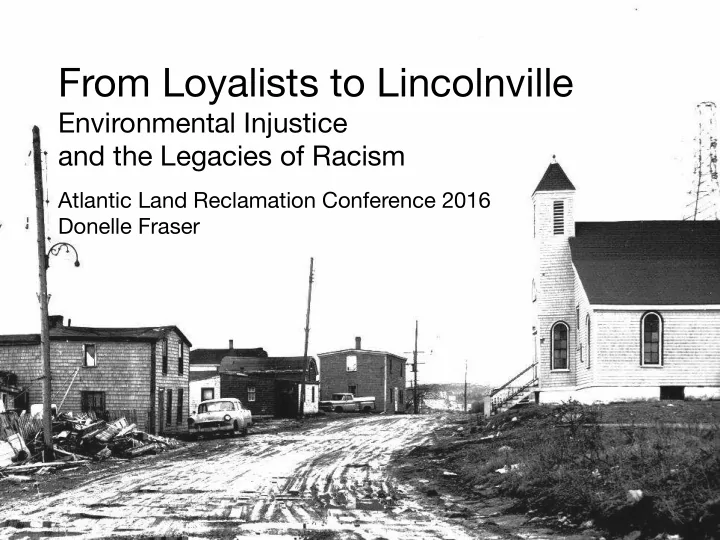
From Loyalists to Lincolnville Environmental Injustice and the - - PowerPoint PPT Presentation
From Loyalists to Lincolnville Environmental Injustice and the Legacies of Racism Atlantic Land Reclamation Conference 2016 Donelle Fraser Introduction Introduction Youve probably heard of Africville Introduction Youve probably heard
Introduction
Introduction
- You’ve probably heard of Africville
Introduction
- You’ve probably heard of Africville
- The ENRICH Project on environmental racism
Introduction
- You’ve probably heard of Africville
- The ENRICH Project on environmental racism
- “the disproportionate location of industrial
polluters… near to communities of colour and the working poor”
Introduction
- You’ve probably heard of Africville
- The ENRICH Project on environmental racism
- “the disproportionate location of industrial
polluters… near to communities of colour and the working poor”
- Also: “the lack of organization and political power
that these communities hold for advocating against the siting of industrial polluters”
Introduction
- You’ve probably heard of Africville
- The ENRICH Project on environmental racism
- Africville is not really history
Introduction
- You’ve probably heard of Africville
- The ENRICH Project on environmental racism
- Africville is not really history
- Lack of legislation addressing issues of justice
within environmental procedures
Introduction
- You’ve probably heard of Africville
- The ENRICH Project on environmental racism
- Africville is not really history
- Lack of legislation addressing issues of justice
within environmental procedures
- Long legacy of racial injustice in the province
dating back to the arrival of Black Loyalists
Environmental Justice Movement
- Civil rights movement + environmental movement
Environmental Justice Movement
- Civil rights movement + environmental movement
- 1982: Warren County protests
Environmental Justice Movement
- Civil rights movement + environmental movement
- 1982: Warren County protests
- Studies confirmed the link between race, class, and
exposure to toxic industries
Environmental Justice Movement
- Civil rights movement + environmental movement
- 1982: Warren County protests
- Studies confirmed the link between race, class, and
exposure to toxic industries
- Development of a national discourse connecting
previously isolated struggles
Environmental Justice Movement
- Civil rights movement + environmental movement
- 1982: Warren County protests
- Studies confirmed the link between race, class, and
exposure to toxic industries
- Development of a national discourse connecting
previously isolated struggles
- Who benefits from – and who is burdened by –
environmental damage?
Environmental Justice Research
- Research frameworks have shifted over 30 years
Environmental Justice Research
- Research frameworks have shifted over 30 years
- In the wake of Warren County: establishing spatial
linkages between marginalization and exposure
Environmental Justice Research
- Research frameworks have shifted over 30 years
- In the wake of Warren County: establishing spatial
linkages between marginalization and exposure
- Also linkages between exposure and poor health
Environmental Justice Research
- Research frameworks have shifted over 30 years
- In the wake of Warren County: establishing spatial
linkages between marginalization and exposure
- Also linkages between exposure and poor health
- More recently: focus on the processes
Environmental Justice Research
- Research frameworks have shifted over 30 years
- In the wake of Warren County: establishing spatial
linkages between marginalization and exposure
- Also linkages between exposure and poor health
- More recently: focus on the processes
- How does historical oppression continue to
manifest in current decision-making?
Environmental Justice Research
- Research frameworks have shifted over 30 years
- In the wake of Warren County: establishing spatial
linkages between marginalization and exposure
- Also linkages between exposure and poor health
- More recently: focus on the processes
- How does historical oppression continue to
manifest in current decision-making?
- How does the technical/scientific framework of
environmental planning undervalue traditional knowledge?
The “Double Burden”
The “Double Burden”
- “Privilege people’s lived experiences of injustice”
The “Double Burden”
- “Privilege people’s lived experiences of injustice”
- Going beyond the narrow, medical definition of
disease
The “Double Burden”
- “Privilege people’s lived experiences of injustice”
- Going beyond the narrow, medical definition of
disease
- Impacts on quality of life, mental health, social morale
The “Double Burden”
- “Privilege people’s lived experiences of injustice”
- Going beyond the narrow, medical definition of
disease
- Impacts on quality of life, mental health, social morale
- But both are problems in their own right!
The “Double Burden”
- “Privilege people’s lived experiences of injustice”
- Going beyond the narrow, medical definition of
disease
- Impacts on quality of life, mental health, social morale
- But both are problems in their own right!
- Known as “compounded disadvantage” or the
“double burden” borne by marginalized communities
The “Double Burden”
- “Privilege people’s lived experiences of injustice”
- Going beyond the narrow, medical definition of
disease
- Impacts on quality of life, mental health, social morale
- But both are problems in their own right!
- Known as “compounded disadvantage” or the
“double burden” borne by marginalized communities
- Environmental injustice can also manifest as limited
access to “environmental opportunities”
Africville
Africville
- Shores of the Bedford Basin first settled by black
refugees after the war of 1812
Africville
- Shores of the Bedford Basin first settled by black
refugees after the war of 1812
- Denied many basic services: paved roads, sewer
systems, water lines
Africville
- Shores of the Bedford Basin first settled by black
refugees after the war of 1812
- Denied many basic services: paved roads, sewer
systems, water lines
- Rezoned as industrial land in 1947
Africville
- Shores of the Bedford Basin first settled by black
refugees after the war of 1812
- Denied many basic services: paved roads, sewer
systems, water lines
- Rezoned as industrial land in 1947
- Environmental hazards included a fertilizer plant, an
- pen dump, and an incinerator
Africville
- Shores of the Bedford Basin first settled by black
refugees after the war of 1812
- Denied many basic services: paved roads, sewer
systems, water lines
- Rezoned as industrial land in 1947
- Environmental hazards included a fertilizer plant, an
- pen dump, and an incinerator
- 1970: poor health of residents used to justify their
removal from the land
Environmental Justice Analysis
- Faced both distributive and procedural injustice
Environmental Justice Analysis
- Faced both distributive and procedural injustice
- Disproportionate exposures
Environmental Justice Analysis
- Faced both distributive and procedural injustice
- Disproportionate exposures
- Exclusion from decision-making
Environmental Justice Analysis
- Faced both distributive and procedural injustice
- Disproportionate exposures
- Exclusion from decision-making
- Halifax Human Rights Advisory Committee
Environmental Justice Analysis
- Faced both distributive and procedural injustice
- Disproportionate exposures
- Exclusion from decision-making
- Halifax Human Rights Advisory Committee
- Alternatives to relocation were never considered
Environmental Justice Analysis
- Faced both distributive and procedural injustice
- Disproportionate exposures
- Exclusion from decision-making
- Halifax Human Rights Advisory Committee
- Alternatives to relocation were never considered
- No one asked why health outcomes were so poor
Environmental Justice Analysis
- Faced both distributive and procedural injustice
- Disproportionate exposures
- Exclusion from decision-making
- Halifax Human Rights Advisory Committee
- Alternatives to relocation were never considered
- No one asked why health outcomes were so poor
- Reports ignored the rich historical and cultural ties
residents had developed with their community
Lincolnville
Lincolnville
- Striking similarities to Africville
Lincolnville
- Striking similarities to Africville
- Early 2000s: Nova Scotia to amalgate 57 existing
landfills into seven second-generation landfills
Lincolnville
- Striking similarities to Africville
- Early 2000s: Nova Scotia to amalgate 57 existing
landfills into seven second-generation landfills
- Guysborough County saw an opportunity
Lincolnville
- Striking similarities to Africville
- Early 2000s: Nova Scotia to amalgate 57 existing
landfills into seven second-generation landfills
- Guysborough County saw an opportunity
- 2006: landfill sited next to Lincolnville
Lincolnville
- Striking similarities to Africville
- Early 2000s: Nova Scotia to amalgate 57 existing
landfills into seven second-generation landfills
- Guysborough County saw an opportunity
- 2006: landfill sited next to Lincolnville
- Decision based purely on surface and groundwater
testing?
Environmental Justice Analysis
- Can’t ignore the issue of race
Environmental Justice Analysis
- Can’t ignore the issue of race
- One of few black communities in Guysborough
Environmental Justice Analysis
- Can’t ignore the issue of race
- One of few black communities in Guysborough
- Long history of racial discrimination
Environmental Justice Analysis
- Can’t ignore the issue of race
- One of few black communities in Guysborough
- Long history of racial discrimination
- Small and aging population
Environmental Justice Analysis
- Can’t ignore the issue of race
- One of few black communities in Guysborough
- Long history of racial discrimination
- Small and aging population
- “Multiple vulnerabilities”
Environmental Justice Analysis
- Can’t ignore the issue of race
- One of few black communities in Guysborough
- Long history of racial discrimination
- Small and aging population
- “Multiple vulnerabilities”
- Also: had already hosted a first-generation landfill for
- ver 30 years
Environmental Justice Analysis
- Can’t ignore the issue of race
- One of few black communities in Guysborough
- Long history of racial discrimination
- Small and aging population
- “Multiple vulnerabilities”
- Also: had already hosted a first-generation landfill for
- ver 30 years
- Community members suffering from high rates of
cancer
Deacon & Baxter’s Findings
- How did Lincolnville end up with another landfill??
Deacon & Baxter’s Findings
- How did Lincolnville end up with another landfill??
- Municipality: no active opposition
Deacon & Baxter’s Findings
- How did Lincolnville end up with another landfill??
- Municipality: no active opposition
- Deacon & Baxter (2013): consultations not as
effective or inclusive as claimed to be
Deacon & Baxter’s Findings
- How did Lincolnville end up with another landfill??
- Municipality: no active opposition
- Deacon & Baxter (2013): consultations not as
effective or inclusive as claimed to be
- Poor advertising
Deacon & Baxter’s Findings
- How did Lincolnville end up with another landfill??
- Municipality: no active opposition
- Deacon & Baxter (2013): consultations not as
effective or inclusive as claimed to be
- Poor advertising
- Inaccessible language used at consultations
Deacon & Baxter’s Findings
- How did Lincolnville end up with another landfill??
- Municipality: no active opposition
- Deacon & Baxter (2013): consultations not as
effective or inclusive as claimed to be
- Poor advertising
- Inaccessible language used at consultations
- “Lip service”
Deacon & Baxter’s Findings
- How did Lincolnville end up with another landfill??
- Municipality: no active opposition
- Deacon & Baxter (2013): consultations not as
effective or inclusive as claimed to be
- Poor advertising
- Inaccessible language used at consultations
- “Lip service”
- Concerned Citizens of Lincolnville ignored
A Systemic Issue
A Systemic Issue
- Africville and Lincolnville are just two examples
A Systemic Issue
- Africville and Lincolnville are just two examples
- Greater than 30 percent of African Nova Scotians
lived with 5 km of a landfill
A Systemic Issue
- Africville and Lincolnville are just two examples
- Greater than 30 percent of African Nova Scotians
lived with 5 km of a landfill
- Also affects Mi’kmaq and Acadian communities
A Systemic Issue
- Africville and Lincolnville are just two examples
- Greater than 30 percent of African Nova Scotians
lived with 5 km of a landfill
- Also affects Mi’kmaq and Acadian communities
- A systemic issue
A Systemic Issue
- Africville and Lincolnville are just two examples
- Greater than 30 percent of African Nova Scotians
lived with 5 km of a landfill
- Also affects Mi’kmaq and Acadian communities
- A systemic issue
- Maintained by a legislative process that lacks
considerations of justice
A Systemic Issue
- Africville and Lincolnville are just two examples
- Greater than 30 percent of African Nova Scotians
lived with 5 km of a landfill
- Also affects Mi’kmaq and Acadian communities
- A systemic issue
- Maintained by a legislative process that lacks
considerations of justice
- Affected communities tend to have a low degree of
political power to resist exploitation
Legislative Loopholes
- Nova Scotia lacks a framework to address
environmental racism
Legislative Loopholes
- Nova Scotia lacks a framework to address
environmental racism
- Landfills are not required to undergo EIA
Legislative Loopholes
- Nova Scotia lacks a framework to address
environmental racism
- Landfills are not required to undergo EIA
- Nova Scotia Environment Act makes no reference to
environmental justice
Legislative Loopholes
- Nova Scotia lacks a framework to address
environmental racism
- Landfills are not required to undergo EIA
- Nova Scotia Environment Act makes no reference to
environmental justice
- Environmental justice too often an afterthought in EIA
Legislative Loopholes
- Nova Scotia lacks a framework to address
environmental racism
- Landfills are not required to undergo EIA
- Nova Scotia Environment Act makes no reference to
environmental justice
- Environmental justice too often an afterthought in EIA
- Public opposition to facility siting is difficult,
especially for already-vulnerable communities
Legacies of the Loyalists
- Important to not forget about history as it still has
impacts today
Legacies of the Loyalists
- Important to not forget about history as it still has
impacts today
- Long legacy of racism in Nova Scotia has kept
certain communities vulnerable to environmental degradation
Legacies of the Loyalists
- Important to not forget about history as it still has
impacts today
- Long legacy of racism in Nova Scotia has kept
certain communities vulnerable to environmental degradation
- Look back at arrival of Black Loyalists fleeing the
American Civil War at the end of the 18th century
Legacies of the Loyalists
- Important to not forget about history as it still has
impacts today
- Long legacy of racism in Nova Scotia has kept
certain communities vulnerable to environmental degradation
- Look back at arrival of Black Loyalists fleeing the
American Civil War at the end of the 18th century
- Injustice today may be less overt, but residents of
Lincolnville could testify that environmental racism remains a pertinent issue in this province
References
References
- Photo: [Untitled Image of Africville]. Retrieved November 5, 2016. http://markcarvery.org/wp-
content/uploads/2013/11/6000_1038_5000581_1.jpg
- Bullard, R. D. (2001). Environmental justice in the 21st century: Race still matters. Phylon,
49(3/4), 151-171. Retrieved from http://jstor.org/stable/3132626
- Deacon, L. & Baxter, J. (2013). No opportunity to say no: A case study of procedural
environmental injustice in Canada. Journal of Environmental Planning and Management, 56(5), 607-623. Retrieved from http://www.enrichproject.org/wp-content/uploads/2015/05/ Leith-Deacon-Article.pdf
- Devet, R. (2015, October 26). Facing environmental racism and white privilege. Halifax Media
Co-op. Retrieved from http://halifax.mediacoop.ca/story/facing-environmental-racism-and- white-privilege/34048
- Fryzuk, L. A. (1996). Environmental justice in Canada: An empirical study and analysis of the
demographics of dumping in Nova Scotia. (Master’s Thesis). Retrieved from http:// www.collectionscanada.gc.ca/obj/s4/f2/dsk3/ftp04/mq24966.pdf
- Hill, L. (2011). A word about history. In Hill, The Book of Negroes. (pp. 10-13). Toronto:
HarperCollins.
- Lewis, T. L. (2015). Environmental movements in the global south. In K. A. Gould & T. L.
Lewis (Ed.), Twenty Lessons in Environmental Sociology (pp. 300-314). Oxford: Oxford University Press.
- Masuda, J., Polland, B., & Baxter, J. (2010). Reaching for environmental health justice:
Canadian experiences for a comprehensive research, policy and advocacy agenda in health
- promotion. Health Promotion International, 25(4), 453-463. doi: 10.1093/heapro/daq041.
References
- McGregor, D. (2009). Honouring our relations: An Anishnaabe perspective on environmental
- justice. In Agyeman, J., Cole, P
., Haluza-DeLay, R., & O’Riley, P . (Eds), Speaking for Ourselves: Environmental Justice in Canada. (pp. 27-41). Vancouver: UBC Press. Retrieved from http://www.ubcpress.ca/books/pdf/chapters/2009/SpeakingforOurselves.pdf
- Open House Nova Scotia. (2015). Debates of November 25th, 2015. Retrieved from http://
www.openhousens.ca/debates/debates-25-november-2015/single-page/#s53152
- Taylor, D. E. (2011). The evolution of environmental justice activism, research, and
- scholarship. Environmental Practice, 13(4), 280-301. Doi:10.1017/S1466046611000329.
- The ENRICH Project. (2015). Background. Retrieved from http://www.enrichproject.org/
about/background
- Wakefield, S. E. L. & Baxter, J. (2010). Linking health inequity and environmental justice:
Articulating a precautionary framework for research and action. Environmental Justice, 3(3), 95-102. doi: 10.1089/env.2009.0044
- Waldron, I. R. G. (2015). Findings from the series of workshops “In Whose Backyard? –
Exploring Toxic Legacies in Mi’kmaw and African Nova Scotia Communities.” Environmental Justice, 8(10), 1-5. doi:10.1089/env.2014.0034
- Waldron, I. (2014). Report on the regional meetings & convergence workshop for: In whose
backyard? Exploring toxic legacies in Mi’kmaw & African Nova Scotian communities. Environmental Noxiousness, Racial Inequities & Community Health Project. Retrieved from http://www.enrichproject.org/wp-content/uploads/2013/12/Environmental-Injustice- Report.pdf