From Layaway to Bitcoin ; Generational Issues in Financial Literacy - - PDF document

from layaway to bitcoin generational issues in financial
SMART_READER_LITE
LIVE PREVIEW

From Layaway to Bitcoin ; Generational Issues in Financial Literacy - - PDF document

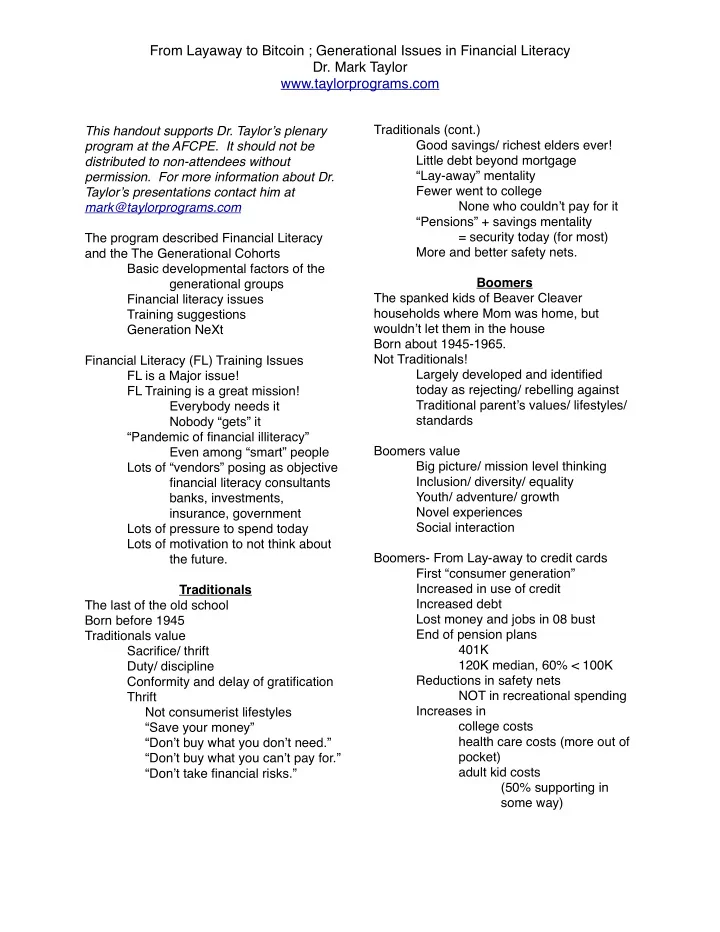
From Layaway to Bitcoin ; Generational Issues in Financial Literacy Dr. Mark Taylor www.taylorprograms.com Traditionals (cont.) This handout supports Dr. Taylors plenary Good savings/ richest elders ever! program at the AFCPE. It


slide-1
SLIDE 1

This handout supports Dr. Taylor’s plenary program at the AFCPE. It should not be distributed to non-attendees without

  • permission. For more information about Dr.

Taylor’s presentations contact him at mark@taylorprograms.com The program described Financial Literacy and the The Generational Cohorts

  • Basic developmental factors of the
  • generational groups
  • Financial literacy issues
  • Training suggestions
  • Generation NeXt

Financial Literacy (FL) Training Issues

  • FL is a Major issue!
  • FL Training is a great mission!
  • Everybody needs it
  • Nobody “gets” it
  • “Pandemic of financial illiteracy”
  • Even among “smart” people
  • Lots of “vendors” posing as objective
  • financial literacy consultants
  • banks, investments,
  • insurance, government
  • Lots of pressure to spend today
  • Lots of motivation to not think about
  • the future.

Traditionals The last of the old school Born before 1945 Traditionals value

  • Sacrifice/ thrift
  • Duty/ discipline
  • Conformity and delay of gratification
  • Thrift
  • Not consumerist lifestyles
  • “Save your money”
  • “Don’t buy what you don’t need.”
  • “Don’t buy what you can’t pay for.”
  • “Don’t take financial risks.”

Traditionals (cont.)

  • Good savings/ richest elders ever!
  • Little debt beyond mortgage
  • “Lay-away” mentality
  • Fewer went to college
  • None who couldn’t pay for it
  • “Pensions” + savings mentality
  • = security today (for most)
  • More and better safety nets.

Boomers The spanked kids of Beaver Cleaver households where Mom was home, but wouldn’t let them in the house Born about 1945-1965. Not Traditionals!

  • Largely developed and identified
  • today as rejecting/ rebelling against
  • Traditional parent’s values/ lifestyles/
  • standards

Boomers value

  • Big picture/ mission level thinking
  • Inclusion/ diversity/ equality
  • Youth/ adventure/ growth
  • Novel experiences
  • Social interaction

Boomers- From Lay-away to credit cards

  • First “consumer generation”
  • Increased in use of credit
  • Increased debt
  • Lost money and jobs in 08 bust
  • End of pension plans
  • 401K
  • 120K median, 60% < 100K
  • Reductions in safety nets
  • NOT in recreational spending
  • Increases in
  • college costs
  • health care costs (more out of
  • pocket)
  • adult kid costs
  • (50% supporting in
  • some way)

From Layaway to Bitcoin ; Generational Issues in Financial Literacy

  • Dr. Mark Taylor

www.taylorprograms.com

slide-2
SLIDE 2

Boomer Financial Literacy Training

  • May not anticipate retirement
  • Until last minute
  • Direct, personal advice from an expert
  • Interactive- talk with, not to
  • Non-critical/ Supportive
  • Realistic yet hopeful
  • Focus on future goals
  • Realistic future plans
  • Next career?
  • Continuing working?
  • “Reach back” parenting training
  • Manage your money and help
  • your kids grow up
  • Use tech for the embarrassing parts
  • Interact for the planning parts.

Gen X The independent, adaptable, pragmatic scrappers of the “baby bust” (reduced birth rate) Born about 1965 to 1985 The skeptical, cautious Latch Key kids. Their

  • Mom’s worked but would not let them
  • ut of the house because “the world is
  • a scary place”.

Generation X Financial Literacy Traits

  • Lots going on with their money now
  • with stagnant wages
  • More employers in work lifetime so
  • confusing plans/ planning
  • Can’t anticipate future safety nets
  • Independent = don’t seek help or
  • advice
  • Over use of credit / overextended
  • Credit, not income mentality
  • May plan/ spend based on
  • what they can borrow, not
  • what they have coming in
  • May not actively take control of
  • their money
  • May blame others for money
  • problems “Had bad luck with
  • your credit?”
  • May focus on current needs
  • May not anticipate future needs
  • Generation X Financial Literacy Traits (cont.)
  • May actively ignore planning issues
  • Frequent lack of long term planning.

Financial Literacy Training with X

  • Focus on “Heads, not hearts”
  • Thinking, not feeling
  • Educational
  • trends, forecasts
  • Data heavy
  • formulas, predictives, charts
  • Individualized/ personalized
  • plug in their numbers
  • Lead them to conclude for themselves
  • Tech interactive / Media rich
  • Confrontive realism
  • some fear OK
  • Long to short
  • Long term planning to short
  • term action= What do you
  • want in the future?
  • What do you need to do today
  • to make that happen?
  • Short to long
  • Future impacts of choices
  • now.
  • This choice today impacts the
  • future.

Generation NeXt The wanted precious, protected kids born

  • after about 1986 and raised in child
  • centric households, contributing to
  • their self-importance.

The self-esteem parenting agenda, where

  • they got a trophy for everything they
  • did, has led them to overrate their
  • skills and be sensitive and defensive
  • to criticism, and has contributed to
  • their entitlement and consumerism.

Parents may have blamed bad teachers, not

  • them, for bad grades, which is both a
  • sign and contributor to their issues
  • accepting responsibility.

From Layaway to Bitcoin ; Generational Issues in Financial Literacy

  • Dr. Mark Taylor

www.taylorprograms.com

slide-3
SLIDE 3

Generation NeXt (cont.) The cover story on TIME May 20, 2013 was

  • f the Me, Me, Me Generation who
  • are “lazy, entitles narcissists who still
  • live with their parents.”

According to Arthur Levine and Diane Dean

  • in Generation on a Tightrope, they are
  • coddled, protected, dependent
  • help seeking
  • immature, praise dependent
  • have the most inflated high
  • school

grades

  • weak academically entering
  • college.

The are very digital, may be web/ device

  • dependent or addicted,
  • confuse what they know with what
  • they can find and their abilities with
  • their ability to use an app.

Financial Literacy Training with Gen NeXt

  • Academically simple
  • reading, math
  • Low effort/ tech rich
  • Easy and fun
  • Games?
  • if they are interactive,
  • not just entertaining
  • Praise heavy
  • “Future orientation”- shove into
  • realistic future
  • “Typical” earnings
  • Don’t expect typical data to be
  • persuasive
  • Active
  • Interactive if F2F
  • “The Magic Dollar”
  • The dollar that you don’t
  • spend at 23 becomes many
  • more dollars later

Financial Coaching with Gen NeXt

  • College is a good investment and
  • worth some borrowing, but
  • nly if you are

frugal with

  • borrowed money and if you
  • finish
  • Are you a good good fit with college/
  • this college?
  • Academically ready?
  • Ready to invest the time?
  • Do you like “school”?
  • Are you a good fit with a career that
  • requires a degree?
  • Lots of skilled trades careers
  • do not require bachelors year
  • degree

Academic/ persistence success interventions If Financial Literacy professionals are going to be working with students around borrowing, credit, money issues that are impacted by academic success, they can/ should talk about what facilitates academic success and persistence

  • Remedial classes completed before
  • credit classes attempted
  • Remedial Summer
  • take remedial classes/ engage
  • in remediation activities during
  • the Summer after Senior year
  • to be ready for college classes
  • in the Fall (often called Bridge
  • Programs)
  • Student success classes
  • “Freshman Seminar”
  • Use of academic and support
  • services
  • Contracting?
  • It may be appropriate to
  • contract with students for
  • certain future academic
  • behaviors to be able to
  • borrow.

From Layaway to Bitcoin ; Generational Issues in Financial Literacy

  • Dr. Mark Taylor

www.taylorprograms.com