
SLIDE 1
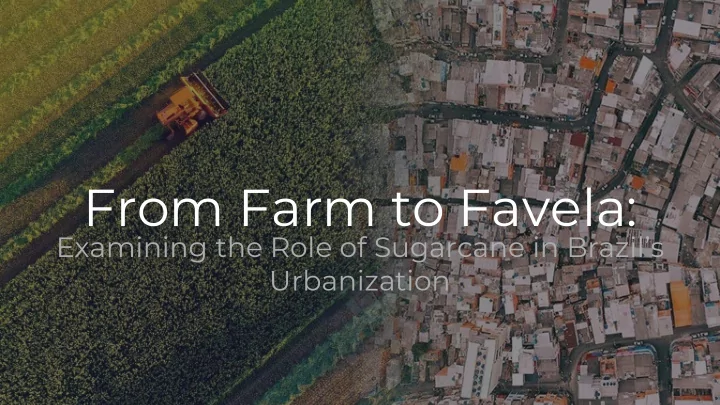
From Farm to Favela: Examining the Role of Sugarcane in Brazils - - PowerPoint PPT Presentation
From Farm to Favela: Examining the Role of Sugarcane in Brazils Urbanization In 2017, 86.31% of Brazil's total population lived in cities. So Paulo is the city in Latin America with the highest number of people living in slums
“São Paulo is the city in Latin America with the highest number of people living in slums [30.0% of the municipality or 3 million people, equivalent to more than a third of all of the favelados in the country]”
1. (França and Barda, 2010) and http://www.planum.net/francesco-chiodelli-sao-paulo-the-challenge-of-the-favelas
Finance bias, exemplified by policies of export-orientation and ethanol prioritization, have led to systematic displacement and depeasantization of sugarcane farmers in northeast Brazil in favor of southeastern states.
Production Refinement Transportation Management
1. Google Earth 2. Raizen
“The analytical focus on the ‘recombinant’ moves us ... to instead focus on the precise institutional mechanisms through which differentiated agrarian property regimes combine with liberalization reforms to produce new geographies of uneven development”1
1. Reis (2017)
“During the colonial period (I5OO to 1822), the wealth generated from the trade
relative terms, the value of sugar exports during the entire colonial period is twice the value of all the gold and diamonds mined in Brazil during the same period.”
“There are no agrarian problems in Brazil: all problems are now urban”
Colonization Large-scale, Plantation Farming & Landless Laborers
Developmentalism Industrialization, Mechanization, & Ethanol Prioritization Liberalization Export Orientation Today’s large-scale, machine operated, capital intensive, export-oriented farming
+ + =
Variegated Configurations
1. IBGE: https://www.ibge.gov.br; inhabitants per square kilometer 2. Unica; thousand cubed meters of ethanol to thousand tons of sugar 3. Conab (2010): PERFIL DO SETOR DO AÇÚCAR E DO ÁLCOOL NO BRASIL
Variegated Configurations
Sugarcane cultivation hectares per mesorregião
Variegated Configurations
Sugarcane cultivation hectares per mesorregião
“[T]he current economic formation is not due to ‘urban bias’, ‘rural bias’ or any misallocation of resources among economic sectors. Rather, it can be explained in relation to ‘finance bias’.”1
1. Reis (2017)
Finance Bias Variegated Configurations
Finance Bias Variegated Configurations Divergent Outcomes:
Labor migration & displacement Changing means of social reproduction
“...expressed in deruralization (depopulation and decline of the rural areas
(massive concentration of peoples and activities in growing urban centers of the world)...”1
1. Araghi (1995)
1. Study by Baptista (2017) from IBGE Brazil Census Data
1. Study by Baptista (2017) from IBGE Brazil Census Data
1. Study by Baptista (2017) from IBGE Brazil Census Data
Theoretical Construction
Complex flows of Surplus Capital and Labor