FRIDAY + SATURDAY APRIL 27 + 28, 2018 CHICAGO, ILLINOIS TC - - PowerPoint PPT Presentation

friday saturday april 27 28 2018 chicago illinois tc
SMART_READER_LITE
LIVE PREVIEW

FRIDAY + SATURDAY APRIL 27 + 28, 2018 CHICAGO, ILLINOIS TC - - PowerPoint PPT Presentation

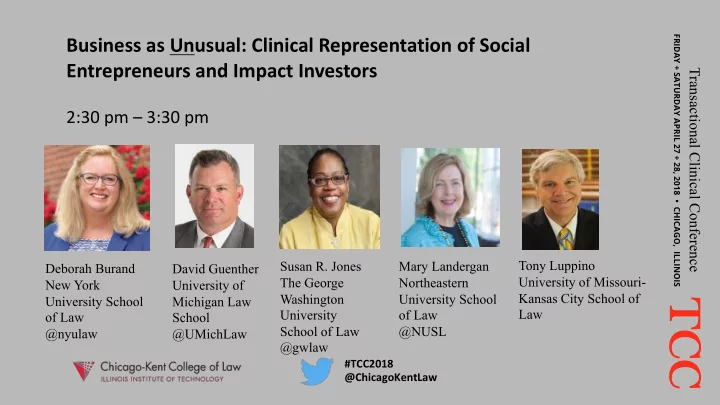
Business as Unusual: Clinical Representation of Social FRIDAY + SATURDAY APRIL 27 + 28, 2018 CHICAGO, ILLINOIS TC Entrepreneurs and Impact Investors Transactional Clinical Conference 2:30 pm 3:30 pm Susan R. Jones Mary Landergan Tony


slide-1
SLIDE 1

@ChicagoKentLaw #TCC2018

Transactional Clinical Conference

FRIDAY + SATURDAY APRIL 27 + 28, 2018 • CHICAGO, ILLINOIS TC

TCC

Deborah Burand New York University School

  • f Law

@nyulaw

Business as Unusual: Clinical Representation of Social Entrepreneurs and Impact Investors

2:30 pm – 3:30 pm

David Guenther University of Michigan Law School @UMichLaw Susan R. Jones The George Washington University School of Law @gwlaw Mary Landergan Northeastern University School

  • f Law

@NUSL Tony Luppino University of Missouri- Kansas City School of Law

slide-2
SLIDE 2

Grunin Center for Law and Social Entrepreneurship

U.S. Law School Mapping Surveys – 2017-2018

  • The Grunin Center at NYU Law conducted several mapping surveys of US law

schools in late 2017/early 2018. Over the course of these surveys and desktop research, we identified over 60 US law schools that are supporting one or more of the following activities related to the fields of social entrepreneurship and/or impact investing: – curriculum, – extra-curricular activities for students, – legal research and writing by faculty members.

  • These US law schools represent around 30% of US accredited law schools.
slide-3
SLIDE 3

Grunin Center for Law and Social Entrepreneurship

Mapping Surveys: 55 Law School Respondents*

Albany University University of Baltimore Boston College Brooklyn University Cardozo University Chapman University University of Chicago University of Chicago-Kent University of Cincinnati Columbia University University of Denver Duke University Florida International University Fordham University Georgetown University George Washington University Georgia State University Harvard University Hofstra University Indiana University University of Iowa Lewis & Clark University Marquette University University of Miami University of Michigan University of Minnesota University of Missouri University of Missouri-Kansas City University of Nebraska New York University University of North Carolina-Chapel Hill Northeastern University University of Northern Kentucky Notre Dame University Pace University University of Pennsylvania University of Pittsburgh University of Richmond Saint Louis University Santa Clara University University of South Dakota University of Southern California Southern Methodist University Southwestern University Stanford University University of Tennessee University of Tennessee-Knoxville University of Texas Vanderbilt University University of Vermont Villanova University Wake Forest University University of Washington Wayne State University Yeshiva University * Desktop research indicates that there are at least 7 other law schools that appear to have relevant courses/activities/scholarship, but representatives

  • f those law schools did not respond to the

surveys.

slide-4
SLIDE 4

Mapping Survey: Teaching

Faculty from the following 41 surveyed law schools responded that they are teaching courses that address social entrepreneurship and/or impact investing:

Albany Baltimore Boston College Brooklyn Cardozo Chicago-Kent University of Cincinnati Columbia Denver University Duke Fordham Law George Washington Georgetown Georgia State Harvard Hofstra Iowa Lewis & Clark Marquette Miami Michigan Minnesota Missouri Missouri-Kansas City Nebraska Northeastern Notre Dame NYU Pace Pennsylvania Pittsburgh Richmond Saint Louis Santa Clara Stanford Tennessee Vermont Villanova Washington Wayne State Yeshiva

slide-5
SLIDE 5

Clinics are a big part of the teaching going on in US law schools in the fields of social entrepreneurship/impact investing

  • At least 25 law schools (representing 28 transactional clinics) offer transactional

clinics serving clients that self-identify as social enterprises or impact investors.

  • Most of these transactional clinics are serving clients that self-identify as social

enterprises (not as impact investors).

  • 21 clinics represent social enterprises.
  • 7 clinics represent both social enterprises and impact investors.
  • This is a relatively new type of clientele for many of these transactional clinics.
  • 12 transactional clinics started serving these clients in the last 3 academic years.
  • 5 transactional clinics have been serving these clients for 10 or more academic years.
slide-6
SLIDE 6

Toe in the Water

  • r

an Incoming Wave?

  • Social enterprises/impact investors represent a relatively small percent of most of

these transactional clinics’ overall clientele (but there are 4 outliers that are making social enterprises/impact investors the focus of their transactional clinics’ clientele) – 1-10% of 12 clinics’ clientele – 11-25% of 7 clinics’ clientele – Over 75% of 4 clinics’ clientele

slide-7
SLIDE 7

Not for Profit vs. for Profit

  • Relatively few transactional clinics represent social enterprises and/or impact

investors that are incorporated as “for-profit” organizations:*

  • 15 clinics indicate that only 1-10% of their social enterprise/impact investor

clients are incorporated as “for- profit” organizations.

  • Yet… 6 clinics indicate that more than 51% of their clients that identify as

social enterprises/impact investors are incorporated as “for profit”

  • rganizations.

* In contrast, 18 clinics indicated that more than 34% of their overall clinic clients are now incorporated or are planning to incorporate as for-profit

  • rganizations.
slide-8
SLIDE 8

Areas of Legal Advice

  • Top four areas of legal advice provided by transactional clinics to clients that

self-identify as social enterprises/impact investors: – Formation/Choice of entity (26 clinics) – Contracts and agreements (26 clinics) – Governance (26 clinics) – Intellectual Property (23 clinics)

slide-9
SLIDE 9

Useful Resources

  • The resources/tools that are currently most helpful to transactional clinics

providing legal services to social enterprises/impact investors are: – Law firm guides/commentaries

  • 16 clinics

– Eship Law Website and Listserve

  • 13 clinics

– Webinars and conferences

  • 11 clinics
slide-10
SLIDE 10

Resource Needs – our Wish List

  • Document Libraries/Templates – 23 clinics
  • Course Materials (case studies, readings, interactive exercises, simulations,
  • etc. for use in seminar component of clinic) – 20 clinics
  • Tools to support advising clients about legal options (such as decisions about

choice of entity/formation, local counsel checklists, etc.) – 19 clinics

  • Syllabi Sharing – 18 clinics
slide-11
SLIDE 11

Building our Toolboxes

  • Some of the tools at our disposal:

– Social Enterprise Law Tracker – NYU School of Law (Grunin Center for Law and Social Entrepreneurship) http://socentlawtracker.org/#/map – Legal Audit Checklist for Social Enterprises in the United States – The George Washington School of Law (Small Business & Community Economic Development Clinic) https://www.law.gwu.edu/sites/g/files/zaxdzs2351/f/downloads/2018-Legal-Audit-Checklist.pdf – Choice of Entity Facilitator Tool - Duke University School of Law and UMKC School of Law (this tool is still under development but will be part of Startup Advisor Toolkit initiatives in connection with Legal Technology Laboratory: see www.thelegaltechlab.com)

slide-12
SLIDE 12
slide-13
SLIDE 13

Social Entrepreneurship Choice of Entity Facilitator Tool Duke/UMKC

  • In-process collaboration of Duke University School of Law and UMKC School of Law
  • Part of Startup Advisor Toolkit initiatives in connection with Legal Technology Laboratory; see

www.thelegaltechlab.com

  • Automated questionnaire for client to complete to help lawyer develop choice of entity

recommendations (type of company, state of formation, and tax classification)

  • Current draft has 45 questions, covering a wide range of topics designed to sort through for-profit,

nonprofit, hybrid, and cooperative organizational forms, as well as tax status

  • Next steps: refine questions/logic branches, vet that content with Clinics network, and then build

software program

slide-14
SLIDE 14

How we do it?

  • Direct Client Representation
  • GW New Venture Competition
  • 2018 New Venture Competition had 276 participants
  • 137 teams
  • 45 teams were social ventures​

Small Business & Community Economic Development Clinic George Washington University Law School

slide-15
SLIDE 15
slide-16
SLIDE 16

How we do it?

  • Action Research Projects

– Collaboration - e.g., with Ashoka, Legal Audit Checklist for Social Entrepreneurs Doing Business in the United States available at https://www.law.gwu.edu/sites/g/files/zaxdzs2351/f/downloads/2018-Legal-Audit-Checklist.pdf.

  • Relationships - Halcyon House Social Enterprise Incubator
  • Working Coalition to Fund the Incarceration to Incorporation Entrepreneurship Act (IIEP) -White paper
  • n Funding the IIEP
  • Partnerships - Washington Area Lawyers for the Arts
slide-17
SLIDE 17
slide-18
SLIDE 18

#DCLaw159 Social Entrepreneurship for Returning Citizens: Creating Self-Sufficiency, Improving Lives, Strengthening Families

Delivery of Open Letter to Mayor Bowser I’m writing on behalf of the Working Coalition to Fund the IIEP (Incarceration to Incorporation Entrepreneurship Program). We’re asking you to join us in a show of force in hand-delivering an open letter to the Mayor expressing funding. We’ll meet at the John A. Wilson Building, ground floor, Room 10, on Monday, March 19th at 9:10 am before heading to the Mayor’s suite at 9:30 am. This is an opportunity to join us in exercising our First Amendment rights with the delivery of our letter to the Mayor. The Coalition believes the IIEP can be a pathway to creating wealth and financial independence, particularly for those who struggle to find employment after incarceration. The fostering of entrepreneurship will enable our citizens to not only create jobs for themselves but improve their communities. The IIEP offers entrepreneurship training, a GED curriculum, apprenticeship instruction, and access to capital through its Incarceration to Incorporation Entrepreneurship Fund (IIEF). This program became law July 12, 2016 but Mayor Bowser has not funded it! Please join us in bringing attention to this important program. We encourage anyone who has expertise or knowledge in videography to video our expression to share on the various social media platforms. Thank you. Support the movement, Kevin Coalition Coordinator ksmith12456@gmail.com Working Coalition to Fund the IIEP
slide-19
SLIDE 19

Call to Action

What more can transactional clinics do to more effectively advance the fields of social entrepreneurship and impact investing? How can we more effectively serve clients that are social enterprises or impact investors?