Freya Croft Australian Centre for Culture, Environment, Society and - - PowerPoint PPT Presentation

freya croft
SMART_READER_LITE
LIVE PREVIEW

Freya Croft Australian Centre for Culture, Environment, Society and - - PowerPoint PPT Presentation

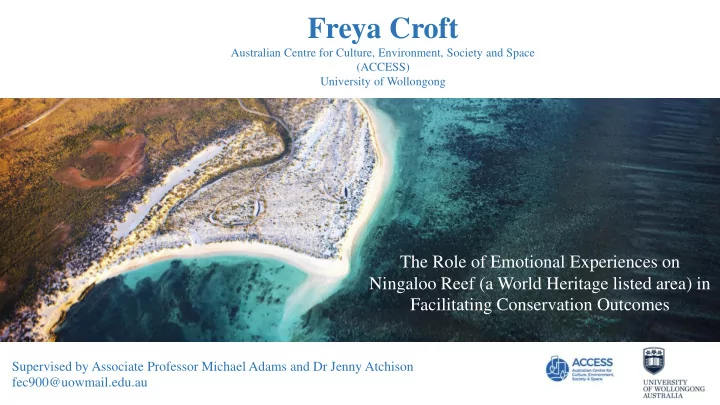
Freya Croft Australian Centre for Culture, Environment, Society and Space (ACCESS) University of Wollongong The Role of Emotional Experiences on Ningaloo Reef (a World Heritage listed area) in Facilitating Conservation Outcomes Supervised by


slide-1
SLIDE 1

The Role of Emotional Experiences on Ningaloo Reef (a World Heritage listed area) in Facilitating Conservation Outcomes

Freya Croft

Australian Centre for Culture, Environment, Society and Space (ACCESS) University of Wollongong

Supervised by Associate Professor Michael Adams and Dr Jenny Atchison fec900@uowmail.edu.au

slide-2
SLIDE 2

The Role of Emotional Experiences on a Ningaloo Reef in Facilitating Conservation Outcomes

slide-3
SLIDE 3

The current state of coral reefs globally

  • They are 'perhaps the most globally

endangered ecosystem' (Mumby and Steneck, 2008: 555)

  • Approximately 75 % of coral reefs worldwide are

threatened by a combination of global and local stressors.

  • Mass coral bleaching has now occurred in every

region in the world

  • These systems are collectively considered a

comprehensive indicator of global ocean health and the prognosis for their future is unanimously seen as bleak' (Bischof, 2016:51)

slide-4
SLIDE 4

Marine Tourism

‘Providing wildlife experiences that elicit from visitors a combination of affective and cognitive responses to marine wildlife increases environmental awareness, modifies intentions to act pro-environmentally, and fosters conservation appreciation and actions by visitors’ (Zeppel, 2008:13)

slide-5
SLIDE 5

Ningaloo Reef

slide-6
SLIDE 6

Research Questions 1) In what ways do emotions shape tourist and other reef users embodied experiences on coral reefs? For example – do they provide transformative experiences for human relationships with coral reefs? 2) How might emotional and transformative marine experiences of reefs lead to conservation outcomes? 3) What kind of emotions emerge in embodied experiences on coral reefs?

slide-7
SLIDE 7

METHODS

Survey Semi-Structured Interviews Participant Observation Auto ethnography Reef Researchers Tour Operators Staff at DPAW Tourists Crew

slide-8
SLIDE 8

Survey

Question: Thinking of your Ningaloo Reef experience today, please describe how you felt and any emotions you experienced while you were in the water. Response #1: ‘Complete awe and love for the animals’ Response #2: ‘Excitement followed by amazement when we watched the whale shark swim by, really special moment’ Response #3 : ‘Peace, elation’ Response #4: ‘I was anxious and nervous, scared, excited and happy all at the same time. Which in itself was overwhelming – but a great time’. Response #5: ‘Amazement, pure pleasure, delight, awe and wonder’

slide-9
SLIDE 9

‘I cried when I got home because I was humbled at my ability to experience what I had experienced. It was an experience that puts superficial thigs on the back burner because you’re not caring about who is dating who or who said what about someone, you are amongst and immersed in the most natural and raw thing possible.’ (Survey respondent 2019) ‘I have spoken about how amazing it was to have witnessed a phenomenal creature tat we know very little

  • about. The diving with a whale shark is something people only read about and it’s a world away but to

experience the true vastness of the marine park and be in the same proximity of a living wonder is something everyone should try to experience. It puts more things into perspective than you’d expect, you reflect on more of what’s outside your own bubble.’ (Survey respondent 2019)

slide-10
SLIDE 10

Thinking of your Ningaloo Reef experience today, please describe how you felt and any emotions you experienced while you were in the water.

slide-11
SLIDE 11

0.5 1 1.5 2 2.5 3 3.5 4 4.5 5 Volunteer marine Volunteer local environment Talk conserving marine Donate to marine conservation Pick up rubbish Choose no disposable straws Reduce single use plastics Eat sustainable seafood Engourage marine conservation

Weighted average of participants scores from 1 - 5

Before n=221 After n=206

Responses before and immediately after in-water experience, indicating behavior intentions

slide-12
SLIDE 12

0.5 1 1.5 2 2.5 3 3.5 4 4.5 5 Volunteer marine Volunteer local environment Talk conserving marine Donate to marine conservation Pick up rubbish Choose no disposable straws Reduce single use plastics Eat sustainable seafood Engourage marine conservation

Weighted Average of paricpants scores of 1- 5

Before n=221 6 months n=78

Responses before and 6 month after in-water marine experience

slide-13
SLIDE 13

ENVIRONMENTAL BEHAVIOUR CHANGE ‘The factors that have been found to have some influence positive, or negative, on pro-environmental behavior’ include things ‘such as demographic factors, external factors (e.g.. Motivation, pro-environmental knowledge, awareness, values, attitudes, emotion, locus of control, responsibilities and priorities).’ (Kollmuss & Agyeman 2002: 240). ‘There is increasing evidence, however, that stated intentions to engage in conservation behaviours rarely manifest as actual behaviour, and that visitors’

  • n site-enthusiasm and

commitment tend to wane following their visit.’ (Hughes, 2013:43)

slide-14
SLIDE 14

0.5 1 1.5 2 2.5 3 3.5 4 4.5 5 Volunteer marine Volunteer local environment Talk conserving marine Donate to marine conservation Pick up rubbish Choose no disposable straws Reduce single use plastics Eat sustainable seafood Engourage marine conservation

Weighted average of partcipants scores from 1-5

Before n=221 After n=206 6 months n=78

The three stages of survey responses

slide-15
SLIDE 15

To experience firsthand and be personally inspired or influenced by all that I saw has brought me to make the extra effort. I made an effort before but everything I used and do now, I think if there is a way to do it that reduces the negative impact I make on the environment.’ Survey Respondent

slide-16
SLIDE 16

Thank you

fec900@uowmail.edu.au

slide-17
SLIDE 17

ACADEMIC SOURCES

Ballantyne, R., Packer, J. and Sutherland, L.A., 2011. Visitors’ memories of wildlife tourism: Implications for the design of powerful interpretive

  • experiences. Tourism management, 32(4), pp.770-779.

Hughes, K., 2013. Measuring the impact of viewing wildlife: Do positive intentions equate to long-term changes in conservation behaviour?. Journal

  • f Sustainable Tourism, 21(1), pp.42-59.

Kollmuss, A. and Agyeman, J., 2002. Mind the gap: why do people act environmentally and what are the barriers to pro-environmental behavior?. Environmental education research, 8(3), pp.239-260. Zeppel, H., 2008. Education and conservation benefits of marine wildlife tours: Developing free-choice learning experiences. The Journal of Environmental Education, 39(3), pp.3-18.

PICTURE SOURCES

Australia’s Coral Coast (2018) Ningaloo Coast, image, Australia’s Coral Coast, viewed 3rd July 2019 https://www.australiascoralcoast.com/destination/ningaloo-marine-park Beattie S. (2018) Sea the key in Exmouth tourism boom, image, Pilbara News, viewed 3rd July 2019, https://thewest.com.au/news/pilbara- news/changes-in-whale-rules-aid-summer-tourism-ng-b88992113z Exmouth Dive and Whalesharks Ningaloo, image, Exmouth Dive and Whale sharks, viewed 3rd July 2019 < https://www.exmouthdiving.com.au/> Geyer, L. (2018) 5 Reasons to Book your next Holiday to Ningaloo Reef, image, Hunter and Bligh, image, viewed 3rd July 2019, https://www.hunterandbligh.com.au/travel/5-reasons-to-book-your-next- holiday-to-ningaloo-reef/ Google Maps (2019) viewed 3rd July 2019, https://www.google.com.au/maps/@- 23.1412586,113.7552024,4914m/data=!3m1!1e3 Kydd, A. (2018) Ningaloo Marine Interactions, image, photographed by A. Kydd while on tour with Ningaloo Marine Interactions Meyer, R. (2017) Ruins, Not Reefs: How Climate Change is Fast Forwarding Coral Science, image, The Atlantic viewed 3rd July 2019, https://www.theatlantic.com/science/archive/2017/04/how-catastrophe-is- changing-the-science-of-coral-reefs/522648/ Morrison (2017) Recreational boaters risk death to swim with humpbacks

  • ff WA’s Ningaloo Coast image, ABC News, viewed 3rd July 2019

https://www.abc.net.au/news/2017-10-16/amateur-whale-tour-operators- risk-death-swimming-with-humpbacks/9054916 Zycher A. Ningaloo Reef Australia for Women Travelers, image, Woman Going Places, viewed 3rd July 2019, https://womangoingplaces.com.au/ningaloo-reef/