Frequency and time... dispersion-cancellation, etc. (AKA: An old - - PowerPoint PPT Presentation

frequency and time dispersion cancellation etc
SMART_READER_LITE
LIVE PREVIEW

Frequency and time... dispersion-cancellation, etc. (AKA: An old - - PowerPoint PPT Presentation

Frequency and time... dispersion-cancellation, etc. (AKA: An old experiment of mine whose interpretation helps illustrate this collapse-vs-correlation business, and which will serve as a segu into time & phase msmt) Dispersion


slide-1
SLIDE 1

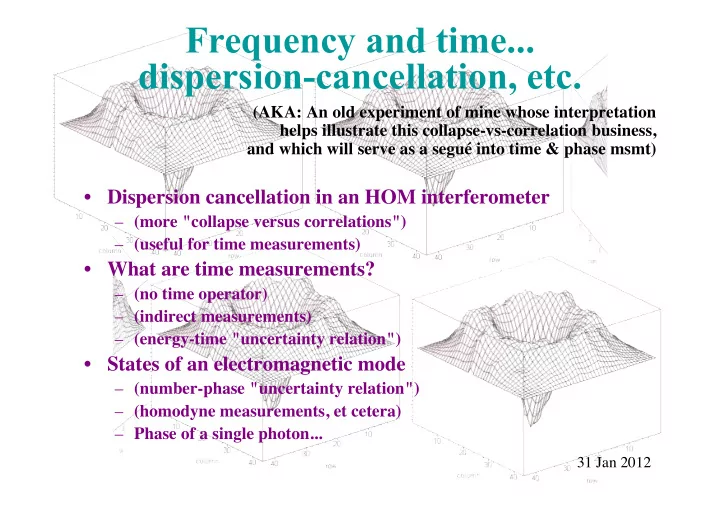
Frequency and time... dispersion-cancellation, etc.

  • Dispersion cancellation in an HOM interferometer

– (more "collapse versus correlations") – (useful for time measurements)

  • What are time measurements?

– (no time operator) – (indirect measurements) – (energy-time "uncertainty relation")

  • States of an electromagnetic mode

– (number-phase "uncertainty relation") – (homodyne measurements, et cetera) – Phase of a single photon...

31 Jan 2012

(AKA: An old experiment of mine whose interpretation helps illustrate this collapse-vs-correlation business, and which will serve as a segué into time & phase msmt)

slide-2
SLIDE 2

Entangled photon pairs

(spontaneous parametric down-conversion)

The time-reverse of second-harmonic generation. A purely quantum process (cf. parametric amplification) Each energy is uncertain, yet their sum is precisely defined. (For a continuous-wave pump!) Each emission time is uncertain, yet they are simultaneous. (What does this remind you of?)

slide-3
SLIDE 3

Hong-Ou-Mandel interferometer

Re Reme membe mber: r: if if you you de dete tect t only

  • nly one
  • ne ph

photon

  • ton,

, the the oth

  • ther ph

photon

  • ton "knows"

"knows" wher where yours yours cam came e from.

  • from. He

Hence there there is is no no interf interference erence (each (each de dete tector tor sees sees 1/ 1/2 2 of

  • f

the the ph photon

  • tons,

, irresp irrespective ective of

  • f any

any ph phases or

  • r pa

path th-length gth di diffe ffere rences). But: But: if if you you de dete tect t both both ph photon

  • tons,

, there there is is no no way way to to tell tell whet whether her both both wer were reflec reflected ted or

  • r both

both wer were e transmitted.

  • transmitted. r2+t

+t2 = = (i (i2 + + 12)/ )/2 2 = = 0. 0. (any (any lossless lossless symmetric symmetric be beam m sp splitter litter has has a a π/2 /2 ph phase shif shift t be betw tween r r and and t.) t.) CA CAVEAT: : there there must must be be no no way way to to tell tell which which oc

  • ccurred.

urred. If If the the pa path ths aren't aren't aligned aligned righ right, t, no no interf interference erence oc

  • ccurs.

urs. If If one

  • ne ph

photon

  • ton reac

reaches hes the the be beam m sp splitter litter be before fore the the other,

  • ther, no

no interf interference erence oc

  • ccurs.

urs.

How How long long is is a a ph photon

  • ton?
slide-4
SLIDE 4

the famous dip

COI COINCI NCIDENCE NCE RA RATE DE DELAY AY TIME TIME (f (fs) s) In In every every exp experiment eriment to to da date te, , the the wid width h of

  • f this

this fe feature ture is is limited limited only

  • nly

by by the the ba bandw dwidth dth of

  • f the

the ph photon

  • tons;

in in other

  • ther wo

words, s, the the ph photon

  • tons are

are as as tightly tightly co correlat elated ed as as they they co could ld pos possibl bly y be be given given their their ow

  • wn

un uncerta rtainty ty in in time time (Δt t > > 1/ 1/2Δω

Δω).

). Instead Instead of

  • f an

an amp amplitu litude e for for each each fre freque uency y co component nent of

  • f each

each be beam, there there is is an an amp amplitu litude e for for each each fre freque uency-c y-corre

  • rrelate

ted d pa pair r of

  • f ph

photon

  • tons.

Energy-entangled Energy-entangled state. state.

slide-5
SLIDE 5

What's the speed of a photon?

Silly Silly qu quest estio ions ns ab abou

  • ut

t group group velo velocity city, ph phase velo velocity city, "c "collec

  • llective"

tive" natu nature re

  • f
  • f the

the ind index ex of

  • f refrac

refraction, tion, pre precurs ursors

  • rs,

, et et cet ceter era. a. Mo More e seriou serious s qu quest estio ions ns ab abou

  • ut

t ho how w to to qu quant antiz ize e electro electromagnetic magnetic fi fields ds in in a a di dispe pers rsive medium. medium. Lon Longs gsta tandi ding g de deba bate te ab abou

  • ut

t "su "superlu erluminal" minal" tunneling. tunneling.

slide-6
SLIDE 6

Problem with propagation measurements

Quadratic Quadratic term term lead leads s to to group-veloc group-velocity ity di dispe pers rsion

  • n,

broa broade dening, g, chir chirp.

slide-7
SLIDE 7

But wait!

slide-8
SLIDE 8

So, what can we predict?

Coi Coinc. . proba probabi bility ty is is an an integral integral ov

  • ver

all all times times at at which which D1 D1 and and D2 D2 co could ld fi fire re: Det Detect ectors s are are "infinitely "infinitely slow" slow" (ns (ns = = 10 106 fs fs);... ;... UGH! UGH! Each Each E E is is an an integral integral ov

  • ver

r its its ow

  • wn fre

freque uency! y! But... But... if if T T goes goes to to inf infinity, inity, lif life e simp simplif lifies: ies: We We have have only

  • nly to

to integrate integrate a†a†aa aa over

  • ver all

all ω1, , ω2. The The ph phys ysical meaning: meaning: calcu calculat late e the the proba probabi bility ty for for each each pa pair r of

  • f fre

freque uencies which which might might reac reach h the the two two de dete tectors tors, , and and then then integrate. integrate. Wh Why? y? No No interf interference erence be betw tween pa path ths lead leading ing to to di diffe ffere rent t fre freque uencies at at the the de dete tectors tors, be becaus use in in pri principl ple one

  • ne co

could ld go go ba back k and and measu measure re how how mu much h energy energy had had be been ab absorb sorbed ed. Note Note: : it it took took a a long long time-integral time-integral to to enf enforce rce this.

  • this. If

If the the de dete tector tor had had be been ope

  • pen on
  • nly

ly for for 1 1 fs fs, , it it wo would ld be be imp impossib

  • ssible

le to to tell tell what what fre freque uency y it it had had seen. seen.

slide-9
SLIDE 9

No, we're not done yet...

The The proba probabi bility ty of

  • f de

dete tecti ting g a a given given fre freque uency y pa pair: r: (one (one can can always always insert insert a a co complet lete e set set of

  • f states.)

states.) But But we we only

  • nly started

started wit with h 2 2 ph photon

  • tons,

, so so if if we we annihilate annihilate 2, 2, there there will will be be 0 0 lef left: t: (the (the squ square are of

  • f the

the tw two-photon

  • -photon amp

amplitu litude) e) the the ph phase di diffe ffere rence is is all all that that co concer ncerns ns us us: Note Note 0: 0: all all that that math math di did d no nothing thing but but get get us us ba back k to to Feynman Feynman’s ’s rule! rule! Note Note 1: 1: the the GVD GVD terms terms (qu (quad adratic ratic in in fre freq.) .) cancelled cancelled out.

  • ut.

Note Note 2: 2: the the pa patte ttern rn moves moves at at the the group group velo velocity city. Note Note 3: 3: the the shap shape e is is the the Fourier Fourier transform transform of

  • f f(

f(ω), ), like like the the pul pulse itself itself.

slide-10
SLIDE 10

Nonlocal cancellation of dispersion

(O (Oh, h, and and by by the the way way... yeah, yeah, single-p single-photon hoton pul pulses travel travel at at the the group group velocity.) velocity.)

slide-11
SLIDE 11

REM REMEM EMBER: BER: interf interference erence

  • n
  • nly

ly oc

  • ccurs

urs be betw tween tw two pa path ths which which yi yield d the the same same

ω1 and

and the the same same ω2. If If in in the the TT TT pa path th, , a a "blue" "blue" ph photon

  • ton is

is de dete tecte ted d at at D1 D1 (and (and a a "red" "red" at at D2), D2), then then I must must co compar are e wit with h the the ph phase

  • f
  • f an

an RR RR pa path th wit with h the the same same

  • utc
  • utcome...
  • me...

The The tw two

  • pa

path ths are are ind indistingu istinguishab ishable le even even th though

  • ugh in

in each each case case on

  • ne of
  • f th

the pul pulses was was broa broade dened. d. Perfect Perfect interf interference erence oc

  • ccurs.

urs. Note Note: : this this is is on

  • nly

ly pos possibl ble be becaus use we we have have assu assumed med a a cw cw (co (continu ntinuous) s) pum pump; p; oth

  • therw

rwise ise, , the the time time of

  • f de

dete tecti tion

  • n of
  • f a

a bl blue ue ph photon

  • ton wo

would ld tell tell us us whet whether her it it had had travelled travelled along along R R or

  • r T

The Feynman path picture

slide-12
SLIDE 12

The collapse picture

Af After ter D1 D1 fi fire res, , it it proj projects ts the the light light in in arm arm 2 2 into into a a su superp erposition

  • sition of
  • f tw

two id identical entical chir chirped ed wave wave pa packets ts-- these these tw two

  • pa

packe kets ts exhib exhibit it pe perfe rfect interf interference. erence.

slide-13
SLIDE 13
slide-14
SLIDE 14
slide-15
SLIDE 15
slide-16
SLIDE 16
slide-17
SLIDE 17

NOTE: the slow detectors were important!

Fast Fast de dete tector tor ->

  • > broa

broad d fe feature ture in in the the pre presence of

  • f di

dispe pers rsion

  • n

(to (too mu much h inf information)

  • rmation)

Slow Slow de dete tector tor ->

  • > narrow

narrow fe feature ture in in the the pre presence of

  • f di

dispe pers rsion

  • n