Free Response Slide 2 / 82 1 Complex molecules are crucial for - - PDF document

free response
SMART_READER_LITE
LIVE PREVIEW

Free Response Slide 2 / 82 1 Complex molecules are crucial for - - PDF document

Slide 1 / 82 Free Response Slide 2 / 82 1 Complex molecules are crucial for life processes. How these molecules came to be on Earth is subject to ongoing speculation and research. Below are several fabricated or real pieces of evidence that


slide-1
SLIDE 1

Free Response

Slide 1 / 82

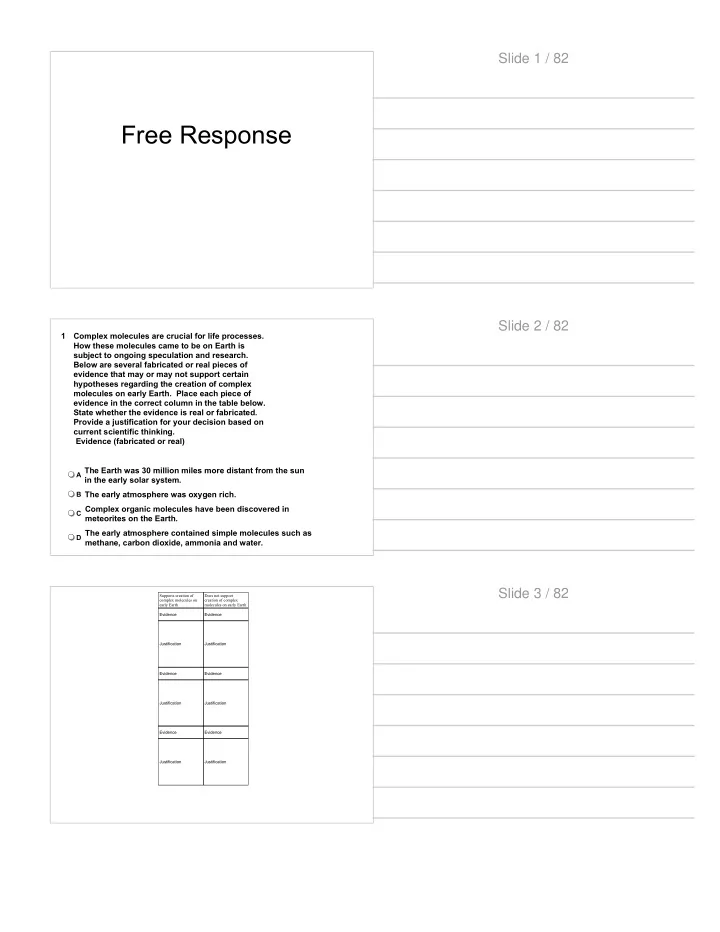
1 Complex molecules are crucial for life processes. How these molecules came to be on Earth is subject to ongoing speculation and research. Below are several fabricated or real pieces of evidence that may or may not support certain hypotheses regarding the creation of complex molecules on early Earth. Place each piece of evidence in the correct column in the table below. State whether the evidence is real or fabricated. Provide a justification for your decision based on current scientific thinking. Evidence (fabricated or real)

A The Earth was 30 million miles more distant from the sun

in the early solar system.

B The early atmosphere was oxygen rich. C Complex organic molecules have been discovered in

meteorites on the Earth.

D The early atmosphere contained simple molecules such as

methane, carbon dioxide, ammonia and water.

Slide 2 / 82

Supports creation of complex molecules on early Earth Does not support creation of complex molecules on early Earth Evidence Evidence Justification Justification Evidence Evidence Justification Justification Evidence Evidence Justification Justification

Slide 3 / 82

slide-2
SLIDE 2

2 The following diagram shows the Miller-Urey experimental setup.

A Why did they select the gases shown in the air mixture? B Describe the conclusion that the results of the experiment

support?

http://upload.wikimedia.org/wikipedia/commons/thumb/5/54/Miller-Urey_experiment-en.svg/500px-Miller-Urey_experiment-en.svg.png

Slide 4 / 82

3 Hydrolysis, or the addition of water in between monomers, breaks up large molecules. Dehydration synthesis is the reverse chemical reaction.

A

With reference to the diagram in question 2, would you expect to find large molecules (many linked monomers) in the cooled water section of the apparatus? Explain.

B

Do you think it is possible to create a cell under the physical and chemical conditions used in the Miller-Urey experiment? Explain.

C

With reference to the diagram in question 2, how can you reduce the possibility of hydrolysis occurring in the experiment?

Slide 5 / 82

4 Stromatolites (pictured below) are sedimentary rock that formed from layers of ancient bacteria, such as blue-green algae, and trapped sediments

  • ver many generations (millions to billions of

years). Stromatolites are a microscopic version of the fossilization process that formed the fossils of the dinosaurs and other macroscopic organisms. Stromatolites are still forming and growing in places like Shark Bay, Australia.

A

If a scientist claims that life arose 6,000 years ago, 1 million years ago, or 100 million years ago, how can you use the geological and biological evidence shown below (stromatolites of Shark Bay, Australia) to evaluate or analyze that statement or hypothesis?

Slide 6 / 82

slide-3
SLIDE 3

5 A diagram depicting the alkaline hydrothermal vents hypothesis for origin of life on Earth is shown below.

A Use the diagram to describe the hydrothermal vents

hypothesis.

B

Why is the hydrothermal vents hypothesis more supported by evidence that the “water soup” suggested by the Miller- Urey experiment?

Sousa FL, Thiergart et. al.. 2013 Early bioenergetic evolution. Phil Trans R Soc B 368: 20130088

Slide 7 / 82

This material is made freely available at www.njctl.org and is intended for the non-commercial use of students and teachers. These materials may not be used for any commercial purpose without the written permission of the owners. NJCTL maintains its website for the convenience of teachers who wish to make their work available to other teachers, participate in a virtual professional learning community, and/or provide access to course materials to parents, students and others.

Click to go to website: www.njctl.org New Jersey Center for Teaching and Learning Progressive Science Initiative

Slide 8 / 82

www.njctl.org

Emergence of Organic Molecules Practice Questions

Slide 9 / 82

slide-4
SLIDE 4

1 Briefly explain the biochemical experiment performed by Miller-Urey and its significance to the origin of living organisms.

Slide 10 / 82

2 The Earth is believed to be 4.5 billion years old. What evidence do scientists use to make this statement?

Slide 11 / 82

3 You are probably most familiar with the name Hubble from the Hubble telescope launched by NASA in 1990. What evidence did Edwin Hubble use to help support the Big Bang theory?

Slide 12 / 82

slide-5
SLIDE 5

Article Review: “Universe as an Infant: Fatter Than Expected and Kind of Lumpy” by Dennis Overbye

http://www.nytimes.com/2013/03/22/science/spac e/planck-satellite-shows-image-of-infant- universe.html?ref=space (note: the NY Times website may ask you to create an account to access the article)

Slide 13 / 82

4 Where do scientist believe all the natural elements that make up the Earth originally came from?

Slide 14 / 82

5 Scientists have come up with the acronym LUCA. What do the letters stand for? Briefly describe the basis for this hypothesis.

Slide 15 / 82

slide-6
SLIDE 6

6 Discuss the uniqueness of the chemical and physical properties of the water molecules, and the significance of these properties to life on Earth.

Slide 16 / 82

7 What sequence of events would occur in a lake as winter progresses, if solid water were more dense the liquid water, as is the case with most molecules?

Slide 17 / 82

8 Describe the two parts that make up a solution.

Slide 18 / 82

slide-7
SLIDE 7

9 Living organisms use buffers to help maintain a steady pH in their internal environment. Human blood has buffers. The buffer contains a large reservoir of an acid and a base. When something is added to the blood the buffer will either bind with excess hydroxide ions or excess hydrogen ions keeping them from affecting the overall pH. This helps maintain the needed blood pH at about 7.4. Describe the buffering system that is used in human blood.

Slide 19 / 82

10 What is the significance of the heat map image of the early cosmos?

Slide 20 / 82

11 What do you think the scientist mean by the statement: “the universe appears to be slightly lumpier”?

Slide 21 / 82

slide-8
SLIDE 8

12 It seems every time we read an article scientist are always correcting old theories. Why should we bother to believe any of them, if they are going to change in the future?

Slide 22 / 82

13 What is the significance of the hot spots in the microwaves?

Slide 23 / 82

14 What do the scientists mean by the “dark matter”?

Slide 24 / 82

slide-9
SLIDE 9

15 When examining the water molecule and its polarity, where is the slightly positive charge located, and where is the slightly negative charge located?

Slide 25 / 82

16 If you drop your drink on the floor during dinner, and place a paper towel over the spilled drink to clean it up, what process is occurring as you witness the paper towel pick up the drink?

Slide 26 / 82

17 Would you expect more temperature and weather fluctuations to occur in Oklahoma or New Jersey? Explain.

Slide 27 / 82

slide-10
SLIDE 10

18 Starches are called complex carbohydrates when speaking in terms of nutrition. What kind of reaction must occur to break it down in to smaller components? Describe the reaction in detail.

Slide 28 / 82

19 Metabolism involves the building and breaking down of molecules in you body. Using molecular models, sketch two monosaccharides being joined together by dehydration synthesis. Be sure and circle where the H and OH came from on the monosaccharide.

Slide 29 / 82

20 If you had a polymer 15 monomers long how many water molecules would be needed to break the molecule down completely? Include a drawing and use arrows to indicate the point of breakage.

Slide 30 / 82

slide-11
SLIDE 11

21 What evidence exists that supports the “organic monomers from space” theory?

Slide 31 / 82

22 From Stanley Miller’s experiment to create

  • rganic monomers from reactions, what 4

conditions had to be present on primitive earth to allow this to happen?

Slide 32 / 82

23 Polysaccharides can be use for storage and

  • structure. Describe a plant and animal storage

and structural polysaccharide.

Slide 33 / 82

slide-12
SLIDE 12

24 Sugar is a general term used in our world today. What is the biological definition of a sugar? Explain the difference between monosaccharide and disaccharides.

Slide 34 / 82

25 Salad is excellent roughage for our digestive

  • system. Although most people love the taste, this

biological molecule is indigestible by the humans. Cows on the other hand are herbivores whose entire diet tends to be grass. What kind of biological molecule found in plants can’t we digest? How are cows able to digest grass?

Slide 35 / 82

26 Write the equations used to make the 3 disaccharides sucrose, maltose and lactose.

Slide 36 / 82

slide-13
SLIDE 13

27 If human DNA were stretch out, it would be over 6 feet long (2 meters) and is made of over 3 billion base pairs. Although these facts seem daunting, if you look closely you will see that each base pair is part of a small repeating unit called a

  • nucleotide. Describe a nucleotide and sketch for
  • f them, each contains one of the bases found in

DNA.

Slide 37 / 82

28 Compare and contrast DNA and RNA. Please include as much detail as possible in your answer.

Slide 38 / 82

29 Below is one stand of a DNA molecule. How did Chargaff findings contribute to what we know about base parings? Also sketch both sides of the molecules. 5’ ATTGCAG 3’

Slide 39 / 82

slide-14
SLIDE 14

30 DNA to RNA to Protein is the central dogma of molecular biology. As we have learned proteins are major part of a living organisms cellular

  • activities. Describe the four levels of protein

structure in as much detail as you can.

Slide 40 / 82

31 The idea of protein synthesis happening outside the nucleus of the cell baffled scientist up until experiments using cell fractionation were able to isolate the source of protein synthesis. Describe the process of protein synthesis from DNA to protein assembly.

Slide 41 / 82

32 Biological molecules are often made of repeating units held together by unique bonds. Describe the reaction for amino acid being joined together to form polypeptides. Please include a sketch of two amino acids becoming a dipeptide.

Slide 42 / 82

slide-15
SLIDE 15

33 Many scientists often refer the N terminus and the C-terminus. State what these refer to and sketch and label an amino acid showing both terminus ends.

Slide 43 / 82

34 Describe the main functions of lipids. Discuss the difference between saturated and unsaturated lipids.

Slide 44 / 82

35 Discuss carbohydrates, proteins and lipids with respect energy contained within each of them.

Slide 45 / 82

slide-16
SLIDE 16

36 Omega-3 and Omega-6 oils are considered the so- called good fats. What is unique about the structure of “good” fats? What is a good dietary source of these fats?

Slide 46 / 82

37 Fat, waxes, oils, and steroids all fall under the category of lipids. Two common lipids are phospholipids and triacylglycerol. Explain how their structure differs and how this affects the molecules when they come in contact with water.

Slide 47 / 82

38 How does hydrolysis participate in energy storage and metabolism?

Slide 48 / 82

slide-17
SLIDE 17

39 When two carbohydrates are joined via dehydration synthesis, what is the link called that joins them together?

Slide 49 / 82

40 What is it about today’s atmosphere in relation to primitive Earth’s atmosphere that would be prohibitive to the formation of organic compounds?

Slide 50 / 82

41 What was Stanley Miller able to produce using inorganic molecules and high energy input, and what was the significance of his experiment?

Slide 51 / 82

slide-18
SLIDE 18

42 Humans do not possess the necessary enzymes to digest cellulose, however, it still aids in

  • digestion. How is this so?

Slide 52 / 82

43 Excess carbohydrates in our diet can be

  • detrimental. What happens to excess glucose in

the human body?

Slide 53 / 82

44 A basketball player eats a sandwich before playing a game. At game time, what will happen to the carbohydrates that were ingested?

Slide 54 / 82

slide-19
SLIDE 19

45 List the two monosaccharides which form together to create the disaccharide Sucrose. By what reaction does this occur?

Slide 55 / 82

46 What is the difference between a purine and a pyrimidine? Which bases are purines, and which are pyrimidines?

Slide 56 / 82

47 What bonds link nucleotides together in nucleic acids?

Slide 57 / 82

slide-20
SLIDE 20

48 When a protein denatures, what occurs? What causes a protein to denature?

Slide 58 / 82

49 What are the components of all amino acids, and which component determines the unique nature

  • f the amino acid?

Slide 59 / 82

50 What are the 7 types of proteins in organisms?

Slide 60 / 82

slide-21
SLIDE 21

51 Considering the 4 levels of protein structure, what structure does hemoglobin have? Out of the 7 types of proteins in organisms, which type is hemoglobin?

Slide 61 / 82

52 Describe what is meant when a lipid is described as amphiphilic. Give an example of where we can find a lipid that displays this property.

Slide 62 / 82

53 When examining a phopholipid molecule, with the 2 fatty acid end, and the phosphate end, which end is the polar end and which end is the non- polar end?

Slide 63 / 82

slide-22
SLIDE 22

54 What is a steroid, and can you give an example with its function?

Slide 64 / 82

55 Scientist use fossil evidence to help determine when life first arrived on our planet. Describe how fossil can be formed.

Slide 65 / 82

Article Review: “It’s Alive! It’s Alive! Maybe Right Here on Earth” by Dennis Overbye

http://www.nytimes.com/2011/07/28/science/28life .html

Slide 66 / 82

slide-23
SLIDE 23

56 When do scientist first believe life originated on

  • ur planet? And what role do stromatolites play in

this puzzle?

Slide 67 / 82

57 The oldest eukaryotic organism is believed to be an endosymbiont. Provide a brief description how an endosymbiont can be formed. Also give an example.

Slide 68 / 82

58 LUCA is based on the idea that many organisms have similar common features. What features of life support LUCA?

Slide 69 / 82

slide-24
SLIDE 24

59 Describe the minimum structural, metabolic and genetic components of a primitive cell.

Slide 70 / 82

Article Review: The Origins of Life” by Helen Fields

http://www.smithsonianmag.com/science- nature/The-Origins-of-Life.html

Slide 71 / 82

60 How is Evolution different from the Origin of Life?

Slide 72 / 82

slide-25
SLIDE 25

61 Discuss Oparin and coacervates.

Slide 73 / 82

62 What do most scientists agree is essential to describing life?

Slide 74 / 82

63 What is the significance of scientific research in the producing life form chemicals in a test tube?

Slide 75 / 82

slide-26
SLIDE 26

64 Describe the significance of Dr. Joyce’s test tube

  • results. Are his results most like LUCA or most

like a form of life we have not yet discovered, why

Slide 76 / 82

65 Which theory of life would these findings support?

Slide 77 / 82

66 What kind of ecosystem can be found near the deep underwater ocean vents?

Slide 78 / 82

slide-27
SLIDE 27

67 Describe Hazen's first experiments with the so- called pressure bomb.

Slide 79 / 82

68 Compare and contrast Hazen's Experiments with Stanley Miller’s Experiment.

Slide 80 / 82

69 What does Hazen mean when he uses the phrase “looking into the first step in that courtship”?

Slide 81 / 82

slide-28
SLIDE 28

70 Why does Hazen believe minerals play a part in the origin of life?

Slide 82 / 82