Francis Bacon By Damani, Parissa, Ali, and Vithu Who were they? - - PowerPoint PPT Presentation

francis bacon
SMART_READER_LITE
LIVE PREVIEW

Francis Bacon By Damani, Parissa, Ali, and Vithu Who were they? - - PowerPoint PPT Presentation

Francis Bacon By Damani, Parissa, Ali, and Vithu Who were they? was an english philosopher,statesman, scientist, jurist, orator, essayist and author served as Attorney General was Lord Chancellor of England father was an english


slide-1
SLIDE 1

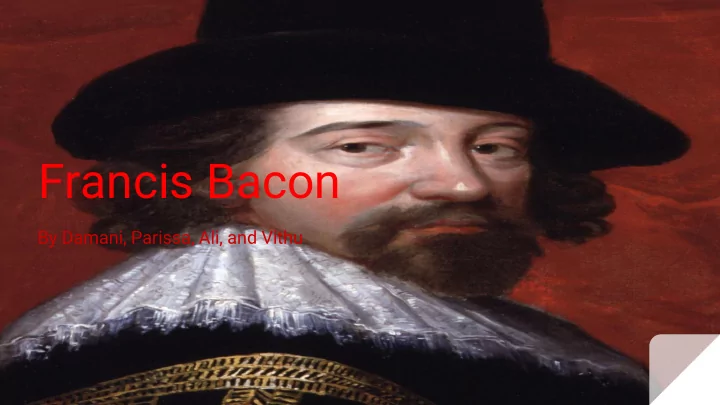
Francis Bacon

By Damani, Parissa, Ali, and Vithu
slide-2
SLIDE 2

Who were they?

  • was an english philosopher,statesman, scientist, jurist,
  • rator, essayist and author
  • served as Attorney General
  • was Lord Chancellor of England
  • father was an english politician during the era of Queen

Elizabeth

  • mother was english lady and Scholar
slide-3
SLIDE 3

Early Life

  • January 22, 1561 - April 9, 1626 (age 65).
  • Born in London.
  • Studied at Oxford and Cambridge.
  • Had interests in philosophy and religion especially puritanism.
  • Read a lot of theories written by Aristotle and other philosophers.
slide-4
SLIDE 4
  • his work was made to be an imitation of the Divine Work

(natural philosophy integrated into England’s political Theory

  • most of his beliefs coexisted with the idea of their being

no god

  • contains many references of the bible within his text

Who did they learn from?

slide-5
SLIDE 5

What did he believe?

  • Had three goals: to uncover truth, to serve his country, and to serve his

church

  • “Knowledge is Power”
  • Devout anglican
  • Believed that philosophy and religion were not to be intertwined
slide-6
SLIDE 6

What did they contribute to Society?

  • Novum Organum is a philosophical book that Francis Bacon wrote and

published in 1620

  • His work was referenced to Aristostles Organon: his logic ans syllogisms
  • Bacon wrote about his new system of logic that he believes to be superior
  • This work describes the way one must seek truth
  • Proves his point of Induction through his impediments he calls Idols

Idols of the Tribe: deceptive beliefs Idols of the Cave: biases Idols of the Market: discrepancies of meanings to words Idols of the Theatre: physical dogmas

slide-7
SLIDE 7

What are they remembered for?

  • known as the Father of Modern Science
  • "most influential work of human history"
  • influenced amateurs to step away from medieval way of thinking
  • Baconian Method: begining with particulars and moving to generalities
  • In the 18th Century Germans used Bacons Theory and created the concept of a

doctorate

  • Novum Organum known as the center of scientific solar system: everything

now revolves around the idea of research as route to advancement