Frameworks for Harbor Sustainability in Africa Arno Kangeri MARE - - PowerPoint PPT Presentation

frameworks for harbor sustainability in africa
SMART_READER_LITE
LIVE PREVIEW

Frameworks for Harbor Sustainability in Africa Arno Kangeri MARE - - PowerPoint PPT Presentation

Frameworks for Harbor Sustainability in Africa Arno Kangeri MARE conference 06-07-2017 Existing Harbour and Environs Traditional Harbour Expansion Sustainable Harbour Expansion Concept What is sustainable? Natural? Idyllic recreation


slide-1
SLIDE 1

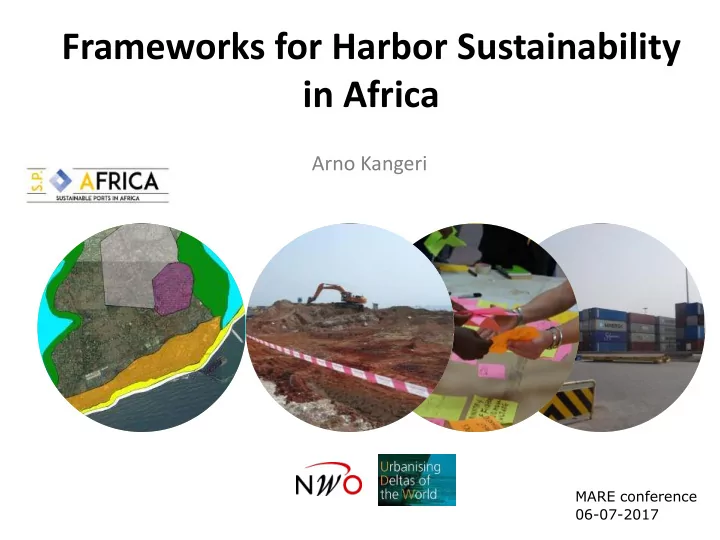
Frameworks for Harbor Sustainability in Africa

Arno Kangeri

MARE conference 06-07-2017
slide-2
SLIDE 2

Existing Harbour and Environs

slide-3
SLIDE 3

Traditional Harbour Expansion

slide-4
SLIDE 4

Sustainable Harbour Expansion Concept

slide-5
SLIDE 5

What is sustainable?

Idyllic recreation spot? Natural? Limited usage?

slide-6
SLIDE 6

What is sustainable?

Idyllic recreation spot? Limited usage? Natural?

slide-7
SLIDE 7

the sustainable port

  • "A sustainable port is a port which has

achieved and is maintaining a balance in economic, environmental and social extent for the surrounding local region. A sustainable port uses the Earth’s resources for its own benefit without affecting its capacities for future generations.”

What is sustainable?

Zhen Zhen Zheng

slide-8
SLIDE 8

Economic: Function as a port Allow for future change Limit long term costs Smart use of ecosystem services Environmental: Room for (semi)natural environment Social: Room for recreation Create jobs Improve quality of life

What is sustainable?

slide-9
SLIDE 9

Economic: Function as a port Environmental: Allow room for (semi)natural environment

What is sustainable?

Maasvlakte II: Port of Rotterdam

slide-10
SLIDE 10
  • Tools to facilitate integrated and sustainable port development.
  • Development of Framework & Guidelines
  • Quick design tools: remote sensing data & ecological data
  • Green Ports Network:

Community of researchers, private sector and port related stakeholders.

Approach

Goals

slide-11
SLIDE 11

Approach

slide-12
SLIDE 12

Case Study: Tema, Ghana

Understanding the System

slide-13
SLIDE 13

Understanding the System

slide-14
SLIDE 14

Quantifying Change

Sedimentation No erosion Sedimentation

Understanding the System

slide-15
SLIDE 15

Mapping Change

Understanding the System

Oral Accounts Old Images

slide-16
SLIDE 16

Understanding the System

Mapping Change

slide-17
SLIDE 17

Valuing Change

Understanding the System

slide-18
SLIDE 18

Planning the Future

Bottom up

Mapping the past

Mapping Interest Groups

Capacity building

Designing Futures

slide-19
SLIDE 19

Planning the Future

Bottom up

slide-20
SLIDE 20

Exploration port lay-outs

Planning the Future

Port behind a breakwater Natural port Offshore berth Open port Port behind an island

e.g.

e.t.c.

slide-21
SLIDE 21

Design for Multifunctionality

Safety Secondary submerged breakwaters grow with sea level/ cheaply upgraded Water Quality/Pollution Quay walls to facilitate growth of bio-filtration Fishery Porous breakwaters promoting fish nursery function of harbour Tourism Attention for Back port area and natural areas

  • Potential for attracting tourists and Cruise vessels.

Planning the Future

e.g.

e.t.c.

slide-22
SLIDE 22

Practicing change and changing practices.

Scaling Up

  • Pilot projects

– Routinization – Replication – Institutionalization – Diffusion

Vreugdenhil (2010)

slide-23
SLIDE 23

Practicing change and changing practices.

Scaling Up

Ripple effects of new practices in port development in Ghana Replicated practices in Ghana and beyond Institutionalized practices in African port development

Decision Makers, Pan-African Ports Network

Phase 1 Phase 2 Phase 3

slide-24
SLIDE 24

Enhancing diffusion

Scaling Up

1. Include diffusion activities in the project planning

– Devote resources to diffusion from the outset

2. Adopt a balanced, supported knowledge programme

– Diverse types of knowledge, critical actor support

3. Explicate context dependency, representativeness

– Too representative, not manageable nor practical – Too limited in scope, not transferrable

4. Spread knowledge and validate

– Scientific, professional publications – Multiple pilots to reduce context dependency

5. Identify, connect to current, future application areas, users, institutions 6. Exercise an open, adaptive governance style with constructive social learning 7. Facilitate a gradual transfer of ownership

?

slide-25
SLIDE 25

Project Partners

  • Technical University Delft (NL)
  • University of Ghana-Legon
  • UNESCO-IHE
  • Wageningen University Marine Research (NL)
  • Free University (VU) Amsterdam
  • Deltares
  • WWF
  • NABC (Netherlands African Business Council)*
  • *Royal Boskalis (Dredging & Marine Experts), Van Oord Dredging, Dame Shipyards, Port of

Amsterdam, Port of Rotterdam, Deep BV, STC, FMO, CWT Sitos