Fr From om Cr Creaming to to Coordi dinated nated Assessm - - PDF document

fr from om cr creaming to to coordi dinated nated assessm
SMART_READER_LITE
LIVE PREVIEW

Fr From om Cr Creaming to to Coordi dinated nated Assessm - - PDF document

6/29/2016 Fr From om Cr Creaming to to Coordi dinated nated Assessm ssessment: One Commun One mmunitys Ef Efforts to to Addr Address ess Homelessn Homelessness ess Diane R. Bessel, PhD, LMSW, CNM Daemen College Despite being third


slide-1
SLIDE 1

6/29/2016 1 Fr From

  • m Cr

Creaming to to Coordi dinated nated Assessm ssessment: One One Commun mmunity’s Ef Efforts to to Addr Address ess Homelessn Homelessness ess

Diane R. Bessel, PhD, LMSW, CNM Daemen College

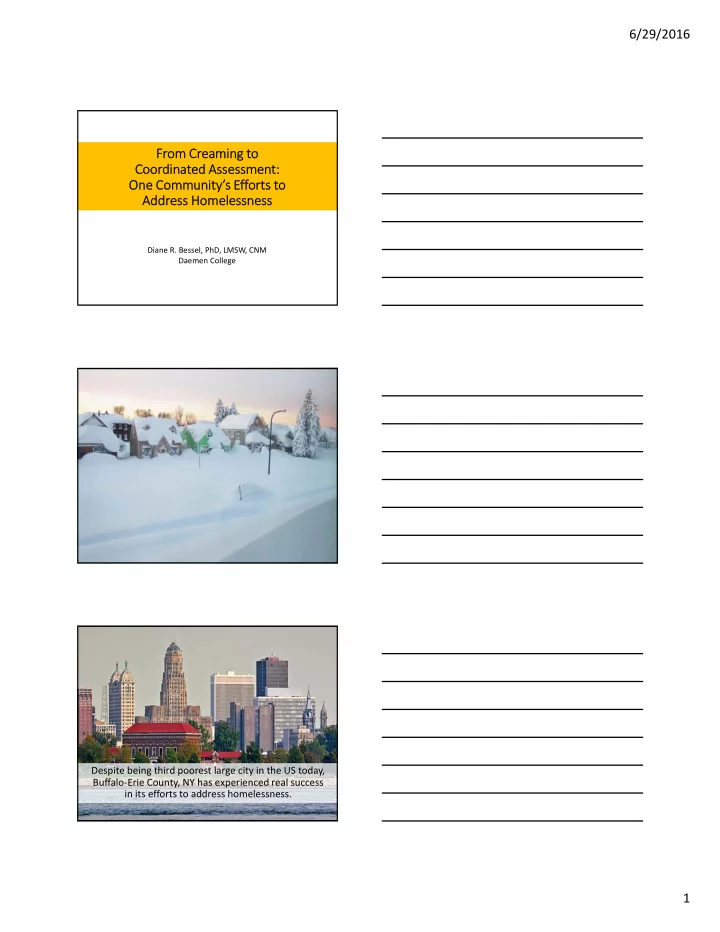
Despite being third poorest large city in the US today, Buffalo‐Erie County, NY has experienced real success in its efforts to address homelessness.

slide-2
SLIDE 2

6/29/2016 2 Setting the Context

Implementation of the Government Performance & Results Act of 1993 required federal agencies to improve their decision‐making capabilities and accountability.

Homeless Continuums across the country were also compelled to develop “Ten Year Plans to End Chronic Homelessness.”

slide-3
SLIDE 3

6/29/2016 3

These new, largely unfunded mandates sent shock waves to homeless service provider

  • rganizations and their local communities.

Creaming describes the process where providers select cases that are easier to manage over clients who are typically identified earlier, with longer homeless histories, and/or greater needs. “From a strictly bureaucratic standpoint, it is easier to take someone who is going to be easier to work with – financially, emotionally, from a staff/resource consumption point of view, productivity, it is just – it’s the

  • ld “creaming effect”– you take the cream of the crop and

you leave the rest behind…it is alive and well.” “Every month there is some kind of an issue where an agency feels that the level of support that the consumer has in the community is not adequate to provide them with a likelihood of being successful – sometimes it is a just a refusal or the classic is “six months clean and sober and you can come back and see us” – well, if the person could get six months clean and sober maybe they wouldn’t even need your help to begin with…”

slide-4
SLIDE 4

6/29/2016 4

Shoring up is a process where providers work with

  • ther professionals to

ensure that clients meet eligiblity criteria for homeless housing and/or services.

“People get around the criteria by telling people to go spend

  • ne night in a shelter. One night at a shelter does not make

you homeless in my mind especially because someone told you to spend one night in a homeless shelter…. It doesn’t happen very often within our agency but I know that it occurs and I was told by people higher up within the area that if they don’t meet criteria that is what we tell them to do. Go to a shelter and get that paper [documentation of homelessness]. I don’t think that is right – let’s be honest, if your mom will hang on to you for a month, she will hold on to you for six

  • months. And someone who doesn’t have that support should

get the funding first even if it means we’ll have to work harder.” “I was told that if the mental illness does not meet criteria to call the person who signed the paper and have them shore up the diagnosis. The person who told me to call the doctor and shore‐up the diagnosis said “well if that person only has depression – NOS [Not Otherwise Specified] you shouldn’t be helping them – they don’t really need the help” but in the same breath said to “call their doctor and ask them to change the diagnosis.” That doesn’t mean that they need the help any more just because the doctor is willing to change it!”

slide-5
SLIDE 5

6/29/2016 5

Homeless service providers grew increasingly suspicious and distrustful of

  • ne another and collaboration declined.

Num Number of

  • f Chr

Chronically lly Hom Homele less ss Pe Persons Buf Buffalo‐Er Erie Coun County Continuum uum of

  • f Car

Care

125 157 193 206 236 274 289 50 100 150 200 250 300 350 2008 2009 2010 2011 2012 2013 2014

“If we had a case load of ten to twenty SPMI [Severe and Persistently Mentally Ill] clients including schizophrenics and people who were MICA, it would make our caseloads that much more difficult and chasing people around town and asking them to participate in services would make it that much more difficult. So, if you can even it out with the “easier clients,” you do.... I really think that is the number one reason…I think people who are truly homeless, the group that HUD is trying to eradicate, are the same people who are on the street next summer because they didn’t get into these programs because they are the ones that are harder to serve.”

slide-6
SLIDE 6

6/29/2016 6

Source: National Alliance to End Homelessness, 2013

In July 2012, United States Department of Housing and Urban Development (HUD) established mandatory use of coordinated assessment. Effective coordinated assessment systems prioritize persons with greatest need and are fair, inclusive, easily accessible, person‐centered, and well connected to needed resources.

slide-7
SLIDE 7

6/29/2016 7 The Process

Continuum planned a series of strategic retreats – aimed at improving trust, buy‐in, and ownership within the provider community.

Guid Guidin ing Pr Princi cipl ples es

Efforts should:

  • Seek to minimize wait, be easy to use and understand, and

focus on positive customer experiences;

  • Be based on an objective and standardized assessment

conducted by well‐trained and well‐qualified professionals;

  • Be client‐centered and client‐driven with a focus on offering

services that fit specific needs; and

  • Ensure the availability and accessibility of holistic services

for all clients. The overall goal is to develop long‐term solutions for people in need rather than short term fixes.

slide-8
SLIDE 8

6/29/2016 8

Participants examined other coordinated assessment systems to identify best practices that might fit within the local community. Participants also mapped available resources and began to develop an initial plan for implementation.

Buf Buffalo alo‐Erie Erie Coun County ty Coordi dinated nated Assessm ssessment Plan Plan

  • 2‐1‐1 (Identification)

Primary Physical Location (DSS)

  • Possible Satellite Locations

Access Access

  • Coordinated Assessment Team
  • Derived from Provider Community
  • Identify opportunities: diversion/rapid rehouse
  • Entry into HMIS – standardized assessment

As Assess sess

  • Maintain single system‐wide wait list
  • Mechanism for appropriate placement
  • Eligibility criteria/program philosophy review
  • Client/Provider Determination

As Assign sign

  • Coordinated Assessment Advisory Board
  • Homeless Alliance of Western New York
  • System and Outcome Monitoring

Acc Accountabil ility ity

slide-9
SLIDE 9

6/29/2016 9

Continuum established various committees to carry out key aspects

  • f coordinated assessment plan.

Continuum quickly began to focus on Housing First and Rapid Rehousing strategies to address homelessness

slide-10
SLIDE 10

6/29/2016 10 Num Number of

  • f Chr

Chronically lly Hom Homele less ss Pe Persons Buf Buffalo‐Er Erie Coun County Continuum uum of

  • f Car

Care

125 157 193 206 236 274 289 134 25 50 100 150 200 250 300 350 2008 2009 2010 2011 2012 2013 2014 2015 2016

Key Lessons Learned

Government‐led change efforts can yield positive results – but, be wary of unintended consequences.

slide-11
SLIDE 11

6/29/2016 11

Organizations must be part of the process and must be able to identify self‐interest in order to balance risk and reward. Quality data is essential to ensure transparency and accountability within collaborative efforts. Communities must identify and invest the right resources, at the right time, in order to be successful.

slide-12
SLIDE 12

6/29/2016 12

“Ending homelessness does not mean that nobody will become homeless, but that effective systems will be in place to help people become housed again rapidly.” ‐ Nan Roman, NAEH

Contact Information:

Diane R. Bessel, PhD, LMSW, CNM Assistant Professor & MSW Program Director Department of Social Work & Sociology Daemen College Email: dbessel@daemen.edu Phone: 716‐566‐7876