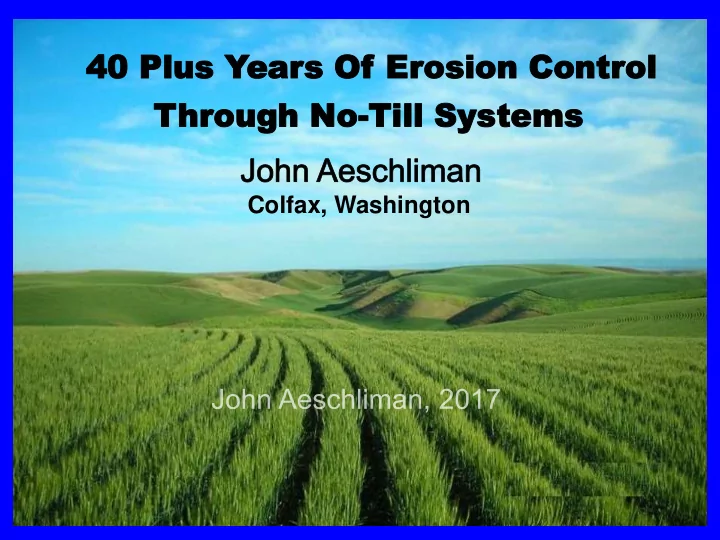
SLIDE 1 Four Decades of Living Proof No-Till Works Under Tough Conditions
Colfax, Washington
40 Plus 40 Plus Year ears s Of Of Er Erosion
Control
Thr hrough No
Till Systems Systems
SLIDE 2
Home Place Settled in 1880s
SLIDE 3 Rotations:
- WW SB SW (CF)
- WW Garbanzo Beans WW SW
- Corn Corn Corn WW WW SW WW
- Other Rotations Include Spring and Winter
Canola, Sunflowers, Spring and Winter Peas, Quinoa, Various Cover Crops,
- Western end (approx. 15 mi. SW from East end ) 11 – 13 in.
- Center Farms 15 – 18 in.
- Eastern end (Home Place ) 18 – 20 in.
Rainfall:
SLIDE 4
Conventional Farming
SLIDE 5
Tillage Erosion
SLIDE 6
Tillage Erosion (same field)
SLIDE 7
Residue, standing corn and wheat stubble
SLIDE 8
Here is what to do to end the erosion and build soil life.
SLIDE 9
Direct Seeding on 50% + Slope
SLIDE 10
Cross Slot Drill Seeding Chem Fallow
SLIDE 11 What changes have occurred with 40 years of continuous Direct Seeding?
- 1. Soil wind and water erosion for us is now a non-issue.
Rainfall is absorbed and stored for the crop.
- 2. Residues left on top of the ground control all wind and
water erosion. Soil is now alive with microbial communities which feed on the residue.
- 3. Our natural prairie OM is 1 ½ - 4 ½%. Most OM
measurements on the land after decades of no-till is now 3 ½ - 5% and still moving up.
SLIDE 12
Seeding into stubble
SLIDE 13
Snow drift and standing residue through the winter, residue helps prevent ditches and erosion
SLIDE 14
Food Quality is a Function of Soil Quality
SLIDE 15
Water infiltration and rain simulator
SLIDE 16
Soil pit and worm castings
SLIDE 17
Soil clod
SLIDE 18
We are now with improved and modified Direct Seed equipment able to successfully crop some very sloped fields with no erosion, due to the high amount of residue left in the field and the changes that have occurred in the soil profile due to Direct Seeding.
SLIDE 19
Direct Seeding Chem Fallow on 50% slope in 18 inch Rainfall
SLIDE 20
Winter Wheat (same field) in Spring no ditches
SLIDE 21
Combine and Spring Wheat in 12 inch rainfall
SLIDE 22
Paired (Twin) Row Wheat with Residue
SLIDE 23
Cover Crops build soil life and change the rhizosphere to accept and hold inches of extra moisture instead of running off.
SLIDE 24
Tillage Radish Seeded into Winter Wheat 12 inch rainfall
SLIDE 25
Radish in Winter Wheat (same field)
SLIDE 26
Tillage Radish Seeded into Winter Wheat (same field)
SLIDE 27
Winter Peas into Corn Silage Stubble
SLIDE 28
Planting into Winter Peas
SLIDE 29
Winter Peas Dying Down and Corn Growing
SLIDE 30
Spring Wheat, Corn and Winter Wheat Direct Seeding and No-Till helps infiltration August (18 inch rainfall)
SLIDE 31
Corn on Winter Wheat Stubble
SLIDE 32
Sunflowers, Winter Wheat on Sidehill, and Corn In August 18 inch rainfall
SLIDE 33
SLIDE 34
Wild life has truly increased due to more feed and cover and less human activity due to no tillage!
SLIDE 35
Moose and Twins in Wheat
SLIDE 36
SLIDE 37
Seeding into CRP Winter Wheat in 11 inch rainfall
SLIDE 38
Winter Canola seeded into CRP sod 11 inch rainfall
SLIDE 39
85 bushel winter wheat seeded into CRP 12 inch rainfall
SLIDE 40
Hard Red Winter Wheat Seeded into CRP (1st year) 12 inch rainfall
SLIDE 41
Hard Red Winter Wheat Seeded into CRP (1st year) in 12 inch rainfall
SLIDE 42
SLIDE 43
Winter Wheat and Green Spring Wheat in August 18 inch rainfall