Forward and Flyback (Converters with isolation ) 4.1 Transfer of DC - - PDF document

forward and flyback converters with isolation
SMART_READER_LITE
LIVE PREVIEW

Forward and Flyback (Converters with isolation ) 4.1 Transfer of DC - - PDF document

Prof. S. Ben-Yaakov , DC-DC Converters [4- 1] Forward and Flyback (Converters with isolation ) 4.1 Transfer of DC current via transformer 4.2 Forward 4.2.1 Voltage transfer function 4.2.2 Magnetization inductance problem 4.2.3 Transformer


slide-1
SLIDE 1

1

  • Prof. S. Ben-Yaakov , DC-DC Converters

[4- 1]

Forward and Flyback

(Converters with isolation)

4.1 Transfer of DC current via transformer 4.2 Forward 4.2.1 Voltage transfer function 4.2.2 Magnetization inductance problem 4.2.3 Transformer reset 4.2.4 Reset of forward 4.3 Coupled inductors 4.4 Flyback 4.4.1 Voltage transfer function 4.4.2 Flyback with multiple outputs 4.4.3 Characteristics of Flyback

  • Prof. S. Ben-Yaakov , DC-DC Converters

[4- 2]

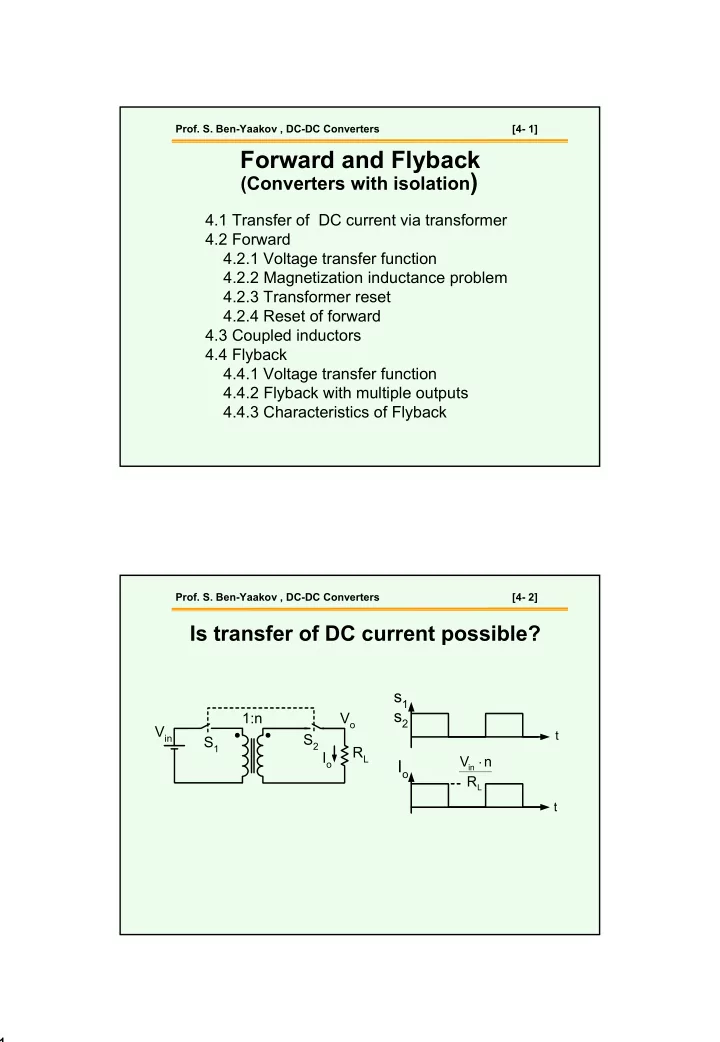
Is transfer of DC current possible?

Io

t

s1

t

L in

R n V ⋅

s2

Io Vin 1:n RL Vo S1 S2

slide-2
SLIDE 2

2

  • Prof. S. Ben-Yaakov , DC-DC Converters

[4- 3]

Replacing S2 by a Diode

Io Vin D 1:n RL Vo S1

  • Prof. S. Ben-Yaakov , DC-DC Converters

[4- 4]

D1 D2 L IL IC IR C R 1:n Vin S Vo T

Forward :

T is a transformer Output section: Buck Buck derived

Forward Converter

slide-3
SLIDE 3

3

  • Prof. S. Ben-Yaakov , DC-DC Converters

[4- 5]

t S ON t VX t V2 n Vin ⋅

1 D 2

V V − Ts ON

D1 D2 L IL IC IR C R 1:n Vin S Vo VX V2

At steady state, over one switching cycle: ; L V =

  • n

in

  • nD

V V S S = ⇒ = +

− +

; t ) V nV ( S

  • n
  • in

⋅ − ≈

+

; t ) V ( S

  • ff

− ≈

Voltage transfer function

  • Prof. S. Ben-Yaakov , DC-DC Converters

[4- 6]

Magnetization Inductance Problem

VLm t ? Vin

S Vin 1:n Lm ideal

slide-4
SLIDE 4

4

  • Prof. S. Ben-Yaakov , DC-DC Converters

[4- 7]

Transformer Reset

Vin t toff ton Vin t ton ) V V (

in reset −

VL VL

  • ff

in reset

  • n

in

D ) V V ( D V − = S Vin Lm Vreset

  • Prof. S. Ben-Yaakov , DC-DC Converters

[4- 8]

Applying a Reset Winding

  • n

D n in V n reset V

  • ff

D 1 3 ≥

Reset Requirements

Vreset S Vin n1 n2 n3 Lm1 Vin IL

Vreset

ON OFF

slide-5
SLIDE 5

5

  • Prof. S. Ben-Yaakov , DC-DC Converters

[4- 9]

Applying same source

  • n

D n in V

  • ff

D n in V 1 3 >

  • ff

D

  • n

D n n < 1 3

Vreset S Vin n1 n2 n3

  • Prof. S. Ben-Yaakov , DC-DC Converters

[4- 10]

Assignment

Given: 0.1<Don<0.7 What will be the voltage stress on S?

Vreset S Vin n1 n2 n3

slide-6
SLIDE 6

6

  • Prof. S. Ben-Yaakov , DC-DC Converters

[4- 11]

Reset of Forward Calculation of n3

Calculation can be done by looking

at any of the windings n1, n2, n3

D1 D2 L IL IC IR C R D3 n1 n2 n3 Vin S

  • Prof. S. Ben-Yaakov , DC-DC Converters

[4- 12]

Fundamental requirement:

n1 Lm n2 n3

  • vwinding =

Example: Looking at n1

S1 S2 t

1 n

V ton toff S1 S2 t ton toff t t

1 n

V

in

V

in

V

3 1 in n

n V S1=S2

Lm

I

1 2

Lm

I

slide-7
SLIDE 7

7

  • Prof. S. Ben-Yaakov , DC-DC Converters

[4- 13]

  • n

in 3 1

  • ff

in

D V n n D V ≥

  • n
  • ff

1 3

D D n n ≤

  • ff
  • ff

1 3

D 1 D n n − ≤

S1 S2 t

1 n

V ton toff S1 S2 t ton toff t t

1 n

V

in

V

in

V

3 1 in n

n V S1=S2

Lm

I

1 2

Lm

I

VT

  • Prof. S. Ben-Yaakov , DC-DC Converters

[4- 14]

Voltage on switch when “off”

in 3 1 in s

V n n V V + = ] D 1 D 1 [ V V

max

  • n

max

  • n

in s

− + = t

1 n

V Don Doff

in

V

3 1 in n

n V

VT

slide-8
SLIDE 8

8

  • Prof. S. Ben-Yaakov , DC-DC Converters

[4- 15]

2 1

n n n =

primary current is a reflection

  • f I2 plus Im

t ton toff TS Ipk I2 t toff I1

pk

I n

pk 2 I

n Switch Current

D1 D2 L IL IC IR C R D3 n1 n2 n3 Vin I1 I2 S

Reset winding

  • Prof. S. Ben-Yaakov , DC-DC Converters

[4- 16]

Taking into account Lm

D1 D2 L C R D3 n1 n2 n3 Vin ILm I2 S Lm

t t t ILm I2n IS I2n+ILm

slide-9
SLIDE 9

9

  • Prof. S. Ben-Yaakov , DC-DC Converters

[4- 17]

Question 1: How does In3 look ? t TS

3

n

I Ipk? toff Question 2: If Dmax=0.3 2.1 Calculate n1/n3 2.2 Find maximum voltage on switch

  • n
  • n

in 3 1 in reset

  • n
  • n

3 1

D 1 D V n n V V D 1 D n n − = = − =

Reset Current

  • Prof. S. Ben-Yaakov , DC-DC Converters

[4- 18]

Coupled inductor

L1 L2

L1 L2 n1 n2

2 2 1 2 1

n n L L       =

slide-10
SLIDE 10

10

  • Prof. S. Ben-Yaakov , DC-DC Converters

[4- 19]

S1 S2 t t

S1 S2 V1 V2 I1 I2 1:1

Current in a Winding CAN be Interrupted !

  • Prof. S. Ben-Yaakov , DC-DC Converters

[4- 20]

S1 S2 I1 I2

1

pk

I L V2 L V1

2

pk

I tS tS t t t t

At transition

2 1 2 1

pk 2 pk 1 pk pk

I N I N I I = =

S1 S2 V1 V2 I1 I2 1:1

(not in wires)

Energy stored in core

slide-11
SLIDE 11

11

  • Prof. S. Ben-Yaakov , DC-DC Converters

[4- 21]

Problem: Leakage inductance (will be discussed later) S1 S2 I1 I2

1

pk

I L V

1

2

pk

I

tS tS t t t t

L n V

2 2

n I I n I 1 I

2 1 2 1

pk pk pk pk

= ⋅ = ⋅

S1 S2 V1 V2 I1 I2 1:n L

Coupled windings

  • Prof. S. Ben-Yaakov , DC-DC Converters

[4- 22]

1 10

V n V ⋅ =

2 20

V n 1 V = (negative voltage)

S1 V1 1:n S1 V1 V2 1:n V20 S2 V1 V2 V10 1:n

Diode replace a switch

slide-12
SLIDE 12

12

  • Prof. S. Ben-Yaakov , DC-DC Converters

[4- 23]

Buck Boost

Polarity Reversal D V D V

  • ff
  • n

in

= +

  • ff
  • n

in

  • D

D V V − =

S Vin D L C R Vo

  • Prof. S. Ben-Yaakov , DC-DC Converters

[4- 24]

Flyback

Buck Boost Isolated Back-Boost Flyback

S Vin D L C R Vo S Vin D C R Vo

slide-13
SLIDE 13

13

  • Prof. S. Ben-Yaakov , DC-DC Converters

[4- 25]

Flyback converter

ton toff

D1 C R 1:n Vin S Vo C R 1:n Vin S Vo nVin C R 1:n Vin S Vo Vo n Vo n Vin I

  • Prof. S. Ben-Yaakov , DC-DC Converters

[4- 26]

Voltage transfer function

The average voltage method Voltage across primary

V1 toff t

  • Vin

ton Ts n Vo

  • ff
  • n

in

t n V t V ⋅ = ⋅

  • ff
  • n

in

D n V D V ⋅ = ⋅

  • ff
  • n

in

  • D

D n V V =

D1 C R 1:n Vin S Vo V1

slide-14
SLIDE 14

14

  • Prof. S. Ben-Yaakov , DC-DC Converters

[4- 27]

Voltage transfer function

The ∆I method

D1 C R Vin S Vo I1 I2 L1 n1 L2 n2 ton Ts t t t I1

1

I ∆

1

I ∆

2 1 2 I

n n

; t L V n t L V n I n I n

  • ff

2

  • 2
  • n

1 in 1 2 2 1 1

= ∆ = ∆

  • ff
  • n
  • ff
  • n

in

  • 2

1 1 2

D D t t V V L L n n = =

  • ff
  • n

in

  • 2

2 1 1 2

D D V V n n n n =      

  • ff
  • n

1 2 in

  • D

D n n V V =

  • Prof. S. Ben-Yaakov , DC-DC Converters

[4- 28]

Flyback with multiple outputs

Vin S D1 Vo1 D2 Vo2 C1 R1 R2 C2 n1 n2

slide-15
SLIDE 15

15

  • Prof. S. Ben-Yaakov , DC-DC Converters

[4- 29]

ton toff

2 1

  • 2
  • 1

V n V n =

Vin Vo1 Vo2 C1 R1 R2 C2 n1 n2 Vin Vo1 Vo2 C1 R1 R2 C2 n1 n2

Flyback

  • Prof. S. Ben-Yaakov , DC-DC Converters

[4- 30]

Characteristics of Flyback

Isolation Step-up or Step-down Discontinuous current at input and

  • utput (Buck-Boost Derived)

Multiple outputs (economical)

slide-16
SLIDE 16

16

  • Prof. S. Ben-Yaakov , DC-DC Converters

[4- 31]

Exercise

V2 TD = 0 TF = 0.01u PW = 10u PER = 20u V1 = 0 TR = 0.01u V2 = 15 Dbreak D1

  • ut_gnd

gate L2 {L1*(n*n)} RL {Load} drain V1 {Vin} R4 10meg

  • ut

C1 220u IC = 6 K K1 COUPLING = 1 K_Linear L1 = l1 L2 = l2 PARAMETERS: n = 0.5 Vin = 12 Load = 10 L1 = 300u

+

  • +
  • Sbreak

S1 L1 {L1}

Find by simulation Llkg and Lm of the magnetic body if k=.9 Calculate Ap of magnetic element