Fort Ward Park Master Drainage Plan Prepared for the City of - - PowerPoint PPT Presentation

fort ward park master drainage plan
SMART_READER_LITE
LIVE PREVIEW

Fort Ward Park Master Drainage Plan Prepared for the City of - - PowerPoint PPT Presentation

City of Alexandria, Virginia Fort Ward Park Master Drainage Plan Prepared for the City of Alexandria Presented by URS Corporation May 7, 2014 Agenda Project Overview and Status Recommendations for Drainage Improvements General


slide-1
SLIDE 1

City of Alexandria, Virginia
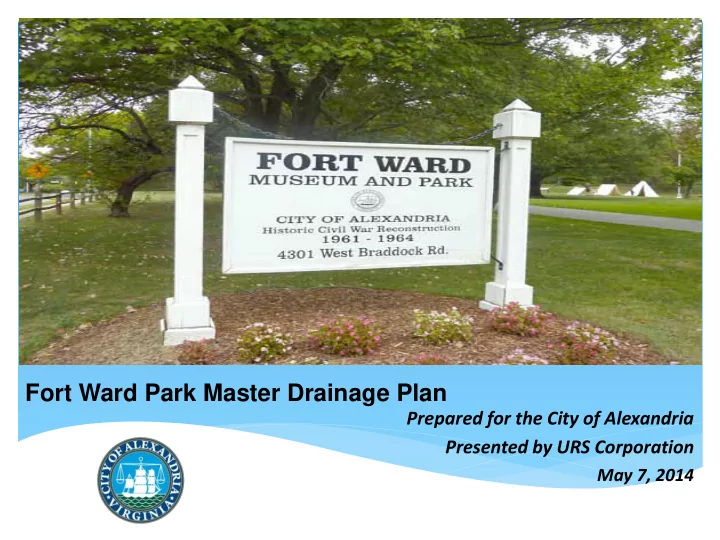
Prepared for the City of Alexandria Presented by URS Corporation

May 7, 2014

Fort Ward Park Master Drainage Plan

slide-2
SLIDE 2
  • Project Overview and Status
  • Recommendations for Drainage Improvements

 General (non-structural)  High Priority Structural Projects  Cemetery Area – Drainage Best Practices

Agenda

2

slide-3
SLIDE 3
  • Concerns

 Stormwater runoff  Erosion  Storm sewer system function

Project Overview

3 Picture from https://www.facebook.com/pages/The-Ft-Ward- and-Seminary-African-American-Descendants-Society/

Before 2011

slide-4
SLIDE 4
  • Existing Measures (Interim Project)

 Storm Drain Pipes  Infiltration Trenches  Perimeter Straw Wattles  Catch Basin

Project Overview

4

slide-5
SLIDE 5
  • Existing Measures (Interim Project)

Project Overview

5 Picture from https://www.facebook.com/pages/The-Ft-Ward- and-Seminary-African-American-Descendants-Society/

Before 2011 After

slide-6
SLIDE 6
  • Project Goals and Objectives

 Identify potential drainage improvements  Develop effective solutions  Minimize impacts to the historic nature of the Park  Minimize runoff impacts from adjacent properties

Project Overview

6

slide-7
SLIDE 7
  • Since August 2013:

 Completed Hydrologic & Hydraulic Analysis and Report  Completed Draft Drainage Master Plan and Submitted to City

  • Recommended solutions for identified drainage deficiencies
  • Developed concept designs
  • Stormwater Filter (Site 3)
  • Diversion Berm around Cemetery (Site 6)
  • Stream Stabilization (Site 7)
  • Cemetery Areas Best Practices

Project Status

7

slide-8
SLIDE 8
  • The recommendations are based on

 Field observations  Engineering analysis  Advisory Group input

  • The recommendations are consistent

with the best practices presented in the Fort Ward Park and Museum Area Management Plan

Recommendations

8

slide-9
SLIDE 9
  • Nonstructural Improvements

 No design required  Lower cost  Can be integrated into existing Park Maintenance activities

  • Structural Improvements

 Design development  Higher cost  Archaeological investigation prior to any earthwork  May require permitting

Recommendations

9

slide-10
SLIDE 10
  • Aeration and Turf Seeding

 Increase infiltration capacity  Reduce erosion  Improve aesthetics

Recommended Nonstructural Improvements

Note: Aeration and Turf Seeding began last Fall by RPCA in partnership with Office of Historic Alexandria. More is planned for this Spring

10

slide-11
SLIDE 11
  • Conveyance Improvements

 Remove sediment and debris  Increase flow conveyance  Improve inlet and outlet areas

Recommended Nonstructural Improvements

Site 9: Near the playground 11

Site 3: Near the Park entrance

slide-12
SLIDE 12
  • Mowing Maintenance Plan

 Identify areas to be mowed and areas to avoid mowing

Recommended Nonstructural Improvements

12

Site 4: Open Space

slide-13
SLIDE 13
  • Storm drain outlet enhancements to diffuse flow

 Convert high-velocity concentrated flow into sheet flow  Reduce erosion

  • For Homeowners and Park Neighbors

 Redirect drainage away from homes

  • Redirecting roof downspouts
  • Sump pumps away from the Park

Recommended Nonstructural Improvements

13

slide-14
SLIDE 14
  • Increase Culvert Maintenance Activities

 Increase the size of culverts to accommodate for up to the 25-year storm  Reduce runoff inundation

  • Site 2: Near the Entrance
  • Site 3: Near the Visitor Parking
  • Site 10: Near the Rifle Trench
  • Site 15: Near the Amphitheater

Recommended Structural Improvements

Site 10 Near Rifle Trench

14

Site 2 Near the entrance

slide-15
SLIDE 15
  • Install Underground Stormwater Filter in the visitor parking lot (Site 3)
  • Redirect Surface Flow near Oakland Baptist Cemetery (Site 6)
  • Stream Restoration/Stabilization on the intermittent stream northeast of

the Oakland Baptist Cemetery (Site 7)

Recommended High Priority Structural Improvements

15

slide-16
SLIDE 16
  • Install Underground Stormwater Filter (Site 3)

 Trap sediment, debris, and pollutants in a filter system  Reduce Improve the water quality

Recommended Structural Improvements

16

slide-17
SLIDE 17
  • Existing Conditions: Sediment and debris deposition was noted at the
  • utlet of 18" pipe that collects runoff from Braddock Road. Engineering

analysis shows that the pipe capacity is impaired by the sedimentation.

Site 3: Stormwater Filter

Downstream Outlet Downstream of the Outlet

17

slide-18
SLIDE 18

Site 3: Stormwater Filter

18

slide-19
SLIDE 19

Site 3: Stormwater Filter

Pictures from http://www.conteches.com/

19

slide-20
SLIDE 20

Site 3: Stormwater Filter

Pictures from http://www.conteches.com/

20

slide-21
SLIDE 21
  • Redirect Surface Flow around Oakland Baptist

Cemetery (Site 6)

 Diversion berm to redirect flow to avoid sensitive areas  Reduce inundation and erosion on the sensitive areas  Berm design avoids need for excavation adjacent to cemetery area  Protect cultural resources

Recommended Structural Improvements

21

slide-22
SLIDE 22
  • Existing Conditions: Temporary solutions to address existing drainage

issues in the area: infiltration trenches, a temporary catch basin, and temporary hay bales. A permanent solution is needed.

Site 6: Diversion Berms

Infiltration Trenches Straw Wattles

22

Catch Basin

slide-23
SLIDE 23

Site 6: Diversion Berms

23

slide-24
SLIDE 24

Site 6: Diversion Berms

24

slide-25
SLIDE 25
  • Stream Restoration/Stabilization on intermittent stream northeast of the

Oakland Baptist Cemetery (Site 7)

 Stabilize stream channel and banks  Reduce erosion and sedimentation along the stream  Improve potential habitat

Recommended Structural Improvements

25

slide-26
SLIDE 26
  • Existing Conditions: Main stream channel that runs through the park

is eroded and there is concrete debris in the channel. In addition, there is a clogged inlet at the end of the natural stream channel.

Site 7: Step Pools

Stream Bed

26

Downstream of the Foot Bridge

slide-27
SLIDE 27

Site 7: Step Pools

27

slide-28
SLIDE 28

Site 7: Step Pools

28

slide-29
SLIDE 29

Site 7: Step Pools

29

slide-30
SLIDE 30
  • Existing Conditions: The base areas are exposed on several

gravestones in the cemetery. Depressions have formed in front of several graves from ponding during rain events. There are several areas of exposed, bare ground in the cemetery and channel is forming through the area.

Site 8: Cemetery Area

Exposed Gravestone Exposed Bare Ground and Gravestone Exposed Bare Ground

30

slide-31
SLIDE 31
  • Turf Maintenance
  • Water Diversion
  • Conservation of Grave Depressions
  • Conservation and Repair of Damaged Headstones

Recommended Best Practices for Cemetery Area

31

slide-32
SLIDE 32
  • Identify opportunities to improve drainage conditions in the

Fort Ward Park using a holistic approach

 Conduct hydrologic analyses  Address drainage issues for

  • Park area
  • Cemetery
  • Offisite contributions

 Development and prioritization of a wide range of solutions

  • Structural
  • Non structural

Summary of Project Purpose/Goals

32

slide-33
SLIDE 33
  • Best Practices for Cemetery Area
  • Runoff from the Park and Marlboro Estates into the Cemetery
  • Increased runoff from compacted dumped gravel and fill in the

maintenance yard

  • Graves in the maintenance yard

Comments from the Public

33

slide-34
SLIDE 34
  • Coordination with OHA & Management Plan
  • Standard Operating Procedures (SOPs) for Park

Personnel

 Practices and procedures

Next Steps

34

slide-35
SLIDE 35
  • Funding

 Total funding = $585,000 (Already approved funding)  Drainage Master Plan spent $80,000  Remaining Funding $505,000 for 100% Design & Construction

Next Steps

35

slide-36
SLIDE 36
  • Cost Estimates for Recommended Improvements (Includes

Engineering Design)

 Diversion Berms at Site 6 = $116,000  Stormwater Filter at Site 3 = $199,000  Stream Stabilization at Site 7 = $203,000  Total Estimated Costs for all three:

  • $518,000

Next Steps

36

slide-37
SLIDE 37
  • Schedule

 FY2014 (Ends June 30, 2014)

  • Wrap up Final Drainage Master Plan
  • Deliver project list to DPI

 FY2015 (Starts July 1, 2014)

  • Design services for 100% design & construction drawings – 12mo
  • Perform Archaeology at designated site(s)
  • Advertise Construction for Fall/Winter 2015

Next Steps

37

slide-38
SLIDE 38

Questions

38