Formulating Problems - - PowerPoint PPT Presentation

formulating problems
SMART_READER_LITE
LIVE PREVIEW

Formulating Problems - - PowerPoint PPT Presentation

ProblemSolving Agents Formulating Problems Problem Types


slide-1
SLIDE 1

SA1

  • ProblemSolving Agents,

Formulating Problems, Search Strategies

  • 03/2
  • ProblemSolving Agents

Formulating Problems Problem Types Example Problems Search Strategies

03/3

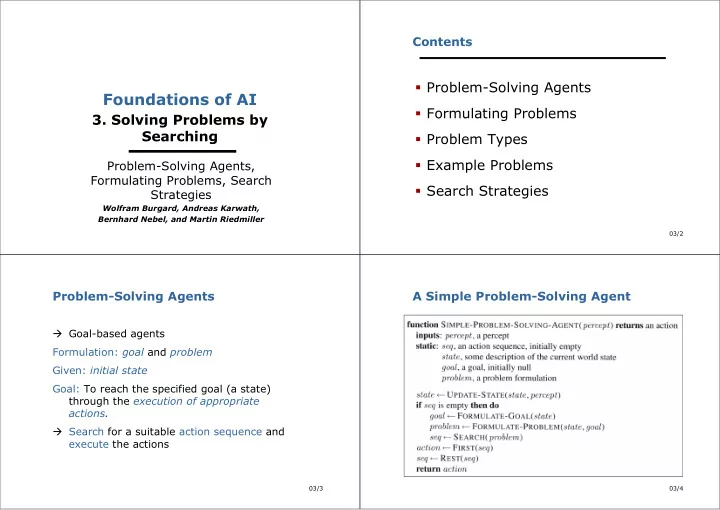
  • Goalbased agents

Formulation: and Given: Goal: To reach the specified goal (a state) through the

  • Search for a suitable action sequence and

execute the actions

03/4

slide-2
SLIDE 2

03/5

  • Static world

Observable environment Discrete states Deterministic environment

03/6

  • Goal formulation

World states with certain properties Definition of the state space (important: only the relevant aspects abstraction) Definition of the actions that can change the world state Definition of the problem type, which depends on the knowledge of the world states and actions states in the search space Specification of the search costs (search costs, offline costs) and the execution costs (path costs, online costs) The type of problem formulation can have a serious influence on the difficulty of finding a solution.

03/7

!"

Given an nxn board from which two diagonally opposite corners have been removed (here 8x8): Goal: Cover the board completely with dominoes, each of which covers two neighbouring squares. Goal, state space, actions, search, …

03/8

  • Question:

Can a chess board consisting of n2/2 black and n2/22 white squares be completely covered with dominoes such that each domino covers one black and one white square? … clearly not.

slide-3
SLIDE 3

03/9

# $

World state space:

2 positions, dirt or no dirt 8 world states

Actions:

Left (L), Right (R), or Suck (S)

Goal:

no dirt in the rooms

Path costs:

  • ne unit per action

03/10

% &'

  • Singlestate problem

Complete world state knowledge Complete action knowledge The agent always knows its world state

  • Multiplestate problem

Incomplete world state knowledge Incomplete action knowledge The agent only knows which group of world states it is in

  • Contingency problem

It is impossible to define a complete sequence of actions that constitute a solution in advance because information about the intermediary states is unknown.

  • Exploration problem

State space and effects of actions unknown. Difficult!

03/11

%# (

If the environment is completely accessible, the vacuum cleaner always knows where it is and where the dirt is. The solution then is reduced to searching for a path from the initial state to the goal state. States for the search: The world states 18.

03/12

%#$ )

If the vacuum cleaner has no sensors, it doesn’t know where it or the dirt is. In spite of this, it can still solve the

  • problem. Here,

states are knowledge states. States for the search: The power set of the world states 18.

slide-4
SLIDE 4

03/13 03/14

*+,

Initial State The state from which the agent infers that it is at the beginning State Space Set of all possible states Actions Description of possible actions and their outcome (successor function) Goal Test Tests whether the state description matches a goal state

03/15

*-,

Path A sequence of actions leading from one state to another. Path Costs Cost function g over paths. Usually the sum of the costs of the actions along the path. Solution Path from an initial to a goal state Search Costs Time and storage requirements to find a solution Total Costs Search costs + path costs

03/16

!" %.//

  • States:

Description of the location of each of the eight tiles and (for efficiency) the blank square.

  • Initial State:

Initial configuration of the puzzle.

  • Actions or Successor function:

Moving the blank left, right, up, or down.

  • Goal Test:

Does the state match the configuration on the right (or any other configuration)?

  • Path Costs:

Each step costs 1 unit (path costs corresponds to its length).

slide-5
SLIDE 5

03/17

!" .0

States: Any arrangement of 0 to 8 queens on the board. Initial state: No queen on the board. Successor function: Add a queen to an empty field on the board. Goal test: 8 queens on the board such that no queen attacks another Path costs: 0 (we are only interested in the solution). Almost a solution:

03/18

!" .0

  • States:

Any arrangement of 0 to 8 queens on the board.

  • Initial state:

No queen on the board.

  • Successor function:

Add a queen to an empty field on the board.

  • Goal test:

8 queens on the board such that no queen attacks another

  • Path costs:

0 (we are only interested in the solution). A solution:

03/19

  • Naïve formulation

States: Any arrangement of 08 queens Problem: 64—63 —…— 57≈1014 possible states Better formulation States: any arrangement of queens (0 ≤ ≤ 8) one per column in the leftmost columns such that no queen attacks another. Successor function: add a queen to any square in the leftmost empty column such that it is not attacked by any other queen. Problem: 2,057 states Sometimes no admissible states can be found.

03/20

!" )

Three missionaries and three cannibals are on one side of a river that they wish to cross. A boat is available that can hold at most two people. You must never leave a group of missionaries

  • utnumbered by cannibals on the same bank.

Informal problem description:

  • Find an action sequence that brings

everyone safely to the opposite bank.

slide-6
SLIDE 6

03/21

/)1

States: triple (x,y,z) with 0 ≤ x,y,z ≤ 3, where x,y, and z represent the number of missionaries, cannibals and boats currently on the original bank. Initial State: (3,3,1) Successor function: from each state, either bring one missionary, one cannibal, two missionaries, two cannibals, or one of each type to the other bank. Note: not all states are attainable (e.g., (0,0,1)), and some are illegal. Goal State: (0,0,0) Path Costs: 1 unit per crossing

03/22

!"2$

Route Planning, Shortest Path Problem Simple in principle (polynomial problem). Complications arise when path costs are unknown or vary dynamically (e.g., route planning in Canada) Travelling Salesperson Problem (TSP) A common prototype for NPcomplete problems VLSI Layout Another NPcomplete problem Robot Navigation (with high degrees of freedom) Difficulty increases quickly with the number of degrees

  • f freedom. Further possible complications: errors of

perception, unknown environments Assembly Sequencing Planning of the assembly of complex objects (by robots)

03/23

3

From the initial state, produce all successive states step by step search tree.

(3,3,1) (2,3,0) (3,2,0) (2,2,0) (1,3,0)(3,1,0) (3,3,1) (a) initial state (b) after expansion

  • f (3,2,0)
  • f (3,3,1)

(c) after expansion (3,3,1) (2,3,0) (3,2,0) (2,2,0) (1,3,0)(3,1,0) (3,3,1) 03/24

%

  • State: state in the state space

ParentNode: Predecessor nodes Action: The operator that generated the node Depth: number of steps along the path from the initial state Path Cost: Cost of the path from the initial state to the node

  • MakeQueue(Elements): Creates a queue

Empty?(Queue): Empty test First(Queue): Returns the first element of the queue RemoveFirst(Queue): Returns the first element Insert(Element, Queue): Inserts new elements into the queue (various possibilities) InsertAll(Elements, Queue): Inserts a set of elements into the queue
slide-7
SLIDE 7

03/25

%

03/26

3%

03/27

  • Completeness:

Is the strategy guaranteed to find a solution when there is

  • ne?

Time Complexity: How long does it take to find a solution? Space Complexity: How much memory does the search require? Optimality: Does the strategy find the best solution (with the lowest path cost)?

03/28

  • Uninformed or blind searches:

No information on the length or cost of a path to the solution.

  • breadthfirst search, uniform cost search,

depthfirst search,

  • depthlimited search, Iterative deepening

search, and

  • bidirectional search.

In contrast: informed or heuristic approaches

slide-8
SLIDE 8

03/29

4*+,

Nodes are expanded in the order they were

  • produced. ! !""
  • Always finds the shallowest goal state first.
  • Completeness.
  • The solution is optimal, provided the path cost is a non

decreasing function of the depth of the node (e.g., when every action has identical, nonnegative costs).

03/30

4*-,

The costs, however, are very high. Let be the maximal branching factor and the depth of a solution path. Then the maximal number of nodes expanded is #$ #% #&# ##'( "∈ #'" Example: = 10, 10,000 nodes/second, 1,000 bytes/node:

1 exabyte 3,523 years 1015 14 10 petabytes 35 years 1013 12 101 terabytes 129 days 1011 10 1 terabyte 31 hours 109 8 10 gigabytes 19 minutes 107 6 106 megabytes 11 seconds 111,100 4 1 megabyte .11 seconds 1,100 2 Memory Time Nodes Depth 03/31

5

Modification of breadthfirst search to always expand the node with the lowestcost ". Always finds the cheapest solution, given that "")"for all n.

03/32

6

Always expands an unexpanded node at the greatest depth (QueueFn = Enqueueatfront). Example (Nodes at depth 3 are assumed to have no successors):

slide-9
SLIDE 9

03/33

67

Depthfirst search with an imposed cutoff on the maximum depth of a path. E.g., route planning: with cities, the maximum depth is ('. Here, a depth of 9 is sufficient (diameter of the problem).

03/34

6*+,

Combines depth and breadthfirst searches Optimal and complete like breadthfirst search, but requires less memory

03/35

!"

03/36

6*-,

Number of expansions

b + b2 + … + bd1 + bd + bd+1 b BreadthFirstSearch (d)b + (d1)b2 + … + 3bd2 + 2bd1 + 1bd Iterative Deepening Search 50 + 400 + 3,000 + 20,000 + 100,000 = 123,450 Iterative Deepening Search 10 + 100 + 1,000 + 10,000 + 999,990 = 1,111,100 BreadthFirstSearch

Example: b = 10, d = 5 For b = 10, only 11% of the nodes expanded by breadthfirstsearch are generated, so that the memory requirement is considerably lower. Time complexity: O(bd) Memory complexity: O(b—d) * + ,+

slide-10
SLIDE 10

03/37

4

As long as forwards and backwards searches are symmetric, search times of O(2—bd/2) = O(bd/2) can be

  • btained.

E.g., for b=10, d=6, instead of 111111 only 2222 nodes!

03/38

'4

The operators are not always reversible, which makes calculation the predecessors very difficult. In some cases there are many possible goal states, which may not be easily describable. Example: the predecessors of the checkmate in chess. There must be an efficient way to check if a new node already appears in the search tree of the other half of the search. What kind of search should be chosen for each direction (the previous figure shows a breadthfirst search, which is not always optimal)?

03/39

  • Time complexity, space complexity, optimality, completeness

b branching factor d depth of solution, m maximum depth of the search tree, l depth limit, C* cost of the optimal solution, ∈ minimal cost of an action Superscripts:

a) b is finite b) if step costs not less than ∈ c) if step costs are all identical d) if both directions use breadth

first search

03/40

  • Before an agent can start searching for

solutions, it must formulate a goal and then use that goal to formulate a problem. A problem consists of five parts: The state space, initial situation, actions, goal test, and path costs. A path from an initial state to a goal state is a solution. A general search algorithm can be used to solve any problem. Specific variants of the algorithm can use different search strategies. Search algorithms are judged on the basis of completeness, optimality, time complexity, and space complexity.